28 February, 2014

Moonstruck Madness And Domestic Violence

I bang on a lot about the way domestic violence can be subtly normalized in the genre. Back in the day, the DV was more open and obvious than it is now. While rereading Moonstruck Madness I wondered if the lack of subtlety will make readers less accepting of the main couple than the more obscured abuse dynamics of today. If you're considering reading Moonstruck Madness do not read this piece.
As I discussed in the review, Sabrina grows up quickly on the battlefields of Culloden. Sabrina is taught, through events in the book, that she cannot rely on any man. Even the hero is unreliable, leaving her HEA more of a Best She Could Hope For than a true HEA. All he has to do to win her is show up. Seriously, that's it. He doesn't have to be honest, faithful, nonviolent or supportive. Sabrina has saved so many days by this point that she's just tired of it all. She needs to land somewhere and he's holding a net.
Let's start with the examples. Please keep in mind that this was a bestselling book considered (at the time) to be a sweet or mild read. In this first excerpt Lucien has just recently met Sabrina. While disguised as a highwayman, she is shot and taken captive. Discovering she is female, Lucien decides to rape her.
Some man would’ve caught her by now; besides, her type never had been innocent, they knew what a man wanted before he did, and she would welcome the chance to buy her way out of the predicament she found herself in. Right now she was too angry and frightened to realize this. But soon, the seduction would begin. - McBain, Laurie (2011-02-01). Moonstruck Madness (Casablanca Classics) (pp. 97-98). Sourcebooks. Kindle Edition.
Super creepy, right? Hey, but it's FINE, it's OKAY because at the same time Sabrina is planning to buy her way out of this hostage crisis through sex. So in effect, he's right. This girl half his age is planning on welcoming his attentions in exchange for an escape route. Which she does. This is pretty much it for their sex life. Sabrina and Lucien spend just enough time in bed to trap her later.  Sabrina's long lost dad shows up to sell her to the highest bidder. She's not happy about it but she accepts her limited options. Lucien screws that up which leads to her father freaking out.
She groaned in pain as time and time again the sharp pain tore across her soft shoulders, ripping the thin material of her bodice and scoring the tender skin with angry welts.  McBain, Laurie (2011-02-01). Moonstruck Madness (Casablanca Classics) (p. 198). Sourcebooks. Kindle Edition.
So her father has fought off one daughter and is blind to anything but abusing the second when the doorbell rings. (Stepmom is pregnant and therefore washing her hands of the matter.) It's Lucien. Her sister Mary is quick to explain Sabrina's life is in danger.
“The marquis is beating her, and it is all your fault,” she accused him, tears streaking her cheeks.  McBain, Laurie (2011-02-01). Moonstruck Madness (Casablanca Classics) (p. 199). Sourcebooks. Kindle Edition.
Lucien saves the day, informs Sabrina she's marrying him and begins his efforts to pay off her dad so he'll leave town. Sabrina isn't so into this. She (and Mary) are busy blaming Lucien for their father's actions, which allows the reader to transfer sympathy to a guy who shot her, planned to rape her, and then invaded her bedroom uninvited for another round.
“I’m not gloating, Sabrina. I would never have you harmed like this,” he told her truthfully.  McBain, Laurie (2011-02-01). Moonstruck Madness (Casablanca Classics) (p. 200). Sourcebooks. Kindle Edition.
He wouldn't whip her so the stuff he WOULD do is totally cool. Lucien informs her of his plans. He's shocked to discover that Sabrina isn't so interested in marrying. He's a rich old guy. She was perfectly willing to marry a different rich old guy. Obviously she's just immature. He tells her to grow up, reminds her she faces prison for theft and tells her that's a super rapey place to hang out. Sabrina doesn't find this endearing. She tells her sister Mary that she'd rather kill Lucien than marry him, so Mary decides Sabrina is unstable and becomes Team Lucien for the rest of the book. Later in the book Sabrina slaps him for refusing to accept her refusals.
Without stopping to think, Lucien slapped her back, reacting in the heat of anger and an instant’s uncontrollable rage. Sabrina’s head jerked back with the force of his hand, and the imprinted outline of his fingers stained her white cheek vividly in angry red marks.  McBain, Laurie (2011-02-01). Moonstruck Madness (Casablanca Classics) (p. 231). Sourcebooks. Kindle Edition.
“All I want to do is kiss you, and I end up hurting you. Forgive me. I’ve never raised my hand against a woman before,”  McBain, Laurie (2011-02-01). Moonstruck Madness (Casablanca Classics) (p. 231). Sourcebooks. Kindle Edition.
Uh-huh. Nobody's ever heard that one before, buddy. Cue the sex scene, interrupted by her angry younger brother. He takes a shot at Lucien but misses.
“You were being mean to her. You made her cry, I heard you, and she told you to leave her alone,” Richard defended himself with childish logic.  McBain, Laurie (2011-02-01). Moonstruck Madness (Casablanca Classics) (p. 233). Sourcebooks. Kindle Edition.
There's nothing childish about Richard's logic. Unlike the rest of her family, Richard has a clue. Here's how Sabrina's sister Mary reacts to events.
“I think you should not wait any longer than necessary to marry her. Take her away from here right now. Kidnap her if necessary, McBain, Laurie (2011-02-01). Moonstruck Madness (Casablanca Classics) (p. 239). Sourcebooks. Kindle Edition.
Well what about Sabrina's trusted friends? They will protect her, right? To their credit, they set a trap for Lucien. He's a duke. They're tenant farmers. Laying a single finger on him is punishable by death in their world, but they set about laying several fingers on him in an attempt to dissuade him from further harassing Sabrina. They lose.
Tell Sabrina I’ll exact my revenge very shortly. She may count on it.” He turned and walked off, ignoring Will’s, “Hey, wait a minute, you’ve got it all wrong!”  McBain, Laurie (2011-02-01). Moonstruck Madness (Casablanca Classics) (p. 249). Sourcebooks. Kindle Edition.
Faced with having further angered him Will and John decide… to do nothing. Lucien's ability to fight them off has won him some respect. Sabrina will not be happy they've increased his anger towards her so they keep it a secret. Let's pause and unpack that. Lucien is more physically threatening than they realized. He is now angrier at Sabrina. The answer to this is to stop trying to protect her. Oh, Romance.
Luckily for Sabrina she's busy contracting a serious fever that will trigger her PTSD and render her an amnesiac. Lucien marries her while she's still dazed and confused. The reader is shown how good their relationship could be if Sabrina would just stop having her own emotions. Rightfully angry after regaining her memory she confronts her sister.
I can’t believe that Lucien would have hit you. Why have you remembered everything suddenly?” Mary demanded in confusion. “Lucien has been so kind these last few weeks. Was it only an act? I can’t understand.”  McBain, Laurie (2011-02-01). Moonstruck Madness (Casablanca Classics) (p. 310). Sourcebooks. Kindle Edition.
Mary has a memory issue of her own, doesn't she? This is a common domestic violence situation. The abuser on good behavior makes the abused and those surrounding her doubt their own experience. The violence is the act, the violence is the aberration, the violence is something to ignore in pursuit of the good times. Sabrina realizes she's trapped. She settles into a resentful life as a pregnant duchess while Lucien runs to the city where a woman might appreciate his attentions.
How to pull a HEA out of this mess? Cue the showing up part of the tale. Sabrina sits alone, spending Lucien's money and nursing her baby. Vulnerable and trapped she romanticizes the good times they had when she wasn't in her right mind. Sabrina wants those back, and therefore wants Lucien back as well. Events lead to her chasing off to Scotland where she is reunited with the man who saved her life at Culloden. He's gone stark raving mad in the intervening five years. Despite being days behind her, Lucien shows up at the crucial second to save the day.
“You came, you came when I needed you. Oh, Lucien, I don’t ever want to leave you again. Never let me go, please,” she pleaded tearfully as she buried her face against his shoulder, blocking out the chilling sight of poor Ewan MacElden, once, long ago, piper of the clan. McBain, Laurie (2011-02-01). Moonstruck Madness (Casablanca Classics) (p. 364). Sourcebooks. Kindle Edition.
By now both Sabrina and the reader have been gaslit to the point that we're willing to accept anyone not actively trying to kill her.
“I missed you desperately, Lucien, and I longed for you to come to me. I thought if ever I got back to Camareigh I would do anything to try and make you love me. My pride be damned, life isn’t worth living without you, Lucien,”  McBain, Laurie (2011-02-01). Moonstruck Madness (Casablanca Classics) (p. 365). Sourcebooks. Kindle Edition.
When I talk about abuse dynamics in the genre they aren't as cleanly laid out as they are in Moonstruck Madness. Like Mary, it's easy for readers to focus on the good times and dismiss bad ones. A story does not have to be made simplistic nor it's hero uninteresting for a romance not to perpetuate DV messages. In the same way that these passages may shock or repel a modern reader I hope that one day the coded DV still upheld in the genre shocks and repels future ones. We've come a long way, baby, but we're nowhere near home yet.
*This post originally appeared at Love In The Margins.

25 February, 2014

Review: Moonstruck Madness by Laurie McBain

Laurie McBain is an author  often underrepresented in casual histories of the genre. Moonstruck Madness did massive business. I decided to revisit Moonstruck Madness because it was the book I remembered the least. MM is a glorious train wreck of domestic violence and kitchen sink plotting. No wonder I forgot most of it.
We open with Sabrina as a small tween on the battlefields of Culloden. Battle worn and weary, she's fleeing for her life. (I didn't pause to do the math, but I think she's 11 or 12 here. Five years later her elder sister is 18 or 19, so let's ballpark it there.)  Sabrina gathers the remaining members of her family and travels to her deadbeat dad's abandoned estate. Of course she embarks on a life of crime to pay the bills and restore the estate to sustainability. This is a classic 70's / 80's thing. A couple teenage girls, a senile aunt, a servant or two with a very young heir suddenly occupy the family manor and no one ever asks where the money is coming from. Dad is off with the second family in Italy or Spain or wherever, but it's all good.
Enter our hero - Lucien, the Duke of something or other. He's got a controlling grandmother, murderous (and likely incestuous) cousins, a seriously bad attitude and Marry By This Date stamped on his inheritance. He starts out determined to capture the local highwayman, so he shoots Sabrina. In a modern Avon Romance this would form the majority of the plot. Back in the day, we were just getting started. Sabrina taking a bullet from this dude is like the meet cute. Sex happens (ow!) and she's on her way. Over the course of the book Sabrina will be beaten with a whip, slapped across the face, survive multiple murder attempts (by multiple murderers) get married, be pregnant, have PTSD, and THEN start to fall for the Duke. (I left some stuff out, this review can't go longer than my attention span.)  Ok, so after all that she and Lucien start to wonder if they like each other. They do, of course, so a bunch of other stuff happens and then they are in loooooove and the book ends. (Spoiler alert.)
Here's the thing about 70's / 80's big books. For all that I absolutely despise the normality of abuse in the relationships I also really admire how Sabrina is a person with a unique backstory. Her strength and determination to overcome obstacles is not a bug to be addressed, but a feature. Some men admire her, some are fatigued by her, some want to change her, but the women all consider her a person to deal with rather than a problem to correct. She is occasionally self sabotaging and highly emotional, but she's also a teenager. Most of the other women fall into super convenient categories. There's a cheating fianceé whose murder no one cares about enough to even resolve, a crazy psychopath for whom disfigurement is punishment enough, an eccentric elderly grandmother who holds all the power, a psychic sister who longs for a conventional life, and the demented aunt who pivots the plot at the last second. Seriously classic stuff.
What turned me off about Moonstruck Madness (and still does) is the way violence between the hero and heroine is excused. Setting aside the fact that he shoots her early in the book, their relationship is incredibly toxic. He's forcing her into situations she would rather escape. Her sister aids and abets him because of her visions and also because she seems to accept his actions as inevitable. Sabrina is a woman alone, struggling to save people who completely fail to appreciate or protect her. I found this one of the most believable aspects of Moonstruck Madness. When you are in a violent relationship people will not protect you. They will give you up without a second thought because your abuser has learned his lesson, he's really in love, he's never going to harm you now. This is both utterly untrue and a myth our culture refuses to abandon.
But back to Lucien. He's not seen by himself or the book as abusive. There are other toxic men in Sabrina's life largely given a pass while Lucien takes some of their blame along with his own. This sets the reader to be more sympathetic to him than his actions dictate. He's deceptive (so is she!) and occasionally violent (so is she!) but the book couples his shouldering of undue blame with the both sides are guilty twist to absolve him. Even Sabrina, after all that has occurred, parrots the "He'd never hurt me" lines. By the standards of the genre at the time, he won't. He's decided he loves her and that makes it different. 
*This review originally appeared at Love In The Margins.

20 February, 2014

Review: No Place for A Dame by Connie Brockway

Uncle. Seriously. I give up.

I’ve been trying to read Connie Brockway’s No Place For A Dame since November 1st. I think three months is enough. Why don’t I love this book? No idea. None. The setup is a science minded heroine and her non science minded man. There’s class conflict – he’s titled, she’s the daughter of an employee. Brockway is an author I generally enjoy, and yet  five seconds after I’ve set it down I forget everything about it. Are those scenes from this book? Other books? What was it about again? Oh yea.. I should… is that glitter?

Avery Quinn, our heroine, is the daughter of (a gamekeeper?) someone who saved our hero’s dad’s life and has therefore been set up as a quasi ward. She’s been shipped out to various scientific homes to study astronomy under the greats. If Avery was overly worldly and possibly cynical it would make some sense. Instead Avery has emerged from her academic travels almost painfully naive. She is neither of her originating class nor of her adoptive one, and she seems to understand little of both. There’s a Manic Pixie Dream Girl happening here, actually. Avery is blasting into Giles life with her obsessions and her quirks to shine a light into his corners. I think. Remember, I didn’t finish it.

So Giles is charming, rich, titled and with daddy issues for days when Avery (decides? requires?) takes a trip to London so she can join the Royal Astronomical Society by cross dressing. (As you do.) There’s some reason Giles has to go along with it (or suggests it?) but he leaves her to get there solo to see if her disguise will hold. She is neither quickly unmasked nor entirely successful in her disguise. Rather than having the Magic Breasts For Binding that so many full figured heroines do, Avery find herself wearing a fat suit. She’s a Humpty Dumpty of a lad with spindly legs and arms and a youthful face. People find her odd, but not as odd as Giles being interested in the stars.

I think the point where I gave up was something to do with her wanting to see the gentleman’s club, which Giles balks at. She is trapped in the house and bored so she befriends another young man thereby ending up in a carriage crash outside the same gentleman’s club, which Giles then invites her into. His objections that were routed in principal are suddenly swept away by practicality. There’s a lot of this in the oddly titled No Place for A Dame, Avery cannot do things until suddenly she can. Things are wrong until they are not. Let’s all smash the patriarchy because science.

There’s some bit about spy cartels and missing agents and mortal enemies and Giles being in disguise and… surely in all of this there would be something for me to care about? One would think? Alas, there was not. No Place for A Dame should have been an Americana piece about the infiltration of local government during prohibition. Or something. Something other than pseudo ward / spy guardian it’s tough out here for a lady scientist in Romanceland romping. Anyway, everyone loves it but me. If egg slash is your thing, Avery’s got your suit. Go crazy.

*This review originally appeared at Love In The Margins

17 February, 2014

Review: The Jade Temptress by Jeannie Lin

The Jade Temptress technically has a March release date. I’ve stopped advance reviewing because people find it annoying, but Harlequin has a history of early release in it’s e-store and I wanted to talk about something I liked for a change. We’ll keep it spoiler free. A few pages in to The Jade Temptress I realized I hadn’t read The Lotus Palace. (Apparently I confused two Lin titles.)  While I imagine the emotional punch might be greater if the series is read in order, I didn’t find it necessary to enjoy the tale.


Mingyu is wonderful. She is essentially a slave with extreme privileges. Bound by debt to her foster mother, Mingyu alternates between her duties as an entertainer and her obligation to obey the dictates of her house. Mingyu is keenly aware that her life of silks and power hinges on keeping the powerful men of the district interested. She is also fiercely ambitious. Having had the option of being purchased from her house to be her protector’s concubine, Mingyu chose to remain as she was. Outwardly demure and acquiescent, Mingyu directs the lives of those around her skillfully. She is not emotionless, but she is highly controlled.

Equally controlled is the town constable, Wu Kaifeng. As ambitious as Mingyu, Kaifeng seeks not power but peace. Kaifeng is a self made man from difficult beginnings who approaches the world scientifically. He dreams of a quietly responsible life but faithfully performs the duties he has fallen into. Mingyu is the flame to his moth, difficult to ignore and almost certain to be ruinous. For a time, it seems Kaifeng is right, as death threatens to destroy everything they have worked for. Divided by class and preference, a failure to control their emotions would end them both.

I enjoyed The Jade Temptress. Toward the end there was a bit too much deus ex machina for my taste. Mingyu dispenses too easily with those I felt would have treated her violently. While I felt the economic constraints on the characters were well handled overall, there were Cinderella moments I disagreed with. I’m not sure there would have been a better way to handle it, but I wanted one. Ultimately The Jade Temptress gets a strong recommendation from me. Due to personal events I stopped and started half a dozen books before Jeannie Lin caught my attention. She held it easily right to the final page.

*This review originally appeared at Love in The Margins

03 February, 2014

Elizabeth "Betty" Rogers Fertig 1921 - 2014

Since August of 2012 there have been a succession of deaths in my life. One week in 2014 was bookended by the loss of my closest friend and the loss of a primary childhood mentor. One loss was encompassing, the other came as a whisper from the newspaper. It's the whisper I want to talk about. Betty opened a franchise of The Book Rack in my hometown when I was almost ten years old.  It wasn't until I read her obituary that it hit me what an astonishing influence she had been on my life.

We were not friends. Certainly, she was friendly to me but she was also frequently impatient and I was a child over attuned to the responses of adults. I never knew if I was going to jeopardize what I saw as precarious privileges. Now, with adult eyes, I realize our relationship was extraordinary. The public library was a several hour walk from my home, while Betty's store was less than two miles. I would pack a shoulder bag with books scavenged from flea market trash bins and bring them in for her approval. I think she took more than she truly wanted, because when she would reject a book there was a regretful explanation of why. Betty allowed me to spend hours in the store unchallenged. I was never asked to leave, even if a whole day had passed. I was quiet. My much younger sibling was permitted to do the same, but was more restless than I. We would arrange the shelves. Sometimes she might direct a customer to a certain section and I would find the item they were looking for and point to it without speaking. Then I'd slide into another aisle so they could shop privately. Eventually, when I was eleven or so, Betty trusted me enough to run errands for her or to watch the store while she walked down to the cafe. She kept a foreign language shelf in the back. When I took my wagon of Girl Scout cookies to meet incoming ships at the port, I'd pass out bookmarks to the sailors. "Biscoito? Livro?"

None of this is the remarkable part. Betty allowed me to read anything I wanted. After lugging my bag of books in for credit (never for cash, although I was always hustling for money) I'd lug home a different bag of books to read. Despite my age, Betty never censored my choices. She might ask if I was certain, or ask me to take a more worn copy if there were duplicates, but the books I chose were the books I took. "Bring this one back quickly, it's popular" was a common admonishment for new releases. When offered recent release books by family or family friends, I always rushed them into the shop. In exchange for being helpful and respectful, I had a safe haven and unlimited resources. Through her store I read college textbooks, WW2 pocket series, gothics, romances, mysteries, horror, Sartre, Camus, Chaucer, travel guides, sex manuals, science fiction. Anything my fingers touched could be mine, for as long as I wanted it.

For a child of dubious economics and questionable school attendance this was an amazing opportunity. By sixth grade I'd read all of Shakespeare and many of his contemporaries. I knew my Sheridan from my Moliere. By ninth grade I was familiar with multiple schools of philosophy and the evolution of horror from Lovecraft to Saul. I supplied V.C. Andrews books to half my middle school and Rosemary Rogers to the other. While my formal education was sporadic and truncated, my informal one was limitless. Betty never asked me to defend a choice or explain it. There were no quizzes, no essays, no instruction on how to experience a book. If it was Thomas Hardy or Willman's Thomasina the most she'd say would be "Did you like this one? Was it good? Should I highlight it on the suggestion wall?" Betty Fertig treated a street kid like an intellectual equal and changed an unknown number of lives as a result. I'm grateful I was polite enough to frequently check in as an adult and let her see how I was getting on.  


31 January, 2014

Review: Thankless In Death by J.D. Robb

While many have given up on the In Death series I wasn’t ready to throw in the towel. They’re a comfort read – the book equivalent of flipping to a favorite syndicated show and hoping for an episode you haven’t seen. I read In Death books to spend time in Eve’s world and check in with favorite characters. I’ve always appreciated how the series keeps it focus on the dead and the detectives, rarely lingering over the crimes themselves. Thankless In Death breaks this unspoken promise.

The killer here is a far more familiar figure than Eve has been dealing with lately. No clone plots, no multi generational vendetta. Eve’s chasing an angry Nice Guy while he murders everyone who failed to appreciate him. We spend far too much time in Nice Guy’s head. When Eve stands and pictures the crime scene, we already know what happened. There’s no revelation in her thoughts, only reruns for the reader. There’s no mystery, the killer and his motivation were shown up front. I spent far more time with the murderer than I wanted to. His contemplation of innovative torture techniques was the opposite of comfort reading.

Eve was unsatisfying as well. Thankless In Death finds Eve stagnant. She has cast aside career ambition, feeling that she is best suited for the rank and role she plays. This limits her character. An Eve who looks at the murder, bangs her husband, reflects on murdering her dad and then locks the bad guy up is a disposable Eve. Expanding Eve’s world, increasing her personal responsibilities, these are the elements that have sustained In Death through a shocking number of installments. Eve has become a media figure in her own right, Rourke’s Cop. She’s grown complacent with that status. She has universal and abundant praise from those around her. No longer fighting for worth, Eve has earned it through her actions and connections. What’s left for Eve (and the reader) to explore? With a new In Deathright around the corner I’ll give the series another installment. If Eve isn’t interested in moving on, I might have to do it for both of us.

*This review originally appeared at Love In the Margins.

23 January, 2014

Review: I'll Catch You by Farrah Rochon

Rameau's take on Farrah Rochon lined up with a free promo for I'll Catch You. Kimani's haven't worked for me in the past, but this was a wonderful book. Payton is a former attorney looking to build a new career in sports management. Cedric is an NFL player with an image problem. Rochon quickly establishes both their personalities with a light and easy humor. Take this moment where Cedric calls out her aggressive courting of him as a client.
Payton felt her face heating. Listening to a detailing of her activities over the past few weeks, she thought she did sound a little stalkerish. He leaned in closer and read her press pass. “And now you’re pretending to be a reporter. Where’s Susan Renee Sutphen? Locked up in the trunk of your car?”
Rochon, Farrah (2013-12-01). I'll Catch You (Kimani Romance) (p. 11). Kimani Press. Kindle Edition.
Payton loves the NFL. If she were a man, she'd be playing the game. This isn't something that makes her bitter. She's caught up in the romance of it all. The crowds, the money, the plays, everything about American football captivates her. Cedric enjoys his sport, but he's more about paying his bills than worshipping the stadium. Having made some PR mistakes, he's in a precarious professional situation. An untried female agent seems like a mistake to top of all his earlier mistakes, but Cedric is out of options.
I'm not a fan of the NFL. My game is futbol, so I was expecting to feel disconnected from the sports centric sections of the book. Rochon brought me into Payton's love for the game in such a way that I began to wonder if I've been selling the NFL short. I enjoyed the tight focus on her central couple and the career choices Payton makes. At one point her professional ambitions are incompatible with her personal desires. Where most authors would have Payton concede her goals, Rochon allows her to value her career as much as Cedric does his own. I closed the book wanting to hang out with both characters longer. If they lived in my town I'd be bringing them baked goods and party invites.
All of my fawning aside, a major element of I'll Catch You disappointed me. Cedric has a twin brother with cerebral palsy. Derek is nothing but a prop. He is used to show Cedric as a sacrificing hero instead of a selfish athlete. Although Cedric casually buys tickets for others, he never brings Derek to his own games. Keeping his brother hidden, Cedric makes career choices based on Derek's medical needs. Although the author describes Derek as having cerebral palsy, there must be mental impairment or the following scene is unexplainable.
“I... have a... girlfriend,” Derek proclaimed. “You do?” “Yes. I’m... gonna... gonna marry her.” “That right?” Cedric chuckled. He leaned over and lifted his brother’s other leg up.
Rochon, Farrah (2013-12-01). I'll Catch You (Kimani Romance) (pp. 211-212). Kimani Press. Kindle Edition.
Cedric's humor at the concept of his brother being emotionally involved with another person infantilizes Derek. His twin brother is not just disabled, he is something to care for and care about but not consider. Rochon has established Derek as NFL obsessed.
And his brother’s love for football had no bounds. When he’d been drafted into the NFL, Cedric knew he was playing for both of them.
Rochon, Farrah (2013-12-01). I'll Catch You (Kimani Romance) (p. 31). Kimani Press. Kindle Edition.
The care center says watching Cedric play is the highlight of Derek's life. Why has Derek never experienced the game in person? If Derek is the most important person in Cedric's life, why is he hidden from Cedric's friends? Payton is touched when Cedric reveals his secret to her, that he has a twin, that the twin is disabled, that Cedric's NFL career is to fund his care. What is Derek if not a burden in this scenario?  Payton never calls out Cedric for treating Derek as less than a fully present person in his life. She, like Cedric, sees only Cedric's guilt and love. Derek is there to make Cedric a hero, not to be his brother. Derek doesn't counsel Cedric, nor does Cedric share his concerns with Derek. I wanted to give I'll Catch You a perfect grade, but it's treatment of disability held me back.
* This review originally appeared at Love In the Margins.

15 January, 2014

Review: No Good Duke Goes Unpunished by Sarah MacLean

Sarah MacLean keeps improving, but No Good Duke Goes Unpunished hits some of the same buttons One Good Earl Deserves A Lover did. Also, there's a black guy in this one but he's not going to be the romantic lead of the next book. He's only there for (would it be unfair to say color?) background depth. I sound snarky (and I am) but I appreciated the acknowledgement that the world these characters live in would have some diversity. I held off reviewing No Good Duke Goes Unpunished because the author wanted it to be approached without spoilers and my review is going to be spoiller-riffic. 
The major revelation (of course) is contained in the epilogue. Who is the mysterious Chase? You'll shrug as the heavily foreshadowed revelation is made. I suspected the answer in Book One (felt pretty certain in Book Two) but was thrown off by the Twitterverse reaction. I'm not going to directly reveal this one, but other things I discuss may obliquely do so. Again, stop here to maintain your ignorance before reading the book.
Temple, the powerful fighter known as The Killer Duke, is the hero of this one. Mara Lowe, the women he believes he murdered, steps up to be the heroine. Temple is offered his old life back, the proof of his innocence in Mara's distinctive features. Mara has no former friends, no extended family. There is only Mara and her brother, a man who has taunted and tormented Temple since the alleged murder. Turned out by his father, Temple made his living fighting on the streets before rising to power as an owner of The Fallen Angel nightclub. Nights find him boxing the ruined patrons whose gambling losses fund the club. Days mean distant management of his ducal holdings. Temple is inconsistent but resonant. I found him to be the most fully realized of MacLean's Scoundrels.
Mara could have been a very strong heroine. She was marred for me by the inconsistency of her story. By that I don't mean the lies she tells Temple, rather the trajectory her life takes after he wakes up covered in blood. While I will give Mara her carefully planned disappearance, her reappearance has several difficult elements. If we accept her current career, we have to accept the book's explanation for how she came to have it. If we accept that, then her circumstances when we meet make little sense. Where did her backers go? Why are they unable to assist her in any fashion? How does a woman able to exploit any situation to ensure her own survival not leverage her multitude of secrets into support payments? If we accept that Mara is alone, with no former friends or extended family except her brother, then her career is a major leap of faith.
Up to the final section of the book the relationships between Mara and Temple, Mara and her brother, Temple and his partners, are all solid. An opportunity to explore sudden disability is squandered, but probably wisely. There's the requisite Good With Kids scene, the Jealous Without Cause bit (quickly dismissed) and a nice evolution of the two coming to understand how they both participated in a defining moment in their lives. I could root for Mara and Temple to work things out. Both their backstories made sense. Mara enjoys self harming as much as Temple. Where he fights in the ring, she fights herself. Everything is Mara's fault, everything was caused by Mara. She never stands up and says "wait a minute, that part is all you" without quickly adding "but you wouldn't have done that if not for what I did." Like Chase, I found that aspect of her personality tedious.
Where it all goes wrong for me is during the Near Death Experience. (With the well known Rapid Healing Ability most  NDE characters have.) There is so much talking. So much. Temple's partners are willing to kill for him, but they never do. They do precious little. Each takes their turn standing on stage to loudly proclaim their devotion, followed by almost no action. It's chest thumping for the hell of it. Women save the day repeatedly, almost ludicrously. We tip from only men acting to only women acting as the men flutter about frowning and missing all the points. Soon Mara is busting through windows and disowning the brother she was protecting moments before.
This entire scene makes no sense at all. Mara's brother was the cause of the NDE. The club members have been searching for him with amazing inefficiency. There are any number of charges they could bring against him, if they chose not to murder him on sight. Yet he enters The Fallen Angel freely to confront Temple. Absolutely no part of this makes sense. None of it should happen. The staff and owners stand by, leaving only Mara available to save the pointlessly endangered day. I was face palming all the way through. MacLean had already strained my patience by Temple handwaving a major betrayal by Chase. Chase compounds that betrayal through further actions that put Mara in the Save The Day position.  My "Dude, Really?" trigger flipped over to "DUDE! REALLY?!" Mara and Temple should both abandon everyone they know and never make a friend again. They completely suck at judging people. Anyway, read it but be ready for the Supergirl moments and lower your expectations that The Scoundrels do anything but thump their chests whilst bellowing.
* This review originally appeared at Love In The Margins and NGDGU inspired a spoiler filled rant as well. 

10 January, 2014

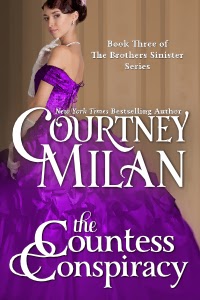
Review: the Countess Conspiracy by Courtney Milan

I am aware Courtney Milan's The Countess Conspiracy has been heavily reviewed. It's at the top of everyone's list for Best Book of 2013. (Save yourself some time, it's good and you should buy it.) Unlike most I had some issues with The Countess Conspiracy that kept me from declaring this her best book ever, ever, ever. It's a good book, it's one of her better books, but did I cry? Not even a sniffle. Every superlative I've ladled over Milan stands and is justified by The Countess Conspiracy. Long may she swim in the butter boat of my adoration. Here's the thing, I didn't want Violet and Sebastian together.
From the prior books in the series it seemed likely they would be together, and for the very reasons that unfolded. Certainly the Violet and Sebastian of this book were perfectly suited and should be together. Absolutely. But what if Violet truly didn't want him? What if Violet deeply treasured his friendship but just wasn't that into him? That was my Violet. I'd toyed with her being interested in Free. I'd toyed with her being truly asexual. I'd considered any number of paths for Violet to walk that I had to abandon to appreciate the path Milan's Violet was on, a path my Violet had already rejected. The real Violet is totally into Sebastian and she absolutely should be. He's divine. I adored the way he had to slowly realize that he was actually just as clever as people thought, despite feeling like a fraud. I applauded the way their lifelong friendship allowed them to see each other's family clearly while giving the wisdom to hold silent. Their miscommunications were appropriate. The relationships with their friends and family was as richly detailed and considered as their relationship with each other. This was a wonderful look at a woman recovering from low expectations and a man from high. Everything about this book is what I want when I want to read a romance.
Which brings us to the close. I've been having a lot of trouble with the final act of romance books lately. Part of it is them, part of it is me. I feel, while reading, as though the end is not something I've arrived at slowly and naturally. Instead a sudden burst of speed occurs as we near the finish. Plot threads start flying, knots are tied,  speeches are hastily assembled, and everything is As It Should Be when our couple embraces on the final page. I feel all askew. I wanted to look out the window a bit longer, I don't understand why we had such a rush and bother. I've become a romance dowager, always too hot or too cold and rarely just right.
At the end of The Countess Conspiracy it's Violet rushing about. I can see her rapid embrace of a newly perceived future but it's all just too easy. Everyone listens to her because she's Violet and the book is ending. I don't want to reveal all the steps to the finish line, if I had my way you'd read the book knowing nothing at all about it when it begins. While Violet deserves her happy ending, this ending was too incandescent for me. There's only one dim spot on her horizon and it's a smudge she can fairly easily live with. Please ignore my curmudgeonly ways and enjoy The Countess Conspiracy for the multitudes of things it gets right. Milan is my favorite author in the field.
* This review originally appeared at Love In The Margins.

06 January, 2014

Review: The One She Was Warned About by Shoma Narayanan

Shoma Narayanan was suggested to me by Suleikha Snyder, and it's a good match of author and reader. I fell completely in love with the heroine of The One She Was Warned About. Shweta is professionally confident but personally uncertain. On the edge of pushing for marriage to a man more suitable for her father to marry, she runs into a childhood frenemy. Nikhil is the boy next door made good. Once an illegitimate young troublemaker, he is now a successful business owner with ties to the entertainment industry. It's a boy next door story.
Shweta is less than impressed with Nikhil's success. While she's pleased for him, she is frustrated by his refusal to set aside the pain of his past and appreciate what he has. Shweta does not see Nikhil's return to her life as a lottery ticket she dare not misplace. She sees Nikhil as a new and interesting option. While her own insecurities and hot temper drive some of their disagreements, the main source of their conflict is Nikhil. Until he has moved beyond his childish view of his parents and his life, Shweta cannot trust him as her partner.
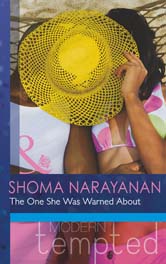
In this image of a man and woman embracing in a hammock, the man's skin is lighter than in the cover above.This sweet romance was consistent in characterization and tone. The office relationships were as believable as the family ones. There were a few points in the book that felt like they had been included for the western or white reader. Narayanan explains general customs at Diwali in one point, yet ignores them at another. It threw me out of the book to have the author explaining something that would be so basic to the characters. Romances with a white focus do not explain our common holiday practices. An author might indicate how her characters deviate from or cling to the norm, but a full explanation is unusual. Aside from those awkward moments, The One She Was Warned About caused me to purchase more by the author as soon as I closed it.
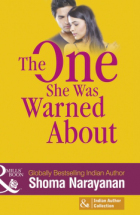
on a yellow backound a man stand behind a pensive woman, embracing her. We see only their heads and shoulders.
I came across several versions of cover art for The One She Was Warned About with interesting differences. The first cover (top left) is for the American market. To my eyes, it appears Nikhil has been lightened from the Mills & Boon version made for the UK (center right). It could be a combination of the dark title coloring and the reduced surface area, but the Mills & Boon cover more clearly indicates a non-white couple to me. The version for the  South Asian market (lower left) goes in a different direction. Instead of their faces being completely hidden by the yellow hat, only their faces are visible on a yellow background. The cover gives me a different expectation of the book. It seems menacing. I would expect this book to contain significant danger for the heroine and possibly include domestic violence. There's a YA after school special vibe going on. It's interesting to me that this reads as a romance cover in other markets.
 * This review originally appeared at Love In The Margins
Final Assessment: Solid category read with an engaging heroine. A-
Source: Purchased copy

13 December, 2013

DNF Review: Buttercup by Sienna Mynx

The Kindle Sample for Buttercup consists of the prologue and a few sentences from the first chapter. I wish the sample had been longer,  because I don’t know that the prologue is a fair representation of the novel. If it is, then Buttercup absolutely isn’t for me. Having a weakness for both the 1930′s and sideshow life I expected to enjoy Buttercup. Instead I struggled to complete the sample.

When we meet Silvio and Buttercup she is dancing on stage and he is masturbating. (I somehow missed that this is an erotic romance, and not a romance with erotic elements.) For reasons I didn’t understand they progress to a one on one physical encounter. Through his arousal, Silvio reflects on events, events that apparently separated them. Here I was confused. Silvio has “bedded the whore, the virgin, the widow” but he is angry that Buttercup may not have been faithful to him. He’s had to seek her out, indicating they were not in communication, but here she is dancing (and disrobing) for him with barely a word.

Because Silvio is revealing their story between “slick sheens of sweat” it was hard for me to stay interested. It seems that Buttercup did something six years ago that endangered Silvio’s life. Four years ago he got out of prison. Two years were spent with his gang, searching for Buttercup while also trying to forget her. Buttercup is apparently indebted to, and protected by, the carnival she works with. She is such a fantasy figure in this prologue that I wasn’t sure she was real. At the end of the prologue is seems clear that this is meant to represent an actual encounter, not a dream of Silvio’s. I also wasn’t sure of the timeline of past events.

“Buttercup was different than in the past, but she was a girl of barely seventeen and he was a kid himself. He paid it no mind. They had both changed. His mind was on one thing. Reclaiming what was taken from him prematurely.” – Kindle Location 219, Buttercup by Sienna Mynx

I think this passage means she is twenty-three, but I had to read it twice. My initial pass seemed to indicate that she’d been eleven during their prior sexual encounter. I know Sienna Mynx is very popular and Buttercup was suggested to me by several different fans but I didn’t purchase the book. As a set up for an erotic novel, the world of a 1930′s carnival is fresh and original. If I were looking for an erotic read I probably would have been more interested than I was. I needed a contrast between Silvio’s sexual needs and who Buttercup is as a person. Because she felt like a fantasy, and he a stalker, I DNF’d the book and moved on.

10 December, 2013

Review: Frozen directed by Chris Buck and Jennifer Lee

Oh, hey, Frozen, you sure are super, super white! What's that you say? It's the setting? They're pseudo-Scandinavian? Oh. Ok. Except no. I finally get a female focused Disney film that doesn't end in a wedding and what do I do? I ask for more. Why shouldn't I? This is a film for all of our children set in a fantasy kingdom where dignitaries from far away lands arrive to witness a queen's coronation. Why are only some of our children represented? Whatever. Let's move on.

There's a lot to like about Frozen. While I'm not a fan of the musical interludes, I know Disney makes serious money on their soundtrack hustle. There was nothing objectionable here. The instrumental tracks felt stronger than the vocal ones, although I heard kids singing the vocals as we left the theater. Visually the film is beautiful, with some of their best character conception in decades. A Ghibli influence was noticeable in the troll scenes, but not in an intrusive manner. Anna and her sister Elsa were distinct characters with different goals. Having been overprotected by helicopter parents (quickly dispatched), both are ready to face the world. Elsa greets the end of her invisible guardianship with fearful trepidation. Anna greets it with an overenthusiastic need for love and companionship. Both are logical outcomes of their situation.
Snow White, plus size Princess

It's interesting that in a film about fearing female power the filmmakers seem afraid to fully unleash the sisters. While there are villains to overcome and boys to consider and adorable sidekicks to meet (more Olaf, please) overall there isn't quite enough between them. Anna is perhaps too forgiving and understanding. Elsa is perhaps too self sacrificing. While Anna dominates the screen it's Elsa we want to spend more time with. Anna's conventionally quirky exuberance is familiar. She's a bit manic and a lot pixie. Her self confidence and loyalty are engaging, it's true. Elsa is a less common female lead. A reluctant queen afraid to indulge her own emotions, Elsa is a study in externally imposed self containment. The true message of Frozen is ultimately not of sisterhood, but of society's Good Girl imperative.

Elsa breaks out in Diva
When Elsa breaks free of her kingdom to live in splendid isolation she transforms. Joy lights her face, freedom infuses her body, and suddenly she gets a makeover. A free Elsa is an MTV Music Awards Elsa. She spins about and transforms from a beautiful woman into a white, ass-free Beyonce. As a viewer, I think WTF? Meanwhile, Anna is aged by her familial disappointment, a disappointment only more family interaction can heal. (It's a fantasy piece.) Anna is urged to see that everyone is imperfect and only though accepting our flaws can we stand together. Which is an odd message, considering the characters Anna sees as flawed are simply different than her. Add in a lovely piece about the joys of infidelity and Frozen is rolling toward the finale. Elsa sees that shutting the world out can't stop her from hurting them, but embracing it will. Anna takes her beer goggles off and her intrepid guide Kristoff continues to spend questionable quality time with his beloved reindeer.

Fantasia's Thinspiration Fairies
Frozen is a step in the right direction for Disney animation, but I left the film thinking they still have room for improvement. I definitely recommend seeing Frozen in the theater, but I can't unthinkingly swoon. I'd put Frozen near the top of the Princess films, however. This is better than Beauty & The Beast or The Little Mermaid, even if the stakes are far lower. We needed to spend less time tromping through the snow or eavesdropping on the various villains and more time exploring the women at Frozen's heart. This is the rare Disney film that leaves you wanting more than you had and probably asks for a repeat viewing.

09 December, 2013

Review: Get A Horse directed by Lauren MacMullen

Get A Horse is brilliant. Certainly it's not immune to criticism, but the brilliance part is unquestionable. Lauren MacMullen has not only made history as the first woman to solely direct a Disney short, she's also made an important statement about Disney's past and future. This is a love letter to Walt Disney that includes his imperfections.

As a huge fan of Ub Iwerks, the oft overlooked co-creator of Mickey Mouse, I was torn between trepidation and elation when his distinctive style came on screen. Get A Horse has been criticized for it's violence, it's sexism and it's decision to speak more to the adults in the audience than the children. I say way to miss the point. Early Disney shorts were sexist, violent and often racist. To sanitize those elements out of the narrative is to further whitewash history.

By placing the sexualization of Minnie Mouse so blatantly in the center of Get A Horse MacMullen offers the viewer the opportunity to reject it. Minnie's giggling and helpless compliance in her objectification is character consistent. Highlighting Peg Leg's lack of interest in the less attractive (and therefore less valued) Clarabelle Cow shows the dynamic played out in most of the early shorts. Peg Leg Pete is not the misunderstood suitor, he is the rich date rapist. Clarabelle Cow is not a random neighbor, she is the "old maid" who refuses to be pushed out of the party. Clarabelle wants what the smaller, slender Minnie has - male admiration. Minnie's cries for help indicate her higher status. Minnie expects help to be offered and accepts danger as a cost of her privileges. Clarabelle has to elbow her way into the scene, she is only pushed forward if she can absorb a threat for Minnie.

1928's Gallopin Gaucho 
Mickey is scrubbed of the halo that Walt himself despised and returned to his more complex roots. Where modern Mickey wants to be friends, archival Mickey wants a punishing win. And a punishing win is what he has as Pete is subjected to increasingly violent retributions before being removed from Toontown completely. MacMullen deftly plays the old sight gags against modern equivalents to keep the action between now and then going. From Horace's cell phone to timeless gravity gags, Get A Horse offers enough quick cuts to keep the youngest viewer quiet. You don't need to unpack all the slapstick references to enjoy the cartoon. As a viewer well versed in early Disney and slapstick conventions I was enthralled.

Ultimately Walt's Mickey (and this is truly Walt's Mickey down to archival voicing) resumes his place in a newly colorized Toontown. He has no need to walk completely in the modern world. Having ejected Pete, Mickey and his friends plug the hole to resume their idyllic life. In the corner of the final scenes Oswald The Lucky Rabbit pops up to wave. As a cartoon short, Get A Horse was enjoyable. As a tribute to Ub and Walt, it was magical.

05 December, 2013

Review: How Not to Be a Dick by Meghan Doherty

She had me at the title, I confess. How Not to Be a Dick is a book that begs multiple purchases. How many people in your life need this lesson? Really, it could be a blank book you fill in yourself and still seem value added. 

This book was pulled from my hands and passed around the local middle school within moments of receipt. (How Not to Be A Dick is almost certainly sold at Urban Outfitters. Let me Google that… and… called it!)

So, setting aside the clever title is there any value here? I’d argue yes. Covering situations as basic as overindulgence in (ahem) soda pop and as complex as toxic relationships, Doherty offers useful information with a light hand. The clean layout has an early 1960′s feel deliberately borrowed from school primers. Mixing text with illustration, Doherty’s characters trade off situations in an effort to avoid the gendering the advice. Forget all the Fun & Puberty books pushed on tween and teen readers. Far more important than yet another graphic about tampon insertion is a book that addresses social anxiety, setting boundaries and calling out racist humor. 

How Not to Be A Dick is the book that fits multiple gift giving needs. Hipster teen? Dick at work? You’re good to go. And remember these words:

The first rule of not being a dick to others is: Don’t be a dick to yourself. – Meghan Doherty


*This review was originally posted at Love In the Margins.

03 December, 2013

Review: In Love Again by Megan Mulry

In Love Again is the third book in Megan Mulry’s series, The Unruly Royals. Claire, the aloof and married older sister from the earlier books, is now  on her own. Moving to New York to pursue a fresh start, she finds a man from her past. Ben is at a similar crossroads in his life. His marriage has dissolved into a shared disappointment born of mismatched assumptions. He’s drifting through the days, waiting for something to bring him out of his malaise.

Although I have a soft spot for second chance at love stories In Love Again was an uneven read. On the positive side, despite it’s upper class setting, Mulry’s world isn’t composed solely of caucasians. Characters with different ethnic backgrounds are presented not as underprivileged made good, but as individuals from solid, sometimes affluent, homes. They belong in the world they are inhabiting. Ben is Lebanese, with a large and close family. His heritage is neither ignored nor presented as unique. Ben alludes to the potential racism of Claire’s mother in a scene that leads to one of the few awkward moments in In Love Again. Claire hastens to assure Ben that ethnicity isn’t something that matters to her. Ben never challenges her. Claire, who has been appropriately awkward in her grab for the non-racist ring, isn’t required to acknowledge that declaring it doesn’t matter has it’s own baggage. It’s a moment I wanted them to linger over despite Ben’s easy acceptance.

I loved Claire’s insecurities, her defense of stay at home parenting, her tentative steps toward creating an adult life after years of suspending her personhood. I hated how easy it all was. Claire gets the first job she applies for, because of her connections. She is embraced by all of her coworkers, because of her connections. Later she comments on how she’s trying not to lean on this privilege, yet at the same time she’s openly deploying it. I could forgive Claire for continuing to fall through her life if Ben were someone other than Ben. Ben and I, we didn’t hit it off.

There was a sense throughout In Love Again of missing pieces. (Claire’s mother has remarried? Freddie is a liar?) Most of these are eventually slotted into place but Ben remains a stubborn hold out. When we first meet him he’s unlikeable. For reasons rooted primarily in the past and her own low self esteem, Claire seeks him out again. Suddenly Ben is utterly accepting of anything. Even when it’s revealed he has good reason to resent Claire he doesn’t. When Claire repeats a sin of the past, even more egregious in light of her maturity and their past experience, he shrugs it off. When Ben takes Claire away for a weekend and a family member hijacks the night, it’s fine with Ben. Everything is fine with Ben. He wants Claire because he used to want her. He hasn’t anyone else at the moment and Claire is the heroine so they’re meant to be.

The easiness continues as Ben charms Claire’s troubled daughter, introduces her seamlessly to his family, and establishes himself at the center of her life. (He’s also very rude to a waiter. It’s meant to read as passion but it put me back to disliking Ben intensely.) Ben plays guitar to make himself interesting. He doesn’t convey any sense of musical obsession. He doesn’t practice around Claire. He chose his day job to be lucrative but is bored senseless by it. While Claire is reinventing herself and reinvesting her in family (another road easily cleared) Ben is just acquiring Claire. He has six sisters, one with a family member in crisis, but they’re almost invisible. Ben feels aimless.

Late in the book Claire becomes quite angry with her sister in law. An apology is quickly offered but the advice found objectionable wasn’t wrong. This too was a moment that could have shown the family divide but instead was quickly smoothed.In Love Again’s true conflict is primarily off the page as Claire’s ex complicates her life before being speedily dispatched. If Ben had been less unquestioning in his acceptance, if Claire’s interpersonal conflicts had led to her being called out on her own bullshit, I think I would have loved this book instead of liking it. As it was, everyone was a bit too perfect and isolated for me to fully embrace them. Even with these issues considered, In Love Again is my favorite of the series.