30 April, 2014

Review: Free Fall by Carolyn Jewel

Pity the poor novella that is meant to hook readers into a series. It's judged not only on it's own merits, but also on it's ability to reduce a complex world into an appetizing bite. One misstep on either side and the reader is ready to bury it. With that in mind, pour one out for Carolyn Jewel's Free Fall. Having a vague impression of liking Carolyn Jewel I picked up Free Fall sometime in 2012. As I only read books that are piping fresh or carefully aged, it sat in the TBR waiting for the right moment. Free Fall packs plenty of story into a decent sized length. (Let me pause to say I appreciate how Jewel tells her readers up front how long the text is. You won't end up buying a 20 page plot summary disguised as a short novel.) Here Be Spoilers, lassies!
We met Lys Fensic (the heroic characters tend to refer to each other primarily by their last names) in the lobby of her building, waiting for a friend to help her escape an abusive relationship. Her co-worker is trying to aid her but his assistance only increases her stress. At this point I was very interested in the paranormal world Jewel created. Fensic demonstrated some quasi-autistic characteristics that I wanted to explore. (Reluctance to make eye contact, sensory overload, aversion to unsolicited contact, struggle to use visual cues to translate emotional contexts). Then her friend shows up. My paranormal problems kicked into high gear and never settled down.
Khunbish is your basic predator hero. (He's supposed to have a line over the u but I can't locate the alt command for that so just go with it or correct me in the comments and I'll add it.) Although he's a computer specialist by trade, Fensic thinks of him as dangerously powerful because he's tall and frequently calm. She builds up fantasies in her mind of him banging girls who wear glitter when he's not beating up random men. Fensic has issues. But maybe not. Khunbish immediately refers to the coworker as "a pussy." This is based on absolutely nothing. A perfectly nice man is trying to assist a coworker with her belongings. Khunbish instantly dismisses him with a slur of questionable taste. Nice. Let me go ahead and root for him right now. Or not. ANYWAY.
I'm briefly given hope that Jewel is going to call Fensic out on her vaguely fetishized reading of Khunbish's character. When Fensic explains that she needs someone like Khunbish he does challenge her on her assumption that he's physically adept and or violent based solely on his size and potentially his Mongolian ethnicity. Both of them hand wave it and move on. Of course Khunbish is violent! He's a demon who could, if he so chose, utterly control her and... (Oh god, really?) There's something about how witches are super sexy hot to demons (who are all male, as presented in this short) and they could enslave them but on the other hand mages (who are all men) can enslave the demons and that's worse than actually dying because... I can't even.
Fensic isn't helpless in the ex-boyfriend showdown. (She's equal in power to the other characters but set up as untutored and therefore exploitable.) They go to get something it turns out they don't need and then it's sexy time. I appreciated how Jewel set up the sexual interaction between the characters as freeing for both of them. Fensic has been held back by the domination of others and the fear of herself. Khunbish has been required to suppress aspects of himself to fit into the normalized human culture. (Vanilla is, of course, used as a dismissive descriptor. Because why not hit most all my peeves?) The concept that honesty enhances their sexuality is well presented and well conceived. Until it's not. (This was my Free Fall reading experience, things were great, then really not great, then kind of great... oh no not great.)
Early in their encounter Fensic asks about condoms. Khunbish explains that demon / human sex is free from disease due to incompatibly. She says that's cool and all, but she doesn't use birth control. He says no problem because in his human form he's sterile. He can only impregnate her if he's in his demon form. Fensic wistfully reveals she's always wanted a baby (because OF COURSE) and even in his demon form it wouldn't matter because she's unable to conceive. WAIT! FULL STOP! If she's unable to conceive why is she asking about condoms in a birth control context? Talk about your mixed messages there, Cookie! Is this a passive aggressive conversation? "Well, I could get PREGNANT!" "No, babe, you can't unless I change" "JOKE IS ON YOU! Even if you change I can't get pregnant, HA!" Of course, she totally CAN get pregnant because his magic demon sperm knows no human infertility. So let's make this hybrid baby and get back to the guys trying to kill us.
Fight scene, drama, ex boyfriend, discover your true powers, blah blah blah. Now we're wrapping things up with another bait and switch moment. Khunbish has been forced to call in the local warlords, who are apparently the main couple of the book series. At the close of the fight, the female half of the partnership asks if they're ok with meeting the male half and they agree. Suddenly it's baby-louge time and they're meeting with the male half several weeks after the female half asked if it was cool to do it now. Fine, ok, something changed, we can go with that. We head over to the mansion where the various demon underlings are hanging out and they're doing fist bumps and hand jives and trash talking and we discover some are Indian, some are not described and here's the big dude and.... oh hell to the no.
The big dude is a sandy haired boy next door type who is deceptively un-powerful in his physical presentation. My paranormal problems are having a five alarm fire in my head as he lays down the law for Fensic and Khunbish. Mr. Big Dude condescendingly tells Khunbish to "use his words" (no kidding) to figure out his relationship with Fensic because they can't be together unless both of them swear loyalty (or not) to Mr. Big Dude's gang. If they swear loyalty there is money and safety in it for them as long as they comply with whatever Mr. Big Dude desires. If they don't then they are "a problem" for him and might end up getting killed or something. Furthermore, while their fealty is of their own free will, once sworn any failure of loyalty could result in their death. Khunbish is fine with this because apparently demons are totally used to being in gangs. They kind of like it. He's been a free agent for so long because... some kind of reason... but he knew it probably couldn't last with all the turf wars heating up. Fensic agrees because love and pregnant and all, and because she isn't sure how to control herself without Mr. Big Dude's group teaching her. Mr. Big Dude welcomes them and the baby into his gang. And. The. Baby. AND THE BABY. Wow.
Your experience with Free Fall will depend completely on if we have the same paranomal problems. If I'd been able to set aside my aversion to ethnic based personality traits and alpha hole heroes pretending to be beta and street gang culture as paranormal normality, I'd probably have given Free Fall a pretty high rating. Because I wasn't I ended up with a C read. I still like Jewel, but I think I'll stick to her historical stories instead.
* This review originally appeared at Love In The Margins.

28 April, 2014

Review: Hot Under The Collar by Jackie Barbosa

Hot Under The Collar was purchased in 2012 and then promptly placed in the TBR pile where it languished until recently. When Courtney Milan suggested we all review Jackie Barbosa's work as a show of support, I had already begun reading it. (The problem I have with Jackie Barbosa is that I love her voice but I've lost interest in erotic fiction. When we're out of bed, she's one of my favorite authors. When we hit the sheets she's just as skilled but I'm wandering off.) With all of those caveats and disclaimers in place, I really enjoyed Hot Under The Collar.
Barbosa avoids a number of pitfalls in her fairly conventional setup of reluctant Vicar and former Courtesan. The first, of course, is that the pairing is completely expected. Vicars never seem to fall for young women of deep faith and enduring piety. The second is that Artemisia, the courtesan in question, is not unknown to Walter, our vicar. Before his injury in the military Walter was an underfunded pleasure seeker who admired Artemisia from afar. There was a danger that she would be something he earned, the nice guy rewarded with the dream girl. Barbosa does a good job of having them earn each other. Artemisia is lonely, yes, but she's not desperate. Walter is not obsessed with her because of her former status but because he enjoys her as she is then and now.
Hot Under The Collar presents two facts about Artemisia and Walter early then leaves them alone. Walter's injury is manageable. He's not impeded in his life nor obsessed with it. There's no detailed scar kissing scene or wallowing in man pain. He got shot, it sucked, he moved on. For Artemisia's part she was ruined and subsequently is infertile. These are facts in her life, not tragic flaws. Walter explains he cares about neither and he means it. She doesn't run and hide from who she is or from his acceptance of it. The objections and obstacles to their relationship are appropriate and appropriately dealt with. I understood the reason for one late arrival's introduction but he wasn't needed. Walter's discovery that true faith adds to lives instead of diminishing them worked without it.
If Barbosa ever decides to write a full length standard Regency I'm completely in.
* This review originally appeared at Love In The Margins.

24 April, 2014

Review: The Unexpected Wedding Guest by Aimee Carson

No. No. No. No. No. No. Just No and more no. This is my second Aimee Carson book. Earlier this week I read (and loved) The Wedding Dress Diaries, which is a prequel to The Unexpected Wedding Guest. Everything I liked about the prequel is completely absent from the first volume of the series. No one... There's no... I just.... ARGH!
Spoiler Alert: I didn't like it.
Reese is the younger (and pampered) sister of the hero from The Wedding Dress Diaries. None of that matters. Although the prequel sets up the relationship between Reese and her brother as something to explore, it's brushed completely aside. As well, the supposed lifelong friendship of Reese and the heroine from the first book becomes irrelevant. Reese has real friends, the girls she went to college with. You know these are her real friends because they show up in the final pages of the book to populate the sequels. For most of the book Reese is either completely on her own or watching a man walk away from her.
Mason is the unexpected guest and Reese's ex-husband. His therapist (he's a war vet with a brain injury) has suggested he contact Reese for closure. It's completely logical that Mason would choose to show up unannounced three days before Reese's wedding. Of course none of the staff at the mansion she's rented for the event would challenge him as he walks right into the bedroom where her fitting is being held. Of course her future sister in law and lifelong friend would pick up her sewing kit and promptly skedaddle. Why wouldn't any of this happen? It makes total sense!
That's not fair. It makes more sense than most of the rest of the book. Reese has allegedly hired a mansion with a full staff. None of them appear, get names or do a single thing. Reese and Mason are left completely alone. Deliveries must be received by one of them, guests must be greeted by one of them, changes to the menu, decorations or favors must be hand completed by one of them. It's like Reese rented an empty house and has no friends or family. Look, that's not how rich people do things. I know rich people. I've worked for rich people. I've been rich people. There is absolutely no way a pampered rich person isn't going to have half a dozen people waiting to hop when they crook a languid finger. Just... no.
Reese's fiancé shows up, sees Mason and promptly calls off the wedding. He sees Reese as a useless doll. (Again, why is she throwing the wedding effectively by herself?) Reese lets Mason stay so they can discuss where their relationship went wrong while she sifts through the wreckage of her current one. Reese blames herself for the end of her engagement, even though her fiancé is a complete tool about it. Mason blames Reese of the end of their marriage, which means Reese eventually does too, even though Mason is a complete tool about it. Reese seems to spend all of her time chasing after tools that just want to slip in her box and then abandon her. We're supposed to feel sorry for Mason because he's a war hero and he's not rich and he has a brain injury. I didn't.
Spoiler: Despite Mason having severe short term memory issues they never appear to cause him difficulty. His brain inury is simplified to Gets Headaches and Forgot Your Name. His impotence is cured by exposure to Reese, so he never mentions it. His PTSD is hand waved away and his utter failure to communicate like an adult is excused as pride. Mason is an emotionally abusive jerk Reese will be running after and begging for answers from the rest of her life. So he's a war hero. So what? Oh yea, it also opens with body policing. 
Reese muddles through with the least amount of support possible from everyone in her life. She's treated like a child by just about everyone. When her inexperience leads her into possible danger, her suddenly present staff runs to find a man to take control instead of just speaking to her clearly. Reese is stuck between apologizing, self blaming, and meeting the needs of others throughout the book. Fail Whale, meet The Unexpected Wedding Guest.
* This review originally appeared at Love In The Margins.

22 April, 2014

Review: Beautiful Darkness by Fabien Vehlmann and Kerascoet

Beautiful Darkness is a French comic book. (Wait, come back.) I implore you to read it. I understand if graphic novels don't work for you, I absolutely do. This isn't a manga or something you have to read in a specialized manner, It's a straightforward American-style comic book. Give it a try. I want to review this without spoiling any of the reveals in Beautiful Darkness. The story unfolds so elegantly that to disrupt the pacing would diminish the experience. Just put your library request in and come back later. Or keep reading.  (But buying it works too.)
Spoiler Alert: After a young girl dies suddenly in the forest the fairy tale creatures find themselves lost and disoriented in the woods. Aurora, being purest of heart, takes charge of the necessities of food and shelter while her prince forms an exploration team.
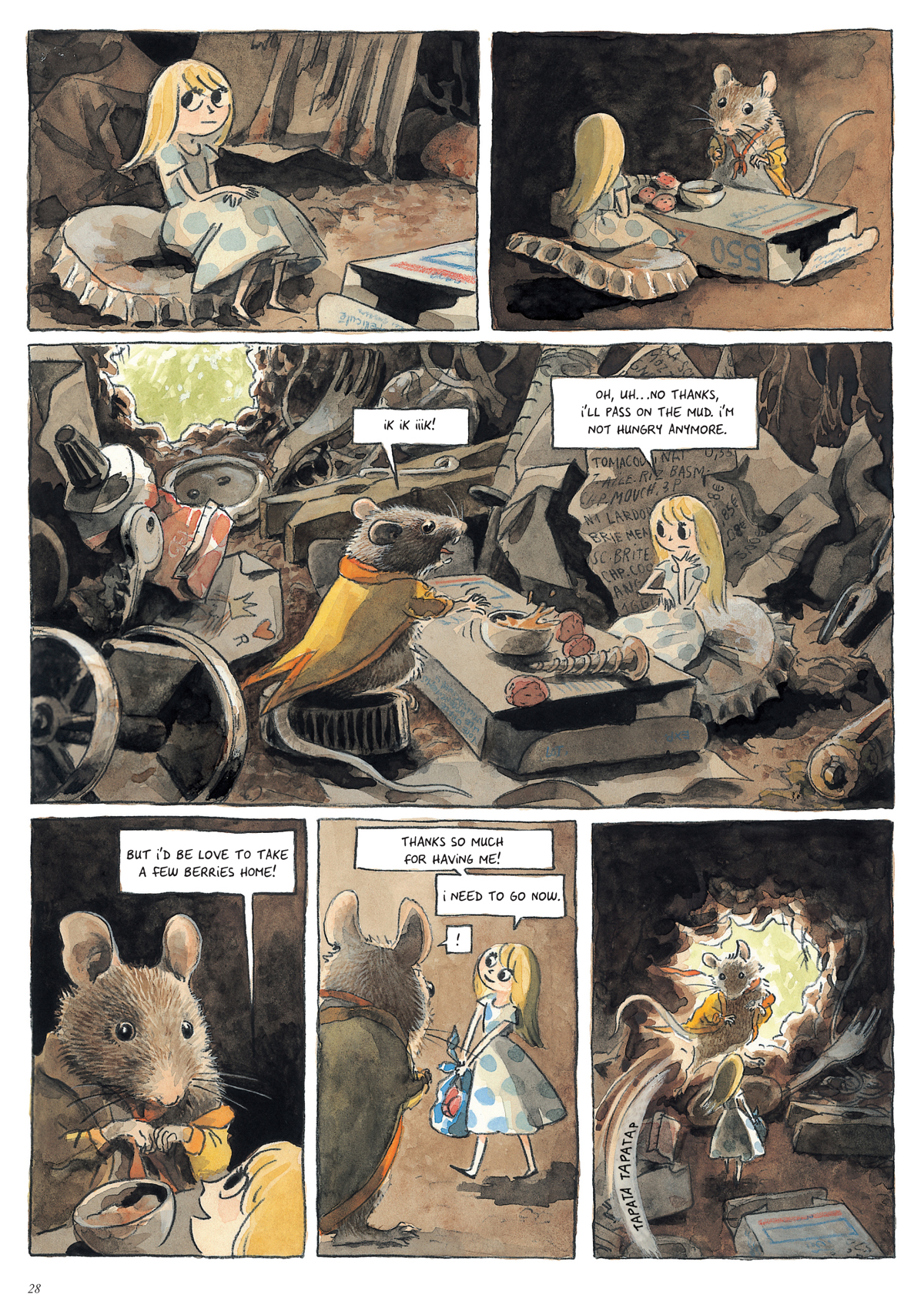
Vehlmann and Kerascoet (Kerascoet needs an umlaut on the e, but the alt text commands I know are being rejected by Wordpress. forgive me Kerascoet.) have created an absolute masterpiece. (Dascher's translations are smooth and natural.) It's been quite a while since I read a graphic novel that stayed with me for the rest of the week. Beautiful Darkness is deceptively straightforward, even light. It's a fairy tale in the most traditional sense of the word. Romance and quiet horror play out side by side in Beautiful Darkness while the reader considers the moral choices made within. There's a princess, of course (Aurora) and a prince or two. There are talking animals and girls lost in a forest and quests to overcome. A page from a comic depicting the young girl having lunch with a mouse
Beautiful Darkness is like stepping into a vintage Disney piece. The deceptively simple artwork reminded me of the late 1950's with a bit of Harriet Burns and Mary Blair mixed in. Aurora is separated from her prince by a natural disaster. The book follows her through a traditional fairy tale journey of self discovery as she seeks personal and romantic fulfillment. Like most fairy tale heroines, Aurora asks nothing for herself, she is focused on providing good for others. I don't think it's a coincidence that Aurora shares her name with Disney's Sleeping Beauty. There are enough woodland creatures to satisfy even Walt's mouse fetish. Not everyone in Beautiful Darkness gets their happy ending. It's the trip, not the destination.
* This review originally appeared at Love In The Margins.

20 April, 2014

Review: The Wedding Dress Diaries by Aimee Carson

The Wedding Dress Diaries is a short prequel to Aimee Carson's Wedding Season series. It's been free at most e-book sites for several months but is also bundled in some versions of Secrets & Saris. As a sales tool, it's effective.
Amber Davis is a wedding shop owner and the best friend of the bride. Parker Robinson is the bride's estranged brother and Amber's childhood crush. When Parker shows up to refuse his sister's wedding invitation, Amber decides to change his mind. While I like the Little Girl Grown Up trope it felt unlikely that Parker wouldn't recognize Amber at all. He's a cop, and therefore fairly observant. I went with it.
Parker is estranged from his family with cause. Amber's knowledge of those causes is difficult for Parker to accept. He's reinvented himself and shaken off the insecurities from his upbringing. In the process he's also become closed and cynical. Parker's not interested in long term relationships, and the bridal shop owning best friend of his little sister has long term all over it. He's right about that, but Amber's been waiting half her life for a chance at Parker Robinson. She's not about to let him get away again. Here I had a bit of an issue.
Spoiler: Parker tells her a one night stand is all she gets. Amber agrees. Minutes later she's leaning on him about HEA and how he needs to open up. I hate when one character is honest about their intentions and the other character completely ignores them in favor of magical thinking. The genre generally rewards this, but it frustrates me.
After an unexpected round of Who's Got The Handcuffs, Parker and Amber head into the sunset. A gender flip could have made this exceptional. Amber's insistence that Parker spend time with his most toxic family member really bothered me. (Emotional abuse is no easier on adult children.) The Wedding Dress Diaries still won me over but I really hope Patrick doesn't buy into Amber's happy family fantasy in the long run.
* This review originally appeared at Love In The Margins.
10 April, 2014

Revisiting Wonder Woman

While I no longer buy anything but Tiny Titans I used to be an avid fan of the DC Comics line. I subscribed to 20 or 30 titles a month (sometimes more) though the 80's and 90's and read extensively in the back issues of the decades prior. DC has gone to great lengths to throw my business away, so I'm raising my kids to be Marvel fans. There's still a tiny corner of my heart that desperately wants a Wonder Woman movie. Walking out of Captain America: The Winter Soldier I wondered why. Marvel is doing so much to be inclusive. What is there about Wonder Woman, a character I never followed as avidly as the JLA or Batman, that still tugs at me? Was it all based in Linda Carter's television series? (If that's the case why is my dream casting Lupita Nyong'o?) I decided to go back to the beginning - Wonder Woman's second appearance in DC Comics, Sensation Volume 1.

If you're a modern Wonder Woman fan, this is long before she became Superman's love interest, a pairing I have always had problems with. Back in the beginning Wonder Woman had no concern over being more powerful than her man. Diana focuses on Steve as the first man she's seen in her hundreds of years of eternal life. She's fascinated by him and falls in love. But Diana doesn't give up her immortality just for a boy. Yes, she's intrigued by him (and pressures her mother to allow access) but she doesn't leave the island for passion alone. The island is threatened by the global conflicts that will become WW2. The goddess instructs one of them to escort the fallen pilot back to the world to serve her there. Diana volunteers for the suicide mission. Her mother, obviously, says no.
Check Out His Fedora!

 Diana disguises herself to compete in a physical challenge designed to find the most physically adept of the Amazons. These women have not lived lives of lazy indulgence. For hundreds of years the daughters of Aphrodite have challenged themselves to continually improve. They strive to run faster, aim truer and defend themselves confidently. When Diana's deception is revealed her mother's reaction is not one of anger but of pride. Of course Diana is the most qualified, and of course she should be the one chosen to protect her people. Her mother presents Diana with her uniform and Diana pilots her invisible plane back to America.

Steve is badly injured so she leaves him in the hospital and explores her new world. She dress shops, she scandalizes the town by the scanty nature of her costume, she encounters (and defeats) low level criminals. In so doing, Diana comes to the attention of a P.T. Barnum type who offers her a job playing "Bracelets and Bullets" on the stage. Diana confidently accepts. She has time to kill so why not earn the currency of this nation? It is Wonder Woman's complete assurance that strikes me about this early appearance. She lacks the self doubt of other super heroes. Diana expediently assesses her options and selects the best routes open to her. She's a problem solver who refuses to be intimidated or exploited, even by people above her in power (her mother) or experience (her employer). When offered more money, Diana declines. She is driven by her personal goals, not fortune. When her manager attempts to cheat her she apprehends him and regains her pay.

Street Harassment Stays In Style
It's not only Diana's confidence that reminds me why Wonder Woman endures as an icon despite the mishandling of her copyright owner. It is the unequal power dynamic between her and Steve. In this first appearance Steve has nothing but respect for her abilities. When he sees her perform physical feats outside of his own he's not threatened. He laughs when she returns to rescue him and acknowledges her superiority.

The book closes with a reiteration of her femme identity and an establishment of the dual life that will carry her through the next several volumes but the bones of Wonder Woman are laid. Diana is an intelligent soldier impervious to the opinions of others. She is living her life without apology or explanation. If DC is interested in doing justice to the original conception of Wonder Woman then Lupita is exactly right for the role.

08 April, 2014

Review: Fall Guy For Murder by Johnny Craig

Johnny Craig is one of those artists we'd call mid list if he was an author. Prolific, talented, a cult favorite, but unable to adapt to a new publishing house. Tales From The Crypt, the Crypt-keeper, if you're a child of the 80's you may not recognize these horror icons as originating in the comic aisle. EC Comics was a casualty of the CCA but back in the day it was up there beside Marvel and DC and a host of other companies as a major player for your Saturday dime. Craig was one of their best artists, but he was also one of their slowest and least adaptable. When the horror line folded he wasn't suited to cross over into superhero work. With the 1950's on the rise, I hope work like Craig's gets a second life. Fantagraphics is doing their part by issuing a number of EC collections based on specific artists instead of specific titles or years.

Fall Guy For Murder and Other Stories is focused on Johnny Craig. Artistically, Craig was a very precise artist. His characters are ugly-pretty in the popular noir fashion of the day. As collected in Fall Guy they are predominately white, which was typical of the books as well. Craig's women have sharply angled faces with slashing brows and nipped waists. They're angry gold diggers looking out for themselves, taking the steps necessary to get what they want. His men are a series of failed Don Drapers, tired of the nagging, unable to meet the demands placed on them. Domestic violence is part and parcel of the murder plots. And yet. Craig's women are also sympathetic. They're placed in worlds they may have little control over and they lash out because of those limitations. Many of them are deeply loved by the men they are exploiting. Some of them reciprocate.

Craig generally worked on his own scripts and adaptations, giving his work an unusually cohesive feel. While his tales of vampires and schemers are fairly predictable to a modern reader, they are ruthlessly logical. Craig foreshadows his reveals with precision and care. He thought about his panels, the placement of objects or people. He thought about his twists, how they worked with their set up and the emotional payouts they contained. Even when the story reads as tediously familiar the art draws the viewer in. His work still pulls you into rooting for his poor doomed underdogs.

While Fall Guy For Murder focuses primarily on white characters there was a very interesting piece set in Haiti. I'd like to see if Craig had more non-white characters in his horror because what looks on the surface like a typical colonization story turns into something far more interesting. I'd like to think it's by design, but the few pages of the tale don't support a wide reading of his intent. The early depiction of the childlike Haitian people so eager to please their "B'wana-Steve" is typical of the period. They speak in childlike and imperfect english. They beat their drums and dance in joy while the white people marry. Their joy is in serving the white man as completely as they can and yet... In the end, he is betrayed. In itself, this isn't so interesting. The black servant shown as duplicitous is typical. Even the method of betrayal fit established stereotypes. What gives me pause and made me wish for more to examine was the reasoning behind the betrayal. The Haitians give "B'wana-Steve" exactly what he claimed to want. They don't inform him of the horrific repercussions of his desire, they only fulfill it. His word is his bond. Even his death won't free him of his fate as they solidify his punishment into an eternal sentence. They deliver him into hell with a joyful heart. I think Craig offered this revenge fantasy deliberately, and I'd like to think it brought a moment of pause to the young readers who encountered it.

07 April, 2014

Review: Julio's Day by Gilbert Hernandez

Anne Elizabeth Moore wrote a pretty excellent review of Julio's Day. You should probably click through and read it first. My experience is less with the text of this specific book and more with the Hernandez brothers body of work. Love & Rockets is so popular there's an even more popular band named after it. Any best of comics selection invariably includes a few pages of Hernandez work, invariably featuring murder or sex (generally non consensual).  Their art falls into the stylized realism end of graphic novels. The lingering focus on physical imperfections lets you know this isn't some lightweight superhero stuff. The grunts come off the page when they fuck. This is how you know it's literature, darling! Life isn't pretty!

Julio's Day is the work that finally convinced me I just don't like the Hernandez's work individually or collectively. No matter how much critical acclaim they accrue, they leave me feeling bamboozled. In the case of Julio, the conceit is that we're going to follow this man through the hundred years of his life, a page at a time. (His mother lives to about one hundred and thirty because that's how Gilbert rolls.) We hit all the predictable points for a Hernandez work. People will be molested, people will be murdered, ugly diseases will strike, sex will be shown, women will go mad. It's all so meaningless in it's meaning laden run through history. The plot twists are cheap and random, unearned left turns taken for the sake of exploration looping back into pulled punches of revelation.

Darling, listen, life is filthy. It's a filthy place. The very earth we depend on for our food will send parasites to kill us and poison future generations. The mud will rise and destroy our homes, obliterate our families. (Often at the exact moment the plot demands inexplicable random deaths to smooth over pointless truths.) Death cannot be sanitized. The past is a place where everything was left unsaid, the forefathers kept their secrets in their chests, their loves silent, their desires repressed. It has to be that way! If it isn't then our glorious open freedoms are nothing but brightly colored flags waving in the hot breeze of self satisfaction! What's the point?

Literature requires a point. Too often dark themes are mistaken for depth. There's no depth to Julio's Day. A man is born and a man dies. In between he is a witness to other's lives, living almost none of his own. His experiences are alluded to, they are suggested, where the experiences of those around him are flung out like depressing offerings to the fates. When Julio's great-nephew urges him to walk out of the closet and embrace the sun I wonder whose sun is he referring to? In their family legacy of early death, molestation, abduction, murder and madness where does Julio's great nephew see himself? His casual devaluation of the sum of his great uncle's scarcely examined life is the ultimate rejection of Julio himself. Julio's true day is being lived inside himself, away from the reader's eyes. The parade of anguish that we're offered is to let us know we're reading something capital-I important without rising to the challenge of really showing us the depths of the man.

28 March, 2014

Review: Secrets And Saris by Shoma Narayanan

After reading The One She Was Warned About I wanted to check out another book by Narayanan. Secrets & Saris surprised me by being having some fairly controversial content. Shefali Khanna is a recently jilted bride overseeing a child care center in a new town. Neil Mitra is a television personality with too much baggage to start a new relationship. This is a conventional start for Harlequin so I wasn't prepared for where the story went. Narayanan bit off more than the page length allowed her to fully chew. The relationship between Shefali and Neil felt as though I were watching them through a zoetrope, their conflicts circling back as quickly as they'd cleared.
Shefali is a very traditional woman. She was prepared for an arranged (but not hasty) marriage when her fiancé leaves her at the altar. Never having planned for a life beyond wife and mother, she breaks with her family to explore what she wants from life. Shefali is confident, capable and engaging. She also ends up with a HEA despite her best efforts. Shefali spends way too much time telling Neil what he thinks, feels or wants and far too little time protecting herself. She repeatedly agrees to things she knows will make her unhappy. Passive aggressive might be her middle name.
A confident woman of Indian heritage looks skeptically out at the viewer
Mills & Boon cover
For his part, Neil is an enigma. His heritage is brushed over as irrelevant, except for two odd scenes. The first, an obvious plot device, involves him not being expected to understand Bengali. The second has Shefali ruminating that Neil's mother appears more culturally conservative than her own. This was a point I would have liked to explore. Neil's family was less traditional than Shefali's, so why did she interpret Neil's mother that way? Was it only her clothing, or was it in the fetish/appropriation sense? In a way Neil serves the same role the half-Indian hero does in most of his appearances. His heritage makes him mildly exotic without informing much of his personality or the plot. Unlike most, Neil is culturally identified as Indian, not English.
The major conflict between Shefali and Neil involves abortion. I suppose you could say it's Shefali's uncertainty about Neil's commitment or their inability to fully express their feelings. I'd disagree. Neil's hangups are tied directly to children, as are Shefali's. She's ready to start a family and he is not. Shefali decides to marry Neil with the hope of changing his mind over time. (Oh honey, no.) In the end I admired Secrets & Saris more than I enjoyed it. While I liked the ambition, at the book's close too much was swept aside. 
Spoiler Zone: Neil has a child from prior relationship. He pressured his former partner into having the child instead of terminating the pregnancy. Shefali is surprised he is raising his daughter alone, apparently expecting Neil to have then asked a female relative to raise her. Although a devoted father, Neil decides not to have more children. Narayanan lightly touches on how Neil feels entitled to dictate how both women use their wombs but shies away from the point by book's end.
*This review originally appeared at Love In The Margins.

27 March, 2014

Review: Unforgotten by Tohby Riddle

This is a somewhat atypical graphic novel. Instead of a full narrative, the images are used to illustrate what is essentially a poem. The fairly simplistic text furthers the narrative of the images along without really integrating into them. I'm not certain the text is needed at all.

There's a deep sense of history in Unforgotten, mixed into a dreamlike state for the angels to move through. Riddle has created a lovely mixed media rumination about caregiving. The message is portable to caregivers, parents or protestors. It is not easy to care for others, to work toward good. Self care suffers. The caregiver's needs can be invisible against the chaos and clamor of the needy.  Eventually, we all need external care to move forward. A lovely but not essential book.

24 March, 2014

Review: Concealed In Death by J.D. Robb

Ok, so the 38th book in the In Death series is out and… guys? Hey, where's everyone going? Wait! Come back! Eve goes to Africa! (I am totally lying. But come back anyway.) I liked this one! Well, mostly. Anyway, Eve catches a cold case. (By book 38 we all know what In Death is about, right? Abused street kid turned murder cop marries Irish abused street kid turned thief and business tycoon, together they hit the sheets while chasing murderers. There. You can skip books 1-37 if you want.) Early on I was concerned that the flaws of the last few books would mar the reading experience of Concealed In Death but Roberts / Robb has moved back into the sweet spot. It's crime time.
Roarke buys a building, and with it he reveals a fifteen year old murder. While his outrage at the crime happening on his turf was tedious (the guy is like dogs and trees, I swear) having Eve work a cold case was an interesting angle. Although lacking the rush against time urgency of an active serial killer, the department still lets her focus on a single case. Mavis, a character we've seen too little of since the earlier books, is brought back for a pivotal plot turn. She is a welcome figure in Eve's world. Mavis loves but does not idolize her. In fact, Eve's almost pathological inability to consider living people is highlighted throughout Concealed In Death as she struggles to make connections with those she values. Eve is a terrible friend, but people stay in her life anyway.
Without giving away the storyline, the cold case touches on aspects of Eve and Roarke's own youth. Eve has moved past her childhood flashbacks, now she dreams of her victims. Conversations with annoyed dead people is a surprisingly satisfactory way to push the plot along, making Eve's intuitive leaps seem more natural. The resolution is no mystery, but In Death has always been more about the journey than the destination. There are some dropped points, astonishingly long memories, and a few characters built up only to disappear at the close. I'm on the fence about everything related to Africa. It's quirky and a little post-colonial. Ultimately I went with it. Roberts continues to provide diverse side characters without making an issue of their ethnicity. Eve's New York is not a single class or color, even if the core characters often are. Concealed In Death is one of the better books in the series and a good entry point for the curious.
*This review originally appeared at Love In The Margins.

21 March, 2014

Review: Facts In The Case Of The Departure Of Miss Finch by Neil Gaiman and Michael Zulli

Sometimes I wonder why I stopped reading Neil Gaiman. Surely, I think to myself, it can't all be carryover from his wife? Luckily, I had the opportunity to read Facts In The Case Of The Departure Of Miss Finch. It's not just the wife. Gaiman and I, we broke up for me. Finch neatly encapsulates so many things I dislike. I can't even say "We'll always have Sandman" because I hear he's started writing it again. In keeping with tradition, because I loathed Facts In The Case Of the Departure Of Miss Finch and it's an older release, spoilers will fly.

J'accuse: Self Importance

Exhibit One: Gaiman has cast this tale with himself, Jonathan Ross and Ross's wife Jane Goldman as the main characters. As a narrator, Gaiman is so important that he must hide himself in a hotel room in England so he can finish his film script. If people knew where he was they'd call. Of course, Ross finds out and therefore invites him out, proving him oh-so-correct!

Exhibit Two: Ross and Goldman want Gaiman to add some pleasure to their evening. They are stuck with, saddled with, insert your choice of adolescent eye rolling here, the person of Miss Finch. they find her skin crawlingly boring and want Gaiman to help them endure her company. This depersonalizes Finch and sets her up as a joke. Miss Finch does not enjoy what they enjoy (sushi) and therefore is a unbearable. They get her title wrong repeatedly and dismiss her expertise in her field of study. Miss Finch is less than them, but they endure. Oh, how they endure.

Exhibit Three: Why does Miss Finch accompany them? What charm does she find in the company of those who disparage her and snigger behind her back? The reader doesn't know. Who wouldn't want an evening with Gaiman, Ross and Goldman? Isn't the answer evident? Isn't Miss Finch lucky to be taken up by such? Why would the reader care about how she sees events? She's a stodgy bore, she is.

J'accuse: Elitism, Gatekeeping 

Exhibit Four: Our party has decided to take Miss Finch to an underground theater presentation. They clearly consider themselves to be slumming, having a laugh at the artistic pretensions of the troupe. Ross suggests perhaps one script borrows from Gaiman's work, Gaiman suggests no, perhaps Rocky Horror Picture Show? Ross wonders if the sideshow performer was once on Ross's television show. Who can recall? There must have been so, so, many forgettable faces in the other chair.

Exhibit Five: Our party is fairly bored with everything they see. Oh, a trick knife to slit her throat. Yawn. Chopping off a fake hand. Hmm. Planting your partner in the audience to gull the rest. What a chore. Moving from one tired room to another, jaded. Until they aren't. Even then they wonder how one could achieve the same results with proper lighting and a larger budget.

J'accuse: Sexism, Objectification

Exhibit Six: We've established that Miss Finch is a killjoy. In fact, Miss Finch is not her name. It's a name Gaiman has chosen to apply to her, because to give her a real name would somehow make her a real person and she is not a real person, she is a fictional character in a fictional book. That Gaiman the character feels free to take this woman's name from her is treated as a natural event - her name isn't important, Gaiman's story is.

Exhibit Seven: When Gaiman gets her alone and bothers to really listen to Miss Finch she becomes softer, more attractive in his eyes. Less pinched, less tedious. As a reader, we are supposed to care about this. How our fictional Gaiman views Miss Finch must be of importance to us. He doesn't realize he's been a complete tool toward her, of course.

Exhibit Eight: The magical realism kicks in and Miss Finch is unwillingly granted what is stated to be her secret desire. This manifests as a member of the acting troupe grabbing her without permission and taking her into the set piece while Gaiman and Ross and Goldman not only do absolutely nothing, they move into a different room. Let's stop for a second. a protesting member of their party has been taken by persons unknown to them and their reaction is to shrug and seek further entertainment.

Exhibit Nine: Miss Finch returns without her clothes. She is now a sexual fantasy instead of a person. She's topless, her conservative clothing discarded for a scant loincloth. Her hair is unbound, her demeanor sexual and wild where it has been pinched and disapproving. Her glasses are no longer needed, her body is muscular and fetishized. She has been recreated as Sheena, Queen of the Jungle, with her saber-toothed pets.

J'accuse: First Against The Wall

Exhibit Ten: Miss Finch concerns the party not at all. Gaiman imagines that Finch looks at them consideringly before leaving into the mist. The party moves to an empty room and sits, awaiting the actors. The actors fail to arrive, their cash box untouched, the hall seemingly deserted. They leave. Let's say that again, THEY LEAVE. Gaiman gives himself a moment by asking the others if maybe, possibly, they should wait for Miss Finch? The others say no. After all, why bother?

Exhibit Eleven: The book opened with them sitting around a table of sushi (of which Miss Finch, being versed in parasites and disease disapproved) considering how they've not talked of this for years because who would believe them? That's what is important. Not Miss Finch. Not her fate. Who would believe them? A troupe of actors who fetishized blood abducted their companion and appeared to recreate her as a highly sexualized fantasy and the concern is who would believe it. Right. It's really weighed on them, it has.

Exhibit Twelve: They've never been questioned in her disappearance. Miss Finch was a woman with no one to mourn her, no one to miss her. Whatever purpose she had in England was of so little matter that the last people to see her alive are free to eat sushi and ruminate on that crazy, crazy night. No police. No loved ones. No employers. Whoever put her in their path long forgotten. A woman was entrusted to them and abandoned and they ease their minds by telling you about her, as they perceived her, without even the courtesy of leaving her with her name.

Right. That's why I stopped reading Gaiman. His art became about the status quo and how to uphold it.

20 March, 2014

Review: Rage of Poseidon by Anders Nilsen

Go get this. Now.

I loved Rage of Poseidon. Loved. It. Anders Nilsen uses a beautiful silhouette art style to bring a modern reality to the ancient gods and goddesses. His writing is sparse but evocative. In some cases I wished for a bit more to flesh out a concept or character, but I never wished for less.

From the punk rock defiance of Prometheus to the rise of the Nazarene, the gods and goddesses of Nilsen's world struggle to find themselves in a world that has forgotten them.  Does that sound twee? Ok, it's not like what-if-god-was-one-of-us coffee house strumming. Nilsen's work is grounded in reality, in human motivations and change. Minerva's inability to understand the Nazarene at war with her longing to believe. An abusive father apologizing with video games. Finding yourself in a terrible place but not regretting the way you got there.

Keeping this book from getting the attention it deserves is an overly designed presentation. The book is bound, accordion style, as a single sheet. Hold it wrong and the contents cascade out across the room. What works as a limited run art piece doesn't translate as a mass market presentation. I don't want to worry about keeping my book secured on the shelf, I want to consume it, commute with it, share it. A book that demands as much to manipulate as it does to consider is an art statement. Art is inherently exclusive. Rage of Poseidon deserves more than that. I almost ignored this exceptional graphic novel.  I'm glad I went back for a second look.

19 March, 2014

Review: Tokidoki Spring 2014

I have a love / love relationship with tokidoki. There's no hate in my heart. If I lived in an area that actually sold their product it would be difficult not to have a different handbag for every day of the week. As it is, I'm limited to what I can reasonably mail order or convince a friend to pick up in person. (tokidoki mail order has been very good to me - I'm also known at Ju Ju Be and The Giant Peach.) 

The Spring 2014 line has some interesting and not entirely welcome changes. While I absolutely love the prints (a big improvement from Winter 2013 but not as stunning as 2013's Portrait) the bag selection has been narrowed. Many styles have removed their interior zipper pockets, replacing them with sewn in card rows. Making that an even more questionable choice, some of the same bags don't zip at all. (So I am going to move my ID and credit cards from my wallet to unsecured slots in an unsecured bag? Someone at tokidoki lives a very different life than I do!) The shoulder drop feels tighter and the zippers a little tighter. The good news is that the lining problems of Winter 2013 appear to have been resolved. 
The photo to the left shows two bags from the City print and one from Vintage America. Vintage America is adorable, and will likely sell out first. Elvis, Route 66, Jukeboxes, everything that makes you say Baby Boomer Nostalgia is redesigned into a more modern presentation. This hobo could use a slightly longer strap, but it's workable. This is the bag I most missed a zip closure on - with it's tendency to drift around the back it would be too easy for an item to wander off. It's not a great public transit option but it's too cute not to own. 

The taller Shopper is going back. The handles have a nice feel but shopper tote needs a shoulder option and this one won't stay put. Great depth can't make up for a snap top and an inability to sling it out of your way. On the other hand, the Bowling bag is a solid win. This comes in Vintage America as well and might be the best bag on offer. Spring 2014 is much larger than previous Bowlers (which could be a negative, depending on your needs). Featuring a deeper exterior zip pocket, a top zip and an interior zip, this offers more security than the other bags. I can carry this anywhere I go without having to make sure it's not going to attract grabby hands. If I knock it off my desk, I won't be picking my lip gloss out from under my coworkers feet. The Bowler is a solid win and the City print really invokes NYC. In a good way. Unfortunately the Spring 2014 collection doesn't include any cosmetic bags or small cases for electronics. I mix and match my tokidoki items so it's not a deal breaker, but I did miss certain small sizes I'd have picked up in this print run. 

I've also been very pleased with the collaboration between Ju Ju Be and tokidoki. While most of the Ju Ju Be product is geared toward the baby crowd, there are pieces that suit those of us past the diaper zone as well. Pictured on the right are three bags in the Animalini print. Ju Ju Be is less expensive than the main tokidoki line, but also less durable. After about 6 months of kid use a Fuel Cell lunchbox gives up and quits. I love the careful thought they've put into strap lengths, pockets and zippers. I also love being able to throw them in the washing machine after the beach or gym.  

14 March, 2014

Review: Cemetery Girl Book One by Charlaine Harris and Christopher Golden

My curiosity for how Charlaine Harris would translate into this new medium was strong. After all, from the necrophilia and furry-fetish loving of Sookie Stackhouse to the quasi incest is best life of Harper Connelly, Harris can be trusted to dish out WTF action in a page turning fashion. 
As graphic novels go this is a definite C read. The art is fine, the pace is numbingly slow, the storyline is hardly original yet still intriguing enough. Issuing this first chapter in hardcover is a blatant money grab as the content better suits a $3.99 rack title, but you've got to pay your marquee name somehow. We open with Calexa waking up in the cemetery with only a vague memory of having been killed and dumped. She takes her name from the tombstones and hides in the crypts, afraid whoever wanted her dead will find her if she leaves. Calexa is already off to a perfect Charlaine Harris start because if I ever wake up with no memory and the knowledge that someone might want to finish me off I am absolutely going to do anything except stay where they left me. But our dear Calexa, she… who are we kidding? She doesn't matter at all. Let's spoil this thing and you'll see why I brought this book to you.
Calexa witnesses the murder of a girl named Marla. Because there is a huge empty hole in the house of Calexa's body, Marla takes up residence. Calexa hates having Marla's memories of a loving Hispanic/Black family in her brain and she wants them gone. Marla isn't terribly happy about being trapped in Calexa's white slacker brain, but she doesn't know how to leave. The rest of the book is Calexa leaving Marla's family in agony because reporting the murder doesn't fit into Calexa's plans. She carries around Marla's magic smart phone. It can answer calls, be accessed without a password, and never loses power or leads the police to it's location. (Ah, Charlaine, I love the way you roll.)
Eventually Calexa realizes that Marla videotaped her own murder. I'm not sure how, what with lying on the ground and then being dead and buried and all, but Marla got some damn good camera angles. Calexa realizes that Marla has solved her own murder while giving Calexa a way to report the crime without involving herself. Eventually Marla's murderers come looking for the phone, endangering Calexa. This is the kick she needs. Calexa sends the video of the murder to Marla's entire contact list, including Marla's parents. (Hey Mom & Dad! Know you're sick with worry - but here's a cool video of my murder and a few snapshots of where my body is buried! XOXO!) Cops round up the villainous brown kids, as the mentally ill white kid (Calexa, in case I lost you) finds safe haven.
That's the entire book. $24.95 worth of action, right? But wait! You also get a snippet of the script for Book Two revealing that Calexa was experimented on in a mysterious laboratory and that Marla won't be the only dead person to invade her empty brain!
*This review originally appeared at Love In The Margins.

10 March, 2014

Review: Bounce by K.M. Jackson

In keeping with my 2014 policy of reviewing more DNF's, I'm going to talk about the first few chapters of K.M. Jackson's Bounce. At it's heart, Bounce is about a woman rediscovering herself. We meet Sabrina struggling to emotionally connect to her husband after learning of his infidelity. Sabrina's pain and conflict is realistic. She is presented in a different way than a woman in her position usually is. Meeting the primary couple during resentful sex was a unique way to open the book. Hats off.
Bounce is written in the first person. First person is like being trapped at a party with a stranger you just met. If you like the person, it's a wonderfully intimate evening. While Sabrina was talking I was trying to make eye contact with anyone else in the book. Because of the daring opening, we're asked to approve as Sabrina tries to force herself into willing consent.  A few pages later we flash back to the night Sean revealed his affair. While I understood Sabrina better after that, I liked her less. Sabrina and I, we won't be friends.
Sean has been failing her emotionally, then he reveals he was meeting up with a coworker. There's no understanding of what led to this affair, or how long it lasted, or any of the details that would make his position a sympathetic one. Dude can't keep it at home. Ok. Sabrina kicks him out. I've got her back. We'll find out later why she let him come home and… Sabrina calls him home before he's had time to find a place to sleep that night. She decides, with a complete lack of data, that her marriage is worth saving and they need to move forward. She shuts it all down and soldiers on. Look, I get that she's operating from a place of fear and wishful thinking, but I'm not. While Sabrina wonders if the new nanny is too sexy to be around her man I wonder what the hell is wrong with this girl? Does she have a doormat kink?
We follow Sabrina to work, another refreshing change from the normal Lunch With The Girls post infidelity tradition. Here we find that she has a secretary who routinely fails her. Sabrina is stressed about the woman's inability to perform simple tasks but gives her a pass because she's too emotionally overwhelmed to do otherwise. By the end of the first few chapters it's clear that Sabrina's man is a cheater, her secretary is inept, her boss is a sexist racist, and her children are deeply disappointed in her as a parent. Sabrina immediately blames herself for everything. Hey, me too!
I get that Jackson is (probably) setting the stage for Sabrina to realize the problem isn't her ass or her time management or any of the other things she's stressing on. The problem with Sabrina is her inability to emotionally connect with her own desires and insist they be met. She's fetishizing external approvals and needs above her own. She's relying on a secretary to ensure promises to her children are kept instead of keeping them. She's placing the concept of her marriage above her actual one. Sabrina probably gets her head straight over the course of Bounce and lays down some laws for everyone, herself included. I couldn't stick around to find out. The more Sabrina focused on how inadequate she was the more I wanted to get away from her.
Bounce had strong word of mouth. With a broader point of view than Sabrina's I might have really loved it. As it was I gave up after a month and moved it from the TBR to the DNF.
* This review originally appeared at Love In The Margins.

03 March, 2014

Review: The Last Wicked Scoundrel by Lorraine Heath

I've been off Lorraine Heath lately, but the amount of domestic violence in Moonstruck Madness made me inclined to examine how a modern Avon author addresses it. It was interesting how less in charge of her life Winnie is than the heroine of McBain's book. The set up for The Last Wicked Scoundrel involves two side characters from an earlier series. Winnie is the widow of a duke and William is the physician that saved her life.
Both Winnie and William have an abuse history. Winnie is an orphan abused by her dead husband. William is a child of the streets with multiple abuse points. Both of them blame themselves and excuse their abusers in a fairly predictable and natural way. William's scars  are internal, Winnie's external. (Cue yet another round of Scar Kissing.) In the three years that Winnie has been on her own, William has refused to cross the class and wealth lines that divide them. Until suddenly, he does.
(Spoiler alert. Part of William's problem has been that Winnie's husband wasn't dead. In an earlier book William and his friends staged the duke's death and shipped him off to Australia. The duke, having failed to die, returns with a fair amount of anger toward his wife.)
Winnie fears she's going mad and her physician is a natural place to turn. Faced with a new proximity, and having spoiler related reasons of his own, William sets about seducing her. This was utterly boring. I was interested in the emotional development of Winnie and William within the short confines of the novella but suddenly we're all about the licking and the stroking and the succumbing. Winnie never knew it could be like this, William has waited so long, yadda, yadda, yadda. Back to the plot.
While those surrounding Winnie consider her late husband a monster, he is properly shown to be a fairly average (if vindictive) man with entitlement issues. He murdered previous wives because they stood up to him. Winnie's failure to do so preserved her life. His thwarted plan for her disposal seems out of character and a bit convoluted, but I was willing to go with it. The acknowledgement that the women prior to Winnie were emotionally stronger but equally abused is important. Abuse is dictated by the abuser. It is their choices that dictate the violence. It is their failings that trigger it.
Winnie compares a moment of emotional damage from William to prior physical damage from her husband. It's important to me as a reader that she recognized it but it's more important that William accepts it. He doesn't tell her she's wrong, he examines if he agrees with her. He does and he makes amends. She is a woman determined to break old patterns. She is not willing to be in any way diminished. Unfortunately the author is working a tough tightrope by having Winnie skirt into TSTL territory. Winnie goes from never confronting a threat to thinking confronting threats alone is a better choice. It's not. It's pretty idiotic. Let's hand wave that and get back to William.
Spoiler Alert. [su_spoiler title="Can't Wait To Get Nasty?"]William killed his mother by accidentally shoving her down stairs while she was beating him. His father sells her body to the hospital and takes off. William becomes a mudlark, then a thief, then a physician to the Queen.[/su_spoiler]
William makes assumptions based on his abuse history that are natural and logical and get left unresolved. Heath addresses his survivor's guilt but leaves the possibility that his abuse was willingly enabled alone. Complicity in domestic violence is still pretty taboo for the historical romance world. Abusers are not monsters, in the sense that they can present normally and defend their actions. Collaborators may feel completely justified in their own choices or love the abuser to the point that they also subscribe to the logic of the abuse. (There's a lot in that basket. Maybe we'll unpack it in another thirty years.)
Overall The Last Wicked Scoundrel was worth the time. I would have liked less sex and more relationship building, but that's pretty much a given for me. Winnie has a few TSTL moments, including one that completely discounts parental rights in the Victorian era, but overall she's trying to take control of her life. William is wonderfully beta. I say give it a go.
* This review originally appeared at Love In The Margins. 

28 February, 2014

Moonstruck Madness And Domestic Violence

I bang on a lot about the way domestic violence can be subtly normalized in the genre. Back in the day, the DV was more open and obvious than it is now. While rereading Moonstruck Madness I wondered if the lack of subtlety will make readers less accepting of the main couple than the more obscured abuse dynamics of today. If you're considering reading Moonstruck Madness do not read this piece.
As I discussed in the review, Sabrina grows up quickly on the battlefields of Culloden. Sabrina is taught, through events in the book, that she cannot rely on any man. Even the hero is unreliable, leaving her HEA more of a Best She Could Hope For than a true HEA. All he has to do to win her is show up. Seriously, that's it. He doesn't have to be honest, faithful, nonviolent or supportive. Sabrina has saved so many days by this point that she's just tired of it all. She needs to land somewhere and he's holding a net.
Let's start with the examples. Please keep in mind that this was a bestselling book considered (at the time) to be a sweet or mild read. In this first excerpt Lucien has just recently met Sabrina. While disguised as a highwayman, she is shot and taken captive. Discovering she is female, Lucien decides to rape her.
Some man would’ve caught her by now; besides, her type never had been innocent, they knew what a man wanted before he did, and she would welcome the chance to buy her way out of the predicament she found herself in. Right now she was too angry and frightened to realize this. But soon, the seduction would begin. - McBain, Laurie (2011-02-01). Moonstruck Madness (Casablanca Classics) (pp. 97-98). Sourcebooks. Kindle Edition.
Super creepy, right? Hey, but it's FINE, it's OKAY because at the same time Sabrina is planning to buy her way out of this hostage crisis through sex. So in effect, he's right. This girl half his age is planning on welcoming his attentions in exchange for an escape route. Which she does. This is pretty much it for their sex life. Sabrina and Lucien spend just enough time in bed to trap her later.  Sabrina's long lost dad shows up to sell her to the highest bidder. She's not happy about it but she accepts her limited options. Lucien screws that up which leads to her father freaking out.
She groaned in pain as time and time again the sharp pain tore across her soft shoulders, ripping the thin material of her bodice and scoring the tender skin with angry welts.  McBain, Laurie (2011-02-01). Moonstruck Madness (Casablanca Classics) (p. 198). Sourcebooks. Kindle Edition.
So her father has fought off one daughter and is blind to anything but abusing the second when the doorbell rings. (Stepmom is pregnant and therefore washing her hands of the matter.) It's Lucien. Her sister Mary is quick to explain Sabrina's life is in danger.
“The marquis is beating her, and it is all your fault,” she accused him, tears streaking her cheeks.  McBain, Laurie (2011-02-01). Moonstruck Madness (Casablanca Classics) (p. 199). Sourcebooks. Kindle Edition.
Lucien saves the day, informs Sabrina she's marrying him and begins his efforts to pay off her dad so he'll leave town. Sabrina isn't so into this. She (and Mary) are busy blaming Lucien for their father's actions, which allows the reader to transfer sympathy to a guy who shot her, planned to rape her, and then invaded her bedroom uninvited for another round.
“I’m not gloating, Sabrina. I would never have you harmed like this,” he told her truthfully.  McBain, Laurie (2011-02-01). Moonstruck Madness (Casablanca Classics) (p. 200). Sourcebooks. Kindle Edition.
He wouldn't whip her so the stuff he WOULD do is totally cool. Lucien informs her of his plans. He's shocked to discover that Sabrina isn't so interested in marrying. He's a rich old guy. She was perfectly willing to marry a different rich old guy. Obviously she's just immature. He tells her to grow up, reminds her she faces prison for theft and tells her that's a super rapey place to hang out. Sabrina doesn't find this endearing. She tells her sister Mary that she'd rather kill Lucien than marry him, so Mary decides Sabrina is unstable and becomes Team Lucien for the rest of the book. Later in the book Sabrina slaps him for refusing to accept her refusals.
Without stopping to think, Lucien slapped her back, reacting in the heat of anger and an instant’s uncontrollable rage. Sabrina’s head jerked back with the force of his hand, and the imprinted outline of his fingers stained her white cheek vividly in angry red marks.  McBain, Laurie (2011-02-01). Moonstruck Madness (Casablanca Classics) (p. 231). Sourcebooks. Kindle Edition.
“All I want to do is kiss you, and I end up hurting you. Forgive me. I’ve never raised my hand against a woman before,”  McBain, Laurie (2011-02-01). Moonstruck Madness (Casablanca Classics) (p. 231). Sourcebooks. Kindle Edition.
Uh-huh. Nobody's ever heard that one before, buddy. Cue the sex scene, interrupted by her angry younger brother. He takes a shot at Lucien but misses.
“You were being mean to her. You made her cry, I heard you, and she told you to leave her alone,” Richard defended himself with childish logic.  McBain, Laurie (2011-02-01). Moonstruck Madness (Casablanca Classics) (p. 233). Sourcebooks. Kindle Edition.
There's nothing childish about Richard's logic. Unlike the rest of her family, Richard has a clue. Here's how Sabrina's sister Mary reacts to events.
“I think you should not wait any longer than necessary to marry her. Take her away from here right now. Kidnap her if necessary, McBain, Laurie (2011-02-01). Moonstruck Madness (Casablanca Classics) (p. 239). Sourcebooks. Kindle Edition.
Well what about Sabrina's trusted friends? They will protect her, right? To their credit, they set a trap for Lucien. He's a duke. They're tenant farmers. Laying a single finger on him is punishable by death in their world, but they set about laying several fingers on him in an attempt to dissuade him from further harassing Sabrina. They lose.
Tell Sabrina I’ll exact my revenge very shortly. She may count on it.” He turned and walked off, ignoring Will’s, “Hey, wait a minute, you’ve got it all wrong!”  McBain, Laurie (2011-02-01). Moonstruck Madness (Casablanca Classics) (p. 249). Sourcebooks. Kindle Edition.
Faced with having further angered him Will and John decide… to do nothing. Lucien's ability to fight them off has won him some respect. Sabrina will not be happy they've increased his anger towards her so they keep it a secret. Let's pause and unpack that. Lucien is more physically threatening than they realized. He is now angrier at Sabrina. The answer to this is to stop trying to protect her. Oh, Romance.
Luckily for Sabrina she's busy contracting a serious fever that will trigger her PTSD and render her an amnesiac. Lucien marries her while she's still dazed and confused. The reader is shown how good their relationship could be if Sabrina would just stop having her own emotions. Rightfully angry after regaining her memory she confronts her sister.
I can’t believe that Lucien would have hit you. Why have you remembered everything suddenly?” Mary demanded in confusion. “Lucien has been so kind these last few weeks. Was it only an act? I can’t understand.”  McBain, Laurie (2011-02-01). Moonstruck Madness (Casablanca Classics) (p. 310). Sourcebooks. Kindle Edition.
Mary has a memory issue of her own, doesn't she? This is a common domestic violence situation. The abuser on good behavior makes the abused and those surrounding her doubt their own experience. The violence is the act, the violence is the aberration, the violence is something to ignore in pursuit of the good times. Sabrina realizes she's trapped. She settles into a resentful life as a pregnant duchess while Lucien runs to the city where a woman might appreciate his attentions.
How to pull a HEA out of this mess? Cue the showing up part of the tale. Sabrina sits alone, spending Lucien's money and nursing her baby. Vulnerable and trapped she romanticizes the good times they had when she wasn't in her right mind. Sabrina wants those back, and therefore wants Lucien back as well. Events lead to her chasing off to Scotland where she is reunited with the man who saved her life at Culloden. He's gone stark raving mad in the intervening five years. Despite being days behind her, Lucien shows up at the crucial second to save the day.
“You came, you came when I needed you. Oh, Lucien, I don’t ever want to leave you again. Never let me go, please,” she pleaded tearfully as she buried her face against his shoulder, blocking out the chilling sight of poor Ewan MacElden, once, long ago, piper of the clan. McBain, Laurie (2011-02-01). Moonstruck Madness (Casablanca Classics) (p. 364). Sourcebooks. Kindle Edition.
By now both Sabrina and the reader have been gaslit to the point that we're willing to accept anyone not actively trying to kill her.
“I missed you desperately, Lucien, and I longed for you to come to me. I thought if ever I got back to Camareigh I would do anything to try and make you love me. My pride be damned, life isn’t worth living without you, Lucien,”  McBain, Laurie (2011-02-01). Moonstruck Madness (Casablanca Classics) (p. 365). Sourcebooks. Kindle Edition.
When I talk about abuse dynamics in the genre they aren't as cleanly laid out as they are in Moonstruck Madness. Like Mary, it's easy for readers to focus on the good times and dismiss bad ones. A story does not have to be made simplistic nor it's hero uninteresting for a romance not to perpetuate DV messages. In the same way that these passages may shock or repel a modern reader I hope that one day the coded DV still upheld in the genre shocks and repels future ones. We've come a long way, baby, but we're nowhere near home yet.
*This post originally appeared at Love In The Margins.