Johnny Craig is one of those artists we'd call mid list if he was an author. Prolific, talented, a cult favorite, but unable to adapt to a new publishing house. Tales From The Crypt, the Crypt-keeper, if you're a child of the 80's you may not recognize these horror icons as originating in the comic aisle. EC Comics was a casualty of the CCA but back in the day it was up there beside Marvel and DC and a host of other companies as a major player for your Saturday dime. Craig was one of their best artists, but he was also one of their slowest and least adaptable. When the horror line folded he wasn't suited to cross over into superhero work. With the 1950's on the rise, I hope work like Craig's gets a second life. Fantagraphics is doing their part by issuing a number of EC collections based on specific artists instead of specific titles or years.
Fall Guy For Murder and Other Stories is focused on Johnny Craig. Artistically, Craig was a very precise artist. His characters are ugly-pretty in the popular noir fashion of the day. As collected in Fall Guy they are predominately white, which was typical of the books as well. Craig's women have sharply angled faces with slashing brows and nipped waists. They're angry gold diggers looking out for themselves, taking the steps necessary to get what they want. His men are a series of failed Don Drapers, tired of the nagging, unable to meet the demands placed on them. Domestic violence is part and parcel of the murder plots. And yet. Craig's women are also sympathetic. They're placed in worlds they may have little control over and they lash out because of those limitations. Many of them are deeply loved by the men they are exploiting. Some of them reciprocate.
Craig generally worked on his own scripts and adaptations, giving his work an unusually cohesive feel. While his tales of vampires and schemers are fairly predictable to a modern reader, they are ruthlessly logical. Craig foreshadows his reveals with precision and care. He thought about his panels, the placement of objects or people. He thought about his twists, how they worked with their set up and the emotional payouts they contained. Even when the story reads as tediously familiar the art draws the viewer in. His work still pulls you into rooting for his poor doomed underdogs.
While Fall Guy For Murder focuses primarily on white characters there was a very interesting piece set in Haiti. I'd like to see if Craig had more non-white characters in his horror because what looks on the surface like a typical colonization story turns into something far more interesting. I'd like to think it's by design, but the few pages of the tale don't support a wide reading of his intent. The early depiction of the childlike Haitian people so eager to please their "B'wana-Steve" is typical of the period. They speak in childlike and imperfect english. They beat their drums and dance in joy while the white people marry. Their joy is in serving the white man as completely as they can and yet... In the end, he is betrayed. In itself, this isn't so interesting. The black servant shown as duplicitous is typical. Even the method of betrayal fit established stereotypes. What gives me pause and made me wish for more to examine was the reasoning behind the betrayal. The Haitians give "B'wana-Steve" exactly what he claimed to want. They don't inform him of the horrific repercussions of his desire, they only fulfill it. His word is his bond. Even his death won't free him of his fate as they solidify his punishment into an eternal sentence. They deliver him into hell with a joyful heart. I think Craig offered this revenge fantasy deliberately, and I'd like to think it brought a moment of pause to the young readers who encountered it.
Showing posts with label Top Marks. Show all posts
08 April, 2014
17 February, 2014
Review: The Jade Temptress by Jeannie Lin
The Jade Temptress technically has a March release date. I’ve stopped advance reviewing because people find it annoying, but Harlequin has a history of early release in it’s e-store and I wanted to talk about something I liked for a change. We’ll keep it spoiler free. A few pages in to The Jade Temptress I realized I hadn’t read The Lotus Palace. (Apparently I confused two Lin titles.) While I imagine the emotional punch might be greater if the series is read in order, I didn’t find it necessary to enjoy the tale.
Mingyu is wonderful. She is essentially a slave with extreme privileges. Bound by debt to her foster mother, Mingyu alternates between her duties as an entertainer and her obligation to obey the dictates of her house. Mingyu is keenly aware that her life of silks and power hinges on keeping the powerful men of the district interested. She is also fiercely ambitious. Having had the option of being purchased from her house to be her protector’s concubine, Mingyu chose to remain as she was. Outwardly demure and acquiescent, Mingyu directs the lives of those around her skillfully. She is not emotionless, but she is highly controlled.
Equally controlled is the town constable, Wu Kaifeng. As ambitious as Mingyu, Kaifeng seeks not power but peace. Kaifeng is a self made man from difficult beginnings who approaches the world scientifically. He dreams of a quietly responsible life but faithfully performs the duties he has fallen into. Mingyu is the flame to his moth, difficult to ignore and almost certain to be ruinous. For a time, it seems Kaifeng is right, as death threatens to destroy everything they have worked for. Divided by class and preference, a failure to control their emotions would end them both.
I enjoyed The Jade Temptress. Toward the end there was a bit too much deus ex machina for my taste. Mingyu dispenses too easily with those I felt would have treated her violently. While I felt the economic constraints on the characters were well handled overall, there were Cinderella moments I disagreed with. I’m not sure there would have been a better way to handle it, but I wanted one. Ultimately The Jade Temptress gets a strong recommendation from me. Due to personal events I stopped and started half a dozen books before Jeannie Lin caught my attention. She held it easily right to the final page.
*This review originally appeared at Love in The Margins
05 December, 2013
Review: How Not to Be a Dick by Meghan Doherty
She had me at the title, I confess. How Not to Be a Dick is a book that begs multiple purchases. How many people in your life need this lesson? Really, it could be a blank book you fill in yourself and still seem value added.
This book was pulled from my hands and passed around the local middle school within moments of receipt. (How Not to Be A Dick is almost certainly sold at Urban Outfitters. Let me Google that… and… called it!)
So, setting aside the clever title is there any value here? I’d argue yes. Covering situations as basic as overindulgence in (ahem) soda pop and as complex as toxic relationships, Doherty offers useful information with a light hand. The clean layout has an early 1960′s feel deliberately borrowed from school primers. Mixing text with illustration, Doherty’s characters trade off situations in an effort to avoid the gendering the advice. Forget all the Fun & Puberty books pushed on tween and teen readers. Far more important than yet another graphic about tampon insertion is a book that addresses social anxiety, setting boundaries and calling out racist humor.
How Not to Be A Dick is the book that fits multiple gift giving needs. Hipster teen? Dick at work? You’re good to go. And remember these words:
The first rule of not being a dick to others is: Don’t be a dick to yourself. – Meghan Doherty
*This review was originally posted at Love In the Margins.
08 October, 2013
Review: Art And Sole by Jane Gershon Weitzman
* A version of this review first appeared at Love In The Margins.
Strictly speaking, Art & Sole doesn't fit our concept. That said, if you spend very long in romance circles you will find that shoes are an amazingly frequent topic of conversation. If we made a word cloud, Zappos would dominate. I don't know what it is about the shoe. Cinderella, sure, but most romance heroines obsess on their dresses and rarely mention their footwear. In women's footwear it often seems like the least practical and most painful shoe is the most coveted. While I admire a perfectly painful high heel I don't wear them. I appreciate them as art alone.
Art & Sole is not devoted to wearable shoes. Weitzman has assembled a representative sample of the art commissioned for Stuart Weitzman window displays. It's lovely. This is a true art book, devoid of text. Each page is a carefully photographed art piece inspired by the concept of a shoe. From frosting to needle work to glass to gemstones, each piece inspires you to think what if? What if this were truly a shoe? Would I wear it? Who would I be with these on my feet? Who walks on a bed of diamonds? Why do I think she's the evil one in that tale?
Perhaps shoes appeal to so many because they offer the possibility of transformation. Walk a mile in the other man's shoes. Grab something sensible. Put on your dancing shoes. Become, for a moment, someone other than yourself. The flights of fancy in Art & Sole make it an interesting coffee table book. They offer studies in structural design as well as aesthetics. Some of the shoes appear wearable, despite their lack of function. All of them ask you to imagine the girl who wears them.
At the end Weitzman includes small bios with contact information for most of the 33 artists she features. I was surprised to see baker Sylvia Weinstock among them. (I was even more surprised by which pieces were credited to her.) This would be a lovely present for a fashion student. I'm having a hard time keeping it intact. Linda Leviton's pages are begging to be removed for framing. Weitzman has pledged her royalties from Art & Sole to charity. October (of course) is for breast cancer research.
06 October, 2013
Review: From Up On Poppy Hill by Studio Ghibli
*Lately I hate all the books. Every blessed one of them. So let's continue our unofficial look at animated women.
From Up On Poppy Hill gets a solid B from me for overall movie quality. I wanted something with the savage weight of Grave of The Fireflies. That's hardly a fair standard. From Up On Poppy Hill raised those expectations because it is set in 1964. The first generation of post war children are coming into their adulthood and everything is changing. Japan is hosting the Olympics. Construction continues at a booming pace. The post-war life is being replaced by a modern Japan. This is pretty huge stuff.
Before we start spoiling everything let me say that the film is beautiful. Studio Ghibli occasionally skimps in the art department. Not here. From Up On Poppy Hill requires multiple viewings from an art standpoint. Characterization is tight and varied. Some of Miyazaki's most beloved stereotypes are left out and the film is stronger for it. The characters feel more modern, even as they also feel true to the time period. The storyline is slight and pulls some emotional punches it really should have landed. This could be cultural. One problem with a film so heavily weighted in a specific time and place is not understanding what the audience may have brought to the viewing. I have no baggage about 1964 Japan, no oral history, no lived experience. There may be resonance I am unequipped to feel.
On to the spoilers.
From Up On Poppy Hill may be the most feminist work Studio Ghibli has put out. Despite their long tradition of strong female characters this one is the one I would put in front. It's heroine, Umi, is unaware of her own power. She is holding her family together, holding her community together and ultimately holds her school together. She is referred to as a lucky charm or a hard worker, but she herself simply wakes up and handles her life. Umi and her younger siblings live with their grandmother while Umi's mother does a work-study in America. Due to events offscreen Umi has taken in boarders, for whom she cooks and cleans. Umi is also a top student at school with an eye toward the sciences. Every morning Umi sends a message, via signal flag, to the boats in the harbor. Every morning one boy on one boat answers, but she never sees it.
Shun, the boy, is the eventual love interest for Umi. There is a ridiculously melodramatic plot twist where they believe they are siblings. Returning to a friendship, Umi and Shun work together to save a historic building. Where Umi's female centric life is quiet and orderly, Shun's male centric building is chaotic, noisy and filthy. It's Umi's quiet wisdom and work ethic that lead the men to understand victory isn't always gained through making the most noise. This isn't done in a gender conventional way. It's not Umi's pious example against their chagrined response. There is a problem. Umi considers practical solutions and the both genders work toward the goal together. Eventually Umi's mother returns. The mystery of Shun's parentage lies in post war confusion and the need for infants to be properly registered. Shun is the son of deceased friends. Umi's father adopted him but Umi's mother refused to abandon medical school. Shun was placed with another couple they knew.
Let's stop here for a moment. Umi's mother is never shamed for her choices as she would be in a western film. She is presented as a good and responsible citizen. She marries a man of limited future for love. She puts her education above the parental yoke on numerous occasions, even rejecting a child. Umi's mother is a radically feminist presentation of a mother. She has raised a child capable of complex responsibilities. She makes no apologies for her choices. Umi's mother is living her life on her own terms with the full support of her family. But back to our lovers.
Umi, despite idolizing her father, isn't quick to believe this Not My Kid tale her dad laid out on mom. It's 1964 so a DNA test is out of the question. Besides, Shun looks enough like her father that she thinks mom was sold a serious bill of goods. The romance is totally off. Eventually Shun discovers a character witness for all three dead parents and life goes on. Hard work wins the day and happily ever after is assumed by the credits. Despite the slight and familiar tale, From Up On Poppy Hill is mandatory viewing. All the women involved are working, in school, or property owners. There is a purpose to each one's life. Except for Umi's magical hair, the women are portrayed in the same manner as the men. After the shambles that was Tales of Earthsea I had real concerns for a post Miyazaki Studio Ghibli. While I mourn his upcoming retirement, I am very interested to see where they take us next.
From Up On Poppy Hill gets a solid B from me for overall movie quality. I wanted something with the savage weight of Grave of The Fireflies. That's hardly a fair standard. From Up On Poppy Hill raised those expectations because it is set in 1964. The first generation of post war children are coming into their adulthood and everything is changing. Japan is hosting the Olympics. Construction continues at a booming pace. The post-war life is being replaced by a modern Japan. This is pretty huge stuff.
Before we start spoiling everything let me say that the film is beautiful. Studio Ghibli occasionally skimps in the art department. Not here. From Up On Poppy Hill requires multiple viewings from an art standpoint. Characterization is tight and varied. Some of Miyazaki's most beloved stereotypes are left out and the film is stronger for it. The characters feel more modern, even as they also feel true to the time period. The storyline is slight and pulls some emotional punches it really should have landed. This could be cultural. One problem with a film so heavily weighted in a specific time and place is not understanding what the audience may have brought to the viewing. I have no baggage about 1964 Japan, no oral history, no lived experience. There may be resonance I am unequipped to feel.
On to the spoilers.
From Up On Poppy Hill may be the most feminist work Studio Ghibli has put out. Despite their long tradition of strong female characters this one is the one I would put in front. It's heroine, Umi, is unaware of her own power. She is holding her family together, holding her community together and ultimately holds her school together. She is referred to as a lucky charm or a hard worker, but she herself simply wakes up and handles her life. Umi and her younger siblings live with their grandmother while Umi's mother does a work-study in America. Due to events offscreen Umi has taken in boarders, for whom she cooks and cleans. Umi is also a top student at school with an eye toward the sciences. Every morning Umi sends a message, via signal flag, to the boats in the harbor. Every morning one boy on one boat answers, but she never sees it.
Shun, the boy, is the eventual love interest for Umi. There is a ridiculously melodramatic plot twist where they believe they are siblings. Returning to a friendship, Umi and Shun work together to save a historic building. Where Umi's female centric life is quiet and orderly, Shun's male centric building is chaotic, noisy and filthy. It's Umi's quiet wisdom and work ethic that lead the men to understand victory isn't always gained through making the most noise. This isn't done in a gender conventional way. It's not Umi's pious example against their chagrined response. There is a problem. Umi considers practical solutions and the both genders work toward the goal together. Eventually Umi's mother returns. The mystery of Shun's parentage lies in post war confusion and the need for infants to be properly registered. Shun is the son of deceased friends. Umi's father adopted him but Umi's mother refused to abandon medical school. Shun was placed with another couple they knew.
Let's stop here for a moment. Umi's mother is never shamed for her choices as she would be in a western film. She is presented as a good and responsible citizen. She marries a man of limited future for love. She puts her education above the parental yoke on numerous occasions, even rejecting a child. Umi's mother is a radically feminist presentation of a mother. She has raised a child capable of complex responsibilities. She makes no apologies for her choices. Umi's mother is living her life on her own terms with the full support of her family. But back to our lovers.
Umi, despite idolizing her father, isn't quick to believe this Not My Kid tale her dad laid out on mom. It's 1964 so a DNA test is out of the question. Besides, Shun looks enough like her father that she thinks mom was sold a serious bill of goods. The romance is totally off. Eventually Shun discovers a character witness for all three dead parents and life goes on. Hard work wins the day and happily ever after is assumed by the credits. Despite the slight and familiar tale, From Up On Poppy Hill is mandatory viewing. All the women involved are working, in school, or property owners. There is a purpose to each one's life. Except for Umi's magical hair, the women are portrayed in the same manner as the men. After the shambles that was Tales of Earthsea I had real concerns for a post Miyazaki Studio Ghibli. While I mourn his upcoming retirement, I am very interested to see where they take us next.
16 August, 2013
Review: The Heiress Effect by Courtney Milan
My abiding love for Courtney Milan books is well documented. You should know that I have neither objectivity nor credibility on this subject. (Which means you should totally read every Courtney Milan review I ever write because the breakup is going to an epic bit of room clearing.) ANYWAY. The Heiress Effect. The book she didn't really want to write. Ok, that's probably not true. I'm fairly sure CM wanted to write The Heiress Effect as much as she's wanted to write any of her books in the Brothers Sinister series since she's self publishing and therefore not beholden to contracts, Everything about The Heiress Effect indicates an author wanting to push the edges of the genre out just a bit farther and squeeze more interesting people in the box. Our core couple, Oliver and Jane, are a fairly typical lead. Oliver is of noble blood but moderate birth. He's the stuck between two worlds kind of guy busy figuring out what price is too high to pay for his ambitions. I liked him fine. Jane is desperate to protect her family but constrained by limited legal rights. They should just kiss and get married already so we can move on to the secondary romance.
Ok. FINE, That's not fair. Oliver and Jane do not suck even a little bit. Jane is a woman of outlandish attire and complete social failure. Oliver is a man of painful exactitude. In each other they recognize kindred spirits, people constrained by the demands of their lives to wear social masks. I loved them, they rock. Jane gets extra points for refusing to take a man willing to accept her when an outsider would claim that's the best she can get. Oliver and Jane, super awesome. But wow, the secondary romance. I need to not spoil it but I need to tell you everything about it in extreme detail. There is a minority character who clearly sees the limits racism put on his career and daily life. There is a disabled character who refuses to accept the limitations others confer on her because of her medical constraints. These crazy kids meet and save themselves. Push a couch under me because I'm swooning.
But wait! You also get the voting rights movement, same sex attracted characters who are neither saints nor sinners, class turmoil and complicated family dynamics. Now how much would you read this? (If Oliver's sister doesn't bat for the home team and hook up with Obvious Childhood Friend I will be so sad. I'm pretty sure Obvious Childhood Friend is actually going to hook up with Jane's Friend instead, though. Wait! What if Jane's Friend and Oliver's Sister are... yes kids, I'm shipping the secondaries.) I'd love to give The Heiress Effect an unqualified endorsement but I can't. The side story of Anjan and Emily is so strong that it occasionally overpowers Oliver and Jane. I don't want to leave Emily to find out what Jane is doing, although when I do Jane is perfectly interesting in her own right. My other caveat is a scene where Emily stands up for proper pronunciation that makes sense from a class and ethnicity perspective but was an eye roller from a reader perspective. I also feel completely unqualified to judge Anjan's family dynamics or Emily's understanding of them. Is she correct? Is this stereotypical? I have no idea. Let me know after you read it.
* This review was originally posted at Love In The Margins.
07 August, 2013
Double Review: The Sweetest Dark and The Deepest Night by Shana Abe
*If you haven't read Abé's earlier Drakon books there will be mild spoilers in this review. Read on with that in mind.
Shana Abé moved her Drakon series to young adult and it's taken me time to catch up. While book two is stronger than book one (and neither is free of all the issues I had with her romance series) overall I prefer this take on her girls who turn to smoke and dragons. We left the Drakon rebuilding their ruined world in an attempt to curb extinction. In The Sweetest Dark that appears to have been a futile endeavor. Jumping forward to WW1, Abé focuses on a young orphan whisked away from London and into an exclusive boarding school. Here our Littlest Princess meets the requisite young lord and the silent groundskeeper.
Eleanore (Lora), Armand (Mandy) and Jesse begin an uneasy relationship (cue dramatic drum roll) destined to change all their lives! The Sweetest Dark is a languid read. It hits all the notes of the orphan amongst the privileged as it slowly acclimates readers to the world of the Drakon and the place these three hold within it. (The companion novel, The Deepest Night is a much more action driven read.) Abé has made multiple adjustments to the Drakon universe to fit the YA market. Both books hint at sexuality more than they explore it. Jesse is almost ridiculously understanding of Lora's age and Mandy's actions. If Jesse was black he'd be the book's Magical Negro as his primary purpose appears to be filling out the triangle and imparting wisdom. It's a shame that Abé leaves him underdeveloped as it's been a long time since a character perceived as mute has been a romantic lead. She has also toned down her Fated Mate fetish. While still drawn to characters who self describe as Alpha and whose actions are excused as beyond their rational reason, the relationships between Jesse, Mandy and Lora do not skirt the edge of abuse as found in Abé's romantic genre series.
Lora is largely passive for The Sweetest Dark. In The Deepest Night she is actively controlling her life. Where the flaw of the former is a lack of action the flaw of the latter might be an excess of it. Events happen at a rapid pace, with barely a breath between them. England is at war and Lora is ready to fight it. This is not a conflict with nuance. Lora is Team England. It's her or them and she consistently chooses them. The brief interactions she has with German soldiers give her no reason to examine if her actions are the right ones. She is the weapon. They are the target. I found the scenes behind enemy lines the weak point of the book. There is a point where Lora's lack of regard for her own life is meant to feel significant but (given her near suicidal state for much of our time together) seems only expedient. As well, this section of the book includes a quick introduction of a Gay Predator from Mandy's past. I'm incredibly tired of the only representation of a same sex attracted person being negative. The point this blink-and-you'll-miss-him stereotype makes could easily be presented through other means. It's a regrettable flaw in an overall excellent read.
While I tend not to respond to YA as a category, Abé has done an excellent job in taking the best parts of her romance series and molding them into a YA read with a powerful female lead. The characters read age appropriate overall. Late in The Deepest Night they seem matured beyond their years, but not their experiences. The reader is surprised to realize Lora has a year of schooling left to complete. Although the events of the war and her past make us ready to launch her fully into adulthood, the demands of the series require that she remain a schoolgirl. Depending on your tolerance for alcohol as a casual beverage this series could be read anywhere from fourth grade up. I'm looking forward to the next book.
Shana Abé moved her Drakon series to young adult and it's taken me time to catch up. While book two is stronger than book one (and neither is free of all the issues I had with her romance series) overall I prefer this take on her girls who turn to smoke and dragons. We left the Drakon rebuilding their ruined world in an attempt to curb extinction. In The Sweetest Dark that appears to have been a futile endeavor. Jumping forward to WW1, Abé focuses on a young orphan whisked away from London and into an exclusive boarding school. Here our Littlest Princess meets the requisite young lord and the silent groundskeeper.
Eleanore (Lora), Armand (Mandy) and Jesse begin an uneasy relationship (cue dramatic drum roll) destined to change all their lives! The Sweetest Dark is a languid read. It hits all the notes of the orphan amongst the privileged as it slowly acclimates readers to the world of the Drakon and the place these three hold within it. (The companion novel, The Deepest Night is a much more action driven read.) Abé has made multiple adjustments to the Drakon universe to fit the YA market. Both books hint at sexuality more than they explore it. Jesse is almost ridiculously understanding of Lora's age and Mandy's actions. If Jesse was black he'd be the book's Magical Negro as his primary purpose appears to be filling out the triangle and imparting wisdom. It's a shame that Abé leaves him underdeveloped as it's been a long time since a character perceived as mute has been a romantic lead. She has also toned down her Fated Mate fetish. While still drawn to characters who self describe as Alpha and whose actions are excused as beyond their rational reason, the relationships between Jesse, Mandy and Lora do not skirt the edge of abuse as found in Abé's romantic genre series.
Lora is largely passive for The Sweetest Dark. In The Deepest Night she is actively controlling her life. Where the flaw of the former is a lack of action the flaw of the latter might be an excess of it. Events happen at a rapid pace, with barely a breath between them. England is at war and Lora is ready to fight it. This is not a conflict with nuance. Lora is Team England. It's her or them and she consistently chooses them. The brief interactions she has with German soldiers give her no reason to examine if her actions are the right ones. She is the weapon. They are the target. I found the scenes behind enemy lines the weak point of the book. There is a point where Lora's lack of regard for her own life is meant to feel significant but (given her near suicidal state for much of our time together) seems only expedient. As well, this section of the book includes a quick introduction of a Gay Predator from Mandy's past. I'm incredibly tired of the only representation of a same sex attracted person being negative. The point this blink-and-you'll-miss-him stereotype makes could easily be presented through other means. It's a regrettable flaw in an overall excellent read.While I tend not to respond to YA as a category, Abé has done an excellent job in taking the best parts of her romance series and molding them into a YA read with a powerful female lead. The characters read age appropriate overall. Late in The Deepest Night they seem matured beyond their years, but not their experiences. The reader is surprised to realize Lora has a year of schooling left to complete. Although the events of the war and her past make us ready to launch her fully into adulthood, the demands of the series require that she remain a schoolgirl. Depending on your tolerance for alcohol as a casual beverage this series could be read anywhere from fourth grade up. I'm looking forward to the next book.
01 July, 2013
Review: At Your Pleasure by Meredith Duran
I can't explain this cover. It's wrong for the era and vaguely disturbing. She looks like a vacant doll. Of course, Nora kind of is a vacant doll at times but still....
Wait, what? This isn't a Regency? At Your Pleasure is set at the end of Queen Anne's reign? This is a Jacobean / Georgian that never goes to Scotland? Shut! Up! I'd say how did I miss this when it came out but I already know the answer. Despite being one of my favorite authors Duran fell on the Agency Pricing sword. Anything priced higher than MMPB I neither purchased nor requested for review. Recently there's been some more realistic pricing for Duran's books so I grabbed the ones I'd missed.
Wowsa.
Where do we start? Nora is a widow holding her brother's estate after her father's conviction for treason. With George the 1st coming to assume the throne, her family has chosen to remain Jacobites. Adrian, her former lover, is a Catholic lord fighting to maintain his own properties in a time of religious intolerance and upheaval. George sends him to capture Nora's brother, a task he's very willing to undertake. And with that set up, Duran is quickly off to the races. This is old school romance in the sense that the stakes are far higher than someone being embarrassed. The lives of Adrian and Nora, as well as those of their people, are very much in play. Nora's loyalty to her brother could end up costing all of them everything.
Nora is a woman of both limited and limitless power. Her actual standing is small but her ability to influence the elements at play is huge. Her conflict is choosing between her family or her future. Have they gambled on the right side of the royal cause? Does it matter? Does she owe more to herself or to her brother and father? Whose version of history is true - Adrian's or Nora's? Or neither? There was so much in Nora's conflict I responded to as the age old problem of family interest versus personal interest played out. Even more engaging was Adrian, stuck as he was playing all things to all people while trying to protect those determined to self destruct. It's too rare that I really love a romance, but I loved At Your Pleasure and was sorry to see it end. This is the kind of book I want when I say I want something different in the genre that's also exactly the same.
Wait, what? This isn't a Regency? At Your Pleasure is set at the end of Queen Anne's reign? This is a Jacobean / Georgian that never goes to Scotland? Shut! Up! I'd say how did I miss this when it came out but I already know the answer. Despite being one of my favorite authors Duran fell on the Agency Pricing sword. Anything priced higher than MMPB I neither purchased nor requested for review. Recently there's been some more realistic pricing for Duran's books so I grabbed the ones I'd missed.
Wowsa.
Where do we start? Nora is a widow holding her brother's estate after her father's conviction for treason. With George the 1st coming to assume the throne, her family has chosen to remain Jacobites. Adrian, her former lover, is a Catholic lord fighting to maintain his own properties in a time of religious intolerance and upheaval. George sends him to capture Nora's brother, a task he's very willing to undertake. And with that set up, Duran is quickly off to the races. This is old school romance in the sense that the stakes are far higher than someone being embarrassed. The lives of Adrian and Nora, as well as those of their people, are very much in play. Nora's loyalty to her brother could end up costing all of them everything.
Nora is a woman of both limited and limitless power. Her actual standing is small but her ability to influence the elements at play is huge. Her conflict is choosing between her family or her future. Have they gambled on the right side of the royal cause? Does it matter? Does she owe more to herself or to her brother and father? Whose version of history is true - Adrian's or Nora's? Or neither? There was so much in Nora's conflict I responded to as the age old problem of family interest versus personal interest played out. Even more engaging was Adrian, stuck as he was playing all things to all people while trying to protect those determined to self destruct. It's too rare that I really love a romance, but I loved At Your Pleasure and was sorry to see it end. This is the kind of book I want when I say I want something different in the genre that's also exactly the same.
26 June, 2013
Review: She Left Me The Gun by Emma Brockes
I want you to read this book. It's going to win a basket of awards. It's the memoir of the year, for certain. I don't care who writes a memoir this year, Brockes has the top spot sewn up. There are some second half issues and the author occasionally loses her way but it doesn't matter. Because this book is everything. She Left Me The Gun is about the complexity of the mother / daughter relationship. It's about clashes of culture and class. It's about the inability to have cross generational understanding until one of the parties has gone. The questions come too late, the understanding of what we didn't know part of the hole left in the leaving.
Brockes and her mother speak different languages. They come from different countries, homes, classes and times. The thing that holds them together is the parent child bond, something Brockes mother has had to create from whole cloth. I found She Left Me The Gun compelling because Brockes is very clear eyed about her own reactions. She sees where she resisted when her mother would allude to her life. She sees the involuntary judgements she makes on her distant family as she meets them. Brockes is aware that she has not lived the experiences they have, that she is unknowingly shaped by them but apart from them. There is a passage midway through the book between Brockes and a friend that I think (by it's inclusion) sums her self awareness up.
"Fascists under our bonnet," I say to Pooly.
"Yeah," she says. "Be grateful you're not the black one."
By the time the third biker pulls over we are so numb to the situation that when he takes his helmet off and turns out to be a woman, with long blonde hair and a weather beaten face, the relief hardly registers. - Emma Brockes
Brockes gets many of the small details right. She understands that she cannot, on a fundamental level, understand. The rules of her world don't apply to those of her mother or her mother's siblings. In the same way that she was a British daughter of a South African woman so too is she the protected child of an unprotected parent. Some gulfs of experience cannot be filled, they can only be bridged. Ultimately, Brockes is writing a letter of love and respect to her mother and in so doing she offers a unique insight to what it is like to be successfully raised by an abuse survivor. Too many memoirs focus solely on unbroken cycles while the world itself offers far more possibility.
21 March, 2013
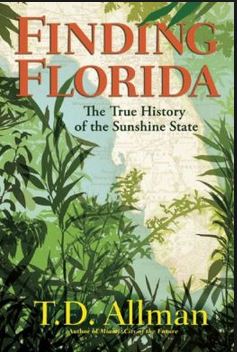
Review: Finding Florida by T.D. Allman
Spoiler Alert: I'm a Floridian.
I picked up an advance copy of Finding Florida planning to hate read it. Instead I fell completely in love. I fell so in love that I've been struggling with how to properly convey that love to you without imitating Gollum and the Ring. If I ruled the world, people would be unable to have an opinion on Florida without having read Finding Florida. We'd pass it out with our free samples of orange juice, take copies door to door with the Yellow Pages. Pundits speaking in election years would have to first read a sample passage from the book before continuing to weigh in on whatever issue of the day Florida was allegedly causing. And then, as a nation, we'd take a good long look at what we've done.
Here's the thing. Everyone writes about Florida. Everyone knows what Florida is, be it a punchline or a destination. If you have enough cash, Florida is Mar-a-Lago. If you don't, Florida is Trayvon Martin. If you want to prove a point (any point, really) you can use Florida as the example and people will assume you're right. No one ever tells the truth in or about Florida. This is a place where reality twists to the will of the speaker and that frustrates the hell out of the natives. Especially if the speaker is from the New York corridor. T.D. Allman tells the truth. He actually found Florida and wrapped it in a book for you. This is a clear eyed, race neutral history of the Sunshine State. Therefore, Finding Florida may strike some as an incendiary book with an agenda. I would argue that it is impossible to really understand Florida and not be angry. Take our snakes. The milk snake is harmless. It's identical cousin the coral snake will kill you. Schoolchildren are taught rhymes to tell the difference. (My school used "Red on black, friend of Jack. Red on yellow kills a fellow." They also dumped a bag of snakes on the table to make sure we remembered it.) Florida is a coral snake repeatedly packaged as a milk snake. Don't blame T.D. Allman for getting the facts in proper order.
Florida was never purchased. It was not ceded by Spain. Florida was conquered by repeat covert military actions on tenuous premises. Florida was home to interracial towns which were repeatedly cleared for white settlement. Massacres were common and frequent. Free blacks were enslaved on the pretext that their ancestors had been slaves. Florida is America's spoil of a long and bloody war based on race and profit. The fight for Florida was a fight to expand slavery. A mixed community could not be tolerated as a border to the slaveholding south.
"Only in Flori-duh!" is something a Floridian hears often. Failed by our schools, failed by our government, we are a people with a mutual hope that consistently eludes us. We want to be the state we know in our bones we can be. The problem is that too many of us want too many versions of that state. A thousand versions imagined in our own image consistently at war with each other, consistently in denial of our shared history. To the other 49 states we are inexplicable, bewildering and backwards. To ourselves, we are a scapegoat for national failures. Finding Florida proves we're both right.
I picked up an advance copy of Finding Florida planning to hate read it. Instead I fell completely in love. I fell so in love that I've been struggling with how to properly convey that love to you without imitating Gollum and the Ring. If I ruled the world, people would be unable to have an opinion on Florida without having read Finding Florida. We'd pass it out with our free samples of orange juice, take copies door to door with the Yellow Pages. Pundits speaking in election years would have to first read a sample passage from the book before continuing to weigh in on whatever issue of the day Florida was allegedly causing. And then, as a nation, we'd take a good long look at what we've done.
Here's the thing. Everyone writes about Florida. Everyone knows what Florida is, be it a punchline or a destination. If you have enough cash, Florida is Mar-a-Lago. If you don't, Florida is Trayvon Martin. If you want to prove a point (any point, really) you can use Florida as the example and people will assume you're right. No one ever tells the truth in or about Florida. This is a place where reality twists to the will of the speaker and that frustrates the hell out of the natives. Especially if the speaker is from the New York corridor. T.D. Allman tells the truth. He actually found Florida and wrapped it in a book for you. This is a clear eyed, race neutral history of the Sunshine State. Therefore, Finding Florida may strike some as an incendiary book with an agenda. I would argue that it is impossible to really understand Florida and not be angry. Take our snakes. The milk snake is harmless. It's identical cousin the coral snake will kill you. Schoolchildren are taught rhymes to tell the difference. (My school used "Red on black, friend of Jack. Red on yellow kills a fellow." They also dumped a bag of snakes on the table to make sure we remembered it.) Florida is a coral snake repeatedly packaged as a milk snake. Don't blame T.D. Allman for getting the facts in proper order.
Florida was never purchased. It was not ceded by Spain. Florida was conquered by repeat covert military actions on tenuous premises. Florida was home to interracial towns which were repeatedly cleared for white settlement. Massacres were common and frequent. Free blacks were enslaved on the pretext that their ancestors had been slaves. Florida is America's spoil of a long and bloody war based on race and profit. The fight for Florida was a fight to expand slavery. A mixed community could not be tolerated as a border to the slaveholding south.
"Starting when he was still Billy Powell, Osceola drew his wives and friends from all racial groups. People of Indian, black—and white—descent fought under his command in every battle. They kept fighting even when betraying the blacks among them would have saved them much suffering and, in many cases, saved their lives. Osceola’s brutal mistreatment, as Congressman Giddings put it, demonstrated “the intimate relation which this war bore to slavery.” General Jesup was even more blunt about it. It was, he pointed out, a war to protect and expand slavery, “a Negro and not an Indian war.” Finding Florida, Page 186
T.D. Allman captures the essential problem of Florida. Billy Powell becomes Osceola. Our history, as it actually happens, is continually rewritten into a narrative that serves forces outside our borders. Without knowing who we really were we cannot understand who we are. Finding Florida is about the framework of political corruption that began our state and still rules it today. It is about the unending ability of people who have failed elsewhere to reinvent themselves, rise to the highest levels, and fail again.
"When people are unwilling or unable to come to terms with reality, a politics based on unreality becomes necessary to sustain what the Florida scholar Eugene Lyon describes as the “utopia of
mutual hopes.” - Finding Florida, Page 454"Only in Flori-duh!" is something a Floridian hears often. Failed by our schools, failed by our government, we are a people with a mutual hope that consistently eludes us. We want to be the state we know in our bones we can be. The problem is that too many of us want too many versions of that state. A thousand versions imagined in our own image consistently at war with each other, consistently in denial of our shared history. To the other 49 states we are inexplicable, bewildering and backwards. To ourselves, we are a scapegoat for national failures. Finding Florida proves we're both right.
30 January, 2013
Spoileriffic Review: One Good Earl Deserves A Lover by Sarah MacLean
*Since we're diving deeper into the book I thought the step back would be a more fitting graphic than the cover.
A few days ago I suggested you preorder Once Good Earl Deserves A Lover, read it at midnight and meet me back here to discuss where I thought it fell apart. I can only show you the path, I can't make you walk it. If you're reading this without having finished One Good Earl that's on you, kitten.
With everything I loved about OGEDaL this is not a cliche free book. MacLean deals with the logistics of a girl who wears glasses so well that I forgave that girl being an intellectual. (The details of Pippa trying to tie a mask to her face won me over.) While I'd love to read about vision impaired heroines without their defective eyes conferring intellectual power, I get that this stereotype is hardly negative. But still. Smartacles. The magic of myopia.
With all the Pippa Middleton / Prince Harry shipping in the zeitgeist it took me a moment to get past our leads being Pippa and a tall charming redhead. It certainly didn't hurt that Cross was also an intellectual. (Say what you will about Harry but he's never been known for scholarly prowess.) I appreciated how Pippa dominated the book. Cross was well represented but it's Pippa that drives the story and dictates the action. She never becomes a passive passenger in her own story. The human relationships were (with some exceptions) well defined and realistic. I believed the divide between Cross and his family, as well as the interactions between Cross and his partners. I appreciated MacLean leaving Cross and his sister estranged. It was truthful and appropriate. What was neither was the distance of Bourne. I found his exclusion completely implausible. It's one thing for Cross to conspire with Pippa, it is another thing for his partners to do so. Events escalate to the point that the partners spend 19 million in company funds (300,000 plus pounds converted to modern pounds) without consulting or informing him. (The 19 million spent made little sense. This was a feel good resolution that didn't hold logically. It also put the owners - and thus Bourne - into business with men they didn't wish to entertain.) Aside from the financial aspect, Bourne is invisible in his own family life. He is a prop used to support the HEA from a prior book instead of a realistic character. This is Bourne, he likes to bang Penny now - as though there is no other purpose to his existence. Send your prior characters on a tour of Europe if you're going to write them out of their own lives.
Cross and Pippa have a nemesis in rival club owner Knight. Of course Knight has a daughter. Since Pippa has two men on her string you know we're going to end with one of them marrying the girl. It's unlikely, unrealistic and unbelievable. It weakens the overall story when characters not destined to be sequel bait pair off like animals on an ark. There is no need for Knight (or his daughter) to bag an aristocrat. Late in the book events also weaken the portrayal of our extra earl. It's understandable that Pippa would build a plan requiring the full cooperation of a recently rejected lover. It's less understandable that he would comply. Marrying him off to Knight's daughter undermines the only simple explanation for his eager compliance. We needed more characterization of his friendship with Pippa to understand what appears to be an inexplicable willingness to comply with her desires. "Hi, I'm not going to marry you. It's really sweet of you to offer to marry me even if I'm pregnant or just desperate, and I totally adore how you're keeping the offer on the table, but would you come help me win the man I want instead?" What makes him agree? Nothing but the needs of the plot.
One aspect of the book I I really enjoyed was Pippa's frank acceptance of human sexuality and lack of disdain for sex workers. Pippa struggles to understand who would choose such a life (and if they would). I felt MacLean was having it both ways when Pippa tells a prostitute that there is no shame in the word, then tells the hero she cannot condone the life. On the one hand, a heroine refreshingly free of slut shaming. On the other, nod to conservative reader expectation. When the prostitute flips on Pippa she has a wonderful defense of her actions that again, is adjusted to reader expectation by her regret at having wronged our Pipster. I'm conflicted in my feelings about this aspect of the book.
I'm not at all conflicted about the final pages. Cross has his last minute revelation. He runs down the street to make the church on time where he finds Pippa in the foyer instead of walking down the aisle. A public proposal follows, and a babylouge ties it off in a bow. This part of the story couldn't be more cliched if it starred Hugh Grant. Pippa has called off her wedding. Why is she at the church? If not Pippa then at least her family is aware she has jilted an earl and will be subject to extreme public scrutiny. Pippa is sporting a bruised face and a blackened eye. Someone around her (oh, I don't know, Bourne?) might have feelings about her appearance. Someone might suggest (her mother?) that society is going to assume the earl beat her and thus she canceled the wedding or that her father beat her for canceling the wedding. Either way, bare faced Pippa hanging out at the church is going to create unwarranted and unsavory rumors for someone. I didn't believe that she'd appear or that she'd hang out in the lobby. Far more likely that Pippa would be at home or at the wedding breakfast (where her appearance could possibly be explained). Pippa is in the church only to facilitate the cinematic staging of her proposal. In a book so deeply concerned with logic and intellect it doesn't hold together. Plus, babylouge. So, so sick of babylouges.
I still loved One Good Earl Deserves A Lover. Books, like people, don't need perfection to be worthy of affection. We can embrace them and see their flaws simultaneously. MacLean owns me for her next release and probably two or three after that. If there's an author / reader version of reality show immunity, she's got it.
A few days ago I suggested you preorder Once Good Earl Deserves A Lover, read it at midnight and meet me back here to discuss where I thought it fell apart. I can only show you the path, I can't make you walk it. If you're reading this without having finished One Good Earl that's on you, kitten.
With everything I loved about OGEDaL this is not a cliche free book. MacLean deals with the logistics of a girl who wears glasses so well that I forgave that girl being an intellectual. (The details of Pippa trying to tie a mask to her face won me over.) While I'd love to read about vision impaired heroines without their defective eyes conferring intellectual power, I get that this stereotype is hardly negative. But still. Smartacles. The magic of myopia.
With all the Pippa Middleton / Prince Harry shipping in the zeitgeist it took me a moment to get past our leads being Pippa and a tall charming redhead. It certainly didn't hurt that Cross was also an intellectual. (Say what you will about Harry but he's never been known for scholarly prowess.) I appreciated how Pippa dominated the book. Cross was well represented but it's Pippa that drives the story and dictates the action. She never becomes a passive passenger in her own story. The human relationships were (with some exceptions) well defined and realistic. I believed the divide between Cross and his family, as well as the interactions between Cross and his partners. I appreciated MacLean leaving Cross and his sister estranged. It was truthful and appropriate. What was neither was the distance of Bourne. I found his exclusion completely implausible. It's one thing for Cross to conspire with Pippa, it is another thing for his partners to do so. Events escalate to the point that the partners spend 19 million in company funds (300,000 plus pounds converted to modern pounds) without consulting or informing him. (The 19 million spent made little sense. This was a feel good resolution that didn't hold logically. It also put the owners - and thus Bourne - into business with men they didn't wish to entertain.) Aside from the financial aspect, Bourne is invisible in his own family life. He is a prop used to support the HEA from a prior book instead of a realistic character. This is Bourne, he likes to bang Penny now - as though there is no other purpose to his existence. Send your prior characters on a tour of Europe if you're going to write them out of their own lives.
Cross and Pippa have a nemesis in rival club owner Knight. Of course Knight has a daughter. Since Pippa has two men on her string you know we're going to end with one of them marrying the girl. It's unlikely, unrealistic and unbelievable. It weakens the overall story when characters not destined to be sequel bait pair off like animals on an ark. There is no need for Knight (or his daughter) to bag an aristocrat. Late in the book events also weaken the portrayal of our extra earl. It's understandable that Pippa would build a plan requiring the full cooperation of a recently rejected lover. It's less understandable that he would comply. Marrying him off to Knight's daughter undermines the only simple explanation for his eager compliance. We needed more characterization of his friendship with Pippa to understand what appears to be an inexplicable willingness to comply with her desires. "Hi, I'm not going to marry you. It's really sweet of you to offer to marry me even if I'm pregnant or just desperate, and I totally adore how you're keeping the offer on the table, but would you come help me win the man I want instead?" What makes him agree? Nothing but the needs of the plot.
One aspect of the book I I really enjoyed was Pippa's frank acceptance of human sexuality and lack of disdain for sex workers. Pippa struggles to understand who would choose such a life (and if they would). I felt MacLean was having it both ways when Pippa tells a prostitute that there is no shame in the word, then tells the hero she cannot condone the life. On the one hand, a heroine refreshingly free of slut shaming. On the other, nod to conservative reader expectation. When the prostitute flips on Pippa she has a wonderful defense of her actions that again, is adjusted to reader expectation by her regret at having wronged our Pipster. I'm conflicted in my feelings about this aspect of the book.
I'm not at all conflicted about the final pages. Cross has his last minute revelation. He runs down the street to make the church on time where he finds Pippa in the foyer instead of walking down the aisle. A public proposal follows, and a babylouge ties it off in a bow. This part of the story couldn't be more cliched if it starred Hugh Grant. Pippa has called off her wedding. Why is she at the church? If not Pippa then at least her family is aware she has jilted an earl and will be subject to extreme public scrutiny. Pippa is sporting a bruised face and a blackened eye. Someone around her (oh, I don't know, Bourne?) might have feelings about her appearance. Someone might suggest (her mother?) that society is going to assume the earl beat her and thus she canceled the wedding or that her father beat her for canceling the wedding. Either way, bare faced Pippa hanging out at the church is going to create unwarranted and unsavory rumors for someone. I didn't believe that she'd appear or that she'd hang out in the lobby. Far more likely that Pippa would be at home or at the wedding breakfast (where her appearance could possibly be explained). Pippa is in the church only to facilitate the cinematic staging of her proposal. In a book so deeply concerned with logic and intellect it doesn't hold together. Plus, babylouge. So, so sick of babylouges.
I still loved One Good Earl Deserves A Lover. Books, like people, don't need perfection to be worthy of affection. We can embrace them and see their flaws simultaneously. MacLean owns me for her next release and probably two or three after that. If there's an author / reader version of reality show immunity, she's got it.
18 January, 2013
Review: One Good Earl Deserves A Lover by Sarah MacLean
Emotionally, One Good Earl Deserves a Lover is absolutely fantastic. Epic. Sheer greatness. Best Book Of The Year material. Critically, One Good Earl Deserves a Lover has substantial flaws. Much like Jennifer Ashley's book The Madness of Lord Ian MacKenzie reader investment overcomes the structural problems. I was so engaged in the story of Pippa and Cross that I forgave the book everything. In Pippa we have an educated woman free of the cultural bias authors generally ascribe to educated heroines. Pippa does not rebel against conventional femininity nor does she require anyone's defense. She is accepted by those around her. Pippa is not disdainful of people who think differently than she. This is an intellectually curious woman with difficulty understanding and processing emotional cues.
Pippa uses information as a shield against embarrassment, a way to mimic the conventional behavior that seems so alien to her. By studying the strange world most people inhabit, Pippa can move confidently within it. This brings her to Cross, a business partner of her brother in law. Pippa is marrying a perfectly nice man, a man she wants because he wants her. Pippa is aware her interests do not mirror those of conventional society. She is grateful to have found a man who honors her unique qualities. In the interest of conducting herself properly as a wife, Pippa seeks to understand human sexuality. This is a common beginning for historical romance - the naive heroine in need of a sexually experienced tutor. MacLean tweaks the plot by pairing her ingenue with a celibate. Cross is also a prodigy. Where Pippa is emotionally unconnected, Cross is attuned to the way emotions dictate human behavior. He understands and categorizes it the way another might their personal library. What is a mystery to Pippa (human sexuality and attraction) is an open book to Cross. He shares her interest in science as well as her inability to stop thinking critically about the world surrounding him. Where Pippa labels herself as odd, Cross labels himself as continually inadequate. The difference between them is larger than age or experience. It is built by their extended family. One is embraced, the other was rejected. Pippa has never before had a need to decode human interaction. Cross has always been forced to look outside his home for warm appreciation.
Because the emotional strengths of One Good Earl Deserves A Lover outweigh the structural weaknesses I'm going to run a second review after the book's release. It will discuss the dissatisfactions I had with the framing of Cross and Pippa's courtship. I'm splitting the review because I strongly recommend One Good Earl Deserves a Lover and believe it should be read without spoilers. Pre-order this one, read it at midnight and come back on the 30th to see what I have to complain about. All you need to know before you crack the cover is that MacLean has written a celibate hero, a strong female lead and an emotionally satisfying resolution. Enjoy it, for tomorrow (or in two weeks) we quibble.
Pippa uses information as a shield against embarrassment, a way to mimic the conventional behavior that seems so alien to her. By studying the strange world most people inhabit, Pippa can move confidently within it. This brings her to Cross, a business partner of her brother in law. Pippa is marrying a perfectly nice man, a man she wants because he wants her. Pippa is aware her interests do not mirror those of conventional society. She is grateful to have found a man who honors her unique qualities. In the interest of conducting herself properly as a wife, Pippa seeks to understand human sexuality. This is a common beginning for historical romance - the naive heroine in need of a sexually experienced tutor. MacLean tweaks the plot by pairing her ingenue with a celibate. Cross is also a prodigy. Where Pippa is emotionally unconnected, Cross is attuned to the way emotions dictate human behavior. He understands and categorizes it the way another might their personal library. What is a mystery to Pippa (human sexuality and attraction) is an open book to Cross. He shares her interest in science as well as her inability to stop thinking critically about the world surrounding him. Where Pippa labels herself as odd, Cross labels himself as continually inadequate. The difference between them is larger than age or experience. It is built by their extended family. One is embraced, the other was rejected. Pippa has never before had a need to decode human interaction. Cross has always been forced to look outside his home for warm appreciation.
Because the emotional strengths of One Good Earl Deserves A Lover outweigh the structural weaknesses I'm going to run a second review after the book's release. It will discuss the dissatisfactions I had with the framing of Cross and Pippa's courtship. I'm splitting the review because I strongly recommend One Good Earl Deserves a Lover and believe it should be read without spoilers. Pre-order this one, read it at midnight and come back on the 30th to see what I have to complain about. All you need to know before you crack the cover is that MacLean has written a celibate hero, a strong female lead and an emotionally satisfying resolution. Enjoy it, for tomorrow (or in two weeks) we quibble.
25 December, 2012
Review: A Kiss For Midwinter by Courtney Milan
Merry Freaking Christmas, indeed.
In what shocks no one ever (assuming they read my reviews) A Kiss for Midwinter gets high marks from me. I love what Milan does with the emotional life of her characters. In this case she's taken a character that bored me silly in The Duchess War and reinvented her as a fascinating person. Lydia is one of those determinedly happy people. All the glasses are half full all the time and if they're not she'll figure out a way to use shorter tumblers. She's fond of everyone, looking as she does on their brighter side. Everyone but Jonas. When Lydia looks at him she can't maintain her facade of blithe cheer. Jonas knows a bit more about Lydia than she's comfortable with.
Jonas I loved from the beginning. He's the gruff medical character that ends up (eventually, not in this novella, but traditionally) grumbling about his bum leg as he's pulled from his bed in the wee hours to attend yet another odd medical crisis at the local estate. This is that guy, 40 or so years earlier. From the moment he tells Lydia she's the eleventh best looking girl in town I knew who he was. (I know a Jonas or two and that's how their brains work.) He wants a wife and he wants that wife to be Lydia. He needs her determined cheer and her ability to draw a gauze curtain over life's harsher realities. Jonas is a man who faces reality too clearly, too often. A touch of whimsy would serve him well.
For most authors, telling you all of this would spoil the novella. For Milan, that's just the opening pages. Learning why Lydia avoids Jonas, watching Jonas teach Lydia that his opinion of her is not the one she made up in her head, all these things, are still ahead of you. Milan packs enough detail into her leads for a full length novel. Adding in a subtle (and very holiday appropriate) theme about the transient nature of established traditions, Milan brings Christmas in as more than just a seasonal setting. Times are changing in Victorian England. They're changing what people do and how people think. For Lydia the challenge is to stop acting happy long enough to really be happy. For Jonas, it's to accept (as every doctor must) that some things are beyond his ability to repair.
In what shocks no one ever (assuming they read my reviews) A Kiss for Midwinter gets high marks from me. I love what Milan does with the emotional life of her characters. In this case she's taken a character that bored me silly in The Duchess War and reinvented her as a fascinating person. Lydia is one of those determinedly happy people. All the glasses are half full all the time and if they're not she'll figure out a way to use shorter tumblers. She's fond of everyone, looking as she does on their brighter side. Everyone but Jonas. When Lydia looks at him she can't maintain her facade of blithe cheer. Jonas knows a bit more about Lydia than she's comfortable with.
Jonas I loved from the beginning. He's the gruff medical character that ends up (eventually, not in this novella, but traditionally) grumbling about his bum leg as he's pulled from his bed in the wee hours to attend yet another odd medical crisis at the local estate. This is that guy, 40 or so years earlier. From the moment he tells Lydia she's the eleventh best looking girl in town I knew who he was. (I know a Jonas or two and that's how their brains work.) He wants a wife and he wants that wife to be Lydia. He needs her determined cheer and her ability to draw a gauze curtain over life's harsher realities. Jonas is a man who faces reality too clearly, too often. A touch of whimsy would serve him well.
For most authors, telling you all of this would spoil the novella. For Milan, that's just the opening pages. Learning why Lydia avoids Jonas, watching Jonas teach Lydia that his opinion of her is not the one she made up in her head, all these things, are still ahead of you. Milan packs enough detail into her leads for a full length novel. Adding in a subtle (and very holiday appropriate) theme about the transient nature of established traditions, Milan brings Christmas in as more than just a seasonal setting. Times are changing in Victorian England. They're changing what people do and how people think. For Lydia the challenge is to stop acting happy long enough to really be happy. For Jonas, it's to accept (as every doctor must) that some things are beyond his ability to repair.
31 August, 2012
Review: Midnight Scandals by Carolyn Jewel, Courtney Milan and Sherry Thomas
I don't love this cover. The model's expression is a little angry, a little vacant. I don't know why she's leaning against a wall. Her head being slightly lopped while her skirt is artificially extended reads awkwardly. I like the teal and orange combination. I like the bolding of author names over title. Visually it works in Milan's brand, but I don't love it.
That concludes at least three quarters of my objections to Midnight Scandals, which I hereby rename Doyle's Grange for the BBC miniseries that absolutely must happen. (Someone Kickstater that for me.) Midnight Scandals absolutely begs to be a BBC costume drama. Each of the three stories takes place around a small home (cue Doyle's Grange) on a larger estate. As one era passes into the next the elderly couple from the former generation brush paths with the young couple of the next. How is that not prime time catnip? As a well executed concept the home bridges the gaps between the tales, making them stronger collectively than they are alone. As the authors involved in Midnight Scandals are some of the genre's strongest, this takes us pretty close to perfection.
First up is Carolyn Jewel. Her story of lovers with two unforgivable secrets made me realize I don't read Carolyn Jewel often enough. (Why don't I read more Carolyn Jewel? I'm going to buy her backlist.) Reunited as teens after a disastrous affair with long reaching consequences for them both, her couple have to learn to forgive themselves as easily as they've forgiven each other. I adored the risk Jewel took with her secrets almost as much as the heroine's sister in law. I know that woman. I deal with that woman. Like Portia, I would chew my own arm off to escape her. She does not mean well, she is a toxic bundle of manipulation.
Picking up the narrative is Courtney Milan. Her couple have only been apart a short period of time, but that time has transformed the heroine. Thrust out of a comfortable life, Mary has grown up quickly. As with all of Milan's tales the challenge is to discuss the dynamics without revealing the plot. I found the situation Mary escapes (or rather, situations) very well drawn. Each had that essential feeling of truth while allowing for the fictional solutions to play out. All of my issues with Mary and John occur in the wrapping up of loose ends but her benevolent villain was perfectly done.
Closing the door is Sherry Thomas. I've really missed her since I switched away from price fixing in e-books and I'm sorry she's caught up in the publisher fight. I look forward to catching up on her backlist when it's properly priced. (I could pirate them, yes. Please don't message me about it. I don't lean that way.) Because I'm not familiar with her most recent books, the characters from them felt like an annoyance instead of an enhancement. This is obviously a story meant to resolve a character from a full length book but without knowing more about them I was waiting for an explanation that never came. Thomas has a great set up in her tale of mistaken identity and second chances. Buying in required accepting that two people could look completely alike (easy) while being unrelated (no problem, happened to me) and sharing very similar names (um, not so much but ok). Her hero and heroine have nothing to forgive each other and little to forgive themselves. While I admired aspects of the other works more the romantic element felt the strongest here. Her couple fell in love in front of the reader, while the others repaired an existing love.
If the authors want to work off brand, I would love to see a sequel to Midnight Scandals taking Doyle's Grange through the World Wars and into the London Scene. Maybe in reverse order. I think I'd give WW1 to Thomas, WW2 to Milan and the 60's to Jewel. You know, because I'm bossy like that.
That concludes at least three quarters of my objections to Midnight Scandals, which I hereby rename Doyle's Grange for the BBC miniseries that absolutely must happen. (Someone Kickstater that for me.) Midnight Scandals absolutely begs to be a BBC costume drama. Each of the three stories takes place around a small home (cue Doyle's Grange) on a larger estate. As one era passes into the next the elderly couple from the former generation brush paths with the young couple of the next. How is that not prime time catnip? As a well executed concept the home bridges the gaps between the tales, making them stronger collectively than they are alone. As the authors involved in Midnight Scandals are some of the genre's strongest, this takes us pretty close to perfection.
First up is Carolyn Jewel. Her story of lovers with two unforgivable secrets made me realize I don't read Carolyn Jewel often enough. (Why don't I read more Carolyn Jewel? I'm going to buy her backlist.) Reunited as teens after a disastrous affair with long reaching consequences for them both, her couple have to learn to forgive themselves as easily as they've forgiven each other. I adored the risk Jewel took with her secrets almost as much as the heroine's sister in law. I know that woman. I deal with that woman. Like Portia, I would chew my own arm off to escape her. She does not mean well, she is a toxic bundle of manipulation.
Picking up the narrative is Courtney Milan. Her couple have only been apart a short period of time, but that time has transformed the heroine. Thrust out of a comfortable life, Mary has grown up quickly. As with all of Milan's tales the challenge is to discuss the dynamics without revealing the plot. I found the situation Mary escapes (or rather, situations) very well drawn. Each had that essential feeling of truth while allowing for the fictional solutions to play out. All of my issues with Mary and John occur in the wrapping up of loose ends but her benevolent villain was perfectly done.
Closing the door is Sherry Thomas. I've really missed her since I switched away from price fixing in e-books and I'm sorry she's caught up in the publisher fight. I look forward to catching up on her backlist when it's properly priced. (I could pirate them, yes. Please don't message me about it. I don't lean that way.) Because I'm not familiar with her most recent books, the characters from them felt like an annoyance instead of an enhancement. This is obviously a story meant to resolve a character from a full length book but without knowing more about them I was waiting for an explanation that never came. Thomas has a great set up in her tale of mistaken identity and second chances. Buying in required accepting that two people could look completely alike (easy) while being unrelated (no problem, happened to me) and sharing very similar names (um, not so much but ok). Her hero and heroine have nothing to forgive each other and little to forgive themselves. While I admired aspects of the other works more the romantic element felt the strongest here. Her couple fell in love in front of the reader, while the others repaired an existing love.
If the authors want to work off brand, I would love to see a sequel to Midnight Scandals taking Doyle's Grange through the World Wars and into the London Scene. Maybe in reverse order. I think I'd give WW1 to Thomas, WW2 to Milan and the 60's to Jewel. You know, because I'm bossy like that.
28 August, 2012
Review: The Kid by Charles Chaplin
Unlike most silent films, The Kid is intact. Chaplin restored and personally scored it. It absolutely benefits from this care.
The Kid was a phenomenon, with far reaching implications not only for the industry but for the lives of those involved. Silent films have a lot in common with category romance. In silent films the characters were often unnamed. The audience knew there would be The Boy and The Girl, a name for either was beside the point. The Boy is almost always of a different economic status than The Girl. True Love was at first sight, with the plot hinging on misunderstanding, class conflict, and external forces. The audience expected The Boy and The Girl to overcome all of this on their path to happiness. This deceptively simple framework offered limitless variations. Chaplin's first full length film was The Kid. He had appeared in six reels for other directors but here he had full creative control as actor, producer and director. Everything hinged on this one. I think it's his finest film. While emotional, it's not as manipulative as City Lights. It has statements about class, but they are subtle.
The Kid subverts many conventions of the orphan story. In The Kid Edna Purviance was given a very feminist role. She does not suffer spiritually from her out of wedlock child. She is presented as a respected, talented, admirable woman. The Girl is not brought down by her out of wedlock child. Instead she thrives in life, becoming wealthy and famous. Given a chance to reunite with her child she eagerly takes it. Through the entire film The Kid is presented as a person, not an object. His wishes and capabilities are given as much weight as The Tramp and The Girl. Set aside is The Boy. By his failure to support The Girl he becomes a footnote to her life and his son's. If this were a Harlequin romance, The Girl would be The Boy and The Tramp would be a friend or sister of The Girl who steps up to mother the orphan in her place. It is odd to consider a 1921 film more modern than many 2012 books. I often wonder how the angel sequence played to contemporary audiences. Occurring in the final seven minutes of the film it seems out of place to modern eyes. Did contemporary audiences expect The Tramp to quietly die in the doorway? It's also difficult to put aside the knowledge that the flirtatious angel is 12. (Several scholars have effectively argued Lita Grey's real life relationship with Chaplin inspired Nabakov to write Lolita.) The absolute star of the film is Jackie Coogan. His story is heartbreaking. In fiction, The Kid was abandoned only to find himself continually beloved. In life, Jackie Coogan was at the mercy of those who exploited him. Even during the film he made (as the co star) half the salary of his bit player father and realized none of it.
Silent films are invaluable resources for anyone interested in the history of their time. Aside from showing off different norms of attire they portray what would be acceptable realities to a contemporary viewer. Slanted for humor or effect, they still contain truth. The pay to sleep homeless shelter, The Girl passing out toys and apples to children in the slums. America fell in love with The Kid because Jackie Coogan was heartbreaking and his reality plausible to them. They wanted The Tramp to have his happy ending and they wanted The Girl to get her son back. When I watch The Kid, I do too.
The Kid was a phenomenon, with far reaching implications not only for the industry but for the lives of those involved. Silent films have a lot in common with category romance. In silent films the characters were often unnamed. The audience knew there would be The Boy and The Girl, a name for either was beside the point. The Boy is almost always of a different economic status than The Girl. True Love was at first sight, with the plot hinging on misunderstanding, class conflict, and external forces. The audience expected The Boy and The Girl to overcome all of this on their path to happiness. This deceptively simple framework offered limitless variations. Chaplin's first full length film was The Kid. He had appeared in six reels for other directors but here he had full creative control as actor, producer and director. Everything hinged on this one. I think it's his finest film. While emotional, it's not as manipulative as City Lights. It has statements about class, but they are subtle.
The Kid subverts many conventions of the orphan story. In The Kid Edna Purviance was given a very feminist role. She does not suffer spiritually from her out of wedlock child. She is presented as a respected, talented, admirable woman. The Girl is not brought down by her out of wedlock child. Instead she thrives in life, becoming wealthy and famous. Given a chance to reunite with her child she eagerly takes it. Through the entire film The Kid is presented as a person, not an object. His wishes and capabilities are given as much weight as The Tramp and The Girl. Set aside is The Boy. By his failure to support The Girl he becomes a footnote to her life and his son's. If this were a Harlequin romance, The Girl would be The Boy and The Tramp would be a friend or sister of The Girl who steps up to mother the orphan in her place. It is odd to consider a 1921 film more modern than many 2012 books. I often wonder how the angel sequence played to contemporary audiences. Occurring in the final seven minutes of the film it seems out of place to modern eyes. Did contemporary audiences expect The Tramp to quietly die in the doorway? It's also difficult to put aside the knowledge that the flirtatious angel is 12. (Several scholars have effectively argued Lita Grey's real life relationship with Chaplin inspired Nabakov to write Lolita.) The absolute star of the film is Jackie Coogan. His story is heartbreaking. In fiction, The Kid was abandoned only to find himself continually beloved. In life, Jackie Coogan was at the mercy of those who exploited him. Even during the film he made (as the co star) half the salary of his bit player father and realized none of it.
Silent films are invaluable resources for anyone interested in the history of their time. Aside from showing off different norms of attire they portray what would be acceptable realities to a contemporary viewer. Slanted for humor or effect, they still contain truth. The pay to sleep homeless shelter, The Girl passing out toys and apples to children in the slums. America fell in love with The Kid because Jackie Coogan was heartbreaking and his reality plausible to them. They wanted The Tramp to have his happy ending and they wanted The Girl to get her son back. When I watch The Kid, I do too.
15 August, 2012
Review: The Way To A Duke's Heart by Caroline Linden
Yea, go ahead and buy it.
I love almost everything about this book. I like everything on the cover from the color balance to the "Bitch, please" stare of the heroine. Linden finishes her The Truth About The Duke series with the best of the three. (I admit I had my concerns about this one.) Having reviewed both the prior books I decided to finish the series out. I'm so glad I stuck with Linden. In fact, I liked The Way To A Duke's Heart so much I think you should go ahead and start there. Nothing really happens in the prior books that is vital to the third. Look, I'll get you ready. There's this Duke In Waiting named Charlie. He's got two brothers and an inheritance issue. His brothers have tried to help but both of them wised up and dumped the ball back where it belongs. Charlie has had enough time to feel sorry for himself and work on his Daddy Issues. It's crunch time. (That's it. You're good to go.)
Our heroine is an awkward businesswoman on a mission. With her brother considering investment in the latest canal scheme Tessa is off to investigate the legitimacy of this enterprise. Trusted by her family, unable to trust those outside it, Tessa doesn't want to suck up to a charmer in the hotel lobby. Since Tessa might hold the key to Charlie's dilemma, he charms her elderly companion instead. Tessa says ok, whatever, that's cool. I've got books to audit and swamps to slog. You do you, Charlie. I'm busy doing me. Which she does. Sadly for Tessa, Charlie is trying to do her too. (But not that way.) He pretends an interest in the canal investment as a pretext for investigating Tessa's involvement in his dilemma. Continuing Linden's tradition of bucking some time honored Regency conventions it turns out that Tessa is a completely disinterested bystander. She has nothing at all to do with the mysterious blackmailer that's been mucking up Charlie's life. Nor is she willing to be a diversion while Charlie evades his responsibilities.
The evolution of Charlie from sulky party boy to Duke Of Tessa's Dreams is very well done. Both characters know who they are and (more importantly) why they are. Tessa and Charlie offer each other the same thing - someone to take them seriously and hold them accountable. Charlie respects Tessa's intelligence. As a man well aware of his own shortcomings he can easily see the strength in hers. For her part, Tessa has no experience of him. She sees a man well positioned to make changes in people's lives so she expects him to do so. While she guides him toward responsibility he leads her into frivolity. They are well suited to each other and to the plot. It's a nice balance Linden maintains for almost the whole of the book. My only complaint about The Way To A Duke's Heart arrives shortly after The Truth About The Duke is revealed. The truth itself is satisfying in content and execution. The events just following that are a failure for me. In exploring his past Charlie falls into one of my genre pet peeves. "If I had sex with you and you're not the hero / heroine, you completely suck." Yes, Charlie has a Crazy Bitch Ex in his past (as does Tessa) and the CBE briefly becomes the books focus. Handled just a little differently the CBE would have lifted the book from very good to possibly brilliant. As it stands the CBE bogs us down before being swept to the side as Tessa and Charlie get on with the getting on.
If you've been following the series or not, The Way To A Duke's Heart is a fun read. I like Linden's way with characterization. With this book the author moves off my TBR and onto my auto-buy list. (If nothing else, her strong voice knocked Charlie Sheen out of my mind for the entire read. I didn't think that was going to be possible.)
I love almost everything about this book. I like everything on the cover from the color balance to the "Bitch, please" stare of the heroine. Linden finishes her The Truth About The Duke series with the best of the three. (I admit I had my concerns about this one.) Having reviewed both the prior books I decided to finish the series out. I'm so glad I stuck with Linden. In fact, I liked The Way To A Duke's Heart so much I think you should go ahead and start there. Nothing really happens in the prior books that is vital to the third. Look, I'll get you ready. There's this Duke In Waiting named Charlie. He's got two brothers and an inheritance issue. His brothers have tried to help but both of them wised up and dumped the ball back where it belongs. Charlie has had enough time to feel sorry for himself and work on his Daddy Issues. It's crunch time. (That's it. You're good to go.)
Our heroine is an awkward businesswoman on a mission. With her brother considering investment in the latest canal scheme Tessa is off to investigate the legitimacy of this enterprise. Trusted by her family, unable to trust those outside it, Tessa doesn't want to suck up to a charmer in the hotel lobby. Since Tessa might hold the key to Charlie's dilemma, he charms her elderly companion instead. Tessa says ok, whatever, that's cool. I've got books to audit and swamps to slog. You do you, Charlie. I'm busy doing me. Which she does. Sadly for Tessa, Charlie is trying to do her too. (But not that way.) He pretends an interest in the canal investment as a pretext for investigating Tessa's involvement in his dilemma. Continuing Linden's tradition of bucking some time honored Regency conventions it turns out that Tessa is a completely disinterested bystander. She has nothing at all to do with the mysterious blackmailer that's been mucking up Charlie's life. Nor is she willing to be a diversion while Charlie evades his responsibilities.
The evolution of Charlie from sulky party boy to Duke Of Tessa's Dreams is very well done. Both characters know who they are and (more importantly) why they are. Tessa and Charlie offer each other the same thing - someone to take them seriously and hold them accountable. Charlie respects Tessa's intelligence. As a man well aware of his own shortcomings he can easily see the strength in hers. For her part, Tessa has no experience of him. She sees a man well positioned to make changes in people's lives so she expects him to do so. While she guides him toward responsibility he leads her into frivolity. They are well suited to each other and to the plot. It's a nice balance Linden maintains for almost the whole of the book. My only complaint about The Way To A Duke's Heart arrives shortly after The Truth About The Duke is revealed. The truth itself is satisfying in content and execution. The events just following that are a failure for me. In exploring his past Charlie falls into one of my genre pet peeves. "If I had sex with you and you're not the hero / heroine, you completely suck." Yes, Charlie has a Crazy Bitch Ex in his past (as does Tessa) and the CBE briefly becomes the books focus. Handled just a little differently the CBE would have lifted the book from very good to possibly brilliant. As it stands the CBE bogs us down before being swept to the side as Tessa and Charlie get on with the getting on.
If you've been following the series or not, The Way To A Duke's Heart is a fun read. I like Linden's way with characterization. With this book the author moves off my TBR and onto my auto-buy list. (If nothing else, her strong voice knocked Charlie Sheen out of my mind for the entire read. I didn't think that was going to be possible.)
16 July, 2012
Review: Booker's Place: A Mississippi Story by Raymond De Felitta and Yvette Johnson
Booker Wright was a man.
I don't know if he was a perfect man. I doubt he was. From my own life I know that overcoming obstacles and perfection rarely walk hand in hand. Booker Wright was a man who kept his eye on the prize. Work hard. Save up. Build something better. Then NBC came to town. What do you do if you've been silent your whole life and someone asks you to speak? A man speaks. So Booker Wright did. To modern ears what he said may not seem very strong. His short speech is available on the internet and was recently featured in various stories about this film. The important part of Booker Wright's story is that he waited. He waited until his speech would be documented, until his speech could endure. Booker's words were a pebble in his own life, a pebble in the lives of those who heard him on the night his words aired. The ripples slowly faded.
Just as Booker's life collided with filmmaker Frank De Felitta's, so Booker's granddaughter collides with Frank's son Raymond. The resulting film, Booker's Place: A Mississippi Story gives voice to the hundreds of Bookers that America held in the recent past. There were Booker Wrights standing up across the south and refusing to Yassir another day. We are taught about Malcolm X and Martin Luther King not because these men were alone in their work, but because they were the most recorded, the most organized, the most eloquent. The black men of America are not made up of the nightly news. The black men of America are Booker Wright. If you ask them to speak, they will.
Booker knew there was a price to his words and he paid it. While he survived the initial attack, he was later murdered. The film, like the family, have their own suspicious about the event. I don't know if I agree. It is tempting to believe in something grand conspiring to put Booker back in his place. It's even reasonable. But sometimes the greatest story can end for senseless reasons. Someone gets drunk. Someone gets even. There may be a broader narrative at work but there doesn't have to be. Booker Wright is enough. We don't need more. The film, however, does. Using the scant source material of Booker Wright available to them the filmmakers rely on a repetition of key scenes or phrases to drive various points home. It's both effective and off-putting. While it doesn't damage the viewing experience it does make the film seem lighter in content than it is. De Felitta interviews many principals of the time and of his father's earlier NBC documentary.
For all that has changed, not much has. Faced with black pain, the white response is still a bewildered "Ain't I been good to you?" One white man stands to talk about that old canard, the black mother. Faced with a black perspective he becomes very emotional. He says he wouldn't have given up that relationship for anything, that he was equally important to the black woman, that he treated her well and she loved him. This is America in a nutshell. Faced with the reality of black life, white America won't give up it's privileges for anything. We are still, in so very many ways, the plantation owner of the 1966 film. And Booker Wright's words are as brave and important now as they were then.
Yvette Johnson, the granddaughter in the film, has collected her blog posts about Booker and Booker's Place into an ebook. I scanned her blog after writing this review and I may cover the book at a later time. As well, there is an excellent review of Booker's Place from the Chicago Sun-Times blog. I don't usually do links, but these are worth a glance.
I don't know if he was a perfect man. I doubt he was. From my own life I know that overcoming obstacles and perfection rarely walk hand in hand. Booker Wright was a man who kept his eye on the prize. Work hard. Save up. Build something better. Then NBC came to town. What do you do if you've been silent your whole life and someone asks you to speak? A man speaks. So Booker Wright did. To modern ears what he said may not seem very strong. His short speech is available on the internet and was recently featured in various stories about this film. The important part of Booker Wright's story is that he waited. He waited until his speech would be documented, until his speech could endure. Booker's words were a pebble in his own life, a pebble in the lives of those who heard him on the night his words aired. The ripples slowly faded.
Just as Booker's life collided with filmmaker Frank De Felitta's, so Booker's granddaughter collides with Frank's son Raymond. The resulting film, Booker's Place: A Mississippi Story gives voice to the hundreds of Bookers that America held in the recent past. There were Booker Wrights standing up across the south and refusing to Yassir another day. We are taught about Malcolm X and Martin Luther King not because these men were alone in their work, but because they were the most recorded, the most organized, the most eloquent. The black men of America are not made up of the nightly news. The black men of America are Booker Wright. If you ask them to speak, they will.
Booker knew there was a price to his words and he paid it. While he survived the initial attack, he was later murdered. The film, like the family, have their own suspicious about the event. I don't know if I agree. It is tempting to believe in something grand conspiring to put Booker back in his place. It's even reasonable. But sometimes the greatest story can end for senseless reasons. Someone gets drunk. Someone gets even. There may be a broader narrative at work but there doesn't have to be. Booker Wright is enough. We don't need more. The film, however, does. Using the scant source material of Booker Wright available to them the filmmakers rely on a repetition of key scenes or phrases to drive various points home. It's both effective and off-putting. While it doesn't damage the viewing experience it does make the film seem lighter in content than it is. De Felitta interviews many principals of the time and of his father's earlier NBC documentary.
For all that has changed, not much has. Faced with black pain, the white response is still a bewildered "Ain't I been good to you?" One white man stands to talk about that old canard, the black mother. Faced with a black perspective he becomes very emotional. He says he wouldn't have given up that relationship for anything, that he was equally important to the black woman, that he treated her well and she loved him. This is America in a nutshell. Faced with the reality of black life, white America won't give up it's privileges for anything. We are still, in so very many ways, the plantation owner of the 1966 film. And Booker Wright's words are as brave and important now as they were then.
Yvette Johnson, the granddaughter in the film, has collected her blog posts about Booker and Booker's Place into an ebook. I scanned her blog after writing this review and I may cover the book at a later time. As well, there is an excellent review of Booker's Place from the Chicago Sun-Times blog. I don't usually do links, but these are worth a glance.
21 June, 2012
Review: The Price of Inequality by Joseph Stiglitz
To be completely honest, I can't really call this a review. Perhaps I should have labeled it a strong recommendation. What would I say? As a protagonist the legislative bodies of America frequently act in odds with the nation's self interest. I find it unlikely that such actions would occur. Insanely rich people are completely fine with breaking the economic core of the nation, rendering them unsympathetic. Voters are locked in an abusive relationship through a lack of choices and a powerful desire to self harm.
Actually, that review would probably rock. Alas, it remains unwritten.
With The Price of Inequality Stiglitz lays out some pretty tedious economic theory in an accessible and popular way. You might think you understand why our economy is bleeding jobs while your bank account gets thinner but you really don't. Unless you do, I don't want to prejudge you. However I am not a Nobel Prize winning economist and therefore found Stiglitz made several outstandingly infuriating points. What we do about it, that's a different story. Step one, admit you have a problem.
We are so screwed.
I'd like to pretend that I've been spending my time reading books like this one. Or genre fiction, or comic books. To be truthful I've spent the slump evaluating various iPad games. VelociRapture vs Monsters Ate My Condo? I'm your girl. Things are looking up though, since I switched from the K3 back to the Land of Sony Readers my reading has gone up dramatically.
Actually, that review would probably rock. Alas, it remains unwritten.
With The Price of Inequality Stiglitz lays out some pretty tedious economic theory in an accessible and popular way. You might think you understand why our economy is bleeding jobs while your bank account gets thinner but you really don't. Unless you do, I don't want to prejudge you. However I am not a Nobel Prize winning economist and therefore found Stiglitz made several outstandingly infuriating points. What we do about it, that's a different story. Step one, admit you have a problem.
We are so screwed.
I'd like to pretend that I've been spending my time reading books like this one. Or genre fiction, or comic books. To be truthful I've spent the slump evaluating various iPad games. VelociRapture vs Monsters Ate My Condo? I'm your girl. Things are looking up though, since I switched from the K3 back to the Land of Sony Readers my reading has gone up dramatically.
24 April, 2012
Review: The Governess Affair by Courtney Milan
If I just say Buy This would that be enough? It's a buck. You can't even get coffee for a buck anymore. (Wait, maybe you can. I don't drink coffee.) Courtney Milan is to my romance shelf what MadMen is to my DVR. I finish it. Like it. Think about it. Like it more. Think about it. Bore everyone I know with semi-coherent ravings on the deep brilliance of it all. She is the Roger Slattery to... wait. I'm getting pretty far afield.
On the surface The Governess Affair is a long novella setting up Milan's next series. (The Turner Brothers are dead, long live The Brothers Sinister.) TGA is also an amazing example of folding content into a short form. Within The Governess Affair Milan delivers a satisfying and light romance while also exploring some dark themes. At play in the story of Hugo and Serena are issues of consent, the basis of power (interpersonal and societal), reactions to trauma, self perception in mental illness, family dynamics both functional and not, dignity, self determination... the list goes on. I could talk longer about The Governess Affair in a completely spoiler way than I could about the last five books I read put together.
All of that praise being heaped, The Governess Affair has a slow start. The first few pages feel choppy, like the story isn't quite sure about itself. Hugo handles the Duke's life while quietly despising him. Got it. Less than a handful of pages in, TGA finds it's footing and never lets go again. Hugo is our Duke's fixer, his enforcer, his right hand man, the master behind the puppet. Serena is the governess who has chosen to occupy their square. She is taking a stand for recognition and she's taking it on Hugo's doorstep. From here we have an unfolding of quietly revealing moments as each shows glimpses of their cards. Both have been dealt their hands by other people, both are trying to play them to the best advantage they can. Neither is willing to fold and both are willing to bluff. The bluff isn't over what they could do, rather how much of it they are willing to do. Each of them could completely ruin the other. It is impossible for the game to end in a draw.
I identified with the forces driving Hugo and Serena. I found their emotional reactions authentic and believable. Hugo is holding out for one big payoff, the stake for his future, the justification for all the struggle he has gone through to get to it. He can't see that the payoff is costing him as much as the road to it ever did. Serena has a compelling family situation (in multiple respects) and an equally strong desire for her struggle to end in security. The events leading to her occupying the square, her reaction to them, was very familiar to me. In keeping with The Turner Brothers, neither Hugo nor Serena have the sort of warm family that Julia Quinn's characters do. Which sets up an interesting question for The Brothers Sinister. It is likely that at least one of the leads from that series will come from almost exactly such a stable and caring home. How is Milan going to kneecap him?
Spend the buck. Skip the cheap coffee. Join in me in waiting feverishly for The Brothers Sinister.
On the surface The Governess Affair is a long novella setting up Milan's next series. (The Turner Brothers are dead, long live The Brothers Sinister.) TGA is also an amazing example of folding content into a short form. Within The Governess Affair Milan delivers a satisfying and light romance while also exploring some dark themes. At play in the story of Hugo and Serena are issues of consent, the basis of power (interpersonal and societal), reactions to trauma, self perception in mental illness, family dynamics both functional and not, dignity, self determination... the list goes on. I could talk longer about The Governess Affair in a completely spoiler way than I could about the last five books I read put together.
All of that praise being heaped, The Governess Affair has a slow start. The first few pages feel choppy, like the story isn't quite sure about itself. Hugo handles the Duke's life while quietly despising him. Got it. Less than a handful of pages in, TGA finds it's footing and never lets go again. Hugo is our Duke's fixer, his enforcer, his right hand man, the master behind the puppet. Serena is the governess who has chosen to occupy their square. She is taking a stand for recognition and she's taking it on Hugo's doorstep. From here we have an unfolding of quietly revealing moments as each shows glimpses of their cards. Both have been dealt their hands by other people, both are trying to play them to the best advantage they can. Neither is willing to fold and both are willing to bluff. The bluff isn't over what they could do, rather how much of it they are willing to do. Each of them could completely ruin the other. It is impossible for the game to end in a draw.
I identified with the forces driving Hugo and Serena. I found their emotional reactions authentic and believable. Hugo is holding out for one big payoff, the stake for his future, the justification for all the struggle he has gone through to get to it. He can't see that the payoff is costing him as much as the road to it ever did. Serena has a compelling family situation (in multiple respects) and an equally strong desire for her struggle to end in security. The events leading to her occupying the square, her reaction to them, was very familiar to me. In keeping with The Turner Brothers, neither Hugo nor Serena have the sort of warm family that Julia Quinn's characters do. Which sets up an interesting question for The Brothers Sinister. It is likely that at least one of the leads from that series will come from almost exactly such a stable and caring home. How is Milan going to kneecap him?
Spend the buck. Skip the cheap coffee. Join in me in waiting feverishly for The Brothers Sinister.
07 March, 2012
Review: Persepolis 2 The Story of a Return by Marjane Satrapi
Having talked about Persepolis: The Story of a Childhood I suppose I should address the sequel. Most people are going to read these two books in one volume. I almost wish they were not packaged together. While the story Marjane tells in this second section of her life is no less compelling it is less universal.
In the first, Satrapi is a young child at the mercy of the forces around her. In the second she is a young adult making the sorts of bad choices many young adults make. Because she is in some control it is easier for the reader to judge her. In judging her the tale loses some of it's universal power. Where young Satrapi is grounded in her family, teenage Satrapi is lost. Her focus moves from the external to the internal. Having become an expatriate she is without family or culture to sustain her during some very formative years. She falls into self destructive habits that ultimately force her back to Iran. As much as Satrapi has changed (her parents don't recognize her) so too has her country. Now we are in an Iran Westerners feel comfortable with. Her struggles feel less immediate, there is a distance that one doesn't feel in The Story of a Childhood. I think the author is a remarkable woman and a remarkable talent. I am certain that some of the events she depicts so honestly in The Story of a Return haunt her to this day. It is to her immense credit that she neither excuses nor defends herself from reader censure. Satrapi reports her life and then stands beside it.
In The Story of a Return Satrapi covers the drug years, the misguided love years, the years of finding herself in small rebellions that wouldn't have been open to a woman of a different class. She acknowledges her privileges and her limitations. Ultimately, like many displaced by war, the author realizes that she cannot live in her home country again. It is something often forgotten when we discuss immigrants. They are caught between worlds, having children that will always be slightly alien to them, trying to assimilate into a culture they didn't truly choose. When Germany unified all East Germans woke up in another country. The streets were the same, the neighbors were the same, but their home was forever gone. No matter how much they longed for freedom, that is a massive adjustment one can only imperfectly make. I hope there is, or will be, a third volume of Persepolis (The Story of Exile?) covering these years for Satrapi. She has had great success in her adopted country but I wonder what the cost was.
Subscribe to:
Posts (Atom)