22 April, 2013

Review: Relish by Lucy Knisley

Every book I read this month earned my undying dislike except Relish. I didn't love Relish, but it cleared the bar and for that I salute it. Other people in my life raved about Relish so probably it is way better than I think. I loved the cover. Crisp, clean, graphic, it sets the tone perfectly for these light vignettes from the author's childhood. There are some hyperbolic pull quotes from Big Industry Types hanging out on a clean prairie-esque design. This cover is how you sell me a book.

The interior is as lovely as the exterior. Knisley uses space well. Her art is clean and thoughtful, inviting the reader to linger and appreciate instead of rushing off to the next panel. As an illustrator, she's top notch. I felt the same way looking at one of her pages that I felt reading Herge as a child. (Knisley inspires hyperbolic pull quotes from sporadic bloggers as well.) It's a lovely book.

Content is where I started to fight my Relish love. I appreciated so much (So! Much!) the opportunity to read a coming of age graphic novel that didn't harbor dark secrets or sudden trauma. Knisley beautiful captures the mood of her youth both in the visual representation and her recollection of how things feel when you are at the mercy of people older than you. Each section is themed around a food memory, with an appropriate recipe or cooking tip ending the section. This never feels gimmicky or forced. (It is also unlikely I will ever prepare one. They are more visual than hunger inspiring.) Focused on herself or her mother Knisley tells a strong story. She idolizes her mother. She sees herself in her mother. The changes in their lives that bewildered her at the time added value in the end. When talking about these choices Knisley is on solid ground.

What weakened Relish for me was the inclusion of her father. As a reader, he felt unconnected and out of place to the narrative. Apparently Knisley's parents are Somebody in the food world. Being unfamiliar with them I didn't have the added thrill that might come with peeking behind an idol's curtain. Knisley's depiction of her father reads like an author pulling her punches. I gained little understanding of him as a person or of Knisley's role as his daughter. Relish might have been the stronger for leaving him to another volume. (I also vehemently disagreed with the author's defense of tube dough crescent rolls in a chapter about European croissants, but that's a rant for another day.)

04 April, 2013

Master Of His Domain

Master Of His Domain by meoskop
This week I read something on Twitter that made me reconsider a number of cherished beliefs.

Wondering if romancelandia is an escape into privilege and not an escape from reality - @MerrianOW

(I'm not going to define privilege as I trust everyone to do their own reading.)

Merrian stopped me in my tracks. One of the things we frequently discuss in the genre is why certain time periods / plots / races are so popular. What she has said is so blindingly obvious that I'm surprised I haven't considered it sooner. Speaking from my own US perspective, I've often argued that the lack of Civil War based books (as opposed to Napoleonic) is tied into the genre not wanting to deal with slavery now that the plantation novel has fallen out of favor. It did not occur to me that a loss of the privilege in that read - the freedom to have characters so enslaved, to freely treat them as commodities, to have no obligation to turn them into fully developed individuals - was the reason for their demise.

In my own reading I become frustrated with appropriation or racism in the very white section of Romanceland I live in but I don't leave my self defined space very often. I may appreciate a genre novel driven solely by non-white characters but I am unlikely to emotionally connect with it. This is not true of non genre reading, where I am most likely to identify and connect with non-white leads. As well, I am always seeking out the working class historical, but in my contemporary reading affluence is the norm. I appreciate a hero or heroine struggling to balance the budget but a true portrait of life on the edge of (contemporary) poverty doesn't hold me.

Recently I knocked the very popular Jacquelin Thomas for what I saw as a pointless listing of party favors. Looking at that scene (and others from the book) in light of Merrian's comment causes me to revaluate. If I am reading for a restoration of my existing privilege or for access to a higher tier of it, the scene fails. But if I were reading from a different privilege than the ones I currently have (racially and economically) that scene takes on a different meaning. If I had read that scene from a different point in my class history I might have not been so quick to dismiss it as pointless. Yes, it was pointless to the plot, but was it truly pointless to the reading experience of the intended audience? The narrow confines of the genre market make sense if viewed not as escapes from reality, our general perception, but as reinforcements of underlying assumptions of how life should be.

Escaping into one's privilege is not inherently bad. I think it's important to consider this motivation in genre reading because I am fascinated by why we respond to texts the way that we do. In applying this to what is to me the truly bewildering rise (return?) of emotionally abusive relationships in the genre I wonder how privilege could be driving the differing reading experiences. An expectation of emotional safety is a privilege I have never experienced. I cannot assume that Christian / Edward / Tack has anyone's best interests at heart. I cannot assume that they are other than they appear to me on the page - predators. I am not reading from a position of privilege that would allow me to assume such a benign interpretation possible. I find these men conceptually terrifying and the adoration of them by seemingly sensible women inexplicable. Viewed through the lens of varied privilege, the escape these works offer changes. Are they father figures? Patriarchal constructs to be conquered through obedience? Is the strong emotional divide between the fans and the pans driven not by the books but by different expectations of reality?

Obviously my thoughts are not fully formed on this. But I believe I will be considering Merrian's words far longer than she likely intended when she composed them. I will certainly be examining my own preferences through that lens as I consider what drives my genre choices.

* Merrian's comment arose during a discussion of recent events in the blog world, specific thoughts about which I considered elsewhere.

* Editing to add some interesting links provided to me in current Twitter conversation. 
From Ars Marginal.
From the former Vacuous Minx.


03 April, 2013

Review: Wii-U

Before the Wii-U came out it was firmly at the top of my household's holiday list. As Nintendo devotees we were early adopters of every platform they've released. When the Wii-U hit stores, it was quickly removed from the holiday list and replaced by iPads. The Wii-U, with Nintendo's bizarre DRM, seemed overpriced and underwhelming. Store displays did not allow you to play the game, relying on prerecorded commercials to sell you on the new concept. It was the exact opposite of their Wii launch and it was a disaster

I've listened to store clerks who have not played the Wii-U struggle to explain it to parents before directing them to other consoles. I've watched Nintendo issue press releases about the supposed supply shortage while my local retailers heavily promoted an excess of stock. Individual game titles went from $60 USD down to $19. The Wii-U made me think my time with Nintendo had come to an end. Nintendo is trying to make an improbable world happen. In this world you pay for a virtual version of a game which you can only play on one device. You cannot share it with a sibling or a friend. You cannot carry it to a friend's house. If you lose your device, or it dies, you lose all of your games. Nintendo makes no price concessions for this. You pay full price for a crippled version of a game. Apple charges small amounts for games you can put on any of your devices anytime. You can upgrade or change devices at will. Replace a device and Apple will load all your settings for you. Buy one copy and both kids can play. This is a battle Nintendo is going to lose and in my house they lost it long ago. We have no WiiWare. No 3DS paid downloads.

With the Wii-U falling off the holiday list it seemed that Nintendo was going to follow Little People and Playmobil out to the dustbin of growing up. The kids took their holiday cash and bought iThings. We didn't look back. Birthdays rolled around and the kids found themselves kicking around Gamestop with giftcards they weren't sure how to use. Skylanders? iCases? Like a Pixar film come to life, a fully functional Wii-U made it's play. Once it was in the kids hands their hearts beat a little faster. They remembered Mario and all the good times they'd had. The cumbersome iClone control pad stopped confusing and started to make sense. This is the marketing experience Nintendo should have opened with. Giftcards hit the counter with a clatter. Birthday money flew out of pockets. Frantic counting led to begging, then cajoling and finally pleading. iTunes and Target cards were sold on the spot to an agreeable parent. Promises destined to be broken were made. Allowance was forsworn. Spring Break belonged to Nintendo and times thought past.

Is the Wii-U more fun to play than it's weird kid averse marketing leads you to expect? Yes. Absolutely.  It's the Wii, with some added features. Unfortunately one of the added features is a cumbersome load time. I expected a dial up modem soundtrack to accompany each interminable wait. Want to start the system? That multi hour update and load thing isn't a myth. (Do NOT buy the base model, you will fill it with the first update.) Want to play a game? Wait for another system update. Now wait for the disc to load. Now wait for the .... and so on. Want to switch games? It's going to take a while. You might take this chance to fix a snack or catch up on your favorite magazines. While the Wii-U may be underpriced for it's components it is overpriced for it's out of the box experience. If you love Mario like our house does the investment may still be worth it. Super Mario Bros U is much more challenging than recent Mario games. NintendoLand beats WiiSports. Pikmin 3 is coming. If you are not a Nintendo devotee the frustration factor may drive you to another console. Perhaps that explains the lack of playable systems in the stores - a fear that encountering load times would discourage sales. It's a fair concern. If I hadn't wanted to get my Mario on I might well have said screw it and flipped the unit back to the store. The Wii-U has been a very enjoyable purchase but it certainly isn't a necessary one.

02 April, 2013

Review: BBC History Magazine Delivery Options

As a long time fan of BBC History Magazine I was frustrated when my bifocals were no longer up to the challenge of it's text. It is a beautifully designed magazine, the sort I enjoy flipping through as much as I enjoy reading. Unfortunately the effect of small fonts and bold colors meant slow going. So last year I started exploring my iPad options.

My first stop was Zinio. The subscription price was reasonable and I read other magazines with this app. Unfortunately, the thing that makes Zinio ideal for those is not enabled for the BHM. When reading articles in some magazines, Zinio brings the selected article up in a pop up window, allowing you to enjoy the layout without sacrificing readability. For BHM you can only pinch and zoom - moving the entire page and being forced to zoom it back before turning the page. It's tedious, but not impossible. My life doesn't lend itself to tedium, so I have 12 issues all half read in my Zinio library. A big change from my cover to cover preference.

Next I gave Amazon a shot. With the Kindle Fire on the market I assumed the BHM would be a full color magazine with all the detailing I adore. It was very much not. Large blocks of black and white text, tiny tokens of art begging for space on the page, the effect was to make me appreciate even more the artistry of BHM's staff. Kindle for iPad rendered BHM high school textbook dull. I quickly abandoned it. It was a can of Ensure when I wanted a full meal.

The last option under consideration was the native iPad app. I use a few Newsstand apps. The lack of consistency across them is similar to the lack of consistency across Zinio, but with a further irksome aspect. Each Newsstand app requires it's own password and it's own operation quirks. While the magazine in the iPad app is the most attractive (and possibly the most readable) it still lacks complete immersion. The iPad native version of BHM is my favorite, so I committed for a year. We'll see how that stacks up against my Zinio experience.

I didn't try Google Play out - but there is always next year. BHM has a roundup of your delivery options with prices per country as well. It's interesting to me that unlike American based magazines UK Print subscribers have to pay extra for a digital version. The U.S. market has a weird convention that buying a paper version means free access to the digital one. I think digital delivery is a medium that hasn't quite matured but my eyes hope we find the right balance soon.

27 March, 2013

Review: Calculated In Death by J.D. Robb

Preparing to review absolutely anything except the latest J.D. Robb book forced me to face how much I meh'd all the books this month. I didn't even hate them. We can't be friends. I'm left wondering why they came to my house at all. Go home books, you bored me.

So Calculated In Death. At this point the In Death series is like yet another rerun of yet another CBS procedural. We all know what we're getting going in. There's a murder, it gets solved. Eve has her marks to hit taped off on the floor and she gets her angles in pretty quickly. There is a scene in CiD that made me reconsider the comfort zone this series has moved to. Mr. Dallas is an infinitely wealthy guy, right? He fitted Eve out with an experimental coat meant to take a taser hit and keep her moving. He did not outfit Peabody with the same. Because she is not his wife. She is his wife's partner, she is sometimes the difference between his wife living and dying, but she is not his wife. So when the killer targets Eve she wastes valuable time protecting Peabody from a second strike instead of using all of the advantage her coat would have otherwise bought her. We could argue that Mr. Dallas (because really, who else is he at this point?) was unaware the coat would function, or that Peabody isn't his problem or any number of things. Still. Safety equipment. Half the duo only. Infinite resources.

Later in the book Eve offers a costly pair of sunglasses (one of many she fails to value but recalls stuffed into her glovebox) to a street junkie in exchange for information. She has it, it's a tool, she uses it. Eve alternates between her complete contempt for the wealth in her life (and it's effects on others) and utilizing that wealth to the fullest. Eve has not overhauled anything in her department or otherwise flashed her cash. She wants to be one of the kids when the kids are around and Super Cop enjoying the bounty of her marriage when they are not. It's as though the class tight rope she (and her relationship) were walking has become a bounce house to play in. I don't believe Eve has a wealth struggle anymore. I believe Eve has passed into the world of Has. As such, her resentment of obligations related to the cash now reads as petulant and childish instead of pragmatic or uncomfortable. Eve is loaded. Her former best friend is loaded. In a sense, Eve is now slumming at her job.

It no longer makes sense for Eve to operate as the cop in the corner office. She likes her job, her job defines her, but she has become a high profile target independent of her job. It's the Batman problem. Without Batman would so many freaks settle in Gotham? Is Batman's one man show ego driven or the best use of Wayne Industries cash? As the In Death books go Calculated In Death was very enjoyable. It didn't feel like a rerun or a Very Special Chapter, just a new episode of a comfortable old series. In Death will run as long as Robb wants it to go. There will be no baby-louge, no balancing of work and parenting (unless Eve adopts). She and Mr. Dallas will run their Nick and Nora well into the dinner theater years and beyond. I'm not knocking that. I'm not sure what I want from Eve right now. She can't win for losing, I suppose.

21 March, 2013

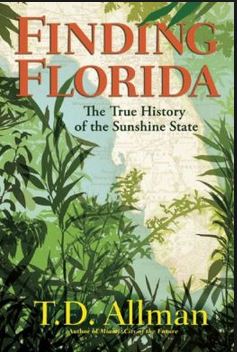
Review: Finding Florida by T.D. Allman

Spoiler Alert: I'm a Floridian.

I picked up an advance copy of Finding Florida planning to hate read it. Instead I fell completely in love. I fell so in love that I've been struggling with how to properly convey that love to you without imitating Gollum and the Ring. If I ruled the world, people would be unable to have an opinion on Florida without having read Finding Florida. We'd pass it out with our free samples of orange juice, take copies door to door with the Yellow Pages. Pundits speaking in election years would have to first read a sample passage from the book before continuing to weigh in on whatever issue of the day Florida was allegedly causing. And then, as a nation, we'd take a good long look at what we've done.

 Here's the thing. Everyone writes about Florida. Everyone knows what Florida is, be it a punchline or a destination. If you have enough cash, Florida is Mar-a-Lago. If you don't, Florida is Trayvon Martin. If you want to prove a point (any point, really) you can use Florida as the example and people will assume you're right. No one ever tells the truth in or about Florida. This is a place where reality twists to the will of the speaker and that frustrates the hell out of the natives. Especially if the speaker is from the New York corridor. T.D. Allman tells the truth. He actually found Florida and wrapped it in a book for you. This is a clear eyed, race neutral history of the Sunshine State. Therefore, Finding Florida may strike some as an incendiary book with an agenda. I would argue that it is impossible to really understand Florida and not be angry. Take our snakes. The milk snake is harmless. It's identical cousin the coral snake will kill you. Schoolchildren are taught rhymes to tell the difference. (My school used "Red on black, friend of Jack. Red on yellow kills a fellow." They also dumped a bag of snakes on the table to make sure we remembered it.)  Florida is a coral snake repeatedly packaged as a milk snake. Don't blame T.D. Allman for getting the facts in proper order.

Florida was never purchased. It was not ceded by Spain. Florida was conquered by repeat covert military actions on tenuous premises. Florida was home to interracial towns which were repeatedly cleared for white settlement. Massacres were common and frequent. Free blacks were enslaved on the pretext that their ancestors had been slaves. Florida is America's spoil of a long and bloody war based on race and profit. The fight for Florida was a fight to expand slavery. A mixed community could not be tolerated as a border to the slaveholding south.

"Starting when he was still Billy Powell, Osceola drew his wives and friends from all racial groups. People of Indian, black—and white—descent fought under his command in every battle. They kept fighting even when betraying the blacks among them would have saved them much suffering and, in many cases, saved their lives. Osceola’s brutal mistreatment, as Congressman Giddings put it, demonstrated “the intimate relation which this war bore to slavery.” General Jesup was even more blunt about it. It was, he pointed out, a war to protect and expand slavery, “a Negro and not an Indian war.” Finding Florida, Page 186

T.D. Allman captures the essential problem of Florida. Billy Powell becomes Osceola. Our history, as it actually happens, is continually rewritten into a narrative that serves forces outside our borders. Without knowing who we really were we cannot understand who we are. Finding Florida is about the framework of political corruption that began our state and still rules it today. It is about the unending ability of people who have failed elsewhere to reinvent themselves, rise to the highest levels, and fail again. 

"When people are unwilling or unable to come to terms with reality, a politics based on unreality becomes necessary to sustain what the Florida scholar Eugene Lyon describes as the “utopia of
mutual hopes.” - Finding Florida, Page 454

"Only in Flori-duh!" is something a Floridian hears often. Failed by our schools, failed by our government, we are a people with a mutual hope that consistently eludes us. We want to be the state we know in our bones we can be. The problem is that too many of us want too many versions of that state. A thousand versions imagined in our own image consistently at war with each other, consistently in denial of our shared history. To the other 49 states we are inexplicable, bewildering and backwards. To ourselves, we are a scapegoat for national failures. Finding Florida proves we're both right.

15 March, 2013

Oh March, You Are Full Of Ides

In February I discussed the extensive run of DNF books I'd encountered. I'm afraid the trend continued. Any number of books were picked up and discarded for TSTL heroines or sexapalooza plot avoidances or sheer boredom. (Wait, that was just Five Golden Rings.)

My point remains. Secret society, secret matchmakers, secret crime fighters. Secrets upon secrets and not a drop of intrigue to be had. It's a dark time in my fiction TBR, and it's made for quiet times here.

I considered dropping in a music review or three. After all, David Bowie put out a new album. You probably heard. It's brilliant. You probably heard that too. I'm not sure I had much to add from a critical standpoint. (If Courtney Milan and David Bowie collaborate it is all over for me and my credibility.) I think I'll go on a non-fiction run. I've recently read a number of decent books that I can talk about without running off on side roads about These Kids and the Books They Read.

02 March, 2013

Review: Heaven With A Gun by Connie Brockway

*Somewhat disappointingly, this is not a tribute to the 1969 film.

The most I can come up with for Heaven With A Gun is that it was fine. Perfectly acceptable. That's sort of the review kiss of death, I know. This novella is neither compelling enough for me to remember the leads names nor offensive enough for me to have renamed them something like The D-Bag Duke. It's a western with a reporter and an outlaw. There. We're done. Wait, we're not? Ok, uhhhh...  I didn't love HWAG but I certainly liked it.

There's a pretty equal mix of charm and tedium in here. Saloon whores with hearts of gold. Hot headed youth. You know the deal.  The heroine's backstory isn't shown. It's strictly told. This is a shame because her history prior to the hero is the most engaging part of the book. I loved her meeting him, I loved her mind, I loved how she got her reputation. I tolerated her motivation and life choices. The hero starts strong too. I enjoyed his early mid life crisis, his cynicism and desire to shake the West off his shoes. Somehow putting them together diminished both of them. Our heroine falls for the hero because he's the hero and vice versa. Not in a bad way, just in a very conventional way that is perfectly... fine.

I suppose my hopes were high for this story. The Americana side of the genre hasn't knocked my socks off since Morsi. It's been a long dry spell for me and American historical. Plus, I love a good western. What's not to adore about European Colonialism using corrupt political motivations to clear indigenous populations? That is some prime drama there. Some of the early frontier towns were models of multiculturalism. (Much of what we learn in grade school is a heavily fictionalized account of how the West went white.)  Liking  HWAG fine just wasn't quite enough. I think Brockway could have made an interesting full length book out of the characters she created for the novella. The ending felt rushed, almost anticlimactic. Some of the early details begged for full length scenes.  If you're jonesing for a lightly comedic western you can do much, much worse than HWAG. I couldn't help wishing it had been just a bit better.

28 February, 2013

Social Media & Review Crews Q&A With Meoskop

*Over at SBTB Sarah is running a Q&A with Susan Mallery about her newest reader initiative. If you haven't yet read it, I would.

With the rapid changes in publishing authors have been pushed into being their own publicity department. With so many voices willing to tell authors what to do (and what not to do) it seemed like a great opportunity for us to connect with an expert on author behavior. Meoskop has been a blogger and reviewer under various names since the mid 1980's, when net access was primarily through phone numbers found in the classified ads. Back in the day we'd phone a stranger's basement to talk books.

Q: So Meoskop. (Can I call you Meoskop? Going 3rd person seems like something I should ask permission for.) You get a number of books for free. What's wrong with Susan Mallery offering books to her readers?

A: I suppose I can call myself anything I like, so yes, feel free. If it's good enough for Michael Douglas... Wait, books. Let's get back to that.  Nothing is wrong with Susan Mallery giving away any number of books she chooses. The free book is a long standing promotion. In fact, the free book is one of the best tools an author has to self promote.

Q: Then what's the issue? If authors have been giving books away since books began and many reviewers frequently receive promotional copies, why is Mallery's Review Crew controversial? Is this about gatekeeping reviews?

A: Not at all. In fact, a novice reviewer can be a consumer's best friend. The conflict lies in the author's natural (and necessary) desire to promote being at war with the consumer's natural (and necessary) desire to find reviews they can trust. The issue here is the winnowing of the review pool. Mallery says that she has thousands of readers wanting a chance at reviewing her books in advance. Where I believe she's raising the eyebrows is the consolidation of her reviewers...

Q: I have to interrupt you. If I'm not mistaken you didn't pay for a Courtney Milan book in all of 2012. In point of fact, you proclaimed yourself her number one fan girl in 2011. How can you hope to have any credibility at all on this issue?

A: Excuse me. I was assured there would be no Courtney Milan questions.

Q: You're evading the point.

A: Obviously, I am untrustworthy. This question proves that. It is that fact upon which my credibility hinges. An author or publisher who provides a free book to me has no assurance of a positive review. In fact, when it became clear to both of us that I would likely be hate reading her new release, Avon declined to provide me with an advance copy of Lorraine Heath's upcoming work. I have a track record of refusing to review authors who expect favorable reviews of their work. Or any review. I frequently decline to review ARCs that have been sent to me. Sometimes they're boring.

Q: Mallery obviously realizes not all reviews will be favorable. While she demands a review within two weeks to remain in her program, she acknowledges that not all reviews will be five star!

A: It's the tiered aspect. If Mallery ran a lottery for each release that did not have the tiered aspect this wouldn't have warranted a second look. By offering bars for her reader reviewers to hit, she introduces the elements of bias. She wants something for her time and money that is in conflict with general consumer interest. If you want the next book, review it in two weeks and you're golden. Look at all the thousands of people that want to be you. You're in the Review Crew. You're an insider. I love 5 stars (who doesn't?) but you say what you really think. On the one hand, she's saying (mostly) all the right things. On the other she is justifiably building a network of reliable superfans who can commit to deadline. It's like walking up to the people camped out for a new Chik-Fil-A in a Chik-Fil-A uniform while carrying a video camera and asking them if the food is any good. They're going to say yes. They wouldn't be there if pickle brine made their nose hairs curl.

Q: Aren't all review and promotion schemes in conflict with consumer interest?

A: Pretty much. The tightrope for the author is to conduct their promotion in a way that enhances their brand. Libby Bray puts on a cow suit, I pre-order her book. Maybe I hate it (ok, I did) but I bought it. I hit a review site I know is flawed (that would be any of them) and I see 200 happy reviews all posted in a two week window? That one star review complaining that the author never calls her mother just became the ONLY review I read. Mallery is gambling (probably correctly) that more readers will see a stack of glowing reviews and slam the preorder button than will call shenanigans. Shenanigans rarely answers the phone, anyway. It's probably going to work. But undermining already flawed review systems undermines all authors. A reader who doesn't trust anything she reads has reduced discoverability.

Q: Discvoerabi - whatever you said. That's like, making my head hurt. You're not industry, are you? That industry stuff is a snooze. I just want to find a good book and buy it. How does Susan Mallery stop me from doing that? I don't see the issue.

A: Maybe she doesn't. Maybe the future is one where buyers expect hundreds of largely positive reviews to quickly appear on her books. What does that buyer do next? If the buyer disagrees with those reviews or knows about the Review Crew does the buyer stop trusting all positive reviews? Are you going to trust positive reviews on other authors? Will the three star review become the new rave review? Look! This book doesn't have 5 star reviews - it must be good! Will the one star review be the only one given credibility? In a sea of solicited 5 star reviews how do you apply comparative meaning?

Q: Was that a shot at Klausner? That got old in the 90's.

A: Not at all. I do me and I let other reviewers do them. My point is that an author who plans on having the same name (or hundreds of names) attached to her book reviews needs to carefully consider issues of credibility. Consumers already suspect reviews and review sites.

Q: Are we back to Courtney Milan?

A: You really need to get over this Courtney Milan thing. You're starting to embarrass me.

27 February, 2013

Review: The Magic Mirror And The Seventh Dwarf by Tia Nevitt

Tia Nevitt has a lot of promise. I liked (but couldn't quite love) her debut. When Dear Author featured this second tale as a Daily Deal I snatched it up. Nevitt writes with an easy style that put me in mind of Gregory Maguire at his least cumbersome. She has a fresh eye for familiar fairy tales. Taking her characters from the sidelines, Nevitt world builds like a master. I'm definitely in for her third tale and probably the one after that. Something about this author intrigues me. And yet I lack the love. The passion isn't there. I want Nevitt to take just one step further from the comfort zone.The Magic Mirror And The Seventh Dwarf (Accidental Enchantments) has a title which tells you most of what's wrong with the story. There are too many elements vying for your attention. I get that Nevitt's concept is to intertwine a slightly different version of a familiar tale with a completely new one. The difficulty she faces is making both tales equally compelling and in that she failed.

In Gretchen the dwarf Nevitt has a great character she mostly abandons for the side tale of Snow White. We all know everything we care to know about Snow White. The minor changes here don't compel me as a reader. Gretchen starts out so strong but then she fades. When we meet Gretchen she is strong, pragmatic, confident and determined to improve her life. She's a savvy commentator on the motivations of others, adept at reading faces and vocal tones. By the time we leave Gretchen she's no longer steering her own course. Gretchen has become almost tediously like our standard heroine, interested primarily in other's opinions of her. I didn't buy the lessons the author felt Gretchen needed to learn. Snow White is a complete bore. She's too good to be true and too bravely heroic to tolerate. Snow is absurdly trusting. Someone may try to rape her, someone may try to kill her, but Snow just keeps trucking. Snow's only weakness is not having friends. She's too pretty to make friends. Snow talks about being valued only for her beauty. Snow has real problems she could absolutely focus on so her insistence that beauty has been her obstacle rings false. She's the borderline anorexic girl who complains for hours about her fast metabolism keeping her from gaining weight while ignoring the laxative in her purse. Snow is used as a club to beat home the message the author wants Gretchen to learn. Beauty is in the eye of the beholder. Whatever. Snow is also painfully dim. When the mirror presents a solution to her problems (a completely obvious one at that) Snow seems to have never considered it.

Gretchen was a dream until she met Snow. Soon she's repeatedly obsessing about her looks while beating herself up for prejudging beautiful women. It might have been more tolerable if there was real conflict about who Gretchen would pair off with but there isn't. He's going to be short and he's going to be the only short character the author spends much time on. Then there is the melodramatic villain. He's blinded by his own (comparative) beauty. He's a bully and an attempted rapist. I'm not sure what the point of that is. On the one hand, the author argues that Snow's near assault is a result of her beauty. On the other Gretchen's is about thwarted power and anger. Does a short need two such events? Does it need dual motivations? Rape is rape. Is it supposed to shock us that it would happen to anyone? It happens to 101 year old women. Is Mr. Bad Dwarf's bullying and violence just not enough? It serves little story purpose to have Gretchen experience the assault and the ease with which she (and Snow) shake it off bothered me.

Reading TMMATSDAE I thought of a dozen turns Nevitt could have taken. There were so many paths open to her once the character of Gretchen was established. I was sad that we wasted them on the conventional path of visually dissimilar women becoming friends. I was sorry that the burden to overcome assumptive bias was primarily on Gretchen. I was bored that Gretchen ended up with the most predictable partner possible. I think Tia Nevitt has some great books in her. I'm hoping in her next outing she sticks to her instinct for reinvention. If anyone could make dwarf romance a genre, she could.

25 February, 2013

A Paucity of Posts

February has been a slow month for this blog. There have been a succession of DNF titles which not only failed to engage me, they failed to provoke interesting thoughts. I'm currently reading a fantastic non-fiction that I question the broad appeal of. (When I finish I'll be raving about it and you can decide.)

I think we're entering one of those romance cycles where the market and my preferences are turning away from each other. Kleypas doubled down on her paranormal series and is dipping her toes into the bondage stream. I'm not the 50 / Motorcycle / Benson reader. So there goes Kleypas. She used to be a reliable read for me - an author you reset yourself with. I'm reviewing my extensive list of books to read when the pricing system repairs. There are not a lot of Must Catch Up authors there. Most of those books will go unread.  Maybe 10% still tempt me.

I've got a big bag of books and no idea what's going to stick. Bear with me into March and we'll see if the Book Bag part of my subheading reclaims ground currently occupied by A Slacker. Perhaps I'll just start posting "HATED IT" next to DNF covers. (Minimalism redefined for book blogging.) I think a DNF without exploration is useless. Mostly, aside from the non-fic, I'm thinking about Sharon Shinn's Shapeshifter book. I hate that she went series with it. I hate that by the end the mystery of is he or isn't he was neatly resolved in exchange for a conventional validation. Sometimes as a reader I feel much like Shinn's heroine did about her lover. A certain amount of self harm is required to keep the relationship alive.

20 February, 2013

Review: Five Star Romance by Jacquelin Thomas


I didn't finish Five Star Romance. After struggling with the opening pages, I threw in the towel on page 136. It's rare for me to do a review on a DNF book but I wanted to discuss how the style of the book kept me from engaging in the content. Thomas is working with classic romance elements. Her lead, Blaze, is the family's lost boy. He blames himself for the troubles of his past far more than his family does. This leads him to value his privacy, where he can control the face he puts out to the world. Livi is a rich girl trying to make it on her own, without the protection of her family connections. When an enemy of his family reveals their secret marriage, Blaze find his personal life on the front pages.

Thomas gives herself a lot to work with. Both characters have a reason to have initially interacted and reasons not to have seen each other since. Both have strong family units that offer support and encouragement. Wealth is not an issue that divides them or hinders their freedom to live as they wish. Five Star Romance is a classic case of great on paper. Thomas relies heavily on telling over showing. Her characters interact with others (and each other) only in very brief exchanges. The vast majority of the story is told in informational dumps. For example, an important confrontation between Livi and Blaze takes place in less than a full page. In that space Blaze has arrived to apologize for assumptions he made that have driven Livi away. She refuses to speak to him and he leaves. Major changes in motivation and assumptions hinge on handfuls of dialogue followed by paragraphs of exposition.

We don't see Blaze or Livi evolve, we are told they are. And they evolve rapidly. On one page Blaze wants a divorce. On another he's committed. In the same space of time Livi flips from committed to finished. Their actions and motivations don't engage the reader because the reader never experiences the transformation with them. As well, their world is inconsistent. Livi works with Blaze's family. She's been part of their business longer than they have. Livi has had two years to study any aspect of Blaze's life she chooses. As a result, some of Livi's actions make no sense. At times she appears star struck by the world Blaze lives in but it's a world she was born to and has worked around for some time. Thomas chooses odd details unconnected to the world she's building.

"A few minutes later, Blaze and Livi walked back inside and headed straight to the dance floor.
At the end of the evening, guests were given a choice of an iPad case or a notepad, pen and flash drive set by Ungaro as a party favor. Blaze gave Livi one of each.
When they were inside his car, he glanced over at Livi and asked, “Are you ready to go home?”" Page 103, Five Star Romance


Nothing about the party favors matter to the plot. Caring about the party favors doesn't fit with the background of the characters so the inclusion seems aimed at the readers. The first 130 pages of Five Star Romance are filled with these secondary details used as a substitute for natural scene transitions. This happens, so now that happens. Then this other thing. And they were thinking that. But then they did this. Livi and Blaze never really come alive, they stay puppets moved through a pantomime tale. 

05 February, 2013

Review: Thief of Shadows by Elizabeth Hoyt

This was my first foray into the Maiden Lane series and I might have one more in me before I call it quits on Hoyt for good. What makes Hoyt catnip to my fellow reviewers makes me sneeze. I think we're far enough from the release date for me to freely make use of spoilers.

Thief of Shadows is one of those books where all the characters are very strongly something until suddenly they are not. Winter Makepeace is a dedicated teacher with a serious Batman complex. He runs around in an ornate, colorful costume and leaps on rooftops to ferret out enslaved children. His rationale for the elaborate disguise (striking fear into men's hearts) was a bit of a yawn. Leaving his attire aside, the rest of Winter Makepeace had promise. Through his dedication to the children a true conflict existed for him and Isabel. Unfortunately it takes just one nonconsensual blowjob for Winter Makepeace to forget everything he holds dear. Isabel sucks the character right out of him. Suddenly he's gone from swearing his life has been promised to a higher purpose to abandoning everything he once stood for. No longer is the need of the many (the orphans) greater than the need of the one (himself and a favored orphan). No longer are his nightly raids on criminals the calling he cannot set aside. Winter packs his bags and arrives at Isabel's house with boots made for knocking.

Isabel is no better. She's a flighty hedonist who refuses to bond with the child sharing her home. She orders him away and complains to the servants when she sees signs of him in her home. She works on the charity board for the orphanage but never spends time there. Her goals are a life in society filled with distractions. After sexually assaulting Winter she suddenly craves children and stability. By the end of the book Isabel has packed down her mansion and set up house in the orphanage by Winter's side. She's busy making it a home. No mention is made of the probable social cost because now Isabel has a makeshift family and therefore has satisfied all her life's desires. If I were Makepeace, I'd be worried about a sexual predator in a house of young men but then if I were Makepeace I'd have shoved her off a balcony instead of chasing her down and professing my love.

Along the way there is a tedious Pygmalion subplot even the characters fail to take seriously. There are a few Bad Guys and Even Worse Guys and a bit of Conspiracy keeping time for us so Isabel and Winter can pretend anything matters but getting naked. The plot points are so disposable that one involving a young jewish orphan is completely cast side once Winter buys his knocking boots. Presumably the concerns he had about taking her into a Christian Home are swept away by the clarity of passion. Or something. There's also this dude that wants the orphanage for REASONS and is thwarted by an old lady with a pile of slingshots. I don't know why he wouldn't just beat the crap out of our orphans, but he throws his hands up like a modern couple whose live in nanny has walked off in a huff. How can he manage these dirty, dirty children?

Hoyt keeps being recommended to me by people whose opinion I generally agree with. This is my second or third attempt at her. I do appreciate her ability to create distinct characters but I think she lacks follow through. I have another Maiden Lane book cued up on the old TBR but I'll stop there. It hurts my eyes when I roll them.

01 February, 2013

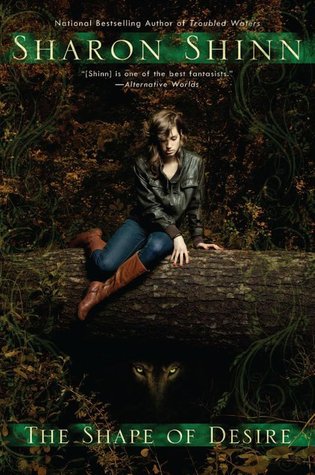
Review: The Shape of Desire by Sharon Shinn

Sharon Shinn has been all about confusing her readers since her career started. Is she chicken, or is she fish? Taken as a whole, her career makes perfect sense. She writes fairly standard romances with strong science fiction elements and extremely real human interaction. Shinn understands power dynamics in a way that sets her apart. She breaks your heart by loading her implausible worlds with plausibility. In that sense, The Shape of Desire is anything but a departure. Taken on it's own, I can see why it confused readers in it's hardcover release.

The Shape of Desire is a rumination on human relationships. What we are willing to trade away to have specific people in our lives and what we are not. In the case of Maria, she has given up stability. Her lover claims to be a shape shifter. Maria has never seen Dante change out of his human form. She has never seen anyone change from a human form. What Maria knows is that when she is with Dante she is blissfully happy and when she is not she falls apart. Much of the book focuses on her relationships with other people. Although forced to keep Dante a secret, Maria is close to her family. Her coworkers are involved in each other's lives, including that of a woman in an abusive relationship. While trying to befriend her Maria is forced to consider harder questions about both their lives. When is concern misplaced? What does an outsider know of the risks and rewards inside a relationship?

Shinn is successful in creating a memorable tale with important questions at it's heart. She's less successful in making me care about Dante and Maria. I never connected with Dante, despite the evolution of his character. I sometimes grew impatient with Maria. I was more interested in some of the coworkers and I was frankly disappointed to have all of Maria's questions so neatly answered. The book would be more powerful as an open ended single title than as a start of a new series. That said, there is an unanswered question at the end of the book that neatly underlines the theme of the whole. What will we allow ourselves to believe or accept to have the thing we love? Late in the book Maria, who hungers for a child, has the opportunity to raise one. Does she have a right to this child? Has this child been stolen? For the reader, as for Maria, the question hangs as something that cannot be examined too closely. Maria has what she longed for. Is that enough?

30 January, 2013

Spoileriffic Review: One Good Earl Deserves A Lover by Sarah MacLean

*Since we're diving deeper into the book I thought the step back would be a more fitting graphic than the cover. 

A few days ago I suggested you preorder Once Good Earl Deserves A Lover, read it at midnight and meet me back here to discuss where I thought it fell apart. I can only show you the path, I can't make you walk it. If you're reading this without having finished One Good Earl  that's on you, kitten.

With everything I loved about OGEDaL this is not a cliche free book. MacLean deals with the logistics of a girl who wears glasses so well that I forgave that girl being an intellectual. (The details of Pippa trying to tie a mask to her face won me over.) While I'd love to read about vision impaired heroines without their defective eyes conferring intellectual power, I get that this stereotype is hardly negative. But still. Smartacles. The magic of myopia.

With all the Pippa Middleton / Prince Harry shipping in the zeitgeist it took me a moment to get past our leads being Pippa and a tall charming redhead. It certainly didn't hurt that Cross was also an intellectual. (Say what you will about Harry but he's never been known for scholarly prowess.) I appreciated how Pippa dominated the book. Cross was well represented but it's Pippa that drives the story and dictates the action. She never becomes a passive passenger in her own story. The human relationships were (with some exceptions) well defined and realistic. I believed the divide between Cross and his family, as well as the interactions between Cross and his partners. I appreciated MacLean leaving Cross and his sister estranged. It was truthful and appropriate. What was neither was the distance of Bourne. I found his exclusion completely implausible. It's one thing for Cross to conspire with Pippa, it is another thing for his partners to do so. Events escalate to the point that the partners spend 19 million in company funds (300,000 plus pounds converted to modern pounds) without consulting or informing him. (The 19 million spent made little sense. This was a feel good resolution that didn't hold logically. It also put the owners - and thus Bourne -  into business with men they didn't wish to entertain.) Aside from the financial aspect, Bourne is invisible in his own family life. He is a prop used to support the HEA from a prior book instead of a realistic character.  This is Bourne, he likes to bang Penny now - as though there is no other purpose to his existence. Send your prior characters on a tour of Europe if you're going to write them out of their own lives.

Cross and Pippa have a nemesis in rival club owner Knight. Of course Knight has a daughter. Since Pippa has two men on her string you know we're going to end with one of them marrying the girl. It's unlikely, unrealistic and unbelievable. It weakens the overall story when characters not destined to be sequel bait pair off like animals on an ark. There is no need for Knight (or his daughter) to bag an aristocrat. Late in the book events also weaken the portrayal of our extra earl. It's understandable that Pippa would build a plan requiring the full cooperation of a recently rejected lover. It's less understandable that he would comply. Marrying him off to Knight's daughter undermines the only simple explanation for his eager compliance. We needed more characterization of his friendship with Pippa to understand what appears to be an inexplicable willingness to comply with her desires. "Hi, I'm not going to marry you. It's really sweet of you to offer to marry me even if I'm pregnant or just desperate, and I totally adore how you're keeping the offer on the table, but would you come help me win the man I want instead?" What makes him agree? Nothing but the needs of the plot.

One aspect of the book I I really enjoyed was Pippa's frank acceptance of human sexuality and lack of disdain for sex workers. Pippa struggles to understand who would choose such a life (and if they would). I felt MacLean was having it both ways when Pippa tells a prostitute that there is no shame in the word, then tells the hero she cannot condone the life. On the one hand, a heroine refreshingly free of slut shaming. On the other, nod to conservative reader expectation. When the prostitute flips on Pippa she has a wonderful defense of her actions that again, is adjusted to reader expectation by her regret at having wronged our Pipster. I'm conflicted in my feelings about this aspect of the book.

I'm not at all conflicted about the final pages. Cross has his last minute revelation. He runs down the street to make the church on time where he finds Pippa in the foyer instead of walking down the aisle. A public proposal follows, and a babylouge ties it off in a bow. This part of the story couldn't be more cliched if it starred Hugh Grant. Pippa has called off her wedding. Why is she at the church? If not Pippa then at least her family is aware she has jilted an earl and will be subject to extreme public scrutiny. Pippa is sporting a bruised face and a blackened eye. Someone around her (oh, I don't know, Bourne?) might have feelings about her appearance. Someone might suggest (her mother?) that society is going to assume the earl beat her and thus she canceled the wedding or that her father beat her for canceling the wedding. Either way, bare faced Pippa hanging out at the church is going to create unwarranted and unsavory rumors for someone. I didn't believe that she'd appear or that she'd hang out in the lobby. Far more likely that Pippa would be at home or at the wedding breakfast (where her appearance could possibly be explained). Pippa is in the church only to facilitate the cinematic staging of her proposal. In a book so deeply concerned with logic and intellect it doesn't hold together. Plus, babylouge. So, so sick of babylouges.

I still loved One Good Earl Deserves A Lover. Books, like people, don't need perfection to be worthy of affection. We can embrace them and see their flaws simultaneously. MacLean owns me for her next release and probably two or three after that. If there's an author / reader version of reality show immunity, she's got it.

18 January, 2013

Review: One Good Earl Deserves A Lover by Sarah MacLean

Emotionally, One Good Earl Deserves a Lover is absolutely fantastic. Epic. Sheer greatness. Best Book Of The Year material. Critically, One Good Earl Deserves a Lover has substantial flaws. Much like Jennifer Ashley's book The Madness of Lord Ian MacKenzie reader investment overcomes the structural problems. I was so engaged in the story of Pippa and Cross that I forgave the book everything. In Pippa we have an educated woman free of the cultural bias authors generally ascribe to educated heroines. Pippa does not rebel against conventional femininity nor does she require anyone's defense. She is accepted by those around her. Pippa is not disdainful of people who think differently than she. This is an intellectually curious woman with difficulty understanding and processing emotional cues.

Pippa uses information as a shield against embarrassment, a way to mimic the conventional behavior that seems so alien to her. By studying the strange world most people inhabit, Pippa can move confidently within it. This brings her to Cross, a business partner of her brother in law. Pippa is marrying a perfectly nice man, a man she wants because he wants her. Pippa is aware her interests do not mirror those of conventional society. She is grateful to have found a man who honors her unique qualities. In the interest of conducting herself properly as a wife, Pippa seeks to understand human sexuality. This is a common beginning for historical romance - the naive heroine in need of a sexually experienced tutor. MacLean tweaks the plot by pairing her ingenue with a celibate. Cross is also a prodigy. Where Pippa is emotionally unconnected, Cross is attuned to the way emotions dictate human behavior. He understands and categorizes it the way another might their personal library. What is a mystery to Pippa (human sexuality and attraction) is an open book to Cross. He shares her interest in science as well as her inability to stop thinking critically about the world surrounding him. Where Pippa labels herself as odd, Cross labels himself as continually inadequate. The difference between them is larger than age or experience. It is built by their extended family. One is embraced, the other was rejected. Pippa has never before had a need to decode human interaction. Cross has always been forced to look outside his home for warm appreciation.

Because the emotional strengths of One Good Earl Deserves A Lover outweigh the structural weaknesses I'm going to run a second review after the book's release. It will discuss the dissatisfactions I had with the framing of Cross and Pippa's courtship. I'm splitting the review because I strongly recommend One Good Earl Deserves a Lover and believe it should be read without spoilers. Pre-order this one, read it at midnight and come back on the 30th to see what I have to complain about. All you need to know before you crack the cover is that MacLean has written a celibate hero, a strong female lead and an emotionally satisfying resolution. Enjoy it, for tomorrow (or in two weeks) we quibble.


17 January, 2013

Review: Cravebox Teen Time

Oh, patriarchy. You never change. 
Before the holidays I briefly touched on Cravebox. Normally I wouldn't revisit the topic. After all, this is a book blog. If I turned it into a consumption blog you'd either endlessly read about my handbags or be grossed out by an examination of Victorian medical practices. (Both of which would be epic, now that I consider the matter.) We're back at Cravebox because I decided to give them one more try. Cravebox and I are breaking up. We are never, ever, ever getting back together. (You go talk to their friends.)

Last month Cravebox offered a Teen Time box with the description: "Being a teen girl can be kinda hard. Finding them cool stuff just got easier. We at Cravebox think girls deserve their own space… and their own stuff. That’s why our creative curators thought “outside the box” to find fun, girl-friendly discoveries to put into a box, just for them." 

I don't know why I expected anything other than what arrived. Maybe it was the words "outside the box" or perhaps "girl-friendly" instead of "gender normative mandates". I thought they might have chosen an upcoming young adult fiction title, coupled it with craft or club items. You know, some gender marketing, some "outside the box" acknowledgement that a growing teen girl needs to be shown that she is more than her sexuality. (I must have been drunk. I really have no defense.)

The Teen Time Cravebox arrived with an inspirational card I'm too depressed to quote from. More of the same about unique challenges and adventures. Being a teen sure is hard, but Cravebox is here to help. First up, a razor. Now that you're leaving your prepubescent years behind you'll want to erase as many traces of that as you can. While you're shaving, you can chew gum. Teens chew gum, because food makes you fat. (I actually have no issue with the gum.) Don't blow bubbles! This is chewing gum and your new hot pink Mary Kay gloss might smudge. 

Now that you're clean shaven and smacking those pink lips, it's time to address the rest of you! That's right - your hair. With the enclosed moisture mousse you can address all those nasty split ends you might have earned playing sports. Well groomed hair is a must for teen success. It's almost as important as clear skin, which is why Cravebox gives you a bottle of Vitamin E. You might have your skin under control but acne scars reveal a time when you didn't. Scars, burns and blemishes - Vitamin E has you covered. And that's it. Four products reinforcing the media message of your visual inadequacy and a pack of gum to chew your insecurities away. (Give mom a hug!)


Cravebox, they're just a bunch of crazy radicals. Radicals who totally know how to find cool things for teen girls struggling with questions of worth and identity. If you'll excuse me, I'm going to buy mine a gift from Think Geek

11 January, 2013

Review: Back to the Good Fortune Diner by Vicki Essex

Occasionally a book comes along that catches every reviewer's eye at once. Maybe it's the marketing, maybe it's the theme, sometimes it's random chance. In the case of Back to The Good Fortune Diner it's the promise of a non-caucasian lead in a traditionally caucasian line. Vicki Essex is an author in the right place at the right time. Essex is also a talented writer. Ultimately, I think she's better than her book. I'm going to give Diner it's small town beats dirty big city vibe because that's a fetish. It's not my fetish, but the topic of message coding in this theme is more than I care to get into with this review.

I'm also going to give Diner it's simultaneous embrace and rejection of education - no I'm not. It was very problematic for me. The racism in the book was another stumbling block. For much of the story we have an interesting tale of two culturally different people learning to communicate with each other as adults but then it takes a sharp turn. The book couldn't sustain the weight of the material. Ultimately, it feels very After School Special in it's quick presentation and smooth resolution. A secondary romance felt it should have been the focus of (or a sequel to) the book. Finally, the brother and sister duo at the heart of both relationships felt completely wrong for their age. Whew. Let's unpack some of that.

Age before anything - Daniel and Tiffany are highly educated professionals in their mid to late thirties. both are so deeply enmeshed in their parent's possible view of them that they cannot see themselves. I felt their age was driven by the author's need to reunite her high school couple (Chris and Tiffany) through his teenage son. Drop everyone's age seven years, make the son a nephew, and all my issues with this part of the story evaporate. The emotional conflicts were realistic and interesting. Their timing was not. Tiffany and Daniel are both trying to figure out who they are. Both have degrees they don't want to use. While I completely disagreed with Daniel's choice of work I want to focus on Tiffany. About Daniel (certainly the more compelling sibling) I'd say that most 35ish year old men working the back of a kitchen (who are not chefs) have beaten their bodies to the point that they would welcome any alternate opportunity. That Daniel is in possession of funds, education, contacts and support but chooses to take a fairly low level position on impulse mystified me. He is banking on the financial support of a girlfriend he is estranged from while rejecting all paths that lead to his own financial stability. At 25, this is a mistake. At 35 it's running into poverty instead of away from it. Daniel will struggle for the rest of his life where a slight change of course could have given him the work he loves and the ability to enjoy his life while doing it. (I have to stop talking about Daniel. His dominance of a book not about him is turning into his dominance of the review.)

Tiffany has been chasing publishing jobs she doesn't find rewarding. I wanted Tiffany to grow into an appreciation of her own worth but she never does. Tiffany is the over achieving student, she's the impassive faced minority who magically brings the hateful white bigot into line, she's the understanding and self demonizing girlfriend and the overly devoted employee. Even as a rebellious daughter she's just a little too good. When the women of the town want to socialize with her Tiffany wonders why they would want to. Tiffany never wonders why she should want to talk to them. When Chris calls her out on her lack of interest she examines it as a personal flaw. Tiffany spends the entire book wondering what she offers others and ends it the same way. It is always Tiffany that is inadequate and Tiffany that must change. I wanted Tiffany to demand more for herself and standing up to a sick old racist was insufficient. Tiffany suddenly decides her jobs are unsatisfying. Her inability to make friends is her personal flaw and not a facet of her being uncomfortable in her own skin (this was hinted at but not developed). Breadcrumbs of an alternate career path are laid in the story. They are not used. Tiffany appears to give up her professional dreams so she can have the boy, because the boy trumps everything else in her life. She doesn't find a different dream, unearth a deferred dream, or reveal a dream she was afraid to follow. She settles. She's going to be with the boy and figure the rest out later. Again, understandable at 25 but troubling in your 30's.

I think Back to The Good Fortune Diner would be a stronger read without the racism. Or a stronger read with more racism in it. Of course the only Chinese family in a town is going to face bigotry. I've repeatedly lost friends to other states because they wanted their children to grow up as something other than "the Asian kid" in town. Having Tiffany face racism from one man was dealing with it in a token manner. Tiffany stands up to him, he folds. He's a softie underneath anyway. It's true enough in that it could happen, but it feels far too pat. Leave it out. Adding in Daniel's concern that his parents are bigots without really resolving if they are makes the post-racial ending even less satisfying. Daniel's story was too big for this book. Including all of it not only short changed Chris and Tiffany but it ended any chance to resolve the core of their arrested development. Why do their parents constantly fight? How did they both feel about the sudden move from the big city to the small town when they made it? Why did they press their children to get educations if they don't want either of them to use them? How does this dynamic stop influencing their children and start informing them? Chris and his father get their emotional issues resolved, leaving Tiffany as a Magical Asian when I wanted her to be the star. Removing most of Daniel's romance would have given Tiffany more room to earn a happy ending instead of concede her way to one.

All praise to Essex for making me care enough about her world and her prose to devote so much thought to it. I'm absolutely going to read her next book but I have to give a mixed recommendation to this one. Essex suffers from a lack of space over a lack of ideas. She might be better served by a longer word count. Back to the Good Fortune Diner is more enjoyable than my review suggests. It's actually very good, it just isn't amazing. There's a joke in there about the no-win life of the American (or Canadian) born Chinese, but I'm not going to explore it.

*I also wanted to explore Daniel's unconventional choice not to be the dominant financial power in his relationship and his willingness to subvert that gender norm. Really, the wrong couple led the book.

* If you haven't read the discussion at My Extensive Reading I highly suggest it. Among many excellent comments Sunita brings up a point I'd failed to consider. 

03 January, 2013

Review: Your Wicked Heart by Meredith Duran

I've held off writing this review because so much about Your Wicked Heart annoyed me. First of all, the blurb being used to sell it is not only inaccurate, it's a complete inversion of the central relationship.

"She’ll do whatever it takes to secure a berth on an England-bound ship, even if it means pretending to be the wife of the absentee viscount who jilted her. But when the anchor lifts, she’s not the only impostor on board—for the stranger in her bed claims to be the real Viscount Ripton. Can she trust this devastatingly attractive scoundrel? Or is his offer of friendship only a pretext for seduction...and revenge?" - Simon & Schuster

His offer of friendship? Can I get that again, please?

"Amanda's having the worst day of her life. Her groom failed to appear at the wedding, her employer withheld her references and now a man claiming to be the real Viscount Ripton has kidnapped her. When the anchor lifts she can only pray the truth isn't as bleak as her fears." - Meoskop

I spent less than ten seconds on that. (At least I read the story.) Pretending to be the Viscount's wife? More like destitute bride in search of answers. An offer of friendship? More like crazy accusations and deranged imaginings. Can she trust him? Not if she has half a brain in her head. I haven't been reading Meredith Duran lately. The middle of Your Wicked Heart reminded me why I liked her so much while the beginning and end made me want to DNF the short and call it a day. Amanda is beautifully portrayed as a lost soul at the end of her rope. The book opens on her heartbreak and desperation giving the reader every reason to root for her. Our first encounter with Spencer shows a power mad man who can't function without the full weight of his wealth behind him. He's threatening, he's accusing, he's enraged. He doesn't have to listen to anyone because he has already made up enough answers in his head to satisfy himself. He enables his relatives (who then disappoint him) while assuming the darkest motives in those his relatives dupe.

In the center of the novella I was able to put aside Spencer's extreme dysfunction long enough for Duran to charm me with the tale of a poor little rich boy and a scrambling companion. Amanda's issues of self worth rang true, her desire for more than she has while accepting that she's likely to have even less also worked. Spencer's defensive posturing turned to desperation and exhaustion. Slowly I began to accept that this couple deserved more than a third class ticket on the Titanic. (I even got past Spencer telling Amanda she was inviting rape by appearing above deck without him because he's a super duper good guy and those sailors, no telling! This isn't some classy ship I kidnapped you onto, baby, it's full of all kinds of miscreants!!)

Eventually, Amanda and Spencer catch up to the other Viscount Ripton and all is revealed. (Here lie spoilers.) I was disappointed in Amanda's revelation that she agreed to wed as an escape. A more complex situation involving Amanda actually having feelings for both men would have been welcome. Knowing that Amanda did not love the second Viscount, Spencer still steps aside for the man. Amanda, it seems, is a commodity. He paints it as freedom of choice, but it's still appalling. A freedom of choice requires communication and Spencer hates to use his words when his power will do. Amanda tells them both to get lost. She searches for work she doesn't find until she does. She then rejects the job because Spencer arranged it for her. She hopes he will come and find her. Amanda is about to be homeless, cannot pay for her food, and she turns down the only viable job offer she has based on principle and magical thinking. I completely lost patience with her.

In a less capable author's hands I wouldn't have finished the story. Duran carried me though with her beautiful descriptions of place and her ability to make me feel for the most appalling people. If issues of power and communication bother you less than they do me you'll probably love Your Wicked Heart. There are worse ways to spend a buck and a lot Duran gets right.

02 January, 2013

Review: The Work Of The Devil by Katherine Amt Hanna

All credit to the cover designer. This is an arresting image with fantastic use of tone. I like almost everything about it. (The borders are too tight on the author's name, but I'll go with it.) This should be on a NYT bestseller, but it's not. It's on a novella from fledgling author Katherine Amt Hanna. When I read Hanna's work it feels like there is a major talent inside who can't quite get where she needs to be. The fact that I found The Work of the Devil to be flawed and still have tons of comments to make illustrates that. I'd rather be frustrated by Hanna than entertained by many. It's my hope she keeps writing.

The Work of the Devil is a fairly classic SF set up. It's evocative of golden age books while keeping a modern pace. It it was a short filler story in an ongoing series I'd probably be calling it brilliant. Unfortunately, there are no full length novels holding it up. Hanna has built more world than she can comfortably deal with in 70 odd pages. This leaves gaps the reader can't leap. She also relies on a few twists the experienced SF reader will easily see coming. As well, in a book largely free of racial cues, she ends with a bit of whiteness. It's so tiny it's not even a sin but until Hanna introduced pointedly Hispanic characters I hadn't assigned race to most of her leads. The larger problem keeping The Work of the Devil from realizing it's potential is authorial choice. Hanna appears to be supporting an American obsession - the purity of the ignorant faithful. Her dominant character holds to his simplicity and triumphs against a powerful force beyond his understanding.  He hails from a community which is faith based and machine averse. We slowly come to understand there is a an second community more like our own (or an early 1900's version) with limited mobility and no aircraft. This second community is not explored and exists only to solve problems for the main characters.

Why the main community has limited contact with the second for hundreds of years is explained as an article of faith. They are sworn to shun, so they largely do. These are weighty issues for a novella to carry. The division has to be accepted for the reader to continue. Through the second community the main community is made aware that their lifespans are shorter and their illnesses greater. A third community (or artifact) is potentially the source of this difference. The second community cannot approach the artifact because reasons. Those reasons are explained as a compulsion they involuntarily experience. Our main community feels these compulsions in differing but muted amounts. The second community theorizes it's a function of proximity but the logic for this is shaky. It's made shakier when our main community approaches the artifact and only the least worldly of the characters is able to maintain free will. The compulsion extending from the artifact affects each in different ways without an explanation for those differences made. The purpose or origin of the artifact is left unsaid as well. Toward the end our main characters are told there may be a dozen of these artifacts left in place for hundreds of years. Why? To what end? Is there a repercussion for the destruction of one?

Why destroy the artifact at all?  Is Hanna in favor of the destruction, or does she oppose it? The most sympathetic character is set up to make a sacrifice and achieve a victory. He is the least knowledgable. He is a man of faith and rules, not deep thought or insight. A man he trusts says there is an object they do not understand and that object must be destroyed. Destroying it may (or may not) change the health of their community. (I'd argue their rejection of the medical knowledge the second community has could be a factor in the differing life spans.) They approach the artifact. It has machines therefore it is evil, because their faith labels all machines as evil. It has the ability to alter their behavior and it takes an animal for food (as do they, but that's beyond their insight levels). It exists, it is not them, and therefore it must be destroyed. The author's position in this is invisible. I don't believe it's invisible by design. The Work of the Devil reads like a text written without an eye to what the author knows versus what the reader knows. The ending is frustrating because the reader is not certain of the previous events' meaning. The Work of the Devil is a great pitch piece but it isn't a great novella. You should still read it.