* Note, this may have been the short included in the print version of The Ugly Duchess. I'm so annoyed by the prospect of buyers getting even less value in an ebook that I can't be bothered to ascertain exactly which title they tossed in the MMP. Either way, it's now for sale as a short.
Eloisa and I are breaking up. I probably have one or two books left in me, but the writing on the wall seems pretty clear now. Everything I disliked about The Ugly Duchess is magnified in Seduced By A Pirate. (More than a sister story, Seduced By A Pirate could almost be a synopsis.) Where Sir Griffin Barry was a thug for most of The Ugly Duchess, here he was always a pirate with a heart of gold. Pity the poor press ganged boy who sees no way out but to rebel against his moral father by embracing immorality.
Let's pause for a second. Griffin is a 17 year old member of the landed gentry (Or is it nobility? Griffin seems to have gotten a title upgrade.) when he is taken by a press gang. Right. Assuming Griffin keeps silent about his identity, he then becomes a pirate because his dad spent too much time at work. Griffin doesn't want to be a servant of the people, he wants to rape, rob and pillage. (If you only read the short, you'll think Griffin was freeing slave ships and changing lives his whole career. Not so much.) We will give James her Hollywood Pirate and move on.
Griffin returns home with a full pardon and a wife he married through parental arrangement. His wife has spent the last 14 years denying her sexuality, so she's a virgin. (Hermetically Sealed Heroine alert!) When Griffin returns she sensibly explains to him that she's economically sound and interested in dissolving their marriage. She's failed to do so over the last decade and a half under the assumption that he'd get himself killed and there'd be no need to bother. Griffin says he'd rather get laid and five sentences later she's up for that too. Seriously. "I want a divorce. / I want you. / Ok, then." Apparently one look at Griffin's super muscled pirate build is all she needs to go from frigid to frothing. Phoebe (whose name he doesn't even know) instantly switches to concerns that she's not enough for her recently returned spouse. Will he desire her? Is she still pretty? Can they do it on the floor right by the front door as soon as he gets home?
By the end of the day they're pledging their love for each other. Approximately 10 hours from "Who are you?" to devoted beloved. (It takes Insta-love to new levels.) Along the way Griffin finds out he actually likes his dad and his dad arranges for him to become a judge, or a magistrate or some sort of thing. Because when your son has been a pirate for 14 years with nary a letter home of course your first thought is handing him a gavel. Wait, did I forget to mention his sisters? Yes, Griffin also has sisters that he has ignored. He tells himself that sending his pirate money home was buying their freedom from the sort of arranged marriage he suffered. I'm sure, given a few more pages, they'd have been just as forgiving as Phoebe and Griffin's dad. It's that kind of tale.
Closing out this short novella are not one but two epilogues, each with a baby nicely tucked inside. So you get a baby. And YOU get a baby. And Griffin gets his virgin wife. Let the HEA'ers abound.
Showing posts with label Avon Impulse. Show all posts
05 November, 2012
09 February, 2012
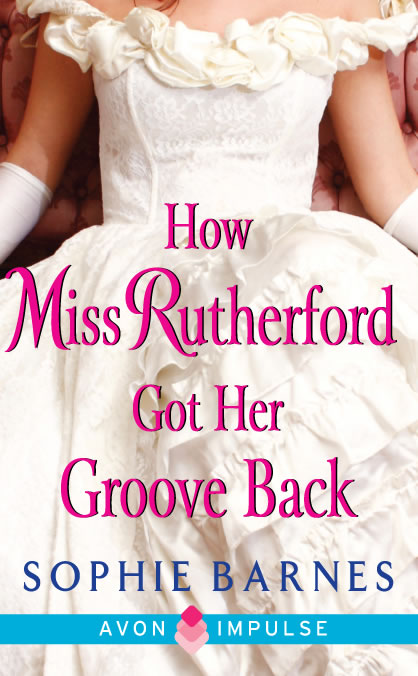
Review: How Miss Rutherford Got Her Groove Back by Sophia Barnes
This cover suggests Boxing Helena to me. Miss Rutherford is presented as a headless torso in an open position. It feels somewhat soulless, which brings me to the title. A genre that is aggressively Caucasian mimicking a very popular contemporary African American title is problematic. Add in that How Stella Got Her Groove Back was a thinly disguised tip to the author's own (now failed) marriage and certain problems in Barnes' book are thrown into even sharper relief. Emily is a complete Mary Sue, and a manic one at that.
When we first meet Emily she could put Snow White to shame. Living in a cottage with her sisters after being disinherited by her evil step-relative, she whistles while she works. Scrubbing floors and living for the one day a year she is invited to the ball, Emily dreams of marrying her neighbor, her childhood sweetheart, her savior. When this fails to pass, she becomes suicidal. (She is fond of saying things like she should have been "left to die".) It is not that Emily breaks as much as she dents. Her suicidal depression leaves as quickly as it arrives. Emily walks through a series of cliches that range from the allowable to the completely infuriating while those around her hold her hand and weep over her noble purity of feeling. Those who bruise the tender fruit of Emily's soul are heartless creatures, while Emily herself is excused of all responsibility.
Given that the side characters are so thinly drawn it hardly matters that their emotions are barely noted. At one point Emily is put in possession of an elderly chaperone who immediately goes to her room and fails to appear until close to the end of the book. (Much like the eldest Martin child in the American serial All My Children, who walked upstairs in the 1970's and was never seen again.) Gone and forgotten, when she is mentioned again I had to flip back to recall who they were discussing. Further removing the reader from an ability to sympathize is the author's inability to choose a path and stay on it. In one scene Emily urges her former fiance and his intended to enjoy every second of their betrothal ball as she could not stand to diminish it in any way. With her very next breath she berates them as undeserving of her. Whiplash moments like these abound. Later in the book Emily rushes off to see the previously rejected BFF as "I have no quarrel with her, you know." Emily is prone to this kind of passive aggressive bullshit when she isn't making her own life infinitely harder through impulsive and ill considered actions. The author drops in and out of these implausible shifts with equally awkward conversations. Not naturally, or in a way that makes internal sense, but to point out the author realizes this is kind of a left field event. As a reader, I was as bewildered as Emily's former fiance. In addition to the emotional curveballs the author keeps the plot curveballs coming too. (What's that, Lassie? Emily must marry in a month or her sisters lose all? Why didn't anyone mention this 2/3 of the book ago?)
So. Emily kisses childhood friend, Emily jokes about marrying childhood friend, entire town and both families expect it to occur, Emily (when faced with a need to marry) does not tell him. She lives on the neglected corners of his life scrubbing her own floors and waits. Emily charms the birds from the trees with her gaiety. Childhood friend runs off to London and falls in love with BFF who returns to town but doesn't tell Emily who she is engaged to marry so that it can be a shocking revelation at the ball. This makes no sense. I can buy both of them as completely clueless about Emily's air castles, but to not tell your BFF you're marrying a mutual friend? Not to challenge your son on his fiance's changed circumstances? Not to tell your parents ahead of the ball you will announce the engagement at that you're marrying? Like the rest of the book, these events have to happen for other events to happen. At one point I wrote "Miss Barnes has gone a cliche too far."
The real one eyed reading occurs at the end of the book. Our hero has been harboring the deep dark secret that he is a surrogate child. His father was so enraptured by the surrogate that he installed her in all their homes, preferring her to his wife and living openly with her after his wife's suicide. Since his death said evil doer has been blackmailing our hero for fairly absurd sums of money on the basis of a signed letter confessing all! Why our hero's father would write such a letter set aside, why the hero wouldn't just let her give her plot a shot, all of this you have to take on faith. (After all, this is the guy who thinks Emily isn't like the rest of us but means that in a good way.) Kate (the former BFF) runs to Emily (because she hasn't had enough gas-lighting) and tells Emily that the hero's biological mother is actually his mistress. Rather than run suicidally off into the night like the last time, Emily runs suicidally off to a formerly barely mentioned and shortly never to be mentioned again diabolical relative. She'd rather marry him (here we discover the must marry in a month timetable) than face Hero McIncestCheaterpants again!! (Histrionic, much?) Emily arrives, determined to marry Edward. I was sort of hoping he'd ask Emily if she'd ever consider a soothing drink and a nice cooling cloth, but he's as over the top as the rest of them.
First he gloats about his feelings of inadequacy and then he proclaims he's going to rape her. Emily can't go back to her sisters, her life or our hero. Remember, her former BFF who is engaged to her pretend fiance told her that a woman old enough to be his mother is sleeping with the hero! Rape is her only option!!! Emily starts to take her clothes off like the good little martyr she is. (I think the only way I followed this bit is my southern heritage. Convoluted explanations are our birthright.) Luckily Emily is saved by the hero and Edward is whisked off the canvas with a "Sorry, my bad" after the hero stakes his prior claim. While we were waiting for Emily to finish taking her clothes off Kate was being berated (yet again) by Emily's equally reality challenged sister. How could Kate make such an allegation? Doesn't she know Emily self harms?? (I hope Kate learns her lesson here and puts as much distance between this toxic family and herself as possible.) Emily is whisked off to marry the hero in secret, since he stopped off at the Get A Special Permit Store and took care of business. At his home, he confesses all (after first dillydallying about confessing anything) and they decide to trick the blackmailer into revealing the location of the letter.
Crazy things happen (big shock) that I am really not interested in reliving. In the course of them the blackmailer reveals a secret addition to the dead Earl's will that leaves her buckets of things. She will trade Emily the letter in return for access to the home (that she already had access to earlier in the book, and earlier in her life) so she may retrieve it. But what's this! As the hero braces himself to learn how his father further betrayed him he discovers the codicil is a giant "Pwnd!" intended for the blackmailer. It reveals that the letter in question has a fake signature! It can't be used! He knows his wife didn't commit suicide but was killed by his mistress and he kept sleeping with her because... I can't even. Why would you write either document? Man up, dead Earl. Quit abandoning your wife, your son and your duty to the estate. Don't leave her with an inheritance and a blackmail letter and a lot of bad sex memories! On the other hand, if he hadn't then our blackmailer couldn't do what we were all longing to do at this point. She whips out a hidden gun and shoots Emily.
Sadly, Emily survives.
*Since I wrote this (and scheduled it) my kindler, gentler, less annoyed short form review was the subject of one of many sock puppets out in force for those who dare to dislike this book. My personal puppet was as unable to pick a lane and stay in it as Emily herself. (Bless.) Someone should hold a class on Effective Puppetry For The Debut Author with a section on Making It Look At Least Plausibly Organic. That someone won't be me. I can't be bothered. I left How Miss Rutherford Got Her Groove Back intending to try the author's next book. Despite some style issues there were indications that (freed from her melodramatic bent) Barnes could deliver an entertaining tale. Watching the drama playing out over multiple sites I would rather make my break with Miss Barnes as clean as my break with Emily.
When we first meet Emily she could put Snow White to shame. Living in a cottage with her sisters after being disinherited by her evil step-relative, she whistles while she works. Scrubbing floors and living for the one day a year she is invited to the ball, Emily dreams of marrying her neighbor, her childhood sweetheart, her savior. When this fails to pass, she becomes suicidal. (She is fond of saying things like she should have been "left to die".) It is not that Emily breaks as much as she dents. Her suicidal depression leaves as quickly as it arrives. Emily walks through a series of cliches that range from the allowable to the completely infuriating while those around her hold her hand and weep over her noble purity of feeling. Those who bruise the tender fruit of Emily's soul are heartless creatures, while Emily herself is excused of all responsibility.
Given that the side characters are so thinly drawn it hardly matters that their emotions are barely noted. At one point Emily is put in possession of an elderly chaperone who immediately goes to her room and fails to appear until close to the end of the book. (Much like the eldest Martin child in the American serial All My Children, who walked upstairs in the 1970's and was never seen again.) Gone and forgotten, when she is mentioned again I had to flip back to recall who they were discussing. Further removing the reader from an ability to sympathize is the author's inability to choose a path and stay on it. In one scene Emily urges her former fiance and his intended to enjoy every second of their betrothal ball as she could not stand to diminish it in any way. With her very next breath she berates them as undeserving of her. Whiplash moments like these abound. Later in the book Emily rushes off to see the previously rejected BFF as "I have no quarrel with her, you know." Emily is prone to this kind of passive aggressive bullshit when she isn't making her own life infinitely harder through impulsive and ill considered actions. The author drops in and out of these implausible shifts with equally awkward conversations. Not naturally, or in a way that makes internal sense, but to point out the author realizes this is kind of a left field event. As a reader, I was as bewildered as Emily's former fiance. In addition to the emotional curveballs the author keeps the plot curveballs coming too. (What's that, Lassie? Emily must marry in a month or her sisters lose all? Why didn't anyone mention this 2/3 of the book ago?)
So. Emily kisses childhood friend, Emily jokes about marrying childhood friend, entire town and both families expect it to occur, Emily (when faced with a need to marry) does not tell him. She lives on the neglected corners of his life scrubbing her own floors and waits. Emily charms the birds from the trees with her gaiety. Childhood friend runs off to London and falls in love with BFF who returns to town but doesn't tell Emily who she is engaged to marry so that it can be a shocking revelation at the ball. This makes no sense. I can buy both of them as completely clueless about Emily's air castles, but to not tell your BFF you're marrying a mutual friend? Not to challenge your son on his fiance's changed circumstances? Not to tell your parents ahead of the ball you will announce the engagement at that you're marrying? Like the rest of the book, these events have to happen for other events to happen. At one point I wrote "Miss Barnes has gone a cliche too far."
The real one eyed reading occurs at the end of the book. Our hero has been harboring the deep dark secret that he is a surrogate child. His father was so enraptured by the surrogate that he installed her in all their homes, preferring her to his wife and living openly with her after his wife's suicide. Since his death said evil doer has been blackmailing our hero for fairly absurd sums of money on the basis of a signed letter confessing all! Why our hero's father would write such a letter set aside, why the hero wouldn't just let her give her plot a shot, all of this you have to take on faith. (After all, this is the guy who thinks Emily isn't like the rest of us but means that in a good way.) Kate (the former BFF) runs to Emily (because she hasn't had enough gas-lighting) and tells Emily that the hero's biological mother is actually his mistress. Rather than run suicidally off into the night like the last time, Emily runs suicidally off to a formerly barely mentioned and shortly never to be mentioned again diabolical relative. She'd rather marry him (here we discover the must marry in a month timetable) than face Hero McIncestCheaterpants again!! (Histrionic, much?) Emily arrives, determined to marry Edward. I was sort of hoping he'd ask Emily if she'd ever consider a soothing drink and a nice cooling cloth, but he's as over the top as the rest of them.
First he gloats about his feelings of inadequacy and then he proclaims he's going to rape her. Emily can't go back to her sisters, her life or our hero. Remember, her former BFF who is engaged to her pretend fiance told her that a woman old enough to be his mother is sleeping with the hero! Rape is her only option!!! Emily starts to take her clothes off like the good little martyr she is. (I think the only way I followed this bit is my southern heritage. Convoluted explanations are our birthright.) Luckily Emily is saved by the hero and Edward is whisked off the canvas with a "Sorry, my bad" after the hero stakes his prior claim. While we were waiting for Emily to finish taking her clothes off Kate was being berated (yet again) by Emily's equally reality challenged sister. How could Kate make such an allegation? Doesn't she know Emily self harms?? (I hope Kate learns her lesson here and puts as much distance between this toxic family and herself as possible.) Emily is whisked off to marry the hero in secret, since he stopped off at the Get A Special Permit Store and took care of business. At his home, he confesses all (after first dillydallying about confessing anything) and they decide to trick the blackmailer into revealing the location of the letter.
Crazy things happen (big shock) that I am really not interested in reliving. In the course of them the blackmailer reveals a secret addition to the dead Earl's will that leaves her buckets of things. She will trade Emily the letter in return for access to the home (that she already had access to earlier in the book, and earlier in her life) so she may retrieve it. But what's this! As the hero braces himself to learn how his father further betrayed him he discovers the codicil is a giant "Pwnd!" intended for the blackmailer. It reveals that the letter in question has a fake signature! It can't be used! He knows his wife didn't commit suicide but was killed by his mistress and he kept sleeping with her because... I can't even. Why would you write either document? Man up, dead Earl. Quit abandoning your wife, your son and your duty to the estate. Don't leave her with an inheritance and a blackmail letter and a lot of bad sex memories! On the other hand, if he hadn't then our blackmailer couldn't do what we were all longing to do at this point. She whips out a hidden gun and shoots Emily.
Sadly, Emily survives.
*Since I wrote this (and scheduled it) my kindler, gentler, less annoyed short form review was the subject of one of many sock puppets out in force for those who dare to dislike this book. My personal puppet was as unable to pick a lane and stay in it as Emily herself. (Bless.) Someone should hold a class on Effective Puppetry For The Debut Author with a section on Making It Look At Least Plausibly Organic. That someone won't be me. I can't be bothered. I left How Miss Rutherford Got Her Groove Back intending to try the author's next book. Despite some style issues there were indications that (freed from her melodramatic bent) Barnes could deliver an entertaining tale. Watching the drama playing out over multiple sites I would rather make my break with Miss Barnes as clean as my break with Emily.
13 December, 2011
Review: Winning The Wallflower by Eloisa James
Lately I have enjoyed James' novellas more than her longer format books. Winning the Wallflower continues this trend. At the current selling rate of 99 cents, this short might be underpriced. It's a great value. Some readers may wish for a longer story as the file included long excerpts from other books. I'm a strong believer that the value of a story isn't in how long you take to tell it but how engaged the reader is in the telling. I was completely invested in Cyrus and Lucy.
Lucy is a wallflower through choice and circumstance. As a tall heroine when the fashion is for the petite, she has some self esteem issues. Adding to that, she lacks wealth. While her parents would prefer to marry her to someone of higher status, her father accepts the offer that comes his way. With her eyes on her shoes, Cyrus Ravensthorpe seems like more than Lucy could have hoped for. Attractive, charming, and slightly scandalous (not in his person, but in his parents) Cyrus is using his money and charm to ease their way back into society. A well placed bride is a necessary step, with Lucy being the most attractively bred. An unexpected windfall makes Lucy's mother rethink the betrothal. Lucy isn't so sure. Once she raises her eyes from the floor, Lucy realizes that while Cyrus answered most of her hopes, he didn't fulfill any of her dreams. As her confidence increases others look at her differently, especially Cyrus. Freed from the clever conceits of the upcoming release The Duke Is Mine, James writes to her strengths. Keeping her plot tightly centered on two people looking at each other with new eyes she delivers an excellent romantic tale. Absolutely worth the time, brief as it may be.
20 September, 2011
Review: The Real Duchesses of London by Lavina Kent Revisited
I rather wish there had only been two volumes of the Real Duchesses series. Initially, it seemed like a fun and fresh concept, the added aspect of female friendships made the novellas seem deeper than they were. While Annabelle, The American is not a bad story the hero is fatally flawed. The sustaining aspect of female friendship is given little to work with as the girls barely know Annabelle and her close friends reside in America. The revelation of the catalyst for events falls flat as well. Carrying on with the Kink of The Week theme established in the earlier books, we discover Annabelle might have some Naughty Schoolteacher in her soul. (File that under things I didn't care to know.)
Before I spoil the ever loving heck out of Annabelle, I'll take a quick pass at Elizabeth, The Enchantress. For me, the cool and collected Elizabeth has been a star of the series. Her ability to stay composed in the face of scandal has it's roots in her own scandal ridden past, a scandal level that seems fairly extreme. One wonders where her husband's heir was as she took the reins of his estate in her 19 year old hands. Removed from the reach of her comically uncaring uncle, her husband off to parts unknown within days, Elizabeth masters her own destiny? I suppose. There's no KoTW here, unless you count a sex toy that makes a brief and somewhat anticlimactic (sorry) appearance. Elizabeth and Linnette (you may recall her as The Lioness) are forced to make nice, the women gather around in a show of solidarity, but the true bonds of female friendship are weaker yet. Perhaps the overriding theme of this series hasn't been KoTW, but rather Women Who Just Wanted To Be Wanted. For all her strength of character, Elizabeth folds like a house of cards when her husband shows up.
Annabelle takes the revelation of her husband's secret family as her cue to get busy with the sexxing. Sure she's sad and all, but how can they move past whatever it is unless they keep the lines of communication open (the same lines that never revealed he might be keeping two households)? Here we're going to go into spoiler land because Annabelle, The American has the same unrecoverable flaw that Elizabeth Boyle's Lord Langley does. This guy is an absolutely terrible father. An unredeemable creep of a father. He's not just a deadbeat dad, he's a deserter who moans that he couldn't stay gone. Why would I want rich beautiful caring Annabelle to end up with him? Do the only kids that count belong to the heroine? Is this some sort of postmodern second wife syndrome hero we're seeing these days? Remember when a hero collected all their bastards from the countryside and insisted on fathering them? Remember when they were careful not to be a baby daddy at all? How is parental desertion suddenly acceptable? I don't get this. The set up for Annabelle's man is that he knocked up a women below his class but he super extra loved her. Reader, He Married Her. These are legitimate kids. So his dad gets mad. Rather than man up and tell the Duke that he has a wife with a pair of kids, thank you very much (Actually, only one is legit. He married her between kids.) he allows himself to be sent off to some estate to do something.

When he returns, he has a young daughter and an infant daughter and a dead wife. His dad, the aforementioned Duke, tells him to keep his yap shut or the kids go to the workhouse. Again, his kids with his wife, who is dead because he left them behind. Like a coward. So does our hero snatch his kids up and take them to America? Does he tell his dad to stuff it and get a job from one of his society friends? No! He goes to America alone, where he plans on staying forever, and his dad agrees to educate the kids then places the older one as a governess. Right. So after raising her younger sister with her dad off living the life of a ducal second son in America (did he even appeal to his brother, the heir?) she (still towing her younger sister) enters into the workforce taking care of others children. Here she meets a boy and falls in love. He dies. Like her mom did. There's a baby (not hers) and she takes the care of it and her sister and moves forward with all the strength of character her father lacks. Meanwhile, he meets Annabelle and says "Hey baby, you're hot and rich and could have anyone. Let me tell you I don't love you so your self destructive side can come out to play." They marry and he plans to live in America for his whole life and raise fat happy babies. (Babies that count, I guess.) His brother dies, which makes him the heir, which brings him back to London where he still doesn't tell his wife about his first marriage or his children. Now he's all woe is me, I love my kids, I married you to provide for them, sob sob sob, but it's a lot of Narcissistic Personality Disorder and very little Actual Good Father. Suddenly his dad is all "Yea, when I found out at least one wasn't a bastard I kinda felt bad about this whole thing, but whatevs," Annabelle still doesn't meet her stepchildren, she's too busy consoling and sexxing up the massively entitled baby she married. At no point does she call him out on his child abandonment, despite being American. The guy is a complete creep. So's his dad. When his dad comes by with a halfhearted "Sorry I was a bitch and made your social life hell" Annabelle is all, that's ok. Let's start over! The woman has looks, money, and a family willing to take her back in her home country. What does she need these losers for?
And still I preferred Annabelle The American to Elizabeth, The Enchantress. While Annabelle's man is a weak willed loser, Elizabeth and hers were just deadly dull. I was forcing myself to click through the pages so I could say I did. In Elizabeth the identity of the other cartoonist is revealed. His motivation? "We don't know, he just always kind of hated us. It's weird." His fate? The proverbial plantation home in the Islands where he can be overlord of the non-white citizens around him. Yes, it is always so satisfying when a woman hating villain is given a home where he can prey on the less societally endowed women of the world. That solves everything. I clutched my pearls and cried tears of joy at his fitting comeuppance - a removal from society and all it's pleasures. I suppose my suggestion, after this excessively long opinion piece, would be as follows. Buy Linette The Lioness. Consider Annabelle The American if you have a high tolerance for child desertion. Skip the other two.
Before I spoil the ever loving heck out of Annabelle, I'll take a quick pass at Elizabeth, The Enchantress. For me, the cool and collected Elizabeth has been a star of the series. Her ability to stay composed in the face of scandal has it's roots in her own scandal ridden past, a scandal level that seems fairly extreme. One wonders where her husband's heir was as she took the reins of his estate in her 19 year old hands. Removed from the reach of her comically uncaring uncle, her husband off to parts unknown within days, Elizabeth masters her own destiny? I suppose. There's no KoTW here, unless you count a sex toy that makes a brief and somewhat anticlimactic (sorry) appearance. Elizabeth and Linnette (you may recall her as The Lioness) are forced to make nice, the women gather around in a show of solidarity, but the true bonds of female friendship are weaker yet. Perhaps the overriding theme of this series hasn't been KoTW, but rather Women Who Just Wanted To Be Wanted. For all her strength of character, Elizabeth folds like a house of cards when her husband shows up.
Annabelle takes the revelation of her husband's secret family as her cue to get busy with the sexxing. Sure she's sad and all, but how can they move past whatever it is unless they keep the lines of communication open (the same lines that never revealed he might be keeping two households)? Here we're going to go into spoiler land because Annabelle, The American has the same unrecoverable flaw that Elizabeth Boyle's Lord Langley does. This guy is an absolutely terrible father. An unredeemable creep of a father. He's not just a deadbeat dad, he's a deserter who moans that he couldn't stay gone. Why would I want rich beautiful caring Annabelle to end up with him? Do the only kids that count belong to the heroine? Is this some sort of postmodern second wife syndrome hero we're seeing these days? Remember when a hero collected all their bastards from the countryside and insisted on fathering them? Remember when they were careful not to be a baby daddy at all? How is parental desertion suddenly acceptable? I don't get this. The set up for Annabelle's man is that he knocked up a women below his class but he super extra loved her. Reader, He Married Her. These are legitimate kids. So his dad gets mad. Rather than man up and tell the Duke that he has a wife with a pair of kids, thank you very much (Actually, only one is legit. He married her between kids.) he allows himself to be sent off to some estate to do something.

When he returns, he has a young daughter and an infant daughter and a dead wife. His dad, the aforementioned Duke, tells him to keep his yap shut or the kids go to the workhouse. Again, his kids with his wife, who is dead because he left them behind. Like a coward. So does our hero snatch his kids up and take them to America? Does he tell his dad to stuff it and get a job from one of his society friends? No! He goes to America alone, where he plans on staying forever, and his dad agrees to educate the kids then places the older one as a governess. Right. So after raising her younger sister with her dad off living the life of a ducal second son in America (did he even appeal to his brother, the heir?) she (still towing her younger sister) enters into the workforce taking care of others children. Here she meets a boy and falls in love. He dies. Like her mom did. There's a baby (not hers) and she takes the care of it and her sister and moves forward with all the strength of character her father lacks. Meanwhile, he meets Annabelle and says "Hey baby, you're hot and rich and could have anyone. Let me tell you I don't love you so your self destructive side can come out to play." They marry and he plans to live in America for his whole life and raise fat happy babies. (Babies that count, I guess.) His brother dies, which makes him the heir, which brings him back to London where he still doesn't tell his wife about his first marriage or his children. Now he's all woe is me, I love my kids, I married you to provide for them, sob sob sob, but it's a lot of Narcissistic Personality Disorder and very little Actual Good Father. Suddenly his dad is all "Yea, when I found out at least one wasn't a bastard I kinda felt bad about this whole thing, but whatevs," Annabelle still doesn't meet her stepchildren, she's too busy consoling and sexxing up the massively entitled baby she married. At no point does she call him out on his child abandonment, despite being American. The guy is a complete creep. So's his dad. When his dad comes by with a halfhearted "Sorry I was a bitch and made your social life hell" Annabelle is all, that's ok. Let's start over! The woman has looks, money, and a family willing to take her back in her home country. What does she need these losers for?
And still I preferred Annabelle The American to Elizabeth, The Enchantress. While Annabelle's man is a weak willed loser, Elizabeth and hers were just deadly dull. I was forcing myself to click through the pages so I could say I did. In Elizabeth the identity of the other cartoonist is revealed. His motivation? "We don't know, he just always kind of hated us. It's weird." His fate? The proverbial plantation home in the Islands where he can be overlord of the non-white citizens around him. Yes, it is always so satisfying when a woman hating villain is given a home where he can prey on the less societally endowed women of the world. That solves everything. I clutched my pearls and cried tears of joy at his fitting comeuppance - a removal from society and all it's pleasures. I suppose my suggestion, after this excessively long opinion piece, would be as follows. Buy Linette The Lioness. Consider Annabelle The American if you have a high tolerance for child desertion. Skip the other two.
26 July, 2011
Review: The Real Duchesses of London by Lavina Kent
You know that Alanis Morissette song? The one you never liked but they played forever? The one that made "going down on him in a theater" sound like an even worse idea than it did before? (Honestly, did you hear her wail about public sex as anything but a mark of her desperation?) It's back and it's moved to London. I won't tell you which book it takes place in, but given that the other trots out the equally tired canard of the heroine only being able to relax enough for orgasm if she's bound to the bed, I am a bit afraid what book three will bring. Would a long series be forced to explore autoerotic asphyxiation?
That's my hesitation with The Real Duchesses of London. The premise of novellas based on the love lives and cat fights of a group of women is delightful. In fact, an episode in Linnette, The Lioness is one of the best scenes I've read in ages. The romantic conflicts are equally satisfying. The concept of their fame is a bit underdeveloped, I could see them having more street recognition, but still very engaging. For the price, they're a good length as well. Much as I enjoyed them, the sex seemed a bit forced by the end of Episode 2, as though part of the formula is for each heroine to have her own sex twist. I'd rather have cut half the sex and doubled up on the cat fights. Reading about one of the heroines being proud of her accomplishment (ie, swallowing) made me roll my eyes. That may just be me but if it's you too, be aware.
All of that said, I'd still recommend both. I did enjoy the twisted tale of friendship between the women and would have bought the third book immediately upon closing the second. While not perfectly sublime reads, they are original and fun. A great length for a lunchtime read and a good introduction to the author. In episode one, Kathryn is dealing with the aftermath of a miscarriage and her husband's loss of sexual interest since the event. For Lavinia, the problem is one of emotional interest. The return of her childhood love leaves her wondering if trust can be renewed.
For romance, I'd give the nod to Episode One. For catty enjoyment, I'd have to go with Episode Two. Either way, I don't think you'll go far wrong. (Just skip the theater that night, because at least one of them Oughta Know)
That's my hesitation with The Real Duchesses of London. The premise of novellas based on the love lives and cat fights of a group of women is delightful. In fact, an episode in Linnette, The Lioness is one of the best scenes I've read in ages. The romantic conflicts are equally satisfying. The concept of their fame is a bit underdeveloped, I could see them having more street recognition, but still very engaging. For the price, they're a good length as well. Much as I enjoyed them, the sex seemed a bit forced by the end of Episode 2, as though part of the formula is for each heroine to have her own sex twist. I'd rather have cut half the sex and doubled up on the cat fights. Reading about one of the heroines being proud of her accomplishment (ie, swallowing) made me roll my eyes. That may just be me but if it's you too, be aware.
For romance, I'd give the nod to Episode One. For catty enjoyment, I'd have to go with Episode Two. Either way, I don't think you'll go far wrong. (Just skip the theater that night, because at least one of them Oughta Know)
Subscribe to:
Posts (Atom)