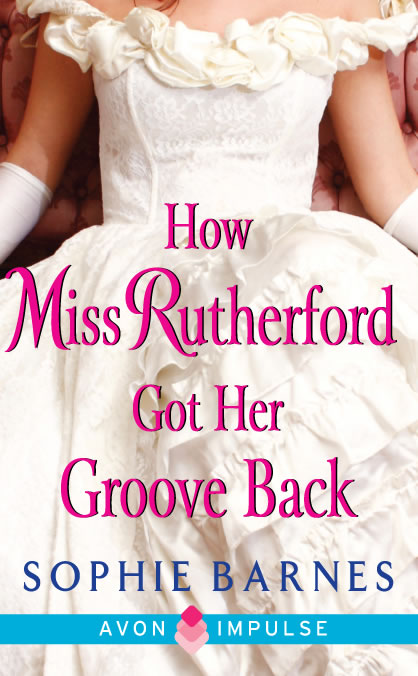
This cover suggests
Boxing Helena to me. Miss Rutherford is presented as a headless torso in an open position. It feels somewhat soulless, which brings me to the title. A genre that is aggressively Caucasian mimicking a very popular contemporary African American title is problematic. Add in that
How Stella Got Her Groove Back was a thinly disguised tip to the author's own (now failed) marriage and certain problems in Barnes' book are thrown into even sharper relief. Emily is a complete Mary Sue, and a manic one at that.
When we first meet Emily she could put Snow White to shame. Living in a cottage with her sisters after being disinherited by her evil step-relative, she whistles while she works. Scrubbing floors and living for the one day a year she is invited to the ball, Emily dreams of marrying her neighbor, her childhood sweetheart, her savior. When this fails to pass, she becomes suicidal. (She is fond of saying things like she should have been
"left to die".) It is not that Emily breaks as much as she dents. Her suicidal depression leaves as quickly as it arrives. Emily walks through a series of cliches that range from the allowable to the completely infuriating while those around her hold her hand and weep over her noble purity of feeling. Those who bruise the tender fruit of Emily's soul are heartless creatures, while Emily herself is excused of all responsibility.
Given that the side characters are so thinly drawn it hardly matters that their emotions are barely noted. At one point Emily is put in possession of an elderly chaperone who immediately goes to her room and fails to appear until close to the end of the book. (Much like the eldest Martin child in the American serial
All My Children, who walked upstairs in the 1970's and was never seen again.) Gone and forgotten, when she is mentioned again I had to flip back to recall who they were discussing. Further removing the reader from an ability to sympathize is the author's inability to choose a path and stay on it. In one scene Emily urges her former fiance and his intended to enjoy every second of their betrothal ball as she could not stand to diminish it in any way. With her very next breath she berates them as undeserving of her. Whiplash moments like these abound. Later in the book Emily rushes off to see the previously rejected BFF as
"I have no quarrel with her, you know." Emily is prone to this kind of passive aggressive bullshit when she isn't making her own life infinitely harder through impulsive and ill considered actions. The author drops in and out of these implausible shifts with equally awkward conversations. Not naturally, or in a way that makes internal sense, but to point out the author realizes this is kind of a left field event. As a reader, I was as bewildered as Emily's former fiance. In addition to the emotional curveballs the author keeps the plot curveballs coming too. (What's that, Lassie? Emily must marry in a month or her sisters lose all? Why didn't anyone mention this 2/3 of the book ago?)
So. Emily kisses childhood friend, Emily jokes about marrying childhood friend, entire town and both families expect it to occur, Emily (when faced with a need to marry) does not tell him. She lives on the neglected corners of his life scrubbing her own floors and waits. Emily charms the birds from the trees with her gaiety. Childhood friend runs off to London and falls in love with BFF who returns to town but doesn't tell Emily who she is engaged to marry so that it can be a shocking revelation at the ball. This makes no sense. I can buy both of them as completely clueless about Emily's air castles, but to not tell your BFF you're marrying a mutual friend? Not to challenge your son on his fiance's changed circumstances? Not to tell your parents ahead of the ball you will announce the engagement at that you're marrying? Like the rest of the book, these events have to happen for other events to happen. At one point I wrote
"Miss Barnes has gone a cliche too far."
The real one eyed reading occurs at the end of the book. Our hero has been harboring the deep dark secret that he is a surrogate child. His father was so enraptured by the surrogate that he installed her in all their homes, preferring her to his wife and living openly with her after his wife's suicide. Since his death said evil doer has been blackmailing our hero for fairly absurd sums of money on the basis of a signed letter confessing all! Why our hero's father would write such a letter set aside, why the hero wouldn't just let her give her plot a shot, all of this you have to take on faith. (After all, this is the guy who thinks Emily isn't like the rest of us but means that in a good way.) Kate (the former BFF) runs to Emily (because she hasn't had enough gas-lighting) and tells Emily that the hero's biological mother is actually his mistress. Rather than run suicidally off into the night like the last time, Emily runs suicidally off to a formerly barely mentioned and shortly never to be mentioned again diabolical relative. She'd rather marry him (here we discover the must marry in a month timetable) than face Hero McIncestCheaterpants again!! (Histrionic, much?) Emily arrives, determined to marry Edward. I was sort of hoping he'd ask Emily if she'd ever consider a soothing drink and a nice cooling cloth, but he's as over the top as the rest of them.
First he gloats about his feelings of inadequacy and then he proclaims he's going to rape her. Emily can't go back to her sisters, her life or our hero. Remember, her former BFF who is engaged to her pretend fiance told her that a woman old enough to be his mother is sleeping with the hero! Rape is her only option!!! Emily starts to take her clothes off like the good little martyr she is. (I think the only way I followed this bit is my southern heritage. Convoluted explanations are our birthright.) Luckily Emily is saved by the hero and Edward is whisked off the canvas with a
"Sorry, my bad" after the hero stakes his prior claim. While we were waiting for Emily to finish taking her clothes off Kate was being berated (yet again) by Emily's equally reality challenged sister. How could Kate make such an allegation? Doesn't she know Emily self harms?? (I hope Kate learns her lesson here and puts as much distance between this toxic family and herself as possible.) Emily is whisked off to marry the hero in secret, since he stopped off at the Get A Special Permit Store and took care of business. At his home, he confesses all (after first dillydallying about confessing anything) and they decide to trick the blackmailer into revealing the location of the letter.
Crazy things happen (big shock) that I am really not interested in reliving. In the course of them the blackmailer reveals a secret addition to the dead Earl's will that leaves her buckets of things. She will trade Emily the letter in return for access to the home (that she already had access to earlier in the book, and earlier in her life) so she may retrieve it. But what's this! As the hero braces himself to learn how his father further betrayed him he discovers the codicil is a giant "
Pwnd!" intended for the blackmailer. It reveals that the letter in question has a fake signature! It can't be used! He knows his wife didn't commit suicide but was killed by his mistress and he kept sleeping with her because... I can't even. Why would you write either document? Man up, dead Earl. Quit abandoning your wife, your son and your duty to the estate. Don't leave her with an inheritance and a blackmail letter and a lot of bad sex memories! On the other hand, if he hadn't then our blackmailer couldn't do what we were all longing to do at this point. She whips out a hidden gun and shoots Emily.
Sadly, Emily survives.
*Since I wrote this (and scheduled it) my kindler, gentler, less annoyed short form review was the subject of one of many sock puppets out in force for those who dare to dislike this book. My personal puppet was as unable to pick a lane and stay in it as Emily herself. (Bless.) Someone should hold a class on Effective Puppetry For The Debut Author with a section on Making It Look At Least Plausibly Organic. That someone won't be me. I can't be bothered. I left How Miss Rutherford Got Her Groove Back intending to try the author's next book. Despite some style issues there were indications that (freed from her melodramatic bent) Barnes could deliver an entertaining tale. Watching the drama playing out over multiple sites I would rather make my break with Miss Barnes as clean as my break with Emily.