Showing posts with label Victorian Kingdom. Show all posts

10 January, 2014

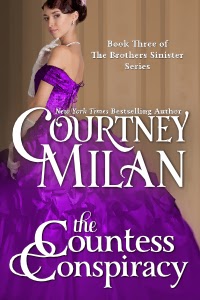
Review: the Countess Conspiracy by Courtney Milan

I am aware Courtney Milan's The Countess Conspiracy has been heavily reviewed. It's at the top of everyone's list for Best Book of 2013. (Save yourself some time, it's good and you should buy it.) Unlike most I had some issues with The Countess Conspiracy that kept me from declaring this her best book ever, ever, ever. It's a good book, it's one of her better books, but did I cry? Not even a sniffle. Every superlative I've ladled over Milan stands and is justified by The Countess Conspiracy. Long may she swim in the butter boat of my adoration. Here's the thing, I didn't want Violet and Sebastian together.
From the prior books in the series it seemed likely they would be together, and for the very reasons that unfolded. Certainly the Violet and Sebastian of this book were perfectly suited and should be together. Absolutely. But what if Violet truly didn't want him? What if Violet deeply treasured his friendship but just wasn't that into him? That was my Violet. I'd toyed with her being interested in Free. I'd toyed with her being truly asexual. I'd considered any number of paths for Violet to walk that I had to abandon to appreciate the path Milan's Violet was on, a path my Violet had already rejected. The real Violet is totally into Sebastian and she absolutely should be. He's divine. I adored the way he had to slowly realize that he was actually just as clever as people thought, despite feeling like a fraud. I applauded the way their lifelong friendship allowed them to see each other's family clearly while giving the wisdom to hold silent. Their miscommunications were appropriate. The relationships with their friends and family was as richly detailed and considered as their relationship with each other. This was a wonderful look at a woman recovering from low expectations and a man from high. Everything about this book is what I want when I want to read a romance.
Which brings us to the close. I've been having a lot of trouble with the final act of romance books lately. Part of it is them, part of it is me. I feel, while reading, as though the end is not something I've arrived at slowly and naturally. Instead a sudden burst of speed occurs as we near the finish. Plot threads start flying, knots are tied,  speeches are hastily assembled, and everything is As It Should Be when our couple embraces on the final page. I feel all askew. I wanted to look out the window a bit longer, I don't understand why we had such a rush and bother. I've become a romance dowager, always too hot or too cold and rarely just right.
At the end of The Countess Conspiracy it's Violet rushing about. I can see her rapid embrace of a newly perceived future but it's all just too easy. Everyone listens to her because she's Violet and the book is ending. I don't want to reveal all the steps to the finish line, if I had my way you'd read the book knowing nothing at all about it when it begins. While Violet deserves her happy ending, this ending was too incandescent for me. There's only one dim spot on her horizon and it's a smudge she can fairly easily live with. Please ignore my curmudgeonly ways and enjoy The Countess Conspiracy for the multitudes of things it gets right. Milan is my favorite author in the field.
* This review originally appeared at Love In The Margins.

16 August, 2013

Review: The Heiress Effect by Courtney Milan


My abiding love for Courtney Milan books is well documented. You should know that I have neither objectivity nor credibility on this subject. (Which means you should totally read every Courtney Milan review I ever write because the breakup is going to an epic bit of room clearing.) ANYWAY. The Heiress Effect. The book she didn't really want to write. Ok, that's probably not true. I'm fairly sure CM wanted to write The Heiress Effect as much as she's wanted to write any of her books in the Brothers Sinister series since she's self publishing and therefore not beholden to contracts, Everything about The Heiress Effect indicates an author wanting to push the edges of the genre out just a bit farther and squeeze more interesting people in the box. Our core couple, Oliver and Jane, are a fairly typical lead. Oliver is of noble blood but moderate birth. He's the stuck between two worlds kind of guy busy figuring out what price is too high to pay for his ambitions. I liked him fine. Jane is desperate to protect her family but constrained by limited legal rights. They should just kiss and get married already so we can move on to the secondary romance.

 Ok. FINE, That's not fair. Oliver and Jane do not suck even a little bit. Jane is a woman of outlandish attire and complete social failure. Oliver is a man of painful exactitude. In each other they recognize kindred spirits, people constrained by the demands of their lives to wear social masks. I loved them, they rock. Jane gets extra points for refusing to take a man willing to accept her when an outsider would claim that's the best she can get. Oliver and Jane, super awesome. But wow, the secondary romance. I need to not spoil it but I need to tell you everything about it in extreme detail. There is a minority character who clearly sees the limits racism put on his career and daily life. There is a disabled character who refuses to accept the limitations others confer on her because of her medical constraints. These crazy kids meet and save themselves. Push a couch under me because I'm swooning.

But wait! You also get the voting rights movement, same sex attracted characters who are neither saints nor sinners, class turmoil and complicated family dynamics. Now how much would you read this? (If Oliver's sister doesn't bat for the home team and hook up with Obvious Childhood Friend I will be so sad. I'm pretty sure Obvious Childhood Friend is actually going to hook up with Jane's Friend instead, though. Wait! What if Jane's Friend and Oliver's Sister are... yes kids, I'm shipping the secondaries.) I'd love to give The Heiress Effect an unqualified endorsement but I can't. The side story of Anjan and Emily is so strong that it occasionally overpowers Oliver and Jane. I don't want to leave Emily to find out what Jane is doing, although when I do Jane is perfectly interesting in her own right. My other caveat is a scene where Emily stands up for proper pronunciation that makes sense from a class and ethnicity perspective but was an eye roller from a reader perspective. I also feel completely unqualified to judge Anjan's family dynamics or Emily's understanding of them. Is she correct? Is this stereotypical? I have no idea. Let me know after you read it.

* This review was originally posted at Love In The Margins.

16 July, 2013

Review: That Scandalous Summer by Meredith Duran

*Someone at Pocket really likes the Angelina Jolie look.

I started this review and then I totally forgot what the book was about. True story.

Duran is not getting enough credit for working outside the Regency period. Sure, Victorian England is the new Regency, but still. She's also diversifying her heroines, replacing the typical virginal heiress with a borderline alcoholic. Our meet cute here finds the heroine passed out drunk in the street and our hero winding his way home from another hard day at the office. Call it the party girl meets the medic. There was something Courtney Milan in the set up, but aspects of the story I expected to find more fully developed slipped away into a conventional resolution.

Liza is down a lover, down a fortune and racing the clock to find herself a new man. With a strong sense of responsibility to her dependents, Liza is the standard Regency hero in a skirt. She's sewn her oats and she's ready to re-don the ball and chain. Duran flirts with the way Liza numbs herself through drink yet she never fully commits to the concept. Liza drinks enough to wake up in strange shrubbery unattended. It's a bit unexpected to find she actually can stop whenever she wants. Happiness easily sobers her up. Overall she's a refreshing change from an uncomplicated heroine but her sadness seemed more assumed than truly heart-wrenching.

Michael has family problems. He's been care-taking his mentally unbalanced brother since the death of said brother's wife and he just can't take it anymore. His brother is destroying himself with grief and suspicion. Here, too, Duran pulls the punch. While the Duke gets a few wonderful lines about the completeness of his power, his resolution makes almost no sense. Liza has the key to breaking through his madness and she comes by it accidentally. She uses that key to blackmail him in a last minute plot twist that doesn't bear deep thought. It works because the story needs it to work and a veil is drawn over any issues. The relationship between Michael and his brother was fairly strong until the easy resolution. The Duke's decline was too total, his radical demands of Michael too intense for the resolution to satisfy. Michael himself becomes an afterthought for me. While he has a number of interesting qualities I wasn't compelled by him.

Overall That Scandalous Summer was a decent but to required read. I enjoyed it as quickly as I forgot it. With a few changes Duran would've had something epic here. I hope next time she dips into mental illness she commits more fully. For me the Duke's cure was akin to Balogh's Silent Melody and equally unsatisfying.

03 January, 2013

Review: Your Wicked Heart by Meredith Duran

I've held off writing this review because so much about Your Wicked Heart annoyed me. First of all, the blurb being used to sell it is not only inaccurate, it's a complete inversion of the central relationship.

"She’ll do whatever it takes to secure a berth on an England-bound ship, even if it means pretending to be the wife of the absentee viscount who jilted her. But when the anchor lifts, she’s not the only impostor on board—for the stranger in her bed claims to be the real Viscount Ripton. Can she trust this devastatingly attractive scoundrel? Or is his offer of friendship only a pretext for seduction...and revenge?" - Simon & Schuster

His offer of friendship? Can I get that again, please?

"Amanda's having the worst day of her life. Her groom failed to appear at the wedding, her employer withheld her references and now a man claiming to be the real Viscount Ripton has kidnapped her. When the anchor lifts she can only pray the truth isn't as bleak as her fears." - Meoskop

I spent less than ten seconds on that. (At least I read the story.) Pretending to be the Viscount's wife? More like destitute bride in search of answers. An offer of friendship? More like crazy accusations and deranged imaginings. Can she trust him? Not if she has half a brain in her head. I haven't been reading Meredith Duran lately. The middle of Your Wicked Heart reminded me why I liked her so much while the beginning and end made me want to DNF the short and call it a day. Amanda is beautifully portrayed as a lost soul at the end of her rope. The book opens on her heartbreak and desperation giving the reader every reason to root for her. Our first encounter with Spencer shows a power mad man who can't function without the full weight of his wealth behind him. He's threatening, he's accusing, he's enraged. He doesn't have to listen to anyone because he has already made up enough answers in his head to satisfy himself. He enables his relatives (who then disappoint him) while assuming the darkest motives in those his relatives dupe.

In the center of the novella I was able to put aside Spencer's extreme dysfunction long enough for Duran to charm me with the tale of a poor little rich boy and a scrambling companion. Amanda's issues of self worth rang true, her desire for more than she has while accepting that she's likely to have even less also worked. Spencer's defensive posturing turned to desperation and exhaustion. Slowly I began to accept that this couple deserved more than a third class ticket on the Titanic. (I even got past Spencer telling Amanda she was inviting rape by appearing above deck without him because he's a super duper good guy and those sailors, no telling! This isn't some classy ship I kidnapped you onto, baby, it's full of all kinds of miscreants!!)

Eventually, Amanda and Spencer catch up to the other Viscount Ripton and all is revealed. (Here lie spoilers.) I was disappointed in Amanda's revelation that she agreed to wed as an escape. A more complex situation involving Amanda actually having feelings for both men would have been welcome. Knowing that Amanda did not love the second Viscount, Spencer still steps aside for the man. Amanda, it seems, is a commodity. He paints it as freedom of choice, but it's still appalling. A freedom of choice requires communication and Spencer hates to use his words when his power will do. Amanda tells them both to get lost. She searches for work she doesn't find until she does. She then rejects the job because Spencer arranged it for her. She hopes he will come and find her. Amanda is about to be homeless, cannot pay for her food, and she turns down the only viable job offer she has based on principle and magical thinking. I completely lost patience with her.

In a less capable author's hands I wouldn't have finished the story. Duran carried me though with her beautiful descriptions of place and her ability to make me feel for the most appalling people. If issues of power and communication bother you less than they do me you'll probably love Your Wicked Heart. There are worse ways to spend a buck and a lot Duran gets right.

25 December, 2012

Review: A Kiss For Midwinter by Courtney Milan

Merry Freaking Christmas, indeed.

In what shocks no one ever (assuming they read my reviews) A Kiss for Midwinter gets high marks from me. I love what Milan does with the emotional life of her characters. In this case she's taken a character that bored me silly in The Duchess War and reinvented her as a fascinating person. Lydia is one of those determinedly happy people. All the glasses are half full all the time and if they're not she'll figure out a way to use shorter tumblers. She's fond of everyone, looking as she does on their brighter side. Everyone but Jonas. When Lydia looks at him she can't maintain her facade of blithe cheer. Jonas knows a bit more about Lydia than she's comfortable with.

Jonas I loved from the beginning. He's the gruff medical character that ends up (eventually, not in this novella, but traditionally) grumbling about his bum leg as he's pulled from his bed in the wee hours to attend yet another odd medical crisis at the local estate. This is that guy, 40 or so years earlier. From the moment he tells Lydia she's the eleventh best looking girl in town I knew who he was. (I know a Jonas or two and that's how their brains work.) He wants a wife and he wants that wife to be Lydia. He needs her determined cheer and her ability to draw a gauze curtain over life's harsher realities. Jonas is a man who faces reality too clearly, too often. A touch of whimsy would serve him well.

For most authors, telling you all of this would spoil the novella. For Milan, that's just the opening pages.  Learning why Lydia avoids Jonas, watching Jonas teach Lydia that his opinion of her is not the one she made up in her head, all these things, are still ahead of you. Milan packs enough detail into her leads for a full length novel. Adding in a subtle (and very holiday appropriate) theme about the transient nature of established traditions, Milan brings Christmas in as more than just a seasonal setting. Times are changing in Victorian England. They're changing what people do and how people think. For Lydia the challenge is to stop acting happy long enough to really be happy. For Jonas, it's to accept (as every doctor must) that some things are beyond his ability to repair.

11 December, 2012

Review: The Duchess War by Courtney Milan

*My reviews of Courtney Milan books are so very boring. "I loved this book. OMG this author. Read it because wow." (How many ways could a fan girl fan if a fan girl could fan girls? I don't know. I'm high on Sudafed.) Anyway. Courtney Milan. New Book. Commence raving. 

The Duchess War is a thing of beauty. How you feel about it may depend on how you feel about other Milan books or what you look for in romance. I'm drawn to character studies. I want broken people feeling their way through a broken world, and Milan gets that. Her characters are not heroic by birth or destiny, they are heroic by choice. In The Duchess War we meet Robert and Minnie. Both are working through the legacy of their parents. I found Robert the more interesting of the two, but it's Minnie who is  the more powerful.

Robert is the image of a man he has defined as a monster. Being his father's son has shaped him more than any other aspect of his life. Robert's life of emotional rejection and economic privilege has led him to embrace radical political views. He is not an unthinking agitator. Robert has taken pains to minimize the effects of his work on those around him. His goal is to unravel the system he believes sheltered his father and allows men like him to escape retribution for their crimes. Everything about him is a reaction to something else. His intense loneliness is a reaction to his parent's rejection and his subsequent rejection of their values. It's a greater self awareness that makes Robert more socially enlightened than his peers. If his father had embraced him, Robert could well have been a carbon copy of his sire. Without a rejection of his father's values, Robert can't make sense of his place in the world. Because of his mother's inclination to extremism, Robert's life as a radical made sense. I believed he would become this person, that he was this person. He may have frustrated me at times, but he didn't ring false. Robert is emotionally guarded to the edge of self harm.

Minnie is no different. Where Robert has embraced radicalism as a rejection of his father, Minnie has embraced conservatism. Her views may mirror Robert's, but her life does not. Having experienced the darker side of fame, Minnie craves security. Economically and emotionally, Minnie is in a precarious situation she knows she cannot sustain. When she meets Robert she's on the edge of a life changing move, one that she believes will lock down the secure box she's created for herself. Robert doesn't undertake any of the typical Hero Knows Best actions of the genre. He is the catalyst that causes Minnie to really look at the path she's forced herself down and consider if it ends in the victory or ruin. Strategy is a theme that runs through The Duchess War. Both Robert and Minnie lead carefully considered lives, perhaps too considered for their own benefit. I found them completely believable as a couple. The difference in social station and reveal of Minnie's past was also smoothly resolved in a way that felt plausible and true. The only off note may have been a scene between Robert and one of his father's victims. (While it granted Robert an understanding he needed, it felt incomplete. The topic was larger than the scene, but may be revisited later.)

I put Courtney Milan in the top ten, perhaps top five, of writers working in the genre today. She's on the front edge of hot trends (bad sex, virgin hero, Victorian social change) while working with time tested romance elements (family relationships, strength in partnership, issues of honor). It's too soon to say where The Duchess War will rank in her entire body of work but if it's not near the top I can't wait to read what beats it.

27 June, 2012

Review: Scandal Wears Satin by Loretta Chase

 Loretta Chase is a victim of high expectations. Scandal Wears Satin is a perfectly serviceable book with a few flaws. Unfortunately when you write like Loretta Chase does you end up being graded on a curve. This is my least favorite Chase book but it still beats most of the wallpaper historical authors working. I want to establish that I know this book would kill as a debut novel. As the second installment of The Dressmakers series it collapses under it's own weight.


Scandal Wears Satin wants to be too many things to too many characters. This keeps it from truly serving any. It also has a tic. I hate that. It can be J.D. Robb running an anal, it can be Jayne Castle and her coff-tea, it can be Loretta Chase and the surname Noriot. I don't care about the context, a tic drives me out of the story and up a wall. In Scandal Wears Satin the word Noirot is an all purpose wallpaper covering a multitude of plot needs.  Why does Sophy do that / think that / feel that? Because she is a Noirot. Often repeatedly. The problem is that while Chase understands enough of what being a Noirot means for the explanation to satisfy, the reader does not. It was her Noriot pride and her Noriot lack of morality and her Noriot style coupled with her Noriot wit that made Sophy a chore to hang out with. Sophy has what could be a fascinating backstory kept hidden from view by the gauzy hand wave of her surname. Sophy also has three sisters. What richer soil is there than the sibling relationship between women? It's never used. Occasionally her older sister (from the prior book) will comfort her or she will worry about the possible reaction of the third sister. (The third sister is nearly invisible.) We have Sophy, from a family of grifters who died of cholera in Paris. She sneaks around London in disguise, works as a columnist and is co-owner of a dress shop. Her sister has recently married a Duke. So of course we spend all our time with Longmore.

Longmore's family is even more fascinating than Sophy's fabled Noriot line. First of all, he's titled and rich. His sister is impulsive and somewhat spoiled. His mother dislikes Sophy. Ok, that's it, we're done. Of course the problems of the extended Longmore clan are the most interesting place to go with this story. It is obvious. Even a Noirot could see it. Or someone who isn't a Noirot. I get confused. Anyway, we also have a street kid with a host of nicknames and a few deft skills that is also just window dressing. His story doesn't go anywhere either. 90% of Scandal Wears Satin involves getting Longmore's incredibly boring sister out of the incredibly predictable problem she's gotten herself into. While there are some interesting side note (Love, love, love Hampton Court as a retirement home) most of the book is just waiting for a different book to happen. Why does Sophy even like Longmore? She thinks he's an idiot. Why does he feed her delusion that he's slow? He shows every sign of intelligence. Why does the rival shop from the prior book enter the picture at all? It doesn't affect the plot in any significant way. Everything about Scandal Wears Satin leads to why? Perhaps it all becomes clear in a third book, perhaps not. Either way I wanted more from the excellent start to this series than I received from Scandal Wears Satin. Maybe it's the Noirot in me.

18 March, 2012

Review: She Tempts The Duke by Lorraine Heath

If you are ever in Indiana I suggest you check out a place called Arni's. On the rare occasions I find myself in Lafayette I HAVE to go and get a pizza. I don't know why. Nothing about it seems like a good idea. I generally eat way too much and regret it for a week or two after. On paper, there is so much wrong with their pizza I can hardly tell where to start. On my plate, it's delicious and devoured.

There is so very much wrong with She Tempts The Duke. I read it cover to cover. (I wish I had an Arni's to go with it. In a different location there's this cute little train that delivers drinks to the tables and... oh right. Books.) She Tempts The Duke takes a basic Beauty & the Beast plot then turns the melodrama up past eleventy. Add to that a completely wonky sense of place and a fairly stale trilogy framework. On paper, this thing is a disaster. We start with three young orphans locked in a tower awaiting their murderous uncle. (As they do) Escape presents itself and the lads scatter to the far corners of plotsville to determine their future narratives.

Our Duke, whose name I've already forgotten, joins the military and fights in a few bazillion wars, leading to his scarred and sinister appearance. He carries a bag of dirt around in his pocket so he can huff it and dream of the land he lost, the land he will reclaim, the property that not even foreclosure by murder could wrest from his hands. (Super melodrama. I am telling you.) On the way he dropped one brother off at a workhouse so he could rise through the ranks of the underworld to become a gaming hell mob lord. (Yawn.) I don't know why our young Duke thought a workhouse was a great idea. I can't imagine my go to girl Paris Hilton thinking "Hey, we totally need to drop Baron off in juvvie, that's going to work out fine." Next he sells his twin brother to a ship. Because ship captains will totally buy your brother off you, especially when the two of you are completely interchangeable. (Now we have our Pirate.) He leaves behind his childhood sweetheart. (I had to go look her name up. Mary and Sebastian, those are our young lovers.) Mary tells her dad that she thinks Sebastian's uncle might be totally evil. Her dad's response is to lock her in a convent and become an alcoholic. As you do.

Pop quiz! What's our time period?

I cannot believe how many of you got it right. YES, shortly after the marriage of Queen Victoria. God, you people are good. I had no idea. When they started talking about Vic's dress I was totally blindsided. Sebastian comes to reclaim his heritage, which happens off the canvas. He and his brothers meet back up after umpteen years apart to have their revenge. Their uncle hasn't declared them dead because he thought it might look bad to accept they aren't just missing until all of them are of legal age. Apparently with all those properties, servants and employees the suddenly missing sons of a suddenly dead Duke didn't raise any red flags before that. Days before he is to declare his spoils well won, those pesky kids show up to keep him from getting away with it. Somehow Sebastian has taken steps to "secure his inheritance" without tipping off his Uncle. I'm not sure how he did that. It was apparently really quick and easy, taking just a couple of days and no legal folk involved at all. So reclaiming his London home is just a matter of a surprise appearance, a melodramatic speech, and a call for the vile one to vacate at once. Of course Sebastian flies into a murderous rage in the process so the gentle hand of Mary can stay him.

Mary just got sprung from the nunnery herownself and is marrying up with a pretty decent guy. Lord Whoever doesn't want much, but he would appreciate it if she'd stop letting herself into Sebastian's house and charging his bedroom. Chaperones still seem pretty important too. Right, so fast forward to (huge spoiler!) Mary and Sebastian getting married. Mary is all we should totally have sex. Sebastian is all wow, sex would be great but it must be on my land because that will make it way hotter for me. Also, I'm really into total darkness. I've got body issues like woah. Mary is like, ok dude, whatever gets you going, but it's just a house. Then they fight. Then Sebastian has the sorts of emotional breakdowns you will after running away from home for like, ever and getting a shot and burned and stabbed in the process. Eventually there is a near death experience and a villain unmasked and all the rest. Then it's baby time!

*PS - Avon cracked on the Agency price with this title, so you can check it out for $5 USD instead of $8. I think that's a better price point.


*PPS - Further reflection on this title makes the choice to send the youngest brother to a workhouse even less understandable. White poverty was criminalized in a way that black poverty is today. The white poor were often sterilized, they were considered mentally deficient and innately immoral. Especially in the early Victorian age, when this sort of social judgement was picking up the steam that would eventually lead to measuring skulls and eugenic theory. I know, it's a romance but C'mon son.

03 January, 2012

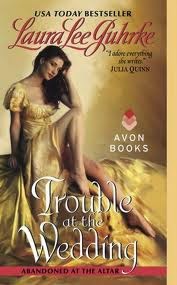
Review: Trouble At The Wedding by Laura Lee Guhrke

I have not been a big fan of this series. In fact, I completely forgot this was a series. (Trouble At The Wedding requires no exposure to the other Abandoned At The Altar books.) Guhrke working with Edwardian characters is brilliant. If you consider how distanced Heyer was from the Regency versus how distant we are from the Edwardians, it makes perfect sense. I can see my great grandparents in these characters, I can relate the things I know of them and their lives to the lives being led by these people. It allows for a familiarity that Regency books don't. While Guhrke is still working with many of the same fairy tale elements that historical romance is based on, this push forward makes them feel fresh. Additionally, there is so much social change and new technology available. (He can admire her car!)

This time around we have the title hunting steel magnolia Annabel versus Christian the (say it with me) Duke. Let's just go ahead and call him Duke, since every man in Romanceland is now a Duke. Anyway, it is very difficult for me to read an American character, especially a southern American character, without getting annoyed. (I imagine it's how the UK feels about every single romance we put out.) Guhrke has dodged that bullet. Her Annabel might drawl but she doesn't dither, she fights without being feisty and she is never going to be called spunky. This is an American without a chip on her shoulder. She wants to fit into British Society and she wants it bad. (Here we pause for a wrong note. Twice her family mentions that they are 'poor white trash'. It's unfortunate that the white is added. While it's a common phrase we are dealing with turn of the century Southern characters, which brings all the post slavery and nascent Jim Crow baggage along. Since this book, like most of Romanceland is All About The White People, tossing the descriptor in threw me out of the story. I have family of that era on both sides of the money tree and that phrase is not in their letters, diaries, or late life conversations. It is a phrase I associate with racists, and my Edwardian to Clinton Era cousin would have as well.)

Right, back to our tale. The Duke is broker than broke and he is offered a fair amount of cash to get Annabel to break it off with her intended fiance. (Where did her uncle get money? Never exactly answered.) Said fiance is (luckily for our Duke!) an uncaring creepster who just wants to be a billionaire so freaking bad. Our Duke isn't interested in marrying for money. He went down that road once before and his Princess Di didn't fare so well. Trapped on a luxury liner with the wedding party, he tries to wake Annabel up to the reality of life under Rumsford. Instead, he reminds her of her weakness for bad boys. Here the book might be the strongest. Annabel and Duke under the pressures of their conflicting desires are far more interesting than your average seafaring couple. It's not so much that the tale weakens when they hit land, but if all had been resolved on the boat I might have loved this one even more.

Annabel and England take to each other fairly easily. England has gotten used to American heiresses since Mr. Duke's time and Annabel is highly motivated. Soon she's realizing she might not have to marry to achieve her goals, she might have just needed the change of venue. Of course, that can't last or Mr. Duke wouldn't get the chance to realize he needs her. So it doesn't, and he does and there it is. I felt the ending was a bit rushed and I really didn't like the theming at the end at all but it was a sin I could forgive. I'd say the first 2/3 of the book was a great read and the last 1/3 had some high notes but dipped a bit lower. Avon has (at least for now) come to their senses on the whole Agency Pricing thing (ok, not completely, but they've stopped charging more than the paperback's going rate) so you can get the eBook for a reasonable $4.99 USD at the moment. On all fronts I'd say things are looking up for the Abandoned At The Altar series.

10 December, 2011

Review: Unraveled by Courtney Milan


You know, I could try and review Courtney Milan's Unraveled. Who would I be kidding? We all know I have been teetering on the edge of full on fawning for this author. I have now fallen completely over the edge. Is it a perfect book? Probably not. Is it an exceptionally excellent book featuring the epic romantic hero Smite? Yes. Yes it is. It's also $3.99 and what you should be reading instead of a review about it.

I swear I will get back to real reviewing tomorrow. Honestly. In the meantime, please appreciate my charter membership in the fan club. (Smite is mine, bitches. Mine.)

25 November, 2011

Review: A Lady's Lesson In Scandal by Meredith Duran

Meredith Duran is an interesting writer. She strikes me as a cross between Judith Ivory and Mary Balogh. Like Balogh, her books are often character studies where little happens externally. Like Ivory, her characters are quite realistic. In A Lady's Lesson In Scandal a lost child is recovered and given the Pygmalion treatment. But her childhood in poverty has made her stronger than the hero, not weaker. Simon has been raised in financial comfort but emotional poverty. As a result, he has found himself with few survival skills outside of his charm. A classic example of meeting the very low bar set for him, Simon keeps his depth hidden. Nell's hard earned need to read people before they strike out allows her to see there is something beneath his surface charm.

I'm surprised to find I have very little to say about Nell and Simon. I very much enjoyed their story. It's definitely on my short list for best books I read this year. (Maybe it's the broken ankle?) The issue of class was executed very well, as Simon's revulsion gives way to a realization of his own petty biases. Nell's anger at her change in circumstance, her refusal to relax her guard and her inability to refute her origins all ring true as well. A Lady's Lesson In Scandal is filled with the sort of small moments that make a character more than a momentary diversion. Nell absolutely found her way into my heart and if she wants Simon, she should have him. I hope there is a sequel in the works. At the book's close we are left with more questions than answers about Nell's separation from her family. It reads like a complete story, but one that leaves the reader wishing it had a few more chapters. If you missed this when it came out, hunt it down. It was absolutely worth the time.

16 October, 2011

Review: All About Seduction by Katy Madison

Katy Madison has my complete attention. 


We're pretty much two for two here. It's interesting to see each generation of authors dust off and shake out the older stories. Katy Madison successfully went after the gothic with her last novel, Tainted By Temptation. This time around she's going with the pimping husband and a sidecar of Shanna.  (Lorraine Heath just took this one on as well, almost redeeming it in the process. Initially, I thought Katy Madison was failing hard in comparison. As All About Seduction continued, I realized she was taking a different but equally successful route to a new look at this tired tale.)

Madison moves her infertile husband and his socialite wife to the Victorian age, offering her more social mobility to work with. Instead of the standard convention of this plot line (the heroine being offered her true love on an adulterous platter) Caroline is faced with a house party of men to choose from. Madison steps away from fantasy to truthfully explore the horror of the heroine's situation. Caroline tries to seduce men as repellant to her as her spouse. Of course there is a man who interests her. Through her relationship with Jack, Caroline slowly reclaims her sexuality. (Jack gets one of the best lines in the book, debunking the 'magic pole' theory of restoring a woman's sexual interest.) After 15 years of rape, Caroline is hardly ready to get wild. Jack is one of her mill workers, saddled with the sort of dysfunctional family many will find relatable. His dreams of becoming a self made man crushed, Jack is willing to risk his own life to be with Caroline.

Despite a slow start, I enjoyed All About Seduction and expect Katy Madison to eventually find her way to my must buy list. With well constructed class differences and a truthful look at the repressed rage of the purchased bride, All About Seduction made good use of this unpopular plot. The ending is a bit neat,  yet Madison lays the groundwork well enough to render it plausible. In this she does surpass the Heath book's wedding-during-birth even as she falls just short in totality. How many authors can stand up to a direct contest to Lorraine Heath? (If I were Madison I'd take the second place with pride.) Of course, the self made ex-husband is a horrible person with a horrible past but it doesn't feel gratuitous. To drive Jack and Caroline to the place they need to be emotionally for this mismatched infidelity to occur, an extreme villain is required. Caroline's family is not as heartless as she assumes, simply distanced by a classic case of the mousy wife in the abuser's trap. Jack's family is weak in a way I personally recognize. They resent his desire to elevate himself from poverty even as they long to improve their own situations. It's an old story, told well here. 


I'm not sure what's next for Katy Madison but I'll show up to find out. Unless it's a harem novel. (Don't dust that one off, it's hopeless. Some plots can't really be redeemed.)

19 September, 2011

Review: In Total Surrender by Anne Mallory

This one's worth Agency pricing. We're talking about Lorraine Heath levels of awesome here. I think it may also be controversial. But we can get to that, right?

The opening had me a little off balance. I was afraid that our heroine, Phoebe Pace, was going to be a TSTL* naive Mary Sunshine type. (At one point I was deeply concerned for her mental stability.) Without giving everything away, I was wrong. So wrong. If Phoebe starts to worry you, give her time. She's worth waiting for. Phoebe's doing the whole "anything for my family" bit but not in a "I'm trading myself for my brother's debts" kind of way. She's more of a bill juggler. You know, like when you accidentally send the power company the phone company's check? (I think they got wise to that one.)  Phoebe's family owes Andreas Merrick quite a bit of cash, but she's thinking they can pay it back if a few events go her way.

Andreas Merrick is the potential controversy. The brother of One Night Is Never Enough's hero, Andreas gives new meaning to 'dangerous to know'. (He's a crime lord, it makes sense.) Taking the realistic outcome of the Merrick brothers background to the next level, Mallory makes it clear that Andreas isn't secretly a super nice and harmless guy. He kills people on at least a weekly basis. While it startled me, it works. We have so many dark, angsty, self made men in Romance Land that claw their way up, run gangs, control vast sections of London, and manage to do it all without hurting anyone. If you're a universally feared ruler of the streets, it's likely more than just talk. I can see some readers having difficulty accepting that Andreas isn't a nice guy. It's not a nice world he lives in. In his world, nice means dead.

So Phoebe wants to save her family business and Andreas wants to destroy it as a step on his path to revenge. (Those dark and angsty guys always have the revenge thing going on.) Poor Phoebe is caught in the middle with her company on one side and Andreas's enemy on the other.  I loved the power struggle between these two equally determined characters so much. I read a Lorraine Heath novel directly after In Total Surrender and I still say Anne Mallory has turned in one of the best books of the year. It's so good I even forgive her giving our super dreamy Andreas a definitely not dreamy family member. (We'll just pretend we've never seen that guy's picture, ok?)

In Total Surrender works on it's own terms but I think my emotional connection to the characters was aided by having read One Night Is Never Enough. Both Andreas's social awkwardness and Roman Merrick's flippant attitude are well established in the prior book. While In Total Surrender certainly explains both, I would read the two together if possible. I hope this book puts Anne Mallory where she belongs. She is on my short list of favorite historical authors. This has been an interesting series from Mallory, asking us as readers to accept that the dangerous hero is often a murderous one. It would be easy for her to spin a series off from the other side of the coin, people who have suffered as the unseen collateral damage of the brothers. I can't explain why women are attracted to men like these in life, but in fiction the Merrick brothers are certainly worth the trouble.

*Too Stupid To Live

10 September, 2011

Review: Unclaimed by Courtney Milan

Do you think if I rolled around on the floor and waved my arms that Courtney Milan would rub my tummy? Because I have to tell you, I am so her bitch. Which is not to say that Unclaimed is perfection in a yellow cover. There's an editorial choice made near the end that I take issue with. (Everyone loves a reunion story, I suppose.)

Back to the book. Mark is the poster child for purity. This made me nervous because in my experience the guys with the purity rings are either A) lying, B) closet cases or C) destined to cheat on their RealDoll. (Did you see the episode of Dollhouse with the RealDolls and the golfing serial killer? I mean, all the icky rape culture implications aside, oh wait. You can't examine Dollhouse without them. Hm. Back to the book again.) Mark is D) None of the above! Mark Turner is Jonas Brothers famous for being a normal guy who just decided not to exploit women.

Jessica (I started to Google Jessica as a Victorian name but I got distracted by Rhenis as a cross gender name of unknown origin and ended up just trusting Milan. I mean, this is a series with a dude named Smite. If she wants a Jessica she can have a Jessica. It's probably even historically accurate.) is not as impressed with Mark's purity as the rest of London. (I don't think she'd be into boy bands either. Jessica strikes me as more of a bar rock kind of girl.) She hasn't been a virgin in a very long time, leading her to think that Mark is of the lying type. For the right bribe, she'll prove it. This leads to a WTF moment for me. It seems the Turner boys reclaimed their childhood home. Some serious stuff went down in that house but Mark decides to go back there to lay low. I haven't been in my childhood home in (cough) years and I still have nightmares about the place. I didn't have half of what the Turner boys dealt with so their affinity for the home confused me. But it's Mark's house, he can live in it. Flashbacks are his own fault. (Burn it down and salt the earth, I say.)

Aside from Mark and Jessica there are some really excellent side characters and a number of Smite sightings. (He's the cute Jonas Turner.) Also, a dog. Sort of. Mark has to deal with all the small town drama that his celebrity and her impurity bring with them while navigating his very normal personal desires. Jessica realizes she's been living inside a shell of herself, unable to see past her survival mode long enough to claim her own life back. I adored them, and I adored their story. Even with the sentimental bits and the weird real estate issue. Unclaimed is a love letter to morality for morality's sake and the power of siblings in our lives. Bring on Smite and toss me a tennis ball.

25 August, 2011

Review: The Many Sins of Lord Cameron by Jennifer Ashley

People love this book. I get it.

I waited a few weeks to review The Many Sins of Lord Cameron because explaining my negative feelings about it requires spoiling some key plot elements. I should probably wait a bit longer (fans of the book will suggest forever) but I'm going to take the plunge. I'll tell you when we get to the spoilery bits. River Song is really... (no, I'm just kidding).

Right, so Dr. Who references aside, here is what I loved about The Many Sins of Lord Cameron. In Ainsley we have a very original heroine. She's doing the whole friend of the Queen thing, but she's doing it for money instead of love. Ainsley is the widow of a much older husband whom she both respected and slept with (is that a spoiler or just a shocker?) and now she runs sensitive errands for Queen Victoria. Ainsley is interesting. She's also a bit inconsistently drawn, but only a bit. If the whole book hung on my feelings about Ainsley we'd be sitting pretty right now. Cameron carries over well from his previous appearances. He's still treating women like Kleenex while haphazardly single parenting an overly precocious son. (Bonus points for the way said son tries to parent his father. That rings true and shows he's got some tightly packed baggage of his own.) So, consistent Cameron and appealing Ainsley should make a perfect evening, right? Here comes the plot revealing part of this. Meaning now. Duly warned!

It's Scottish Romance meets Telenovela. Cameron's dead wife wasn't just crazy. She was maniacal played by Jack Nicholson we'll sell you the whole seat but you only need the edge crazy. Cameron in an abusive relationship? Sure. His wife being manic, or bipolar, or suffering from postpartum depression? I'm right there with you. A completely unhinged sexually voracious suicidal murderess who sodomizes him with a poker? Um, make up your mind? Cameron is afraid to sleep with women because his wife repeatedly attacked him despite his attempts to confine her or protect himself. It's the repeatedly that gets you. Sure, she shoved a poker up my ass, maybe even a few times, but that's no reason to lock her up away from the kid and me, is it? Sure, she's crazy as all hell and sleeps around when she's not lying to my face, but I have to keep her close just in case she's having my kid! My crazy dad was still alive, so my options were limited!  It's a bit much to ask of the reader. Yes, there are people that crazy and there are people that live with them, but I wasn't willing to believe it of this group.

Adding to that, you've got what borders on a bad case of Magical Romney. Why can't people just have met? Why does someone have to have saved someone's life? Why does one side of the equation have to be servile (yet appropriately disrespectful) to the other? Then you've got the mustache twirling bad guy who lives only for profit, unless that profit is made from a a Scottish purse, in which case he'd rather try to... I couldn't even follow it. There's this horse, right? And this crazy dude wants to race it so he bullies Cameron into training it. Horse doesn't win, guy ramps up the bullying, but Cameron is just training the horse because he likes it. Guy won't sell the horse because Cameron is Scottish. Guy wants the horse to win so he can sell it. Cameron says name your price and the guy refuses because, again, no doing business with a Scotsman that you're already doing business with. Guy isn't just mean to horses and a bad businessman, he's a bigot! Because no one in this book ever says "Eh, WTF, let's find something else to worry about." No, they have Epic And Unsolveable Problems.  Of course, it's Ainsley who makes the shocking realization that someone else could buy the horse. Someone who (wait for it) isn't Scottish! You can see why the Queen trusts her to deal with blackmailers and stuff.

Victoria is her own issue. Depending on the needs of the plot Ainsley is either entirely at her beck and call or able to freely leave her side. When the queen is utterly displeased with Ainsley and sends her away, Ainsley responds by making physical contact with the queen and speaking freely. You know, as you do with a boss you just totally pissed off. You give them a smooch and a few words of advice while they're firing your ass. (I don't think Ainsley is going to be eligible for rehire). I didn't hate The Many Sins of Lord Cameron, but I struggled to finish it. The flaws were not enough to put me off the series. I'll be back for the next chapter. I hope it's a bit calmer than this one. I'm an old(ish) woman. I can only take so much drama without a nice lie-down.

21 June, 2011

Review: One Touch of Scandal by Liz Carlyle

Never taunt your TBR pile, kids.

After the awesome read that was Wicked All Day, I was unprepared for One Touch of Scandal. This is one of those reviews where anything you say (no matter how true to your feelings) seems mean. I hated it so much I'm sorry there's a sequel. And perhaps the author feels the same way because the book advertised in the back of One Touch of Scandal, the serially named One Wicked Glance has been renamed The Bride Wore Scarlet (to be followed by The Bride Wore Pearls). Although Amazon sells One Touch of Scandal, you won't find it on their Complete List of Liz Carlyle Books nor is it listed on Amazon's Liz Carlyle Page. Unless you search by title, Amazon goes directly from Wicked All Day to The Bride Wore Scarlet without a book between. (They tried to warn me I suppose) I have an ARC of The Bride Wore Scarlet, so I'll report back next month on that.

On the positive side, our hero Ruthveyn's mother was from India. His heritage is handled fairly well (although of course he's into tantric sex). Our heroine had a French father so she gets her share of exotic in as well. Neither of them slip into offensive territory or use heritage as a substitute for character. There is also a nice scene at a tomb where Grace gives in to grief after being snubbed by the family of her former fiance. It's a bit odd that she just accepts the snubbing (time and again) for as long as she does but we will give her that - she is in mourning after all.

Ok, that's it. We've covered the parts I liked. There's a murder and it's only a mystery to the characters in the book. If you haven't figured out who did the deed by the end of the first chapter this might be your first time. In fact, the murderer seemed so obvious I thought it was a red herring and became annoyed as the clues toward that presumed red herring built up. But whatever, dead guy, suspicion, Grace on the run. She runs right into a (get ready) Super Secret Society of Psychics. No, this isn't a Jayne Ann Krentz book. Yes I know Liz Carlyle is better than that, but apparently a deep seated need to write about pseudo Masons and the Chosen Ones overtook her.  It's not paranormal, it's not steampunk, it's not even butter. I described it elsewhere as stumbling into a bad cosplay event where people were trying to bend spoons with their minds. I meant it. This is the lamest Boys Only, Girls Are Too Loud secret society ever. At one point Grace tries to tell Ruthveyn's sister that she's not psychic when the sister is all "Don't you find you are a good judge of people? AHA! You are just untrained!" I half expected her to add "And can't you always smell when the cookies are burning? AHA!" 

Right. So Ruthveyn finds Grace extra hot because he can't tell when she's going to die or what she's thinking (his super powers) meaning she might be his soul mate! I agree that seeing how someone dies whenever you touch them has to be unsettling at best, but this is one of my least favorite coupling tricks. "I understand you less than anyone else I know - I must have you!" For her part, Grace wants a family. Any family. A dog, a few kids, she just wants to get away from her Aunt and stay away. Ruthveyn will do just fine even before they find out... look, if telling you they are related is going to spoil the book for you then I have done you a favor. Grace has blood heritage to the Super Secrets too! Decoder rings for everyone!

I was done long before Ruthveyn cured his long standing drug use (he charms Grace with a Snoop Doggy Dawg imitation) via one night of sex. I was done before he caught a friend in a compromising position with a tabloid reporter and dealt with it by thinking sure, maybe they'd done some crazy stuff they'd both like to forget during those opium orgies back in the day but no way did that make anyone gay! Then Grace agrees. She knows that guy as well and no way is he gay. Not him. Nuh-uh. Look how upset he is at almost kissing a girl! Um, I mean, boy! There's more to that, for sure! What could it be? What? What could it be!

I'm hoping The Bride Wore Scarlet is significantly more enjoyable than One Touch of Scandal was. We're going to start with two problems. One is it being a sequel to this mess. The other is that Carlyle apparently ties her paranormal world into her previously established non paranormal families. I like Liz Carlyle, I'm pulling for her on this one, but I'd be lying if I said I wasn't scared.

23 April, 2011

Review: Royal Weddings by Stephanie Laurens, Gaelen Foley & Loretta Chase

I don't really understand this marketing.

Avon isn't the only imprint offering short stories to celebrate the wedding of William & Catherine of England, but I still don't quite get it. These weddings are royal in name only, as none of the couples concerned are themselves royal. To earn the Royal Weddings moniker, the events take place during other weddings - but not at them. I know, I already said the marketing confused me. So let's ignore it. Is this worth your cash? Yea, I think so. This isn't a bargain priced full anthology, these shorts are super short, but it's two bucks. What's two bucks these days? (Ok, yes, it could be lunch. I give you the point.)

Stephanie Laurens and I have been planning to break up. I read the final book in her last series and just couldn't bring myself to read The Black Cobra Quartet at all. Imagine my surprise when the best, most satisfying short is hers. Taking a woman who's drifted into wedding planning and a French aristocrat, she delivers a tasty bite size treat without annoying me at all. It's like running into an ex at a party and realizing they don't make you feel vaguely sick anymore, but not quite waking up at their place the next day.

Gaelen Foley wasn't for me. We split up during her India series and I'm not even sure what she's done since. In this one she takes the set up of a happily (from the outside) married couple and their failure to talk. While she gets the biting internal conversations down, the story itself did nothing for me. Pout, have sex, change jobs. Or something like that. Mostly it felt like an erotic short which works for plenty of people but bored me. Gaelen, we weren't meant to stay together. I know you don't miss me. It's ok. I still have Loretta.

Loretta can call me up at 3 am, ask me to meet her in a pouring rainstorm in a dodgy area of town and I'll have my keys in my hands before she stops speaking. (At least, she can right now. I'm fickle, the future is uncertain, void where prohibited by law.) Her couple were supposed to be at the wedding of Princess Victoria and Prince Albert (Now there is a setting - go to the wedding people!! Describe it! Be there! Discuss it! That's your marketing... oh never mind.) but instead find themselves... elsewhere. It's such a short and so beautifully constructed I don't want to tell you anything about it. It's like someone starts folding up a paper and I yell "Goldfish!" before they've even got to the tail. Ultimately, it left me wanting. The characters were ready for a full length book, or at least a longer novella. I enjoyed every bit of it but it's like settling down with a lovely dessert, slowly savoring it, licking the fork between bites and suddenly someone walks up and says "Wow! I love this cake - thanks for sharing!" sticks a fork in and takes the rest away. It was perfect, but it's gone.

14 February, 2011

Review: Scandal of the Year by Laura Guhrke

I didn't hate it as much as the last one?

Scandal of the Year's main problems (outside of the book itself) are reader expectation and Agency pricing. I expect to love a Laura Lee Guhrke book. I resent not loving one far more when I've paid the full Agency freight. In order to detail what I didn't like about Scandal of the Year I'm going to have to spoil some major plot points. So let me say here that it is better than Wedding of the Season and does not depend on knowledge of that book for it's plot. There is every chance you will love it. Do not read on if you think you might wish to read this book free from plot details. Make your buying choice without me. It's better for both of us.

(Well that's out of the way. You've only yourself to blame from here.) So in the prior book, Aidan was an uptight dude who totally had contempt for the married Julia's free for all ways. She was a madcap blithe spirit who rubbed his fur backwards, the in-law he least looked forward to acquiring from his shiny new fiancee Beatrix. Now Aidan has lost a second fiancee (off camera) because he was caught naked with Julia by her estranged husband and was named in the divorce. (Ok, I'm cool with that.) The problem is, Aidan didn't really hate Julia he just told himself he did because he met her umpteen years ago when she was 17 and .... I know, right? Already the first book is starting to fall apart. Why didn't they mention this before? Why would he marry the cousin of the women he was obsessed with? What could be so awesome about that meeting... it doesn't improve upon inspection. Not only did he meet Julia for like, five minutes, but she had also recently found out her fiance was dead (barely a hitch in her stride) and was being forced to marry someone else. There are three different books being shoehorned into one to force a Sleeping Beauty theme here. You've got star crossed childhood sweethearts (but not really), lost love regained (but not really) and the uptight dude meets the free spirit that unlocks him all going on at once.

Now how much would you pay?

But wait! If you call right now you also get emotional shut down from an abusive relationship. Julia is the life of the party with the sad heart of a clown. She smiles to keep from crying. I have a problem with that part of her backstory as well. It's not that her husband is a crazy violent rapist, it's that for a time he finds a mistress who likes that sort of thing and he leaves her alone. So which is it? He was romantically obsessed with her and only enjoys raping women, or he's a BDSM freak who can't play vanilla? It's not the same thing. A true BDSM freak isn't into rape, and a true rapist isn't into willing mistresses. I'm all about the vanilla and I know that. So Julia's powerful story of overcoming socially condoned rape is tainted by the question of perceptions. Was he chalk? Was he cheese? If he was chalk, why did he let her go at all? If he was cheese, why didn't he let her go sooner? It doesn't fit.

But back to Julia. I liked that she dealt with her own problems, I liked that she knew she was emotionally damaged, I liked that she confronted her all consuming (and so trendy) debt without apology or a desire for self exploration. I liked that she was imperfect. (I think the subtext of this series might be imperfect characters.) I liked that she did bad things for her own reasons, but owned it. I liked the way she hid from reality when she could. I liked her not quite as much as I did in Beatrix's book, but that's probably because I wasn't grateful to her for giving me someone other than Beatrix to read about. If Aidan really had not liked her, if his disapproval was real but slowly eroded through understanding her, I would have loved them together. Aidan hating her to resist loving her just annoyed me. It makes no sense to the character of Aidan and it makes no sense to their prior interactions. There's no reason for it but hormones.

And yet. Aspects of Scandal of the Year are fantastic and original. Julia's sense of independence, Aidan's quiet responsibility, tennis games instead of boxing matches, so many details creating a fresher whole. It's that much more frustrating when the details need scotch tape to hold them in place.

25 January, 2011

Review: Unveiled by Courtney Milan

At this point it's just embarrassing.

I should have at least some pride. It's not like it's the first time I've felt this way, there was another author once. (Ok, maybe a few, I'm not going to lie.) At this point I should be able to come up with something a little better for this review than "omgIlovedyourbooksomuch" shouldn't I? I've been reviewing for various places for long enough to know better. This is probably a book with flaws. I have no idea what they are. If you show me, I'll dispute them. This is Courtney Milan's best book. The sheer hell of it is that this is my absolute least favorite romance genre jumping point. I cannot stand books that set up the disinherited heroine trying to retain her property and her resentment of the newly inheriting lordling. Hate them all.

Smarty Pants Milan has knocked the legs right out from under me. In the case of Ash and Margaret, she has every right to be outraged. Rather than a simple death setting off a legal transfer of property, Ash has set out to obtain the property through completely honest but untraditional means. In a wild youth none can even imagine now, Margaret's father married his mistress. Unfortunately, by the time he married Margaret's mother said mistress had not died. (Which begs a question - if that mistress had children would they be in line to inherit? Will Ash end up handing it off to a completely unrelated third party? He's the sort that would, if he felt like it.) So, Margaret isn't just a spiteful princess when she resents Ash so much as breathing the air on the estate, she's just sensible.

Ash isn't headed for a comeuppance, either. He is the legal heir. The current holder of the title is a complete tool who deserves taking down a peg or fifty and his sons are pretty obnoxious as well, if not obnoxious enough for Margaret to realize Ash is somewhat in the right of it all. I think the underlying theme of this trilogy is going to be Things You Don't Tell Your Family. Unveiled isn't a book with unrealistic revelations, it's a book filled with the tiny "why didn't you tell me" moments that lead to so much emotional distance between people. Ash is a creature of instinct. He wants the property because it feels like the right course to take, and his instincts have rarely served him ill. Margaret is just learning what her instincts are after a lifetime of drifting along in her designated lane. Both of them are trying to remain loyal to their brothers while wanting to be loyal to each other. It is a wonderful conflict.

My enjoyment of this book was increased by personal identification. Ash has a crazy bible thumping parent? Me too! Ash has secret reasons for living by his impulses? Me too! Ash had to leave younger siblings behind to secure all their futures? Me too! I could go on, but you were bored at the first paragraph of this review and I've no idea why you've hung on as long as you have. Read this book. Join me in my girlish infatuation. Savor the small moments, such as a few lines revealing why every historical romance sex scene at a ball ever was impossibly wrong, or when the theme of this specific volume is revealed. You matter. You are important. I used similar words last October to explain why romance, as a genre, is important to me.


Unveiled is a perfect example. Buy it. Forget what I said about her last books, buy this one first. Now if you'll excuse me, I have to compose myself before I face the next book I'll be reading. (I feel sorry for it, really. I'll just be going through the pages.)

04 January, 2011

Review: Wedding of the Season by Laura Lee Guhrke

My book bag is trying to kill me. First it offers up the Trophy Wife of the Closet Queen, and now it hands me My Racist Hero. As accessories go, the dark skinned and grateful valet doesn't flatter anyone. The hero who chuckles condescendingly over saving the astonishingly capable valet's life holds about as much appeal for me as the hero who spends the first third of the book chasing down STD's. Where do these servants come from? The dark skinned, the dusky, the obviously not the right kind of brown (sunburned = adventure, birth = valet) men whose brains are packed with trivia, who can handle any crisis with the emotionless calm of "their people", who follow their employer to new lands and serve them with unquestioning faithfulness, yet still require some white guy to show up and save their lives.

I don't know about you, someone saves my life I say thank you. Maybe a fruit basket plays into it, but spending the rest of my days stroking his ego isn't on the list. Taking it the other way, saving someone else's life wouldn't make me think "Wow, I should hire this guy and put him in charge of my entire life!" Trusting Laura Lee Gurhke as I do, my hope was that Aman was biding his time. "Yes sir, very good sir, knife to the ribs sir?" Sadly, he wasn't. "Saving my life, sir? Jolly good idea! Here's your beverage!" Aman was implacable, he was unemotional, he was overly prepared and faultlessly loyal. He was everything the touch of exotic usually is, but he failed to be a real character. Citing his cultural heritage as the source of his fatalistic demeanor made me wonder how many Egyptians the author hangs out with.

I don't find colonialism a sexy trait in a man, real or fictional. (At least the STD's can be treated.) After I got past wanting Aman to school Will on who goes down when the revolution comes, I was able to engage in the story of Will and Beatrix. I am a sucker for stories of love recaptured. Early on, Beatrix showed an adorable mean streak that gave me hope. Unfortunately, like Aman, she was more promise than performance. Will ran off on their wedding for a professional opportunity that has bankrupted him. Colonialist as he may be in his private life, he thinks he's free of class issues. Being a duke was just so dreary and last century compared to the possibility of life as a paid speaker. In fact, both Beatrix and Will have deeply odd ideas of what freedom is and what confers it. Will returns not for her, but to borrow money from her cousin. (Narrow-minded AND panhandling, baby hold me back.) Far from realizing that refusing to leave her way of life was a valid choice, Will begins to belittle her. Not wanting what he wants is a sign of cowardice. Going bankrupt chasing Tut's tomb is the only life for... Well, Will. If you want to be with Will you better want what he wants, because his brain is an express train to Willville.

Once Will is firmly back in her life, Beatrix loses the refreshingly callous impulses she briefly showed. Engaged to another, it is never a true contest. Despite having six full years to do so, Beatrix has failed to fall in love with anyone. Not even a stylish footman has captured her eye. Her fiancĂ© is a friend, not a lover. In her late 20's Beatrix has all the life experience of a fifteen year old girl. She and Will begin a predictable courtship that plays to familiar lines. There are engaging touches, the dialogue between Will and Beatrix's cousin Julia is one of the books best bits. Similarly, an argument between Beatrix and Julia holds more passion than those between she and Will. Pixy's Cove, where the action plays out, is well realized. It's enough to lift Wedding of the Season out of the rut it found itself in, but not enough to place it with Gurhke's best. In fact, there are enough stumbling blocks in Wedding to make it the first Laura Lee Gurhke book I would not recommend. 


Despite some bright spots, Will reads like the beloved but toxic father of a heroine in a better book, a heroine whose loving yet weak willed mother died young, leaving the heroine stuck caring for her obsessed father. Maybe that's the World War 2 based sequel. Somehow I doubt it.