Showing posts with label November 2013. Show all posts

20 February, 2014

Review: No Place for A Dame by Connie Brockway

Uncle. Seriously. I give up.

I’ve been trying to read Connie Brockway’s No Place For A Dame since November 1st. I think three months is enough. Why don’t I love this book? No idea. None. The setup is a science minded heroine and her non science minded man. There’s class conflict – he’s titled, she’s the daughter of an employee. Brockway is an author I generally enjoy, and yet  five seconds after I’ve set it down I forget everything about it. Are those scenes from this book? Other books? What was it about again? Oh yea.. I should… is that glitter?

Avery Quinn, our heroine, is the daughter of (a gamekeeper?) someone who saved our hero’s dad’s life and has therefore been set up as a quasi ward. She’s been shipped out to various scientific homes to study astronomy under the greats. If Avery was overly worldly and possibly cynical it would make some sense. Instead Avery has emerged from her academic travels almost painfully naive. She is neither of her originating class nor of her adoptive one, and she seems to understand little of both. There’s a Manic Pixie Dream Girl happening here, actually. Avery is blasting into Giles life with her obsessions and her quirks to shine a light into his corners. I think. Remember, I didn’t finish it.

So Giles is charming, rich, titled and with daddy issues for days when Avery (decides? requires?) takes a trip to London so she can join the Royal Astronomical Society by cross dressing. (As you do.) There’s some reason Giles has to go along with it (or suggests it?) but he leaves her to get there solo to see if her disguise will hold. She is neither quickly unmasked nor entirely successful in her disguise. Rather than having the Magic Breasts For Binding that so many full figured heroines do, Avery find herself wearing a fat suit. She’s a Humpty Dumpty of a lad with spindly legs and arms and a youthful face. People find her odd, but not as odd as Giles being interested in the stars.

I think the point where I gave up was something to do with her wanting to see the gentleman’s club, which Giles balks at. She is trapped in the house and bored so she befriends another young man thereby ending up in a carriage crash outside the same gentleman’s club, which Giles then invites her into. His objections that were routed in principal are suddenly swept away by practicality. There’s a lot of this in the oddly titled No Place for A Dame, Avery cannot do things until suddenly she can. Things are wrong until they are not. Let’s all smash the patriarchy because science.

There’s some bit about spy cartels and missing agents and mortal enemies and Giles being in disguise and… surely in all of this there would be something for me to care about? One would think? Alas, there was not. No Place for A Dame should have been an Americana piece about the infiltration of local government during prohibition. Or something. Something other than pseudo ward / spy guardian it’s tough out here for a lady scientist in Romanceland romping. Anyway, everyone loves it but me. If egg slash is your thing, Avery’s got your suit. Go crazy.

*This review originally appeared at Love In The Margins

15 January, 2014

Review: No Good Duke Goes Unpunished by Sarah MacLean

Sarah MacLean keeps improving, but No Good Duke Goes Unpunished hits some of the same buttons One Good Earl Deserves A Lover did. Also, there's a black guy in this one but he's not going to be the romantic lead of the next book. He's only there for (would it be unfair to say color?) background depth. I sound snarky (and I am) but I appreciated the acknowledgement that the world these characters live in would have some diversity. I held off reviewing No Good Duke Goes Unpunished because the author wanted it to be approached without spoilers and my review is going to be spoiller-riffic. 
The major revelation (of course) is contained in the epilogue. Who is the mysterious Chase? You'll shrug as the heavily foreshadowed revelation is made. I suspected the answer in Book One (felt pretty certain in Book Two) but was thrown off by the Twitterverse reaction. I'm not going to directly reveal this one, but other things I discuss may obliquely do so. Again, stop here to maintain your ignorance before reading the book.
Temple, the powerful fighter known as The Killer Duke, is the hero of this one. Mara Lowe, the women he believes he murdered, steps up to be the heroine. Temple is offered his old life back, the proof of his innocence in Mara's distinctive features. Mara has no former friends, no extended family. There is only Mara and her brother, a man who has taunted and tormented Temple since the alleged murder. Turned out by his father, Temple made his living fighting on the streets before rising to power as an owner of The Fallen Angel nightclub. Nights find him boxing the ruined patrons whose gambling losses fund the club. Days mean distant management of his ducal holdings. Temple is inconsistent but resonant. I found him to be the most fully realized of MacLean's Scoundrels.
Mara could have been a very strong heroine. She was marred for me by the inconsistency of her story. By that I don't mean the lies she tells Temple, rather the trajectory her life takes after he wakes up covered in blood. While I will give Mara her carefully planned disappearance, her reappearance has several difficult elements. If we accept her current career, we have to accept the book's explanation for how she came to have it. If we accept that, then her circumstances when we meet make little sense. Where did her backers go? Why are they unable to assist her in any fashion? How does a woman able to exploit any situation to ensure her own survival not leverage her multitude of secrets into support payments? If we accept that Mara is alone, with no former friends or extended family except her brother, then her career is a major leap of faith.
Up to the final section of the book the relationships between Mara and Temple, Mara and her brother, Temple and his partners, are all solid. An opportunity to explore sudden disability is squandered, but probably wisely. There's the requisite Good With Kids scene, the Jealous Without Cause bit (quickly dismissed) and a nice evolution of the two coming to understand how they both participated in a defining moment in their lives. I could root for Mara and Temple to work things out. Both their backstories made sense. Mara enjoys self harming as much as Temple. Where he fights in the ring, she fights herself. Everything is Mara's fault, everything was caused by Mara. She never stands up and says "wait a minute, that part is all you" without quickly adding "but you wouldn't have done that if not for what I did." Like Chase, I found that aspect of her personality tedious.
Where it all goes wrong for me is during the Near Death Experience. (With the well known Rapid Healing Ability most  NDE characters have.) There is so much talking. So much. Temple's partners are willing to kill for him, but they never do. They do precious little. Each takes their turn standing on stage to loudly proclaim their devotion, followed by almost no action. It's chest thumping for the hell of it. Women save the day repeatedly, almost ludicrously. We tip from only men acting to only women acting as the men flutter about frowning and missing all the points. Soon Mara is busting through windows and disowning the brother she was protecting moments before.
This entire scene makes no sense at all. Mara's brother was the cause of the NDE. The club members have been searching for him with amazing inefficiency. There are any number of charges they could bring against him, if they chose not to murder him on sight. Yet he enters The Fallen Angel freely to confront Temple. Absolutely no part of this makes sense. None of it should happen. The staff and owners stand by, leaving only Mara available to save the pointlessly endangered day. I was face palming all the way through. MacLean had already strained my patience by Temple handwaving a major betrayal by Chase. Chase compounds that betrayal through further actions that put Mara in the Save The Day position.  My "Dude, Really?" trigger flipped over to "DUDE! REALLY?!" Mara and Temple should both abandon everyone they know and never make a friend again. They completely suck at judging people. Anyway, read it but be ready for the Supergirl moments and lower your expectations that The Scoundrels do anything but thump their chests whilst bellowing.
* This review originally appeared at Love In The Margins and NGDGU inspired a spoiler filled rant as well. 

06 January, 2014

Review: The One She Was Warned About by Shoma Narayanan

Shoma Narayanan was suggested to me by Suleikha Snyder, and it's a good match of author and reader. I fell completely in love with the heroine of The One She Was Warned About. Shweta is professionally confident but personally uncertain. On the edge of pushing for marriage to a man more suitable for her father to marry, she runs into a childhood frenemy. Nikhil is the boy next door made good. Once an illegitimate young troublemaker, he is now a successful business owner with ties to the entertainment industry. It's a boy next door story.
Shweta is less than impressed with Nikhil's success. While she's pleased for him, she is frustrated by his refusal to set aside the pain of his past and appreciate what he has. Shweta does not see Nikhil's return to her life as a lottery ticket she dare not misplace. She sees Nikhil as a new and interesting option. While her own insecurities and hot temper drive some of their disagreements, the main source of their conflict is Nikhil. Until he has moved beyond his childish view of his parents and his life, Shweta cannot trust him as her partner.
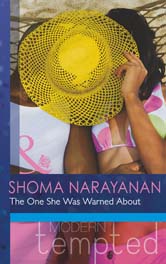
In this image of a man and woman embracing in a hammock, the man's skin is lighter than in the cover above.This sweet romance was consistent in characterization and tone. The office relationships were as believable as the family ones. There were a few points in the book that felt like they had been included for the western or white reader. Narayanan explains general customs at Diwali in one point, yet ignores them at another. It threw me out of the book to have the author explaining something that would be so basic to the characters. Romances with a white focus do not explain our common holiday practices. An author might indicate how her characters deviate from or cling to the norm, but a full explanation is unusual. Aside from those awkward moments, The One She Was Warned About caused me to purchase more by the author as soon as I closed it.
on a yellow backound a man stand behind a pensive woman, embracing her. We see only their heads and shoulders.
I came across several versions of cover art for The One She Was Warned About with interesting differences. The first cover (top left) is for the American market. To my eyes, it appears Nikhil has been lightened from the Mills & Boon version made for the UK (center right). It could be a combination of the dark title coloring and the reduced surface area, but the Mills & Boon cover more clearly indicates a non-white couple to me. The version for the  South Asian market (lower left) goes in a different direction. Instead of their faces being completely hidden by the yellow hat, only their faces are visible on a yellow background. The cover gives me a different expectation of the book. It seems menacing. I would expect this book to contain significant danger for the heroine and possibly include domestic violence. There's a YA after school special vibe going on. It's interesting to me that this reads as a romance cover in other markets.
 * This review originally appeared at Love In The Margins
Final Assessment: Solid category read with an engaging heroine. A-
Source: Purchased copy

09 December, 2013

Review: Get A Horse directed by Lauren MacMullen

Get A Horse is brilliant. Certainly it's not immune to criticism, but the brilliance part is unquestionable. Lauren MacMullen has not only made history as the first woman to solely direct a Disney short, she's also made an important statement about Disney's past and future. This is a love letter to Walt Disney that includes his imperfections.

As a huge fan of Ub Iwerks, the oft overlooked co-creator of Mickey Mouse, I was torn between trepidation and elation when his distinctive style came on screen. Get A Horse has been criticized for it's violence, it's sexism and it's decision to speak more to the adults in the audience than the children. I say way to miss the point. Early Disney shorts were sexist, violent and often racist. To sanitize those elements out of the narrative is to further whitewash history.

By placing the sexualization of Minnie Mouse so blatantly in the center of Get A Horse MacMullen offers the viewer the opportunity to reject it. Minnie's giggling and helpless compliance in her objectification is character consistent. Highlighting Peg Leg's lack of interest in the less attractive (and therefore less valued) Clarabelle Cow shows the dynamic played out in most of the early shorts. Peg Leg Pete is not the misunderstood suitor, he is the rich date rapist. Clarabelle Cow is not a random neighbor, she is the "old maid" who refuses to be pushed out of the party. Clarabelle wants what the smaller, slender Minnie has - male admiration. Minnie's cries for help indicate her higher status. Minnie expects help to be offered and accepts danger as a cost of her privileges. Clarabelle has to elbow her way into the scene, she is only pushed forward if she can absorb a threat for Minnie.

1928's Gallopin Gaucho 
Mickey is scrubbed of the halo that Walt himself despised and returned to his more complex roots. Where modern Mickey wants to be friends, archival Mickey wants a punishing win. And a punishing win is what he has as Pete is subjected to increasingly violent retributions before being removed from Toontown completely. MacMullen deftly plays the old sight gags against modern equivalents to keep the action between now and then going. From Horace's cell phone to timeless gravity gags, Get A Horse offers enough quick cuts to keep the youngest viewer quiet. You don't need to unpack all the slapstick references to enjoy the cartoon. As a viewer well versed in early Disney and slapstick conventions I was enthralled.

Ultimately Walt's Mickey (and this is truly Walt's Mickey down to archival voicing) resumes his place in a newly colorized Toontown. He has no need to walk completely in the modern world. Having ejected Pete, Mickey and his friends plug the hole to resume their idyllic life. In the corner of the final scenes Oswald The Lucky Rabbit pops up to wave. As a cartoon short, Get A Horse was enjoyable. As a tribute to Ub and Walt, it was magical.

03 December, 2013

Review: In Love Again by Megan Mulry

In Love Again is the third book in Megan Mulry’s series, The Unruly Royals. Claire, the aloof and married older sister from the earlier books, is now  on her own. Moving to New York to pursue a fresh start, she finds a man from her past. Ben is at a similar crossroads in his life. His marriage has dissolved into a shared disappointment born of mismatched assumptions. He’s drifting through the days, waiting for something to bring him out of his malaise.

Although I have a soft spot for second chance at love stories In Love Again was an uneven read. On the positive side, despite it’s upper class setting, Mulry’s world isn’t composed solely of caucasians. Characters with different ethnic backgrounds are presented not as underprivileged made good, but as individuals from solid, sometimes affluent, homes. They belong in the world they are inhabiting. Ben is Lebanese, with a large and close family. His heritage is neither ignored nor presented as unique. Ben alludes to the potential racism of Claire’s mother in a scene that leads to one of the few awkward moments in In Love Again. Claire hastens to assure Ben that ethnicity isn’t something that matters to her. Ben never challenges her. Claire, who has been appropriately awkward in her grab for the non-racist ring, isn’t required to acknowledge that declaring it doesn’t matter has it’s own baggage. It’s a moment I wanted them to linger over despite Ben’s easy acceptance.

I loved Claire’s insecurities, her defense of stay at home parenting, her tentative steps toward creating an adult life after years of suspending her personhood. I hated how easy it all was. Claire gets the first job she applies for, because of her connections. She is embraced by all of her coworkers, because of her connections. Later she comments on how she’s trying not to lean on this privilege, yet at the same time she’s openly deploying it. I could forgive Claire for continuing to fall through her life if Ben were someone other than Ben. Ben and I, we didn’t hit it off.

There was a sense throughout In Love Again of missing pieces. (Claire’s mother has remarried? Freddie is a liar?) Most of these are eventually slotted into place but Ben remains a stubborn hold out. When we first meet him he’s unlikeable. For reasons rooted primarily in the past and her own low self esteem, Claire seeks him out again. Suddenly Ben is utterly accepting of anything. Even when it’s revealed he has good reason to resent Claire he doesn’t. When Claire repeats a sin of the past, even more egregious in light of her maturity and their past experience, he shrugs it off. When Ben takes Claire away for a weekend and a family member hijacks the night, it’s fine with Ben. Everything is fine with Ben. He wants Claire because he used to want her. He hasn’t anyone else at the moment and Claire is the heroine so they’re meant to be.

The easiness continues as Ben charms Claire’s troubled daughter, introduces her seamlessly to his family, and establishes himself at the center of her life. (He’s also very rude to a waiter. It’s meant to read as passion but it put me back to disliking Ben intensely.) Ben plays guitar to make himself interesting. He doesn’t convey any sense of musical obsession. He doesn’t practice around Claire. He chose his day job to be lucrative but is bored senseless by it. While Claire is reinventing herself and reinvesting her in family (another road easily cleared) Ben is just acquiring Claire. He has six sisters, one with a family member in crisis, but they’re almost invisible. Ben feels aimless.

Late in the book Claire becomes quite angry with her sister in law. An apology is quickly offered but the advice found objectionable wasn’t wrong. This too was a moment that could have shown the family divide but instead was quickly smoothed.In Love Again’s true conflict is primarily off the page as Claire’s ex complicates her life before being speedily dispatched. If Ben had been less unquestioning in his acceptance, if Claire’s interpersonal conflicts had led to her being called out on her own bullshit, I think I would have loved this book instead of liking it. As it was, everyone was a bit too perfect and isolated for me to fully embrace them. Even with these issues considered, In Love Again is my favorite of the series.


05 November, 2013

Review: The Sum of All Kisses by Julia Quinn


* A version of this review appear at Love In The Margins. 
Is there such a thing as Eloisa James disease? If there is, Julia Quinn caught a bad case of it. I'm so frustrated by The Sum of All Kisses. We begin in such a fantastic place that I start to think this is going to be my favorite Quinn book ever and we end in such a pile of melodrama that it makes Eloisa's chicken coop scene in When Beauty Tamed The Beast look restrained. Seriously, it's the late night infomercial of melodrama. (Now how much would you believe? Not that much.)
We start off with Hugh, the second son of the very crazy Ramsgate. Hugh was the other party in Daniel Smythe-Smith's duel, (in A Night Like This) leaving Hugh with a ton of baggage and a bad leg. For much of the book Quinn gets Hugh exactly right. He's intelligent, he's capable, he's ambulatory with practical adjustments for his physical stamina. There is the occasional insertion of nonsensical no-woman-will-want-me thoughts but it's initially kept to a minimum. Hugh has a fierce loyalty to those he loves, and he loves Daniel Smythe-Smith so circumstances require him to attend the marriages of Daniel and Daniel's sister Honoria. This obligation places him in close proximity to their cousin, Lady Sarah Pleinsworth. Sarah is equally fierce in loyalty to those she loves which puts Hugh on the wrong side of her before they've even met. Further alienating them is the duel itself causing Sarah to miss her first, and possibly best, chance at the marriage mart.
For much of the book I truly enjoyed Sarah and Hugh. The emotional, dramatic heroine and the arch, cerebral hero are the perfect pair for a dialogue driven novel. Quinn writes realistic sibling relationships and when she sticks to the interpersonal dynamics the book soars.  (The only false note is a sharp scene where Sarah's cousin takes what appears to be a completely unfair shot.  Quinn likes to write with interconnected timelines so I assume this will be explored in the next Smythe-Smith installment.) The exploration of divided and colliding loyalties in the lives of the Hugh, Sarah and the Smythe-Smiths is some of the finest genre work I've read this year. It was love. Until it wasn't.
Toward the third act everything went in the handbasket. Hugh began obsessing over his ugly (CHECK!) leg that kept him from being a real man (No dancing? He loved dancing? CHECK!) and therefore made him ineligible for the love of any woman (CHECK!). There's a scene where his physical infirmity means he cannot rescue her from danger (CHECK!) causing him to consider how much better off she'd be without him. For her part, Sarah goes from never once having kissed a man to being completely up for it on the lawn of her family home. From the first brush of the lips to up the skirts, our girl is full of healthy hunger ready to roll. I sighed. A lot. Not in a good way. Despite my frustration with portions of the injury portrayal, the book still hovered at a high B. Cue the chicken coop. And by chicken coop I mean spoilers. Lots and lots of spoilers.
Seriously. Stop reading right here if you care at all about yourself. I mean it. Not another word. 
Ok. I'm not the boss of you. Let's keep going. So Hugh, who has been dealing with this leg for years and is attractive, intelligent and likely to inherit (or have his son inherit) a title has decided his lack of dancing ability makes him damaged goods. Unlike that fat syphilitic guy over there twice his age, but we won't examine Hugh's self esteem issues too closely because his dad is coming to town. In a book almost entirely devoted to the tricky interpersonal workings of family relationships, Hugh has barely had any interaction with his. We meet his brother Freddie early on and establish that he cares deeply for Hugh. So where is he? He's off being gay. Freddie exists as a prop to illustrate the goodness of Hugh and the vileness of Hugh's father. I could write an entire review based on that choice alone, but Quinn quickly distracts me by turning the melodrama up to eleventy.
In A Night Like This Daniel was trying to stay one step ahead of Ramsgate. Ramsgate wanted to kill Daniel because Hugh led him to believe the duel had resulted in Hugh's infertility. Hugh told Ramsgate if Daniel died, Hugh would kill himself and thus end the chance for a child. I expected The Sum of All Kisses to explore the depression that would make this seem a reasonable course of action to Hugh. We don't. Instead we keep dialing the melodrama up until we can't add melodrama no more. In the final few chapters Quinn shoehorns in a frothing at the mouth backstory for Hugh and Freddie that is completely unnecessary. She has Ramsgate drug Hugh, tie him to a bed and contemplate marrying Freddie off and raping his wife. Sarah storms in and frees Hugh. (Further emasculating him? No, arousing him. Because of course.) She then tells Ramsgate if he backs off she will marry Hugh and bear children, on the condition he leaves them all alone.
No really, she does. This is greeted by everyone as brilliant. Sure, Ramsgate is a delusional, violent sadist, but he keeps his word.  Sarah and Hugh should be good. Never mind that once Sarah pops out an heir (or two) there is no reason to keep Daniel and Hugh alive. It's not like Sarah can turn around and un-procreate. Sarah even acknowledges that Ramsgate will have a place at the baptismal font. Because he's family or something. Sarah pats herself on the back for figuring out this oh-so-obvious solution that eluded those poor dumb men and hold Hugh to her bosom so he can sob out his tortured back history. Daddy hurt mommy in bed, never liked Hugh, hates Freddie for being gay, hired sex workers to repeatedly rape Freddie and... he just goes on and on. It's like trying to track down and kill Daniel wasn't crazy enough so Quinn keeps going in case something will stick. But gosh, we're stuck with the guy so we'll have to make nice at family functions or something. (Assuming Sarah is fertile. I don't like her chances if she isn't.)
I couldn't even with the ending of this book. There wasn't enough face palming and WTFing in the world.  Sarah was as reality challenged as the rest of the room. Leaving the whole Same Love Macklemore vibe of the invisible Freddie aside, if you have any experience with domestic violence this "solution" is impossible to buy into. Ramsgate is a murderous sociopathic stalker. How is he going to do anything other than murder Daniel, Sarah and Hugh once a child is born? Why would he risk exposing the focus of his aims to the whims of these failures? Because Sarah would get mad? Because Hugh might kill himself? So what? The guy wants a do-over on the heir front and he doesn't care very much how that happens. He is very not okay with decades of actions proving it. There is no negotiated peace with this flavor of toxicity. I can't go above a C at this point and only the first two thirds of the book are keeping me from D territory. The Sum of All Kisses should have been a wonderful book but it was ultimately unequal to it's premise.