Showing posts with label Contemporary Romance. Show all posts

08 May, 2014

Review: Hush by Carey Baldwin

(NOTE: Between writing this review and posting it the author has corrected the Amazon page to reflect that it is a reissued work. However in the weeks between this review posting on LITM and being transferred here, no further changes have been made. What I originally pointed out at Amazon remains the case on her webpage, Kobo, B&N and iTunes. Make of that what you will.)

I DNF'd Carey Baldwin's Hush for reasons that didn't have much to do with the story. One of my absolute hottest buttons is a rewritten work issued without disclosure. When George Lucas takes his fiftieth pass at Star Wars you generally know going in that he's swapped some stuff up. There's an implicit consent involved. While Baldwin has extensively reworked her limited release anthology tale Solomon's Wisdom, there is enough of the prior story left that I went from "This seems weirdly familiar" to "I've read this before". At that point I didn't want to continue. My consent for that experience had not been solicited.
I get that Solomon's Wisdom had a very limited audience. Most readers are not going to hit the same wall. I also understand the choice to market Hush as new material given the additional work put into it. I simply disagree. So, if you've read Solomon's Wisdom and give your consent to checking out Hush, let me know how it goes. (I stopped at the point where her brother-in-law bursts through the door.)
Hush is a romantic suspense dealing lightly with domestic violence. Anna is the girl next door, the quiet librarian with a spine of steel. Charlie is the former soldier turned medic haunted by their shared childhood. A death from the past and a death from the present intertwine, potentially placing Anna and her elder sister in danger. There was a lot I liked about Solomon's Wisdom that I still liked in Hush. While I found both Anna and Charlie to have cases of arrested development, I appreciated their honest communication. Both want to understand how their past created their present. Anna is proactive in her sexuality and her boundaries. Baldwin has a straightforward style that will work for a reader or it won't. I felt the same way about Charlie and Anna halfway through Hush as I did at the end of Solomon's Wisdom. Neither of them became more than pieces on the game board. If they won or lost was less important than turning the page and seeing where they went next.
Hush was supposed to be my second swing at Baldwin's work but I think I'm out. I like her working class settings (even with the advanced degrees) and everyday problems, but she didn't fully capture me with either version of Anna and Charlie's reunion. Baldwin is worth checking out but not an author I'm planning to follow.

* This review originally appeared at Love In The Margins.

02 May, 2014

Review: The Lost Girls of Johnson's Bayou by Jana DeLeon

Archeologists date The Lost Girls of Johnson's Bayou to 2012 in my TBR stack. I was going on about missing gothic romance and a friend sent me a couple Harlequin Intrigue titles to try. DeLeon was an interesting author. Her mechanics are off but the finished product reads smoothly. I'd suggest this one for the night you just can't settle down but still want to read. The Lost Girls of Johnson's Bayou is an undemanding read. There is an air of the older gothic with definitely modern touches.  It's soap-tastic in it's you've-got-to-be-kidding-me plot details.
Ginny walked out of the woods sixteen years ago with no memory of who she is or how the school in the center of the Bayou burned down, killing the students inside. Paul is a former cop who has switched to private investigation. He has a personal interest (of course) in the mystery that Ginny has largely put behind her. Paul is woefully undeveloped by DeLeon. I knew roughly who he was but he never became more than a sketched in concept of a lead. For the purposes of the story we don't really need more, yet filling in some of those empty areas would have made for a much richer experience. Of course Ginny and Paul team up to work the puzzle, endangering themselves and those important to them in the process.
The Lost Girls of Johnson's Bayou is a solidly working class story. Ginny has a job and a side hustle. She and her mother work hard and count costs. Paul has a partner but no special connections or heavily financed back up. The actions they take are believable. When Paul asks Ginny out to dinner in The Big City she reminds him she has an early shift so they stay close to home. Their response to danger is reasonable as well - no one goes on the run, gets whisked to a safe house, or calls in the FBI. While the emotional punch of one plot resolution is pulled by the speed (and sheer chance) of it's resolution, not every question is answered. I appreciated the author's willingness to let a few loose ends lie.
DeLeon brings in some elements I was concerned would overwhelm the mystery (or be a face palm of a resolution) before setting them aside in favor of a more original explanation for the events in Ginny and Paul's past. The red herrings are appropriately explained with enough foreshadowing for the reader to find the revelations at the end satisfying. While there is a baby in the epilogue it isn't Ginny or Paul's. Overall, a decent read and an author I'll try a second book by.
Spoiler Alert: The questionable element is a nod to the obsession with satanic cults and child abuse that ran rampant a few decades back. I thought DeLeon was going there, but fortunately she only side swiped it. 
*This review originally appeared at Love In The Margins.

24 April, 2014

Review: The Unexpected Wedding Guest by Aimee Carson

No. No. No. No. No. No. Just No and more no. This is my second Aimee Carson book. Earlier this week I read (and loved) The Wedding Dress Diaries, which is a prequel to The Unexpected Wedding Guest. Everything I liked about the prequel is completely absent from the first volume of the series. No one... There's no... I just.... ARGH!
Spoiler Alert: I didn't like it.
Reese is the younger (and pampered) sister of the hero from The Wedding Dress Diaries. None of that matters. Although the prequel sets up the relationship between Reese and her brother as something to explore, it's brushed completely aside. As well, the supposed lifelong friendship of Reese and the heroine from the first book becomes irrelevant. Reese has real friends, the girls she went to college with. You know these are her real friends because they show up in the final pages of the book to populate the sequels. For most of the book Reese is either completely on her own or watching a man walk away from her.
Mason is the unexpected guest and Reese's ex-husband. His therapist (he's a war vet with a brain injury) has suggested he contact Reese for closure. It's completely logical that Mason would choose to show up unannounced three days before Reese's wedding. Of course none of the staff at the mansion she's rented for the event would challenge him as he walks right into the bedroom where her fitting is being held. Of course her future sister in law and lifelong friend would pick up her sewing kit and promptly skedaddle. Why wouldn't any of this happen? It makes total sense!
That's not fair. It makes more sense than most of the rest of the book. Reese has allegedly hired a mansion with a full staff. None of them appear, get names or do a single thing. Reese and Mason are left completely alone. Deliveries must be received by one of them, guests must be greeted by one of them, changes to the menu, decorations or favors must be hand completed by one of them. It's like Reese rented an empty house and has no friends or family. Look, that's not how rich people do things. I know rich people. I've worked for rich people. I've been rich people. There is absolutely no way a pampered rich person isn't going to have half a dozen people waiting to hop when they crook a languid finger. Just... no.
Reese's fiancé shows up, sees Mason and promptly calls off the wedding. He sees Reese as a useless doll. (Again, why is she throwing the wedding effectively by herself?) Reese lets Mason stay so they can discuss where their relationship went wrong while she sifts through the wreckage of her current one. Reese blames herself for the end of her engagement, even though her fiancé is a complete tool about it. Mason blames Reese of the end of their marriage, which means Reese eventually does too, even though Mason is a complete tool about it. Reese seems to spend all of her time chasing after tools that just want to slip in her box and then abandon her. We're supposed to feel sorry for Mason because he's a war hero and he's not rich and he has a brain injury. I didn't.
Spoiler: Despite Mason having severe short term memory issues they never appear to cause him difficulty. His brain inury is simplified to Gets Headaches and Forgot Your Name. His impotence is cured by exposure to Reese, so he never mentions it. His PTSD is hand waved away and his utter failure to communicate like an adult is excused as pride. Mason is an emotionally abusive jerk Reese will be running after and begging for answers from the rest of her life. So he's a war hero. So what? Oh yea, it also opens with body policing. 
Reese muddles through with the least amount of support possible from everyone in her life. She's treated like a child by just about everyone. When her inexperience leads her into possible danger, her suddenly present staff runs to find a man to take control instead of just speaking to her clearly. Reese is stuck between apologizing, self blaming, and meeting the needs of others throughout the book. Fail Whale, meet The Unexpected Wedding Guest.
* This review originally appeared at Love In The Margins.

20 April, 2014

Review: The Wedding Dress Diaries by Aimee Carson

The Wedding Dress Diaries is a short prequel to Aimee Carson's Wedding Season series. It's been free at most e-book sites for several months but is also bundled in some versions of Secrets & Saris. As a sales tool, it's effective.
Amber Davis is a wedding shop owner and the best friend of the bride. Parker Robinson is the bride's estranged brother and Amber's childhood crush. When Parker shows up to refuse his sister's wedding invitation, Amber decides to change his mind. While I like the Little Girl Grown Up trope it felt unlikely that Parker wouldn't recognize Amber at all. He's a cop, and therefore fairly observant. I went with it.
Parker is estranged from his family with cause. Amber's knowledge of those causes is difficult for Parker to accept. He's reinvented himself and shaken off the insecurities from his upbringing. In the process he's also become closed and cynical. Parker's not interested in long term relationships, and the bridal shop owning best friend of his little sister has long term all over it. He's right about that, but Amber's been waiting half her life for a chance at Parker Robinson. She's not about to let him get away again. Here I had a bit of an issue.
Spoiler: Parker tells her a one night stand is all she gets. Amber agrees. Minutes later she's leaning on him about HEA and how he needs to open up. I hate when one character is honest about their intentions and the other character completely ignores them in favor of magical thinking. The genre generally rewards this, but it frustrates me.
After an unexpected round of Who's Got The Handcuffs, Parker and Amber head into the sunset. A gender flip could have made this exceptional. Amber's insistence that Parker spend time with his most toxic family member really bothered me. (Emotional abuse is no easier on adult children.) The Wedding Dress Diaries still won me over but I really hope Patrick doesn't buy into Amber's happy family fantasy in the long run.
* This review originally appeared at Love In The Margins.

28 March, 2014

Review: Secrets And Saris by Shoma Narayanan

After reading The One She Was Warned About I wanted to check out another book by Narayanan. Secrets & Saris surprised me by being having some fairly controversial content. Shefali Khanna is a recently jilted bride overseeing a child care center in a new town. Neil Mitra is a television personality with too much baggage to start a new relationship. This is a conventional start for Harlequin so I wasn't prepared for where the story went. Narayanan bit off more than the page length allowed her to fully chew. The relationship between Shefali and Neil felt as though I were watching them through a zoetrope, their conflicts circling back as quickly as they'd cleared.
Shefali is a very traditional woman. She was prepared for an arranged (but not hasty) marriage when her fiancé leaves her at the altar. Never having planned for a life beyond wife and mother, she breaks with her family to explore what she wants from life. Shefali is confident, capable and engaging. She also ends up with a HEA despite her best efforts. Shefali spends way too much time telling Neil what he thinks, feels or wants and far too little time protecting herself. She repeatedly agrees to things she knows will make her unhappy. Passive aggressive might be her middle name.
A confident woman of Indian heritage looks skeptically out at the viewer
Mills & Boon cover
For his part, Neil is an enigma. His heritage is brushed over as irrelevant, except for two odd scenes. The first, an obvious plot device, involves him not being expected to understand Bengali. The second has Shefali ruminating that Neil's mother appears more culturally conservative than her own. This was a point I would have liked to explore. Neil's family was less traditional than Shefali's, so why did she interpret Neil's mother that way? Was it only her clothing, or was it in the fetish/appropriation sense? In a way Neil serves the same role the half-Indian hero does in most of his appearances. His heritage makes him mildly exotic without informing much of his personality or the plot. Unlike most, Neil is culturally identified as Indian, not English.
The major conflict between Shefali and Neil involves abortion. I suppose you could say it's Shefali's uncertainty about Neil's commitment or their inability to fully express their feelings. I'd disagree. Neil's hangups are tied directly to children, as are Shefali's. She's ready to start a family and he is not. Shefali decides to marry Neil with the hope of changing his mind over time. (Oh honey, no.) In the end I admired Secrets & Saris more than I enjoyed it. While I liked the ambition, at the book's close too much was swept aside. 
Spoiler Zone: Neil has a child from prior relationship. He pressured his former partner into having the child instead of terminating the pregnancy. Shefali is surprised he is raising his daughter alone, apparently expecting Neil to have then asked a female relative to raise her. Although a devoted father, Neil decides not to have more children. Narayanan lightly touches on how Neil feels entitled to dictate how both women use their wombs but shies away from the point by book's end.
*This review originally appeared at Love In The Margins.

10 March, 2014

Review: Bounce by K.M. Jackson

In keeping with my 2014 policy of reviewing more DNF's, I'm going to talk about the first few chapters of K.M. Jackson's Bounce. At it's heart, Bounce is about a woman rediscovering herself. We meet Sabrina struggling to emotionally connect to her husband after learning of his infidelity. Sabrina's pain and conflict is realistic. She is presented in a different way than a woman in her position usually is. Meeting the primary couple during resentful sex was a unique way to open the book. Hats off.
Bounce is written in the first person. First person is like being trapped at a party with a stranger you just met. If you like the person, it's a wonderfully intimate evening. While Sabrina was talking I was trying to make eye contact with anyone else in the book. Because of the daring opening, we're asked to approve as Sabrina tries to force herself into willing consent.  A few pages later we flash back to the night Sean revealed his affair. While I understood Sabrina better after that, I liked her less. Sabrina and I, we won't be friends.
Sean has been failing her emotionally, then he reveals he was meeting up with a coworker. There's no understanding of what led to this affair, or how long it lasted, or any of the details that would make his position a sympathetic one. Dude can't keep it at home. Ok. Sabrina kicks him out. I've got her back. We'll find out later why she let him come home and… Sabrina calls him home before he's had time to find a place to sleep that night. She decides, with a complete lack of data, that her marriage is worth saving and they need to move forward. She shuts it all down and soldiers on. Look, I get that she's operating from a place of fear and wishful thinking, but I'm not. While Sabrina wonders if the new nanny is too sexy to be around her man I wonder what the hell is wrong with this girl? Does she have a doormat kink?
We follow Sabrina to work, another refreshing change from the normal Lunch With The Girls post infidelity tradition. Here we find that she has a secretary who routinely fails her. Sabrina is stressed about the woman's inability to perform simple tasks but gives her a pass because she's too emotionally overwhelmed to do otherwise. By the end of the first few chapters it's clear that Sabrina's man is a cheater, her secretary is inept, her boss is a sexist racist, and her children are deeply disappointed in her as a parent. Sabrina immediately blames herself for everything. Hey, me too!
I get that Jackson is (probably) setting the stage for Sabrina to realize the problem isn't her ass or her time management or any of the other things she's stressing on. The problem with Sabrina is her inability to emotionally connect with her own desires and insist they be met. She's fetishizing external approvals and needs above her own. She's relying on a secretary to ensure promises to her children are kept instead of keeping them. She's placing the concept of her marriage above her actual one. Sabrina probably gets her head straight over the course of Bounce and lays down some laws for everyone, herself included. I couldn't stick around to find out. The more Sabrina focused on how inadequate she was the more I wanted to get away from her.
Bounce had strong word of mouth. With a broader point of view than Sabrina's I might have really loved it. As it was I gave up after a month and moved it from the TBR to the DNF.
* This review originally appeared at Love In The Margins.

06 January, 2014

Review: The One She Was Warned About by Shoma Narayanan

Shoma Narayanan was suggested to me by Suleikha Snyder, and it's a good match of author and reader. I fell completely in love with the heroine of The One She Was Warned About. Shweta is professionally confident but personally uncertain. On the edge of pushing for marriage to a man more suitable for her father to marry, she runs into a childhood frenemy. Nikhil is the boy next door made good. Once an illegitimate young troublemaker, he is now a successful business owner with ties to the entertainment industry. It's a boy next door story.
Shweta is less than impressed with Nikhil's success. While she's pleased for him, she is frustrated by his refusal to set aside the pain of his past and appreciate what he has. Shweta does not see Nikhil's return to her life as a lottery ticket she dare not misplace. She sees Nikhil as a new and interesting option. While her own insecurities and hot temper drive some of their disagreements, the main source of their conflict is Nikhil. Until he has moved beyond his childish view of his parents and his life, Shweta cannot trust him as her partner.
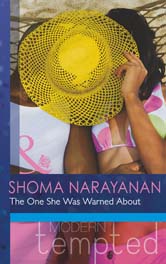
In this image of a man and woman embracing in a hammock, the man's skin is lighter than in the cover above.This sweet romance was consistent in characterization and tone. The office relationships were as believable as the family ones. There were a few points in the book that felt like they had been included for the western or white reader. Narayanan explains general customs at Diwali in one point, yet ignores them at another. It threw me out of the book to have the author explaining something that would be so basic to the characters. Romances with a white focus do not explain our common holiday practices. An author might indicate how her characters deviate from or cling to the norm, but a full explanation is unusual. Aside from those awkward moments, The One She Was Warned About caused me to purchase more by the author as soon as I closed it.
on a yellow backound a man stand behind a pensive woman, embracing her. We see only their heads and shoulders.
I came across several versions of cover art for The One She Was Warned About with interesting differences. The first cover (top left) is for the American market. To my eyes, it appears Nikhil has been lightened from the Mills & Boon version made for the UK (center right). It could be a combination of the dark title coloring and the reduced surface area, but the Mills & Boon cover more clearly indicates a non-white couple to me. The version for the  South Asian market (lower left) goes in a different direction. Instead of their faces being completely hidden by the yellow hat, only their faces are visible on a yellow background. The cover gives me a different expectation of the book. It seems menacing. I would expect this book to contain significant danger for the heroine and possibly include domestic violence. There's a YA after school special vibe going on. It's interesting to me that this reads as a romance cover in other markets.
 * This review originally appeared at Love In The Margins
Final Assessment: Solid category read with an engaging heroine. A-
Source: Purchased copy

03 December, 2013

Review: In Love Again by Megan Mulry

In Love Again is the third book in Megan Mulry’s series, The Unruly Royals. Claire, the aloof and married older sister from the earlier books, is now  on her own. Moving to New York to pursue a fresh start, she finds a man from her past. Ben is at a similar crossroads in his life. His marriage has dissolved into a shared disappointment born of mismatched assumptions. He’s drifting through the days, waiting for something to bring him out of his malaise.

Although I have a soft spot for second chance at love stories In Love Again was an uneven read. On the positive side, despite it’s upper class setting, Mulry’s world isn’t composed solely of caucasians. Characters with different ethnic backgrounds are presented not as underprivileged made good, but as individuals from solid, sometimes affluent, homes. They belong in the world they are inhabiting. Ben is Lebanese, with a large and close family. His heritage is neither ignored nor presented as unique. Ben alludes to the potential racism of Claire’s mother in a scene that leads to one of the few awkward moments in In Love Again. Claire hastens to assure Ben that ethnicity isn’t something that matters to her. Ben never challenges her. Claire, who has been appropriately awkward in her grab for the non-racist ring, isn’t required to acknowledge that declaring it doesn’t matter has it’s own baggage. It’s a moment I wanted them to linger over despite Ben’s easy acceptance.

I loved Claire’s insecurities, her defense of stay at home parenting, her tentative steps toward creating an adult life after years of suspending her personhood. I hated how easy it all was. Claire gets the first job she applies for, because of her connections. She is embraced by all of her coworkers, because of her connections. Later she comments on how she’s trying not to lean on this privilege, yet at the same time she’s openly deploying it. I could forgive Claire for continuing to fall through her life if Ben were someone other than Ben. Ben and I, we didn’t hit it off.

There was a sense throughout In Love Again of missing pieces. (Claire’s mother has remarried? Freddie is a liar?) Most of these are eventually slotted into place but Ben remains a stubborn hold out. When we first meet him he’s unlikeable. For reasons rooted primarily in the past and her own low self esteem, Claire seeks him out again. Suddenly Ben is utterly accepting of anything. Even when it’s revealed he has good reason to resent Claire he doesn’t. When Claire repeats a sin of the past, even more egregious in light of her maturity and their past experience, he shrugs it off. When Ben takes Claire away for a weekend and a family member hijacks the night, it’s fine with Ben. Everything is fine with Ben. He wants Claire because he used to want her. He hasn’t anyone else at the moment and Claire is the heroine so they’re meant to be.

The easiness continues as Ben charms Claire’s troubled daughter, introduces her seamlessly to his family, and establishes himself at the center of her life. (He’s also very rude to a waiter. It’s meant to read as passion but it put me back to disliking Ben intensely.) Ben plays guitar to make himself interesting. He doesn’t convey any sense of musical obsession. He doesn’t practice around Claire. He chose his day job to be lucrative but is bored senseless by it. While Claire is reinventing herself and reinvesting her in family (another road easily cleared) Ben is just acquiring Claire. He has six sisters, one with a family member in crisis, but they’re almost invisible. Ben feels aimless.

Late in the book Claire becomes quite angry with her sister in law. An apology is quickly offered but the advice found objectionable wasn’t wrong. This too was a moment that could have shown the family divide but instead was quickly smoothed.In Love Again’s true conflict is primarily off the page as Claire’s ex complicates her life before being speedily dispatched. If Ben had been less unquestioning in his acceptance, if Claire’s interpersonal conflicts had led to her being called out on her own bullshit, I think I would have loved this book instead of liking it. As it was, everyone was a bit too perfect and isolated for me to fully embrace them. Even with these issues considered, In Love Again is my favorite of the series.


15 November, 2013

Review: Fast Forward by Juliet Madison

While it had a great premise finishing this book was an absolute slog. Fast Forward is meant for the relative who sends you life affirming cartoons about aging as she sips from her Maxine mug. I wanted Big and I gotFreaky FridayJuliet Madison gives us no one to root for. Meet Kelli, a twenty five year old model suddenly thrust into her own fifty year old body. Nothing makes sense to her, or to us. Eventually the reader understands that Kelli was not shown her future, but one of her possible futures.
Unfortunately Fast Forward is as shallow as Kelli’s twenty something self before it becomes completely enraging. (I admit the enraging aspect was personal in nature and will not enrage most readers. Let’s just say the ending for Kelli’s father held some toxic messages.)  Kelli is unhappy with her less than model perfect figure. While she has not been disfigured in any way, Kelli is no longer lithe. For an up and coming young model this is a disastrous fate. Kelli runs around marveling at the technological changes 25 years has brought, despairing over every less than perfect aspect of her appearance, and waiting to wake up in her 25 year old body. (Spoiler alert: she does.) My first source of major frustration was the way Kelli’s friends and family completely fail her.
“Where’s Grant? I need Grant!” I said, shoving his hand away. “Grant? Who’s … oh, surely you don’t mean Grant, your ex?” “Yes. No! I mean, he’s not my ex!” “Honey, you haven’t had anything to do with him since we started dating twenty five years ago.” William’s expression changed to a frown. “Or, have you?” “Twenty five years ago? But Grant and I … we … he was supposed to propose to me on my birthday.” “Kelli, you broke off your relationship with him, remember?” “I did?” It’s quite possible I’d gone mad. William nodded. “But I proposed and you said yes. And here we are, still happily married after almost a quarter of a century.” Madison, Juliet (2013-02-01). Fast Forward (Kindle Locations 191-198). . Kindle Edition.
Her inability to recall her life is treated by everyone, down to her doctor, as a shoulder shrugging mystery. (Can’t recall half your life? Huh. Here’s your car keys, you’ve got a meeting at three.) Her husband is fairly obsessed with nudge-nudge wink-wink sexting while Kelli recoils at the thought of sex with a stranger. Her children have set up birthday treats that are gendered and self interested. From her mini-me daughter to her (of course) fabulous gay son, Kelli’s kids love her in the distracted way that says she’s on her own. Leaving no cliche unturned, Kelli ends up talking to a pair of psychics. As you do.
Fast Forward’s ending is determined by it’s beginning, not by true character growth. There’s nothing here to suggest that Kelli’s horror with her less than perfect (and oh so old at 50!) appearance is wrong. When Kelli comes to accept herself it is not because she has a deep understanding about body image and our culture, it is because she views her body as the beat up vehicle that brought her to her desired destination. She loves it because she put the miles on it herself. This is a very popular age acceptance viewpoint, but not one I ascribe to. (Resignation is not acceptance.)
My body was a living reminder of my wonderful life. It had done amazing, beautiful things and there was no way in the world I’d prefer to look like a twenty-something perfect beauty with a body untouched by life. Of course, I still valued my appearance, but as I dusted my face with mineral foundation I knew that if I chose not to bother anymore, it wouldn’t make any difference. Madison, Juliet (2013-02-01). Fast Forward (Kindle Locations 3720-3723). . Kindle Edition.
Kelli’s world failed to come alive for me and I’m not sure I’d try Juliet Madison again. 


11 November, 2013

Review: If The Shoe Fits by Megan Mulry

* This review originally appeared at Love In The Margins.
In the interest of disclosure, I follow Megan on Twitter and have done since before she was published. (Now that I'm reviewing her books she no doubt regrets that.) The beginning of If The Shoe Fits is brilliant. Then the clock strikes midnight. Well, at least for me. I think many of my issues with Sarah and Devon are unlikely to bother other readers.
Sarah James is a Hermetically Sealed Heroine. And yet, I didn't hate her. She was a believable twenty something virgin instead of an improbable one. Having decided she's ready for a fling,  Sarah offers Devon a weekend of no strings sex while they both attend a wedding. The opening chapters are light and fun. Sarah joins the promiscuous world and Devon marvels at the freedom a plain speaking woman holds. I was thinking "I'm going to love, love, love this story" even as I was reading it. Sarah is neither plus size nor thin. She makes casual references to her size without being overly focused on it. As a woman working in fashion, her curvier figure could have been truly annoying (if mishandled) but Mulry wisely leaves it on the sidelines. As the wedding weekend ends, Sarah returns to her everyday life. This is where we start to unravel.
Sarah has handled her sexual awakening well. She is more aware of how she may have been ignoring signals from interested men in her life. She is more aware of what attracts her and what she wants for her future. Devon's response to his emotional awakening is anger. He blames Sarah for his uncontrolled feelings and he lashes out. While Sarah wisely drops him, Devon never really deals with the source of his anger and jealousy. It remains at the fringes of their relationship in a way I wasn't comfortable with. When she should be moving on, Sarah obsesses. Devon's utterly unacceptable actions are excused and reassembled. Sarah's grandmother talks about passion and fire. Devon talks about jealousy and possessiveness. No one talks about domestic violence but what happened between Sarah and Devon is a huge warning sign. Sarah allows attraction to overcome self protection. I badly wanted Mulry to surprise us all with a left turn into a new hero for Sarah. Instead Sarah's secondary love interest turns into a Helpful Friend as everyone on the canvas conspires to reunite this now dysfunctional couple.
Before Devon our Sarah was frank, open and focused. After Devon she's a bit of a mess. She devolves into a weeper who manipulates situations nonverbally. At three different points I wanted Devon and Sarah to just talk to each other instead of everyone else. The passage of time becomes arbitrary. At one point Sarah asks family to come from Paris to London and it takes a week to happen. The family in question is not employed. They could have been there by dinner, or the next day. Without a reason for the delay, without a reason for Devon not to try and contact Sarah, the time frame feels very artificial.
Back on the positive side, the side characters are distinctive and interesting. Mulry has an intriguing subplot started with a sexually ambiguous sibling that is either going to crash spectacularly or make her name in the field. I don't see a middle ground and I can't wait to see how it falls. Family relationships are heavy handed yet also refreshing in their refusal to hit genre conventional marks. There are no villains here, only flawed people finding their way. In that context I could have been moved to root for Devon and Sarah. As the book ends they're happy for now, but I don't think it's forever. Sarah's mired in that first mad love where you excuse anything for another hit of the drug. Devon's doing the bare minimum. He needs therapy, stat.

28 October, 2013

Review: Who Ya Wit' 3 by Brenda Hampton

* This review originally appeared at Love In The Margins.
Brenda Hampton’s Who Ya Wit’ 3 makes up the first half of Carl Weber Presents Full Figured Plus Size Divas 5. I have a lot to say about Who Ya Wit’ 3 so I’ll leave the second story of the anthology for a later review. After a number of Kindle samples that didn’t compel me to read more, it was almost a surprise when Brenda Hampton caught my attention. WhileWho Ya Wit’ 3 is part of an ongoing series, I had no difficulty following the storyline. Dez, a forty something single mother of two, is in and out of a difficult relationship with the younger Roc. The respectability politics at play between them seem to impact them more than the age difference.

Dez is very frank with her sexuality. (While the content is low overall, it’s very direct.) Dez is a woman who has sex when she pleases, with whom she pleases. She knows what she wants and asks for it bluntly. Dez also  harshly judges the sexuality of others. Her first marriage ended when her husband was unfaithful, something she is still very damaged by. There is a married character who is serially unfaithful. Dez has an extremely low opinion of him and his lovers. When Dez thinks her son may be considering an affair she blames all three parties. Yet Roc has multiple sexual partners. Dez pursues Roc while he is living with his pregnant girlfriend. She does not consider herself to be trash nor Roc a cheat and neither does anyone around her. The dividing line appears to be marriage.

Hampton definitely keeps the reader engaged. I was completely uncertain which man Dez was going to end up with, or for how long. Roc is unusually in touch with his emotions and expresses them without apology. This is definitely a Bad Boy tale with a bit of Hood Made Good around the edges. Roc swears, gets high and has children with multiple women. He’s also romantic, in touch with who Dez is and emotionally available. The dynamic between Dez and Roc seems pretty toxic at points, but it’s a different toxicity than I’m used to reading. While Roc is obviously the hero of the series I am not sure he’s the hero of Dez’s life.

Having promised a plus size heroine, Hampton delivers. Dez is a size 14/16 who enjoys eating. She considers losing weight when her self esteem is low but is encouraged by friends to worry more about enjoying her life and less about her size. Dez considers herself attractive, as do the men in her life. She has realistic concerns about money. When she has it she spends it and when she doesn’t she scales back. There are no tycoons in Dez’s world. Everyone works for their cash. I found Who Ya Wit’ 3 to be much closer to the working class contemporary romances I’d like to read than I expected from the pitch. Hampton is not an especially polished author but her conversational style works for her story. (It reminded me strongly of Charlaine Harris.) I think I will be back for another book.

10 October, 2013

Review: Daffodils In Spring by Pamela Morsi


* A version of this review first appeared at Love In The Margins.
Daffodils In Spring was a 2011 freebie meant to promote literatureforallofus.org and honor it's founder, Karen Thomson. In fact the cover model strongly resembles a younger idealized Thomson. She doesn't fit the age of any particular character so I think she's there to sell us on reading the story. Inside the cover Morsi tries to graft her Americana style onto urban Chicago with mixed results. I admire almost all of the pieces, but I didn't love the whole. Despite my lack of love a number of elements make Daffodils In Spring worth discussing.
This is a midlife romance, not a late spring fling. It's heroine, Calla, is a widowed single mother who had a happy marriage. There is no undermining of that history. In one of the only direct physical descriptions made, we find out the hero has thinning hair. Landry is not bitter or a player or disappointed in love. He is a hardworking man interested in the heroine and he makes that known. (He is so simply sketched that I did wish for a bit of backstory on him to balance out everyone else's but this is a short novella so we'll let that slide.)
Morsi has written Daffodils very color neutral. There are almost no physical descriptions in the book except for a reference to the "braids and curls" of a teenager with a name (Jazleen) that cues black. This is a book free of skin tone, hair texture and obvious signals. The color of these characters is told in inference. They live in Chicago, where they spend a fair amount of time on their porch steps. Alternative high schools are not an oddity. College is not expected, but is the hoped for result from a long struggle. Women work long hours for low pay. Catching a young man is seen as a good move for a young teen with no future. There are few men on the street. Appearance, church clothes and community are all mentioned multiple times. Everything about this codes to me as white expectation of what black life is. It was a strange fit, this fictional world that was so busy not seeing color even as it cued positive stereotypes up for the reader.
Calla and Jazleen become involved in a literacy program through Landry's urging and discover common ground to build a relationship on. Along the way we discover that Calla is (of course) an accomplished cook. Thanksgiving is thrown as a veritable block party and all is right in their worlds come Easter. I appreciated a late book twist that added much needed and realistic motivation to Jazleen's character but found her personality switches extreme. (She is so self aware by the close of the book that I expected her to suddenly be in her thirties.) Calla and Landry both error on the side of saintly. Calla's son, Nathan, is barely there. He's more of a plot motivation device than a true character.
Daffodils In Spring is an informercial for book clubs that fails to rise above it's mission. It's appropriately priced as a freebie and worth reading as a look at Morsi's style bumped out of her comfort lane. With a little more conflict and a lot more at stake, Morsi could've had something special here. As it stands, it's a good palate cleanser if nothing in the TBR is working out.

10 September, 2013

Review: Heart Murmurs by Suleikha Snyder


Reviewing Heart Murmurs is straight up nepotism. I was following two of Snyder's twitter names before I knew she was an author. Someone retweeted her into my TL. I thought she was an interesting person. Here we are. (All of this disclosure becomes relevant later. I swear.)  Heart Murmurs is a quick lunchtime read for commitment-phobes and a cut above most erotic novellas.

Let's start with Anuskha. She's still fresh faced enough at 26 to become flustered around men she's having sex dreams about but seasoned enough not to let it affect her work. Anushka was more developed than I expected her to be. She's very self aware and unwilling to compromise her long term goals for short term satisfactions. Her fatal flaw is being a character who says things out loud she meant to just be thinking. Who does that? Lots of fictional characters do but when did you last have lunch with someone who was shocked their thoughts became verbal? Whatever. I almost forgave Anushka because she was so confident in herself. (But seriously, authors, no.)

The object of her dreams, Dr. Vince McHenry,  is two decades older and far more jaded. Here is where the disclosure becomes relevant. Did I hear every word of his dialogue in Vincent Irizarry's voice because of Dr. McHenry's speech patterns or because of Snyder's love for David Hayward? I've got a chicken and an egg but I don't know which nest they belong to. Either way, Heart Murmurs works very well as a lost episode in Dr. Hayward's life or a single episode in Dr. McHenry's own. What's not to love about an arrogant doctor with gifts as big as his ego? (Healing gifts. Please.)

Making Heart Murmurs even better was Snyder's choice to mention the differences between the couple and then dispense with them. No biases related to age or ethnicity weigh down the breezy narrative. These are the people they are, this is why they are attracted to each other, this is how they resolve it. It's credible from conflict to resolution. (Well except for the thoughts out loud thing because again, no.) If Snyder switches to angsty historicals I am so there.

*This review first appeared at Love In The Margins.

07 May, 2013

Review: Shadow Woman by Linda Howard

Howard and I had totally broken up. If Picasso had a blue period or Van Gogh a sunflower obsession, Howard has been exploring reconstructed women. Her heroines live under assumed identities, waking up in bodies that aren't theirs, reincarnated after the hero (!) kills them to begin their reinvention. I haven't begrudged her the theme. We broke up over the men. (Death Angel. Enough said.) Howard crossed from Alpha Bond style books to Alpha Hole abuse glorification. We couldn't be together. Enter Shadow Woman.

Let me set the scene. Me. The public library. An hour to kill with a dead e-reader. I decide to hate read Howard one more time, just for the memories. Like that I fell back in love. In Shadow Woman Howard takes the elements she hasn't been able to stop working with and frees them from the cycle of abuse. She still has a heroine with a vague memory she might have been someone else. She still has an Alpha hero who kills as easily as he breathes. The difference between Shadow Woman and her other recent books is so simple, so basic and yet so vital to my reading experience. It's respect. The hero respects the heroine. The author respects the heroine. The heroine is in a situation she chose to be in. She is forced to rely on her own instincts and intelligence to feel her way through a dangerous new reality. The heroine is not reformed or repentant, she is self accepting. This is about her reclamation of her identity as she comes to terms with past events. I kind of loved it.

Shadow Woman not a romance. It is a romantic suspense with the classic Howard elements. A cartoonish disregard for human life, covert groups, government conspiracies, the people who make paranoid people look naive. The hero and heroine don't truly meet until the last pages of the book. Their story is told by his distant concern for her and her struggle to remember him. This is a book about waking up crazy and slowly coming to understand that you are not insane but imprisoned. The heroine's struggle to define herself, to identify the core parts of her personality inside the shell, are the focus of Howard's tale. This is a book that reminds me why I started reading her in the first place. I'm going to pretend the last few years didn't happen and reinvest in Linda Howard. Shadow Woman proves that libraries still have a place in reader discoverability.

04 May, 2013

Review: The Girl With The Cat Tattoo by Theresa Weir

My intention was to love The Girl With The Cat Tattoo.  Other people (people I like and generally agree with) loved it. The cover is absolutely adorable. It's all chick lit and friendly and hipster cool. With a few changes I would have absolutely adored Weir and signed on for her back catalogue. As published, I don't think Weir is for me. I was moved to tweet a few times while reading, here's the first one.


Reading Girl w/ Cat Tattoo. Heroine thinks about taking cat to work. Few pages later, hero suggests it. Concept new. She should flip back.


I have a two per book WTF limit and Weir handily exceeded it. She alternates between grounding her characters firmly in reality and taking them so far into Romancelandia that the reader can't follow. The most egregious examples are a television show segment that would have worked well as a dream sequence but blew the book apart for me instead. It set me up to question everything about the last chapter. (Why would he go? Why would he then do that? How would that work, exactly? Why would the host know? How would the host pull that off? Does that even fit who the host is?) There is, of course, a Bad Dude. When the heroine realizes who he is she is placed in a life threatening situation. At the end of it, the Bad Dude just leaves. He knows the hero and heroine are aware of his transgressions. He thinks he has the evidence they were holding. So he... goes home and I go WTF? Then the hero and heroine decide to have a quickie. And I quickly say OMGWTF? After sex, they traipse off to outfox and shut down Bad Dude. I just couldn't. I get that by Romanceland standards this is hardly unprecedented WTFery. I'm not trying for hypocrisy here. When it was good The Girl With The Cat Tattoo was very very good and when it was bad it was sorta awful.

On the positive side, while this wasn't the first romance I've read that used the animal point of view, it was one of the freshest. The heroine has a cupcake affinity and a cosplay bent. She is very of the moment in her thoughts and interests. The hero was pretty standard issue yet honest enough not to love cupcakes just because the heroine is baking. He's not her only hookup, (although he is the only one after they meet). There is no slut shaming or dude shaming of the prior people in her life. She's young, she's single, and she sometimes gets drunk and takes someone home. Sometimes she falls in love too fast, sometimes she prefers the company of her cat to humans. Melody was well conceived and well executed. I felt like she was a girl I might know instead of a Heroine. I can certainly see why Weir is getting accolades. With less WTF moments I'd be raving about The Girl With The Cat Tattoo, but as it stands I doubt I'll check out Book Two. (Why do all books come in threes now? What happened to the single title? Discuss.)

26 April, 2013

Review: The Other Side Of Us by Sarah Mayberry

*The Other Side of Us is a book with something interesting to say but character choices kept me from caring about it. On the plus side, it's a free read in the Kindle Store so you won't be out anything if you give Mayberry a shot.

This is a book by an Australian author. This became important because some key cultural differences set me up to question the entirety. Plus there are annoying pet scenes. Look, I'll just come out and say it. Their dogs bang before they do and with possibly more enthusiasm. Afterward Oliver acts like his dog has been roofied and sold into the sex trade. It's kind of weird. Whatever, dog subplot, you freaked me out. Oliver is probably overreacting because his wife cheated on him. Finding out his dog is stepping out too was just overload.

Mackenzie was in a life altering car crash but due to her past success as a television producer is not bankrupted by the experience. She has that easy, unthinking affluence of many a romance heroine. When we meet Mackenzie she worries that she's come across as a bitch to Oliver, despite what seemed to be completely reasonable reactions. Oliver likes to come over unannounced. Mackenzie apologizes for pages over her rude inability to drop everything in her life to focus on whatever whim the stranger next door has come up with. She tells him she needs to answer an important call, he keeps talking. I'd be rude to the guy too.

I couldn't get a handle on Mackenzie. At the beginning of the book she is all about doing her rehab. I know a thing or two about post surgical exhaustion. Her nausea, shaking, sudden extreme fatigue all felt real to me. Her obsession with her scars did not. Mackenzie explores her scars with the careful consideration of a fetishist. She's had them for a year - it's not like they're new. Mayberry wants you to know that Mackenzie is weakened by injury, covered in scars, and unable to conduct her normal life. Suddenly Mackenzie is cleaning out sheds, filling wheelbarrows with gravel and taking long walks in the sand. (If you've had your pelvis rebuilt long walks in the sand are very much not on your To Do list.) The first time she has sex she requires special positioning to avoid severe pain from her hip. The rest of the time she's just up for it however. When Mackenzie was vomiting after using her weights I understood why she couldn't return to her job in television production. When she's walking to the grocer and working a shovel I didn't. Mackenzie has a super hot ex who wants her back but never met her needs. I liked him much more than Oliver.

Oliver was almost as absurd as Mackenzie. The guy is a rock star turned studio man. He left his wife several months ago but isn't divorced. When he takes up with Mackenzie his brother has kittens. Long soulful talks about taking things slow and knowing your limits and not rushing in take place. Oliver is completely unlike every rock star I've met or currently know. I started to understand why his wife (who wants him back, of course) cheated on him. He puts the E in Emo. It's a shame I couldn't buy into the leads because Mayberry has a lot to say about reinventing yourself after failure or disappointment. Oliver and Mackenzie both look to the dreams of their youth to form a dream for their future. This apparently involves rejecting commercial success. So to wrap up, unlikeable and unlikely leads, issues of consent in the canine community, exs that want you back so bad, realistic conflicts and a lot of emo flouncing. I might try another Mayberry but this one didn't move me.

20 February, 2013

Review: Five Star Romance by Jacquelin Thomas


I didn't finish Five Star Romance. After struggling with the opening pages, I threw in the towel on page 136. It's rare for me to do a review on a DNF book but I wanted to discuss how the style of the book kept me from engaging in the content. Thomas is working with classic romance elements. Her lead, Blaze, is the family's lost boy. He blames himself for the troubles of his past far more than his family does. This leads him to value his privacy, where he can control the face he puts out to the world. Livi is a rich girl trying to make it on her own, without the protection of her family connections. When an enemy of his family reveals their secret marriage, Blaze find his personal life on the front pages.

Thomas gives herself a lot to work with. Both characters have a reason to have initially interacted and reasons not to have seen each other since. Both have strong family units that offer support and encouragement. Wealth is not an issue that divides them or hinders their freedom to live as they wish. Five Star Romance is a classic case of great on paper. Thomas relies heavily on telling over showing. Her characters interact with others (and each other) only in very brief exchanges. The vast majority of the story is told in informational dumps. For example, an important confrontation between Livi and Blaze takes place in less than a full page. In that space Blaze has arrived to apologize for assumptions he made that have driven Livi away. She refuses to speak to him and he leaves. Major changes in motivation and assumptions hinge on handfuls of dialogue followed by paragraphs of exposition.

We don't see Blaze or Livi evolve, we are told they are. And they evolve rapidly. On one page Blaze wants a divorce. On another he's committed. In the same space of time Livi flips from committed to finished. Their actions and motivations don't engage the reader because the reader never experiences the transformation with them. As well, their world is inconsistent. Livi works with Blaze's family. She's been part of their business longer than they have. Livi has had two years to study any aspect of Blaze's life she chooses. As a result, some of Livi's actions make no sense. At times she appears star struck by the world Blaze lives in but it's a world she was born to and has worked around for some time. Thomas chooses odd details unconnected to the world she's building.

"A few minutes later, Blaze and Livi walked back inside and headed straight to the dance floor.
At the end of the evening, guests were given a choice of an iPad case or a notepad, pen and flash drive set by Ungaro as a party favor. Blaze gave Livi one of each.
When they were inside his car, he glanced over at Livi and asked, “Are you ready to go home?”" Page 103, Five Star Romance


Nothing about the party favors matter to the plot. Caring about the party favors doesn't fit with the background of the characters so the inclusion seems aimed at the readers. The first 130 pages of Five Star Romance are filled with these secondary details used as a substitute for natural scene transitions. This happens, so now that happens. Then this other thing. And they were thinking that. But then they did this. Livi and Blaze never really come alive, they stay puppets moved through a pantomime tale. 

11 January, 2013

Review: Back to the Good Fortune Diner by Vicki Essex

Occasionally a book comes along that catches every reviewer's eye at once. Maybe it's the marketing, maybe it's the theme, sometimes it's random chance. In the case of Back to The Good Fortune Diner it's the promise of a non-caucasian lead in a traditionally caucasian line. Vicki Essex is an author in the right place at the right time. Essex is also a talented writer. Ultimately, I think she's better than her book. I'm going to give Diner it's small town beats dirty big city vibe because that's a fetish. It's not my fetish, but the topic of message coding in this theme is more than I care to get into with this review.

I'm also going to give Diner it's simultaneous embrace and rejection of education - no I'm not. It was very problematic for me. The racism in the book was another stumbling block. For much of the story we have an interesting tale of two culturally different people learning to communicate with each other as adults but then it takes a sharp turn. The book couldn't sustain the weight of the material. Ultimately, it feels very After School Special in it's quick presentation and smooth resolution. A secondary romance felt it should have been the focus of (or a sequel to) the book. Finally, the brother and sister duo at the heart of both relationships felt completely wrong for their age. Whew. Let's unpack some of that.

Age before anything - Daniel and Tiffany are highly educated professionals in their mid to late thirties. both are so deeply enmeshed in their parent's possible view of them that they cannot see themselves. I felt their age was driven by the author's need to reunite her high school couple (Chris and Tiffany) through his teenage son. Drop everyone's age seven years, make the son a nephew, and all my issues with this part of the story evaporate. The emotional conflicts were realistic and interesting. Their timing was not. Tiffany and Daniel are both trying to figure out who they are. Both have degrees they don't want to use. While I completely disagreed with Daniel's choice of work I want to focus on Tiffany. About Daniel (certainly the more compelling sibling) I'd say that most 35ish year old men working the back of a kitchen (who are not chefs) have beaten their bodies to the point that they would welcome any alternate opportunity. That Daniel is in possession of funds, education, contacts and support but chooses to take a fairly low level position on impulse mystified me. He is banking on the financial support of a girlfriend he is estranged from while rejecting all paths that lead to his own financial stability. At 25, this is a mistake. At 35 it's running into poverty instead of away from it. Daniel will struggle for the rest of his life where a slight change of course could have given him the work he loves and the ability to enjoy his life while doing it. (I have to stop talking about Daniel. His dominance of a book not about him is turning into his dominance of the review.)

Tiffany has been chasing publishing jobs she doesn't find rewarding. I wanted Tiffany to grow into an appreciation of her own worth but she never does. Tiffany is the over achieving student, she's the impassive faced minority who magically brings the hateful white bigot into line, she's the understanding and self demonizing girlfriend and the overly devoted employee. Even as a rebellious daughter she's just a little too good. When the women of the town want to socialize with her Tiffany wonders why they would want to. Tiffany never wonders why she should want to talk to them. When Chris calls her out on her lack of interest she examines it as a personal flaw. Tiffany spends the entire book wondering what she offers others and ends it the same way. It is always Tiffany that is inadequate and Tiffany that must change. I wanted Tiffany to demand more for herself and standing up to a sick old racist was insufficient. Tiffany suddenly decides her jobs are unsatisfying. Her inability to make friends is her personal flaw and not a facet of her being uncomfortable in her own skin (this was hinted at but not developed). Breadcrumbs of an alternate career path are laid in the story. They are not used. Tiffany appears to give up her professional dreams so she can have the boy, because the boy trumps everything else in her life. She doesn't find a different dream, unearth a deferred dream, or reveal a dream she was afraid to follow. She settles. She's going to be with the boy and figure the rest out later. Again, understandable at 25 but troubling in your 30's.

I think Back to The Good Fortune Diner would be a stronger read without the racism. Or a stronger read with more racism in it. Of course the only Chinese family in a town is going to face bigotry. I've repeatedly lost friends to other states because they wanted their children to grow up as something other than "the Asian kid" in town. Having Tiffany face racism from one man was dealing with it in a token manner. Tiffany stands up to him, he folds. He's a softie underneath anyway. It's true enough in that it could happen, but it feels far too pat. Leave it out. Adding in Daniel's concern that his parents are bigots without really resolving if they are makes the post-racial ending even less satisfying. Daniel's story was too big for this book. Including all of it not only short changed Chris and Tiffany but it ended any chance to resolve the core of their arrested development. Why do their parents constantly fight? How did they both feel about the sudden move from the big city to the small town when they made it? Why did they press their children to get educations if they don't want either of them to use them? How does this dynamic stop influencing their children and start informing them? Chris and his father get their emotional issues resolved, leaving Tiffany as a Magical Asian when I wanted her to be the star. Removing most of Daniel's romance would have given Tiffany more room to earn a happy ending instead of concede her way to one.

All praise to Essex for making me care enough about her world and her prose to devote so much thought to it. I'm absolutely going to read her next book but I have to give a mixed recommendation to this one. Essex suffers from a lack of space over a lack of ideas. She might be better served by a longer word count. Back to the Good Fortune Diner is more enjoyable than my review suggests. It's actually very good, it just isn't amazing. There's a joke in there about the no-win life of the American (or Canadian) born Chinese, but I'm not going to explore it.

*I also wanted to explore Daniel's unconventional choice not to be the dominant financial power in his relationship and his willingness to subvert that gender norm. Really, the wrong couple led the book.

* If you haven't read the discussion at My Extensive Reading I highly suggest it. Among many excellent comments Sunita brings up a point I'd failed to consider.