Showing posts with label Train Wrecks. Show all posts

07 April, 2014

Review: Julio's Day by Gilbert Hernandez

Anne Elizabeth Moore wrote a pretty excellent review of Julio's Day. You should probably click through and read it first. My experience is less with the text of this specific book and more with the Hernandez brothers body of work. Love & Rockets is so popular there's an even more popular band named after it. Any best of comics selection invariably includes a few pages of Hernandez work, invariably featuring murder or sex (generally non consensual).  Their art falls into the stylized realism end of graphic novels. The lingering focus on physical imperfections lets you know this isn't some lightweight superhero stuff. The grunts come off the page when they fuck. This is how you know it's literature, darling! Life isn't pretty!

Julio's Day is the work that finally convinced me I just don't like the Hernandez's work individually or collectively. No matter how much critical acclaim they accrue, they leave me feeling bamboozled. In the case of Julio, the conceit is that we're going to follow this man through the hundred years of his life, a page at a time. (His mother lives to about one hundred and thirty because that's how Gilbert rolls.) We hit all the predictable points for a Hernandez work. People will be molested, people will be murdered, ugly diseases will strike, sex will be shown, women will go mad. It's all so meaningless in it's meaning laden run through history. The plot twists are cheap and random, unearned left turns taken for the sake of exploration looping back into pulled punches of revelation.

Darling, listen, life is filthy. It's a filthy place. The very earth we depend on for our food will send parasites to kill us and poison future generations. The mud will rise and destroy our homes, obliterate our families. (Often at the exact moment the plot demands inexplicable random deaths to smooth over pointless truths.) Death cannot be sanitized. The past is a place where everything was left unsaid, the forefathers kept their secrets in their chests, their loves silent, their desires repressed. It has to be that way! If it isn't then our glorious open freedoms are nothing but brightly colored flags waving in the hot breeze of self satisfaction! What's the point?

Literature requires a point. Too often dark themes are mistaken for depth. There's no depth to Julio's Day. A man is born and a man dies. In between he is a witness to other's lives, living almost none of his own. His experiences are alluded to, they are suggested, where the experiences of those around him are flung out like depressing offerings to the fates. When Julio's great-nephew urges him to walk out of the closet and embrace the sun I wonder whose sun is he referring to? In their family legacy of early death, molestation, abduction, murder and madness where does Julio's great nephew see himself? His casual devaluation of the sum of his great uncle's scarcely examined life is the ultimate rejection of Julio himself. Julio's true day is being lived inside himself, away from the reader's eyes. The parade of anguish that we're offered is to let us know we're reading something capital-I important without rising to the challenge of really showing us the depths of the man.

14 March, 2014

Review: Cemetery Girl Book One by Charlaine Harris and Christopher Golden

My curiosity for how Charlaine Harris would translate into this new medium was strong. After all, from the necrophilia and furry-fetish loving of Sookie Stackhouse to the quasi incest is best life of Harper Connelly, Harris can be trusted to dish out WTF action in a page turning fashion. 
As graphic novels go this is a definite C read. The art is fine, the pace is numbingly slow, the storyline is hardly original yet still intriguing enough. Issuing this first chapter in hardcover is a blatant money grab as the content better suits a $3.99 rack title, but you've got to pay your marquee name somehow. We open with Calexa waking up in the cemetery with only a vague memory of having been killed and dumped. She takes her name from the tombstones and hides in the crypts, afraid whoever wanted her dead will find her if she leaves. Calexa is already off to a perfect Charlaine Harris start because if I ever wake up with no memory and the knowledge that someone might want to finish me off I am absolutely going to do anything except stay where they left me. But our dear Calexa, she… who are we kidding? She doesn't matter at all. Let's spoil this thing and you'll see why I brought this book to you.
Calexa witnesses the murder of a girl named Marla. Because there is a huge empty hole in the house of Calexa's body, Marla takes up residence. Calexa hates having Marla's memories of a loving Hispanic/Black family in her brain and she wants them gone. Marla isn't terribly happy about being trapped in Calexa's white slacker brain, but she doesn't know how to leave. The rest of the book is Calexa leaving Marla's family in agony because reporting the murder doesn't fit into Calexa's plans. She carries around Marla's magic smart phone. It can answer calls, be accessed without a password, and never loses power or leads the police to it's location. (Ah, Charlaine, I love the way you roll.)
Eventually Calexa realizes that Marla videotaped her own murder. I'm not sure how, what with lying on the ground and then being dead and buried and all, but Marla got some damn good camera angles. Calexa realizes that Marla has solved her own murder while giving Calexa a way to report the crime without involving herself. Eventually Marla's murderers come looking for the phone, endangering Calexa. This is the kick she needs. Calexa sends the video of the murder to Marla's entire contact list, including Marla's parents. (Hey Mom & Dad! Know you're sick with worry - but here's a cool video of my murder and a few snapshots of where my body is buried! XOXO!) Cops round up the villainous brown kids, as the mentally ill white kid (Calexa, in case I lost you) finds safe haven.
That's the entire book. $24.95 worth of action, right? But wait! You also get a snippet of the script for Book Two revealing that Calexa was experimented on in a mysterious laboratory and that Marla won't be the only dead person to invade her empty brain!
*This review originally appeared at Love In The Margins.

25 June, 2013

Review: Oz The Great And Powerful

*Having recently taken a number of transatlantic flights, I'm pretty caught up on the selection of B tier movies that are offered to insomniac fliers. They ranged from the surprisingly good to the incredibly awful. And then, of course, there was the Kill It With Fire selection. Which one do you think we're going to talk about? Ha! Trick question! That said, Jack The Giant Killer was surprisingly good and you should see it instead of this complete disaster of a flick. 

I couldn't finish Oz the Great and Powerful. I made it as far as the creation of the Wicked Witch of the West and no farther. I've heard the Wicked Witch of the East is killed off toward the end, which makes perfect sense because Oz is all about killing women. The magic of Frank L. Baum's legacy lies in it's social commentary. He created a world for children with almost entirely female leads and he trusted boys to stay with it. He did not say "Well, this book is for girls and therefore the boys may be excused from the room." Baum wrote about a myriad of women in complex ways (especially given his contemporaries). He wrote about flawed women, shallow women, greedy women, saintly women, naive women, frightened women, brave women, women who were once men. These women have adventures. They rescue others, men included. They expose corrupt leaderships and galvanize others to carry on in their names. They are conventionally beautiful (Ozma) and unconventionally attractive (The Patchwork Girl).

Here is what Baum never wrote. He never wrote about a shallow flawed abusive man with a "good heart" (Lord save us from that life lie) who was the only hope of otherwise capable women. He never wrote about girls turning against their sisters or standing by and waiting for the arrival of a worthless dick holder to create meaning inside them. He wrote the opposite of that. I was cursing through OTGAP long before the Hollywood moment of West turning green with envy for Glinda. The core message of OTGAP was that women are frequently bitches and any sad excuse for a man is better than one of them. Everyone in the film exists to tell Oz (a charlatan and a fraud, as in the book but with the new addition of womanizing) what a good boy he is. He can do it! He can find the tiniest scrap of soul and use it to lead a kingdom to victory over two sisters that just want power and gold. Since Oz also wants power and gold, he likes this message. The hot babe attached to it doesn't hurt either. This is a man who lies to get with women, who plays them like toys and disposes of them just as casually. But when one of those women finds herself engulfed in fury over his lack of sincerity, she is to blame. Her inner evil is revealed. The problem isn't in him, it's in her expecting anything else.

I couldn't watch another frame from the point West drops into Munchkinland to wave some threats around. I don't want to see anyone in this movie in any other movie. I don't want to watch a film anyone associated with this writes, directs or sweeps floors for. Because the problem with Oz, the thing that needed (apparently) to be fixed, is that it's not about a worthless boy and the jealous bitches he has to deal with. Look, Frank L. Baum was a deeply flawed man. He was a racist with colonialist views and genocidal leanings. But he was able to see women as complex individuals capable of great adventures. What does it say that 100 years later one of our major film companies couldn't? Nothing I can discuss without profanity. Do better, Disney. Do much, much better.

05 February, 2013

Review: Thief of Shadows by Elizabeth Hoyt

This was my first foray into the Maiden Lane series and I might have one more in me before I call it quits on Hoyt for good. What makes Hoyt catnip to my fellow reviewers makes me sneeze. I think we're far enough from the release date for me to freely make use of spoilers.

Thief of Shadows is one of those books where all the characters are very strongly something until suddenly they are not. Winter Makepeace is a dedicated teacher with a serious Batman complex. He runs around in an ornate, colorful costume and leaps on rooftops to ferret out enslaved children. His rationale for the elaborate disguise (striking fear into men's hearts) was a bit of a yawn. Leaving his attire aside, the rest of Winter Makepeace had promise. Through his dedication to the children a true conflict existed for him and Isabel. Unfortunately it takes just one nonconsensual blowjob for Winter Makepeace to forget everything he holds dear. Isabel sucks the character right out of him. Suddenly he's gone from swearing his life has been promised to a higher purpose to abandoning everything he once stood for. No longer is the need of the many (the orphans) greater than the need of the one (himself and a favored orphan). No longer are his nightly raids on criminals the calling he cannot set aside. Winter packs his bags and arrives at Isabel's house with boots made for knocking.

Isabel is no better. She's a flighty hedonist who refuses to bond with the child sharing her home. She orders him away and complains to the servants when she sees signs of him in her home. She works on the charity board for the orphanage but never spends time there. Her goals are a life in society filled with distractions. After sexually assaulting Winter she suddenly craves children and stability. By the end of the book Isabel has packed down her mansion and set up house in the orphanage by Winter's side. She's busy making it a home. No mention is made of the probable social cost because now Isabel has a makeshift family and therefore has satisfied all her life's desires. If I were Makepeace, I'd be worried about a sexual predator in a house of young men but then if I were Makepeace I'd have shoved her off a balcony instead of chasing her down and professing my love.

Along the way there is a tedious Pygmalion subplot even the characters fail to take seriously. There are a few Bad Guys and Even Worse Guys and a bit of Conspiracy keeping time for us so Isabel and Winter can pretend anything matters but getting naked. The plot points are so disposable that one involving a young jewish orphan is completely cast side once Winter buys his knocking boots. Presumably the concerns he had about taking her into a Christian Home are swept away by the clarity of passion. Or something. There's also this dude that wants the orphanage for REASONS and is thwarted by an old lady with a pile of slingshots. I don't know why he wouldn't just beat the crap out of our orphans, but he throws his hands up like a modern couple whose live in nanny has walked off in a huff. How can he manage these dirty, dirty children?

Hoyt keeps being recommended to me by people whose opinion I generally agree with. This is my second or third attempt at her. I do appreciate her ability to create distinct characters but I think she lacks follow through. I have another Maiden Lane book cued up on the old TBR but I'll stop there. It hurts my eyes when I roll them.

29 February, 2012

Review: Aaron & Ahmed by Jay Cantor and James Romberger

I've been on a graphic novel kick lately, and sometimes graphic novels mean having to say you're sorry.

I am very sorry I read Aaron & Ahmed. I really should have known better. The thing is, when a graphic novel promises to be a difficult read, emotional, challenging, all of that - I expect it might offer something new. A love story between two men in a time of war? A meeting of two cultures? A transcendence of humanity over inhumanity? Look, it doesn't have to all be Maus. At a certain point I'll take A Very Special Sugar & Spike.

9/11 graphic novels are all sophistic pieces of crap, and I should know that by now.

Aaron & Ahmed opens by showing how our poor schmo Aaron never really had a chance. With a Jewish name (turns out he's a nonreligious halfsie) and a dead dad, he loses his fiancee in the second plane. (Complete with real time phone call and touching the window of her plane as she goes.) Right. So now that the attempt at emotional manipulation has been made, we turn to Gitmo where a Dr. Mengele type is turning prisoners into dogs and frothing about how we are all programmable meat puppets awaiting the right coding of information to cast off our humanity. You know, the kind of shit that sounds deep when you're 11 (getting high at juvvie) or 17 (getting high at your mom's place in the Hamptons) or 43 (drunk on Tea) and male. Soon our young Aaron is feeding Ahmed (our chosen prisoner) estrogen to calm him while trying to make him fall in love via the patient / therapist relationship. Yea, I know. This book seriously wants to be deep. It thinks it has some profound insights about the nature of love and the nature of religion (hint, it hates the latter) and the ways of men who might like men when mixed with Stockholm Syndrome.

Soon Ahmed is magically transporting Aaron off to the depths of training camps in Pakistan where Aaron's first serious exposure to religion (and hard drugs) convert him into a walking time bomb of paranoid fervor. Returned to NYC, Aaron awaits his deployment while Ahmed has some bizarre change of heart. Wait, back up a second - just as emotionally manipulative as the early sequences for Aaron are the mid sequences for Ahmed. The West is bad but the East is worse and there will be war without end, praise Allah. Any complexity of the view from the other side is obscured by the need to have Aaron falling prey to the fanatical brethren. It's like a tiny bit of reason dropped into a giant shaker of bigotry and anger turned into a propaganda martini and served cold. (Insert Ron Paul joke here.)

Ok, so back in NY Aaron has God Fever and his meat puppet is out infecting other meat puppets while Ahmed is offering him romantic love and wanting to run away with him for a life of western decadence. Ahmed's change of heart is never explained. His reasons for taking Aaron to Pakistan are left in the dark, and his switch from trusted driver of OBL to homosexual craver of all things McDonald's rings untrue. Ahmed fails to evoke emotion or drive the plot in a logical manner. He stands in for Aaron to impose his own perceptions on before becoming a device to drive the plot in the circle the author wants it to go.

Religion exists to control us and is harnessed for evil by many forces. Money and power drive wars. Governments don't care about the human cost. Absolute power corrupts absolutely. There is no nuance in fervor. The masses can be manipulated. (It just goes on and on.) If you're drug free and over the age of consent do yourself a favor and give Aaron & Ahmed a pass. There may be an interesting and multifaceted look at the underlying causes of 9/11 out there but I doubt it's got an English translation. I should brush up on my German. Or maybe Swedish. Possibly Japanese. I don't know. Oh, also, gay people are noble and stuff. Love drives Ahmed to his doom!!! (Sorry, was that a spoiler?)

09 February, 2012

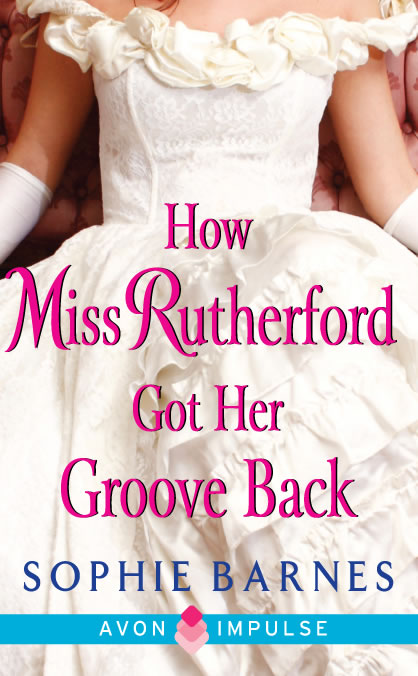
Review: How Miss Rutherford Got Her Groove Back by Sophia Barnes

This cover suggests Boxing Helena to me. Miss Rutherford is presented as a headless torso in an open position. It feels somewhat soulless, which brings me to the title. A genre that is aggressively Caucasian mimicking a very popular contemporary African American title is problematic. Add in that How Stella Got Her Groove Back was a thinly disguised tip to the author's own (now failed) marriage and certain problems in Barnes' book are thrown into even sharper relief. Emily is a complete Mary Sue, and a manic one at that.

When we first meet Emily she could put Snow White to shame. Living in a cottage with her sisters after being disinherited by her evil step-relative, she whistles while she works. Scrubbing floors and living for the one day a year she is invited to the ball, Emily dreams of marrying her neighbor, her childhood sweetheart, her savior. When this fails to pass, she becomes suicidal. (She is fond of saying things like she should have been "left to die".)  It is not that Emily breaks as much as she dents. Her suicidal depression leaves as quickly as it arrives. Emily walks through a series of cliches that range from the allowable to the completely infuriating while those around her hold her hand and weep over her noble purity of feeling. Those who bruise the tender fruit of Emily's soul are heartless creatures, while Emily herself is excused of all responsibility.

Given that the side characters are so thinly drawn it hardly matters that their emotions are barely noted. At one point Emily is put in possession of an elderly chaperone who immediately goes to her room and fails to appear until close to the end of the book. (Much like the eldest Martin child in the American serial All My Children, who walked upstairs in the 1970's and was never seen again.) Gone and forgotten, when she is mentioned again I had to flip back to recall who they were discussing. Further removing the reader from an ability to sympathize is the author's inability to choose a path and stay on it. In one scene Emily urges her former fiance and his intended to enjoy every second of their betrothal ball as she could not stand to diminish it in any way. With her very next breath she berates them as undeserving of her. Whiplash moments like these abound. Later in the book Emily rushes off to see the previously rejected BFF as "I have no quarrel with her, you know." Emily is prone to this kind of passive aggressive bullshit when she isn't making her own life infinitely harder through impulsive and ill considered actions. The author drops in and out of these implausible shifts with equally awkward conversations.  Not naturally, or in a way that makes internal sense, but to point out the author realizes this is kind of a left field event. As a reader, I was as bewildered as Emily's former fiance. In addition to the emotional curveballs the author keeps the plot curveballs coming too. (What's that, Lassie? Emily must marry in a month or her sisters lose all? Why didn't anyone mention this 2/3 of the book ago?)

So. Emily kisses childhood friend, Emily jokes about marrying childhood friend, entire town and both families expect it to occur, Emily (when faced with a need to marry) does not tell him. She lives on the neglected corners of his life scrubbing her own floors and waits.  Emily charms the birds from the trees with her gaiety. Childhood friend runs off to London and falls in love with BFF who returns to town but doesn't tell Emily who she is engaged to marry so that it can be a shocking revelation at the ball. This makes no sense. I can buy both of them as completely clueless about Emily's air castles, but to not tell your BFF you're marrying a mutual friend? Not to challenge your son on his fiance's changed circumstances? Not to tell your parents ahead of the ball you will announce the engagement at that you're marrying? Like the rest of the book, these events have to happen for other events to happen. At one point I wrote "Miss Barnes has gone a cliche too far."

The real one eyed reading occurs at the end of the book. Our hero has been harboring the deep dark secret that he is a surrogate child. His father was so enraptured by the surrogate that he installed her in all their homes, preferring her to his wife and living openly with her after his wife's suicide. Since his death said evil doer has been blackmailing our hero for fairly absurd sums of money on the basis of a signed letter confessing all! Why our hero's father would write such a letter set aside, why the hero wouldn't just let her give her plot a shot, all of this you have to take on faith. (After all, this is the guy who thinks Emily isn't like the rest of us but means that in a good way.)  Kate (the former BFF) runs to Emily (because she hasn't had enough gas-lighting) and tells Emily that the hero's biological mother is actually his mistress. Rather than run suicidally off into the night like the last time, Emily runs suicidally off to a formerly barely mentioned and shortly never to be mentioned again diabolical relative. She'd rather marry him (here we discover the must marry in a month timetable) than face Hero McIncestCheaterpants again!! (Histrionic, much?) Emily arrives, determined to marry Edward. I was sort of hoping he'd ask Emily if she'd ever consider a soothing drink and a nice cooling cloth, but he's as over the top as the rest of them.

First he gloats about his feelings of inadequacy and then he proclaims he's going to rape her. Emily can't go back to her sisters, her life or our hero. Remember, her former BFF who is engaged to her pretend fiance told her that a woman old enough to be his mother is sleeping with the hero! Rape is her only option!!! Emily starts to take her clothes off like the good little martyr she is. (I think the only way I followed this bit is my southern heritage. Convoluted explanations are our birthright.) Luckily Emily is saved by the hero and Edward is whisked off the canvas with a "Sorry, my bad" after the hero stakes his prior claim. While we were waiting for Emily to finish taking her clothes off Kate was being berated (yet again) by Emily's equally reality challenged sister. How could Kate make such an allegation? Doesn't she know Emily self harms?? (I hope Kate learns her lesson here and puts as much distance between this toxic family and herself as possible.) Emily is whisked off to marry the hero in secret, since he stopped off at the Get A Special Permit Store and took care of business. At his home, he confesses all (after first dillydallying about confessing anything) and they decide to trick the blackmailer into revealing the location of the letter.

Crazy things happen (big shock) that I am really not interested in reliving. In the course of them the blackmailer reveals a secret addition to the dead Earl's will that leaves her buckets of things. She will trade Emily the letter in return for access to the home (that she already had access to earlier in the book, and earlier in her life) so she may retrieve it. But what's this! As the hero braces himself to learn how his father further betrayed him he discovers the codicil is a giant "Pwnd!" intended for the blackmailer. It reveals that the letter in question has a fake signature! It can't be used! He knows his wife didn't commit suicide but was killed by his mistress and he kept sleeping with her because... I can't even. Why would you write either document? Man up, dead Earl. Quit abandoning your wife, your son and your duty to the estate. Don't leave her with an inheritance and a blackmail letter and a lot of bad sex memories! On the other hand, if he hadn't then our blackmailer couldn't do what we were all longing to do at this point. She whips out a hidden gun and shoots Emily.

Sadly, Emily survives.

*Since I wrote this (and scheduled it) my kindler, gentler, less annoyed short form review was the subject of one of many sock puppets out in force for those who dare to dislike this book. My personal puppet was as unable to pick a lane and stay in it as Emily herself. (Bless.) Someone should hold a class on Effective Puppetry For The Debut Author with a section on Making It Look At Least Plausibly Organic.  That someone won't be me. I can't be bothered. I left How Miss Rutherford Got Her Groove Back intending to try the author's next book. Despite some style issues there were indications that (freed from her melodramatic bent) Barnes could deliver an entertaining tale. Watching the drama playing out over multiple sites I would rather make my break with Miss Barnes as clean as my break with Emily.  

01 February, 2012

Review: Ali in Wonderland by Ali Wentworth

I did not enjoy Ali Wentworth's book. It is entirely possible her material plays better if you have some frame of reference for her as a comedian. When I read Kathy Griffin, I heard her voice in the story. When I read Mindy Kaling I lacked that voice but the book stood up on it's own. For Ali In Wonderland I had no voice to hold up what was ultimately very weak material.

There could have been a great book from the bones of her story, but Wentworth didn't write it. I felt alienated from the author. Unlike Sedaris, where the joke is generally on him and the evisceration of others is done with some kindness, Wentworth's came across as a child of privilege resenting others judging her for that privilege. It was difficult to find a way to commiserate with her. When I would start to get some interest in her life she would throw something out that derailed it again. Getting through the book was such a chore I posted to Twitter every few pages as an encouragement to finish. Perhaps instead of a proper review I will follow the path taken by the book and offer you my loosely connected and highly personalized thoughts, direct from Twitter and chat.

I am not enjoying this upcoming release. Everyone in the memoir but the heroine sucks and it is saturated in unexamined privilege.


Author Washington insider, assures us all the family money gone, then launches into elite life. Own your status.


Opens with castle rented to propose to her, segues into DC life. Currently in prep school where she can do things like fly home at will.


Her life could be a funny and fascinating memoir but her writing style is SO off putting. Hasn't a kind word for anyone, really.


I could see the material being amusing in certain verbal delivery styles. Not coming across in print at all.


Book has a lot of marketing money behind it, expected to be huge. I'm going to get pummeled for hating it. Whatevs. Kiss my Ammy rank g'bye.


Oh hello, Girl Interrupted.


The author of this book just called out 153 lbs as an impossible tipping of the scales, her own mother doesn't recognize her.


Talking about an ex with a clunker, she relates how her mom is worried about safety so sells him her car at token price of 1k.


She and mom lie to him about why, because crazy pride! But hey, worth it for safe boyfriend car!


Not for boyfriend safety, mind you, but for hers. We should always lie to the poorer classes.


Author started to win me over, promptly killed it with dismissive remark about girls with less advantages than she. Calls them Escorts.


Her class issues are flying through the whole thing, triggering all of mine. She pisses away choices then judges people without them.


She calls herself middle class while jaunting about the world and dining with world leaders.


She walks off on an internship at Christie's because they had a dress code and expected her to fetch tea. London housing, even.


Author wants it both ways. Does not want to be judged for her silver spoon, yet wants to judge them for their lack of utensils.


This next tidbit... Almost gang raped by Mexican crack heads, go to the Four Seasons for 2 wks of pampering. Tries to tie in that old car would have been safer.


Situational humor requires a heart. Author saves her warmth for herself.


I am not sure why this book is funny. 3 big blurbs on it, but I haven't even smiled.


Omg. 9/11 has hit and the author takes to her bed at a luxury hotel when she has a perfectly good hotel room farther away.


No really,  9/11 just used as an anecdote to demonstrate how skewed her family is.


Halfway through. Second time author has said yes to an unwanted proposal. It's easier.


On page 215 I laughed. Yes, it was because she compared baptism to preparing a baby for roasting, but it was a welcome drop in this desert.


By page 234 I am back to frown faced reading.


The book is done! The review will wait. I might start a new personal blog since last night I killed Jesus. (Didn't mean to.)


And thus we conclude our first real time review of a book. I appreciated the opportunity to read Ali In Wonderland, it was an advance copy and I always regret disliking a gift. Ali Wentworth is probably perfectly lovely in real life, charming and amusing on a chat show. I have no doubt she is a better person than she came across to me in this book. If I had to guess, I would predict Ali In Wonderland will hit big and satisfy a core market. The crossover appeal is limited. On to the next. 


11 November, 2011

Review: The Beginner's Guide To Rakes by Suzanne Enoch

People are not happy with my Amazon review of this one, but I have to stand by it. Diane is bat-shit crazy. By any yardstick you care to use, she is dangerously unhinged. Oliver at first seems to be fairly balanced, if a walking STD but by the end of the book you see why these two crazy (and I do mean crazy) kids are together. I've seen a number of reviews focus on the title, completely ignoring the insanity contained within. Look, I like Suzanne Enoch but she's a roller coaster of an author. When she's good, she's very very good and when she's bad, well, Sweet Jesus. I got over the whole conflating I-95 with the turnpike thing in her West Palm Beach series, I got over half of the Adventurers Club, but I have no idea where we go from A Beginner's Guide To Rakes. Suzanne, it's not you but it is definitely, absolutely, positively Diane.

Ok, so let's spoil this one. There is no way to adequately represent how much Oliver needs a restraining order without doing so. When we meet Diane she is determined to open a gaming club. As a respectable young widow who lost everything to her dead husband's gaming ways, she has decided to turn the tables and become the house. Since her business partner has turned up dead, her solution is to blackmail a former lover (Oliver) into loaning her tens of thousands of dollars and training her (all female but not whores) staff so she can realize her dream. Forget the incredibly slender thread of blackmail she has. Forget that Oliver KNOWS she is a master forger. Just go with the fact that he will be blackmailed. Oliver knows she's a master forger because after her husband's death Diane forged all the non-entailed property deeds into her name. (Keep in mind, the rightful heir is the villain of this book. How DARE he want his family property after Diane suffered a bad marriage to his brother? All of that is hers!) Ok, so Crazy-pants Criminal is our heroine and Walking STD is our hero. (He's one of those guys who pulls out of one chick while thinking about banging another in a few minutes. How tedious of these women who want to be treated like actual beings instead of a vessel for his pleasure. How histrionic of them.)

Still with me?

So Diane has her all female gaming club in the renovated downstairs of her stolen home with her blackmailed ex-lover living upstairs. Diane hates Oliver. HATES him. (Dead bunnies in the bed hate. Shredded clothes dipped in her own blood hate. Crazy hate.) She hates him because after two great weeks in bed a few days after the death of her husband he left her. She carries a gun in her pocket, she is so angry. She checks drawers to make sure a gun is always at hand. She threatens to shoot him to get her money. A few days later after some flirty action, he kisses her and walks from the room. So she does what any bat-shit crazy heroine would do. She shoots him in the back. Which everyone treats as normal. Of course you would. Never mind infection, never mind lack of antibiotics, never mind that she is bat-shit crazy, who wouldn't shoot a guy after a kiss? Duh! It's not like it slows Oliver down. No infection, no disability in movement, no discomfort wearing his clothes - within two pages he is his old agile un-shot self. Now he checks the rooms for guns before dealing with her, so her staff keeps threatening to shoot him.

Soon Diane needs more money. When faced with a blackmailing bat-shit crazy gun-toting criminal who hates you, the obvious solution is to pay her to bang you. But not just bang you, Oliver has a whole romantic escapade planned. He left her high and dry after their two week fling because he was beginning to love her. Oliver, this isn't love, this is STOCKHOLM SYNDROME! Run, dude! Run fast and far!! Even worse, this book is sequel bait. We're going to meet more of the ladies in the gaming club and their psycho self justifying boss in later books. By the time Oliver breaks through her ceiling for sex (while the club is open, the hell?) I'd lost any concern for him either. Benchley, the rightful heir of the house is not the bad guy! Trying to get his property returned is not evil! Toward the end of the book Enoch seems to realize this and hastily makes Benchley a slimy gambler who blackmails our loving couple. It's a bit late. I can't even get into the society matrons demonstrating on the steps and being bought off with a charity version of Diane's successful Ladies Night, much less her tour of White's. I'm as much a fan of Romanceland as the next girl, no stickler for historical accuracy when a good tale is spun - but c'mon, son!

This book was one long WTF for me. It might be a brand killer, I have to sit and think about it for a time. Enoch and I, we had some good times together. We had some bad times together. But we've never had bat-shit crazy times before. I never want to read about Diane again, if this is the launch of a series I'm probably going to have to sit it out.

19 October, 2011

Retro Review: The Prize by Brenda Joyce


God almighty I hated this book. It wasn't just my bitterness at the untimely end of the Francesca Cahill series, it was the blatant racism, the TSTL heroine and the right out of 1979 hero. There was just about nothing I liked going on. Don't believe me? Let's take a look back to October of 2004. (I'm here. It's okay. We can do this together.)


According to the enthusiastic foreword, Brenda Joyce has been convinced to return to writing the "kind of books her fans love" about times when "men were men". This requires that I be exceedingly bitter and retract everything I've said about Joyce growing into her talents. (If this new direction corrupts her Cahill novels I’m going to have to Take Action.)  Not only is The Prize a step (way) back to her early days of heroines loving men who abuse them, it’s filled with pointless mayhem, bewildering character motivations and out and out racism. 

The racism falls in the form of our heroine’s best, best, bestest friend, Tillie, the slave. (To my mind, this is always dangerous ground because the act of owning someone negates the open give and take of friendship, but I’m willing to allow for it.) Tillie’s husband is deeply concerned that the plantation is placed up for sale, and the slaves as well. Tillie is worried our heroine isn’t getting enough to eat at the expensive boarding school. (Tillie alternates between patois and proper speech, but she never does learn anything about birthing babies.) After our heroine COMPLETELY FORGETS the danger facing her best best friend Tillie for five long months, Tillie welcomes her back with open arms, concern for her well-being, and (by golly) a good meal. Later, when our heroine’s blatant idiocy has trapped them in a fire fight, with Tillie’s husband most likely dead, it’s our heroine who occupies Tillie's mind because that’s the kind of best friends they are. The kind where you have to protect this sheltered delusional nitwit or spend the rest of your life being raped and beaten by whoever owns you next while your children are god knows where. 

Don’t despair! Our heroine is about to fall hopelessly in love (for no apparent reason) with a cold, violent pirate driven to destroy her entire family. Ok, well, of course she tries to shoot him first, but then she freely offers him no strings sex because how can you NOT love a guy who is busy causing the death of countless others? And really, later you’ll find out it’s all because his baby sister was ‘killed’ and his father was beheaded by your uncle during an Irish uprising. It’s hardly his fault. I mean, his mother got over it, his brother got over it - someone had to be scarred for life!! Though his brother is in love with you, (apparently solely because you know how to let a guy bang you senseless and not even leave a buck on the pillow the next day) he is going to fight to help you save said cold thuggish pirate dude. Barely affected by learning of his six year affair with your aunt, whom you bravely comfort because you are Warm and Good, or of his tossing any skirt that walks by because it is Just Sex, (he totally gets by with the “I banged her and thought of you because she is nothing and you are virgin-like” crap) you offer yourself for misuse again and again against the day that - will it come? Could it come? Yes! One day he will stop trying to kill the man who killed his father and give their country estate to the son who tried to murder him and rape you so that the British will stop fighting the War of 1812 or something like that. Who the hell knows. Not Tillie - she’s too busy trying to keep off the auction block to figure your cracker asses out.


02 August, 2011

Review: DRM vs Piracy

They say it's collapsing by meoskop
They say it's collapsing, a photo by meoskop on Flickr.

In many ways publishing has refused to learn the lessons of the recording industry. DRM is being used to combat piracy, while we all know DRM does nothing to combat piracy and even encourages it. Which is why we're talking about music today. I love music more than books. If I had to choose between losing the publishing industry or the music industry, publishing would have to go. I seek out b-sides, live tracks, Edison cylinders, field recordings, talent shows. I love music. Books I just like. I used to read a few books a day, now I read at least one. Music I might not listen to for weeks, then gorge on for days. It doesn't make logical sense, but there it is. I tell you all of this so you will understand that when I say I have over 30,000 legally purchased tracks I am not kidding. I'm going to Lollapalooza this weekend, so I will probably come back with a dozen or so additional albums. I buy music. I buy books. I pay for things all the time. 


When mp3s went legal they decided to combat piracy by putting DRM on everything. I have a few hundred DRM laden tracks in my iTunes that I never bothered to strip. This week I set up Amazon Cloud and Spotify to do a comparison of the services. Both offer unlimited music storage, one offers new music discovery, one offers a much lower fee. I can't upload those DRM laden tracks to Amazon or Spotify. I'm going all caps here to make a point. IF I HAD STOLEN MY MUSIC I WOULD BE ABLE TO UPLOAD IT.  Although the interface to upload is criminally slow, Amazon will let me listen to anything via their cloud player that I can listen to on my iThings, unless it has DRM. If I stole the music, I could load it. Because I legally paid for it, I cannot. Spotify goes one better - it loads the tracks then highlights them to tell you that you can't play them.


One more time, for the cheap seats. With DRM, paying for a product is actively discouraged. Right now, Publishing is relearning that lesson. I can buy a book to use only on Adobe, to use only on Kindle, to use only for myself for as long as I can remember my passwords and get my computer permissions to agree, but I cannot pay more for an ebook than a paperback and expect to be able to freely use that book in the future unless I remove the DRM. Or, I could just steal everything. Maybe it's not Music and Publishing that are failing to learn these lessons, maybe it's me. Perhaps I shouldn't be buying things. I can't help it, I raised myself not to steal. So instead of enjoying this afternoon and finding new things to buy I will be removing DRM from my music tracks so I can enjoy my purchased music the same way the criminals do. No resentment going to be built there, no sir.


Anyway, back to Amazon Cloud vs Spotify. Spotify is a thousand times faster but wants a minimum of $10 a month to be mobile, which makes sense as they also offer what is in effect a portable listening station. Frustratingly, tracks I would like to purchase frequently come up as "the artist has chosen to make this track unavailable in your country" so it cannot be previewed or purchased, unless it is stolen and uploaded. Amazon is basically free, giving me unlimited storage for music and 20GB of space for a buck. we will see what they want to charge next year. The downside of Amazon is that they don't offer full previews of other albums or the sort of radio on demand thing Spotify has got going on. I'll need to use both for awhile and see what I prefer. iCloud has priced itself ridiculously out of my market. It would  cost hundreds of dollars a year just to store what I already own. There's no reason for me to even explore iCloud as a music option. (Update note, iCloud will offer a plan that allows unlimited music storage for free. We will see what happens.)


Whatever my iLibrary looks like in a few years time I don't want it to be full of books I paid 30 - 40% more for only to find myself unable to read. When DRM started I was anti piracy all the time. I had no understanding or compassion. Having lived through DRM in music and DRM in books I find myself having less patience with both industries. I share their goals of capturing revenue for artists and those who package art, but I cannot support their delusions.

09 June, 2011

Review: Lord Langley Is Back In Town by Elizabeth Boyle

I normally don't write a spoiler filled review on such a recent release but Lord Langley Is Back In Town was such a crushing disappointment that I feel the need to make an exception. Ok, let's break it down for those who wish to remain spoiler free. I did not like Lord Langley, I did not like the deployment of the Nannies, I did not like the reinvention of Minerva, I did not like the breathtakingly cruel way Lord Langley treats his daughters, I did not like the central mystery and I most certainly did not like the return of the hermetically sealed heroine.

Other than that, the book was great. I mean, if you don't care about any of that stuff you'll be fine. You've got spies and shooting and nefarious plots and situational amnesia and duels and betrayals and all that sort of stuff. You could probably turn your mind off and enjoy Lord Langley Is Back In Town. As for myself? Well, Spoilers Ahoy Me Mateys, Here Those Spoilers Be.

Let's start things rolling with Minerva. We've known Minerva (from the prior books) as being wound far too tight, disapproving utterly of Lucy for her low beginnings, an absolute stickler for propriety and a general stick pushed firmly in the mud. Why is Minerva this way? (Really, it's spoiler time, I am not kidding around here!) Because she is actually her half sister. Yes, our Minerva is secretly not Minerva but instead the daughter of the cook who may or may not have also been a murderess. All her starchy ways have just been overcompensation during her masquerade. (I know!) She kept the diamonds from Lucy (and later Felicity) not because Lucy was common, but because she liked them so much. Right. Moving on, the reason Minerva is impersonating her sister is that her sister ran off to marry Minerva's boyfriend forcing their father to substitute his similarly aged bastard for the blue blood said sister's fiance never really met. Which Minerva agreed to do because - I don't know. But she did. And he was old and smelly and couldn't get it up. So! Despite being of lower bastard birth and having the sort of boyfriend that runs off with your sister and being a widow, Minerva is a virgin for our hero Lord Langley! He won't catch anything from her! She's been saved for his protection.

On the other hand, Lord Langley has banged half of Europe, with the utterly charming (read sociopathic) hobby of introducing lovers to his twin daughters as Nannies. The Nannies have appeared, having realized that he isn't dead, and barge into Minerva's home to await his arrival. Why is Langley going to Minerva's house? So they can meet of course. There is a tedious story of Langley having to hide in plain sight and figure out who betrayed him and blah blah blah but I will leave you something to discover on your own. I'd rather talk about Langley and the Nannies. Mostly, they are jokes instead of women. There is one exception (Jamilla) but Langley primarily does what every man lucky enough to get a hermetically sealed heroine does - he looks at his former lovers with distaste and disbelief. Not long standing friends, he and these women. No, because that would make them Real People. A Real Conversation between Langley and the Nannies would rip open the plot (such as it is) and cut about a hundred pages. So, the Nannies are just comic relief or something.

What about Langley's daughters? Has he told his twins he is alive? I really feel for those girls, actually. Given their father's paramours as Nannies, dragged hither and yon by his spy career, dumped alone at boarding school by a certain age and then told he has died in disgrace - it hasn't been sunshine and roses for Felicity and Thalia. Sure, they've got mad skills in all sorts of unlikely places, but their mother is dead and their father isn't available to them. You can't excuse that by writing a scene where he carries their letters by his heart even through French prisons and murder attempts. Those girls have had it rough. This makes the ending of Lord Langley even more breathtakingly cruel. Having cleared his name at last, does Lord Langley settle down to be a doting grandfather or apologetic father? Does he step back from the adventures that cost him and his daughters so much in life?

Of course not. He takes his wife, Minerva, and travels to China for years. Felicity, his more troubled daughter, undertakes a renovation of his townhouse in an attempt to please him. Is her reward his happy face? No, it's finding out that she has three half brothers born during his travels. Half brothers he and Minerva wrote to her sister about, half brothers everyone in the family thought it best to keep from her, to just surprise her with. Is it any wonder Felicity is a bitch of a control freak? How does she look at his face without bursting into tears on a regular basis? How does she not slap Thalia across a room? Making this HEA even less of one, the new family plans to settle down at the family estate - the same family estate they promised not to evict another family from, a loyal family that was of great service to Lord Langley until he had sons and wanted to raise them.

I think Elizabeth Boyle and I are going to have to break up.

01 June, 2011

Review: The Earl Claims His Wife by Cathy Maxwell

This recovery is teaching me that books in my TBR pile are generally there because they suck.

I'd hate for someone to judge all of Cathy Maxwell's books on The Earl Claims His Wife. As Agency Pricing continues being the gift that just won't stop giving (much like VD) there is a possibility that you're considering dropping 8 hard earned USD's on this clunker. (If I can save just one of you, etc.) I didn't even like the cover. Somehow she has ripped her dress around mid thigh, lost all her underthings and shoved her naked body out of the hole. He's not faring much better. That's someone else's boot on the side there, or our hero has extra articulation in his thigh. (Add the super painful Barbie arch of her foot and this seems like a bad idea all around.)

But back to the contents. Brian, the Earl in question, is a complete Tool. Capital T, walking poster child for narcissistic personality disorder. Let's take him first. Brian is in love with Jess, some chick from his childhood days, so he makes her his mistress. He's a third son, and his dad tells him he has to get married anyway so he's all like, whatever, you pick, I don't care. He takes his blushing young virginal bride home, bangs her quick to get it over with (while thinking of Jess) then tells her his heart belongs to another and he is off to be with his true love. No really, like that. Surprised he didn't wipe himself on her leg. Off he goes to be with the woman that holds his heart, leaving his new wife to deal with his disapproving and dominating parents. Then he's off to war, where he doesn't write his wife and upon his return just heads straight to be with Jess again. All this happens before we meet him. When we actually do meet Brian, he's bellowing at his wife for having fled this torture chamber of a life and demanding she come home. She balks, he decides to kill someone to narrow her options. He's a prize, isn't he?

I wish I liked Gillian better.  Not only does she have dreadful taste in men, she's lacking in backbone. She's left Brian (or left his parents actually) and found love (or desire) with a broke as hell Spanish baron working on the estate. Although she is like so totally sure she loves Andres, she hasn't made any moves on him. She mostly watches him stroke horses and sighs while declaring that any minute now, any minute at all, maybe even right this second she's going to get a divorce and be with him. Andres is totally down with that plan. Which makes her think maybe it's a bad plan because when he says he wants her it seems like he's being foolish. (COSIGNED) Anyway, there Brian is doing the bellowing thing in the driveway and dueling in the courtyard with Andres when it occurs to Gillian that someone might die and her options won't be any better. She strikes a deal with Brian that she will go with him in exchange for her freedom in 30 days after she establishes him politically. (Which the divorce would then.... oh she's not the brightest girl.)

Less than a day later, Gillian is riding Brian like he's a naughty pony and forgiving him all. Jess is dead, you say? Well then! Andres is broke so let's get it on. Of course, Jess isn't dead and Brian hasn't come seeking Gillian for love but because he has a household in shambles and a dying baby. Well, it's Jess's dying baby, but since his brothers have died (making him the heir y'all!) and the baby is his father's, then this baby is the Only Brother He Has Left. Gillian is upset and suddenly Andres is looking good again. Despite her post nookie renewal of vows, she wants her 30 day countdown back. Then she doesn't. Then she does. Then she doesn't. Gillian wants to love whichever man she isn't with.

Brian stomps his feet, holds his breath, and proves his independence from his controlling father. He does this by taking the post his father has arranged for him. (I know, Brian can't be helped). His feelings of betrayal from Jess are all tied up in his feelings of anger at his father for banging his mistress. Brian takes comfort in the thought that the Evil Innocent Scheming Victim Jess has ensnared his father who thinks he is So Clever but Really Is Not. (I think Brian is 12. Maybe.) Brian's mom doesn't matter because women don't matter in this book. This book is all about Needy Men Who Need Things. Don't believe me? Let's examine Jess.

Jess is stunningly beautiful and poor. Brian, the 3rd son, swears he loves her and is eternally devoted to her so she becomes his mistress. He moves in with her and sees to all her material needs. When he goes to war, she takes up with his creepy father. Does she do it because she feels betrayed by his marrying? No, she does it because she needs to monetize her youth. Really. She says so. Then she bears his father's son, despite never having a kid with Brian. (I see a problem with the succession looming. Also, where are Brian's older brother's wives? Did they not have kids?) Brian's dad is all, no kids, thanks, so Jess sends the baby to a warehouse where they put it in a closet and forget about it. (Not kidding.) Brian arrives in the Nick Of Time to take the baby and restore it to health where Jess comes to see it. Not because she wants her baby or has regrets, but because Brian's dad tells her to go rattle Gillian's cage. It doesn't make any sense to the guy's motivations, but it allows Gillian to cry a lot and jerk Andres around more. Why is Jess an Evil Whoring Bitch? Apparently she was born that way. Wouldn't any woman whore herself out to father and son then abandon her child? It's just, like, what they do. Bitches. Brian's dad is like, you're a victim of her awesome sexxing and Brian is like, no dad, YOU are and Jess is like, I can't help it if I need to get paid.

Eventually, for no apparent reason, Gillian and Brian loudly declare their love for each other without ruining his political career and set off with their bastard sibling son for the diplomatic post his father wanted him to take in the first place. Brian has successfully broken free of his father by moving where his father wanted, working where his father wanted, and banging who his father wanted. Happy Ending Indeed. (Or not.)