*Lately I hate all the books. Every blessed one of them. So let's continue our unofficial look at animated women.
From Up On Poppy Hill gets a solid B from me for overall movie quality. I wanted something with the savage weight of Grave of The Fireflies. That's hardly a fair standard. From Up On Poppy Hill raised those expectations because it is set in 1964. The first generation of post war children are coming into their adulthood and everything is changing. Japan is hosting the Olympics. Construction continues at a booming pace. The post-war life is being replaced by a modern Japan. This is pretty huge stuff.
Before we start spoiling everything let me say that the film is beautiful. Studio Ghibli occasionally skimps in the art department. Not here. From Up On Poppy Hill requires multiple viewings from an art standpoint. Characterization is tight and varied. Some of Miyazaki's most beloved stereotypes are left out and the film is stronger for it. The characters feel more modern, even as they also feel true to the time period. The storyline is slight and pulls some emotional punches it really should have landed. This could be cultural. One problem with a film so heavily weighted in a specific time and place is not understanding what the audience may have brought to the viewing. I have no baggage about 1964 Japan, no oral history, no lived experience. There may be resonance I am unequipped to feel.
On to the spoilers.
From Up On Poppy Hill may be the most feminist work Studio Ghibli has put out. Despite their long tradition of strong female characters this one is the one I would put in front. It's heroine, Umi, is unaware of her own power. She is holding her family together, holding her community together and ultimately holds her school together. She is referred to as a lucky charm or a hard worker, but she herself simply wakes up and handles her life. Umi and her younger siblings live with their grandmother while Umi's mother does a work-study in America. Due to events offscreen Umi has taken in boarders, for whom she cooks and cleans. Umi is also a top student at school with an eye toward the sciences. Every morning Umi sends a message, via signal flag, to the boats in the harbor. Every morning one boy on one boat answers, but she never sees it.
Shun, the boy, is the eventual love interest for Umi. There is a ridiculously melodramatic plot twist where they believe they are siblings. Returning to a friendship, Umi and Shun work together to save a historic building. Where Umi's female centric life is quiet and orderly, Shun's male centric building is chaotic, noisy and filthy. It's Umi's quiet wisdom and work ethic that lead the men to understand victory isn't always gained through making the most noise. This isn't done in a gender conventional way. It's not Umi's pious example against their chagrined response. There is a problem. Umi considers practical solutions and the both genders work toward the goal together. Eventually Umi's mother returns. The mystery of Shun's parentage lies in post war confusion and the need for infants to be properly registered. Shun is the son of deceased friends. Umi's father adopted him but Umi's mother refused to abandon medical school. Shun was placed with another couple they knew.
Let's stop here for a moment. Umi's mother is never shamed for her choices as she would be in a western film. She is presented as a good and responsible citizen. She marries a man of limited future for love. She puts her education above the parental yoke on numerous occasions, even rejecting a child. Umi's mother is a radically feminist presentation of a mother. She has raised a child capable of complex responsibilities. She makes no apologies for her choices. Umi's mother is living her life on her own terms with the full support of her family. But back to our lovers.
Umi, despite idolizing her father, isn't quick to believe this Not My Kid tale her dad laid out on mom. It's 1964 so a DNA test is out of the question. Besides, Shun looks enough like her father that she thinks mom was sold a serious bill of goods. The romance is totally off. Eventually Shun discovers a character witness for all three dead parents and life goes on. Hard work wins the day and happily ever after is assumed by the credits. Despite the slight and familiar tale, From Up On Poppy Hill is mandatory viewing. All the women involved are working, in school, or property owners. There is a purpose to each one's life. Except for Umi's magical hair, the women are portrayed in the same manner as the men. After the shambles that was Tales of Earthsea I had real concerns for a post Miyazaki Studio Ghibli. While I mourn his upcoming retirement, I am very interested to see where they take us next.
Showing posts with label Studio Ghibli. Show all posts
06 October, 2013
26 June, 2012
Beyond Brave: The Secret World of Arrietty
Brave is being treated as some new, unexpected, long awaited event. It's a film. Intended for children. Marketed and distributed by Disney Pixar. With a female lead. With a mother daughter relationship. If you take away the word Pixar and add the word Ghibli, this happened in February too. The difference is hardly anyone went. If there is such a pent up desire for alternatives to the Disney Princess machine, what kept parents away from The Secret World of Arrietty? This film opened to almost precisely ten percent of Brave's opening. (U.S. numbers).
If you saw Brave I urge you to consider The Secret World of Arrietty. Do you want voice over stars? How about Amy Poehler, Will Arnett, and Carol Burnett? Good reviews? How about a 94% at Rotten Tomatoes? Strong female lead? Check. Troubled but resolved mother / daughter relationship? Check. Fight over traditional values versus a new way of living in the world? Check. Princess? Sorry. No Princess here. Asexuality? No, Arrietty has an age appropriate curiosity. Prince? Nope. Not even close. Her love affair is doomed from the start, such as it is. Strong message of social responsibility? Check. Feminist viewpoint? Check. Total American box office? 19 million. Brave made that on it's opening day.
Face it people. You like the Princess. You want the Princess. It's the Princess you turn out for.
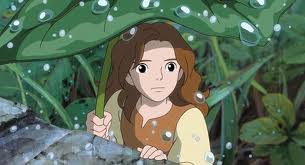
Back to Arrietty. (A local elementary school was so taken with this film they canceled lessons for the day and organized a field trip to the cinema.) Our entry into Arrietty's world is the narrator, Sho. Sent to live with his grandmother prior to heart surgery, Sho spots Arrietty in the grass. Arrietty lives in a two parent family where her father treats her as a fully capable person. Her mother is housebound and fearful, causing friction with Arrietty who strains at the rules her mother imposes. Arrietty's father is training her to provide for their family, with her mother's support. She is expected to do all he does. She faces the same potentially fatal dangers he does, she gathers the same provisions he does. Arrietty is praised for her strength but chastised for her lack of caution. She's a tween, it's what they do. They rebel.
Pod (her father) and Homily (her mother) have warned Arrietty all her life against mixing with humans. It's not xenophobia, it's hard earned experience. Arrietty is a brave and self reliant character. She makes herself a weapon and uses it in her own defense. She prides herself on her ingenuity and physical abilities. Merida climbs a rock face? Arrietty climbs a similar distance in a treacherous storm. When the new human (Sho) arouses her curiosity she investigates. This leads to repeated fights with her mother. Despite Sho's best intentions Pod and Homily are right. He endangers them. Homily is taken from the family and only Arrietty can save her. In doing so she realizes that her mother's rules are based on hard experience and pragmatism, not caprice. By disregarding her mother, Arrietty has cost her family their comfortable home. She says goodbye to Sho as her family is forced to leave everything behind. In doing so Arrietty urges him to fight for his own life, to follow his own path as she will. She embraces the necessity of her parent's rules but does not adopt their bigotry.
Arrietty is not without flaw. There are some slow pacing moments (like Brave) and a subtle racism in the depiction of Spiller, a Borrower from another area. Because he is a forager he is shown in stereotypical 'savage' attire. But Spiller is also their salvation. Where her parents thought they were the last of their race, Spiller proves differently. He offers to be their guide to a new home and shows a strong attraction to Arrietty. She treats his interest casually, her mind is full of Sho and her family. Alongside the messages of self reliance and family respect is a strong rejection of materialism. Arrietty is told time and again to take only what she needs. While they beautify their home it is through their own craftsmanship and recycling. Goods they have not made are a trap they must never accept. It is better, in her family's mind, to live independent lives through their own labor than risk being enslaved in luxury. They pride themselves on repurposing items to meet their needs.
So here was a strong female lead with a complex mother / daughter relationship. It had the Disney brand, big name voice actors, and a full advertising campaign. America stayed home. Don't tell me these characters don't exist. Disney has tried to bring you a number of female leads from Ghibli. Mononoke was even a Princess. Maybe next time we will talk about Sen from Spirited Away or Kiki from Kiki's Delivery Service. I know you think "Well, if they can bring them over as imports why can't they produce these stories in America?" Why should they? You don't go to see them.
If you saw Brave I urge you to consider The Secret World of Arrietty. Do you want voice over stars? How about Amy Poehler, Will Arnett, and Carol Burnett? Good reviews? How about a 94% at Rotten Tomatoes? Strong female lead? Check. Troubled but resolved mother / daughter relationship? Check. Fight over traditional values versus a new way of living in the world? Check. Princess? Sorry. No Princess here. Asexuality? No, Arrietty has an age appropriate curiosity. Prince? Nope. Not even close. Her love affair is doomed from the start, such as it is. Strong message of social responsibility? Check. Feminist viewpoint? Check. Total American box office? 19 million. Brave made that on it's opening day.
Face it people. You like the Princess. You want the Princess. It's the Princess you turn out for.
Back to Arrietty. (A local elementary school was so taken with this film they canceled lessons for the day and organized a field trip to the cinema.) Our entry into Arrietty's world is the narrator, Sho. Sent to live with his grandmother prior to heart surgery, Sho spots Arrietty in the grass. Arrietty lives in a two parent family where her father treats her as a fully capable person. Her mother is housebound and fearful, causing friction with Arrietty who strains at the rules her mother imposes. Arrietty's father is training her to provide for their family, with her mother's support. She is expected to do all he does. She faces the same potentially fatal dangers he does, she gathers the same provisions he does. Arrietty is praised for her strength but chastised for her lack of caution. She's a tween, it's what they do. They rebel.
Pod (her father) and Homily (her mother) have warned Arrietty all her life against mixing with humans. It's not xenophobia, it's hard earned experience. Arrietty is a brave and self reliant character. She makes herself a weapon and uses it in her own defense. She prides herself on her ingenuity and physical abilities. Merida climbs a rock face? Arrietty climbs a similar distance in a treacherous storm. When the new human (Sho) arouses her curiosity she investigates. This leads to repeated fights with her mother. Despite Sho's best intentions Pod and Homily are right. He endangers them. Homily is taken from the family and only Arrietty can save her. In doing so she realizes that her mother's rules are based on hard experience and pragmatism, not caprice. By disregarding her mother, Arrietty has cost her family their comfortable home. She says goodbye to Sho as her family is forced to leave everything behind. In doing so Arrietty urges him to fight for his own life, to follow his own path as she will. She embraces the necessity of her parent's rules but does not adopt their bigotry.
![]() |
| Look Arrietty, I'm not white! But your dad trusts me! Weird! |
So here was a strong female lead with a complex mother / daughter relationship. It had the Disney brand, big name voice actors, and a full advertising campaign. America stayed home. Don't tell me these characters don't exist. Disney has tried to bring you a number of female leads from Ghibli. Mononoke was even a Princess. Maybe next time we will talk about Sen from Spirited Away or Kiki from Kiki's Delivery Service. I know you think "Well, if they can bring them over as imports why can't they produce these stories in America?" Why should they? You don't go to see them.
25 June, 2012
Things Unseen: The Bear And The Bow and Brave
So once upon a time Brenda Chapman had a movie planned for Pixar. It might have been good. It might have been awful. I've been trying to find the original concept for Brave because I can't shake the feeling that this wasn't the intended Girl Power message. (And really, I will move on soon. It's the contrarian in me. As more and more reviews arrive jumping over the incredibly low bar of Not Completely Sexualized to herald Merida as a triumph, I find myself saying Yes, But...)
The largest piece of information I can find is the following text. If you wrote it, let me know. Most people have sourced it to a 2010 Entertainment Weekly article, before Reese Witherspoon dropped the project. So assume authorship as EW until I find differently or confirm the issue.
Brave is set in the mystical Scottish Highlands, where Merida is the princess of a kingdom ruled by King Fergus (Billy Connolly) and Queen Elinor (Emma Thompson). An unruly daughter and an accomplished archer, Merida one day defies a sacred custom of the land and inadvertently brings turmoil to the kingdom. In an attempt to set things right, Merida seeks out an eccentric old Wise Woman (Julie Walters) and is granted an ill-fated wish. Also figuring into Merida’s quest — and serving as comic relief — are the kingdom’s three lords: the enormous Lord MacGuffin (Kevin McKidd), the surly Lord Macintosh (Craig Ferguson), and the disagreeable Lord Dingwall (Robbie Coltrane). - Entertainment Weekly
That sounds like a completely different movie. But it also sounds like the same movie. Since the three lords stayed to become her father's drinking buddies, I think there is a story untold. Until Brenda Chapman gives her post career interview or Brave comes out on the Deluxe Bonus From The Attic Edition DVD with the requisite rueful voiceovers, it remains unanswered. I still want to know why Merida has to apologize for everything but her father gets a pass. Sure, he was under the influence of bear but I still think (since she was tied down and all) that he could've taken a second to set aside his manly anger and listen to his kid. Just me on that one?

Along with the Scot-Face theming, I'm leaving the fantastic (natural black) hair alone. I've already spent more time on Brave than I intended or care to. If I say more it will be on the subject of our low expectations (all Merida had to do for Amazing Status was not be interested in marriage or overtly sexual) and our cultural blindness. Why didn't we salute Arrietty for it's strong family message? Why wasn't that capable and curious girl held up as a girl we'd like to see more of? Despite a wide release through Disney Arrietty (like the female lead of Spirited Away) was largely ignored by the same people overly excited about the extremely conventional Merida. If Merida had been a boy, the reaction to Brave would be quite different and far less enthusiastic. When we embrace Brave we set the bar for female narratives low indeed.
Just say no to sexuality and we will love you. Weird.
The largest piece of information I can find is the following text. If you wrote it, let me know. Most people have sourced it to a 2010 Entertainment Weekly article, before Reese Witherspoon dropped the project. So assume authorship as EW until I find differently or confirm the issue.
Brave is set in the mystical Scottish Highlands, where Merida is the princess of a kingdom ruled by King Fergus (Billy Connolly) and Queen Elinor (Emma Thompson). An unruly daughter and an accomplished archer, Merida one day defies a sacred custom of the land and inadvertently brings turmoil to the kingdom. In an attempt to set things right, Merida seeks out an eccentric old Wise Woman (Julie Walters) and is granted an ill-fated wish. Also figuring into Merida’s quest — and serving as comic relief — are the kingdom’s three lords: the enormous Lord MacGuffin (Kevin McKidd), the surly Lord Macintosh (Craig Ferguson), and the disagreeable Lord Dingwall (Robbie Coltrane). - Entertainment Weekly
That sounds like a completely different movie. But it also sounds like the same movie. Since the three lords stayed to become her father's drinking buddies, I think there is a story untold. Until Brenda Chapman gives her post career interview or Brave comes out on the Deluxe Bonus From The Attic Edition DVD with the requisite rueful voiceovers, it remains unanswered. I still want to know why Merida has to apologize for everything but her father gets a pass. Sure, he was under the influence of bear but I still think (since she was tied down and all) that he could've taken a second to set aside his manly anger and listen to his kid. Just me on that one?

Along with the Scot-Face theming, I'm leaving the fantastic (natural black) hair alone. I've already spent more time on Brave than I intended or care to. If I say more it will be on the subject of our low expectations (all Merida had to do for Amazing Status was not be interested in marriage or overtly sexual) and our cultural blindness. Why didn't we salute Arrietty for it's strong family message? Why wasn't that capable and curious girl held up as a girl we'd like to see more of? Despite a wide release through Disney Arrietty (like the female lead of Spirited Away) was largely ignored by the same people overly excited about the extremely conventional Merida. If Merida had been a boy, the reaction to Brave would be quite different and far less enthusiastic. When we embrace Brave we set the bar for female narratives low indeed.Just say no to sexuality and we will love you. Weird.
Subscribe to:
Posts (Atom)