Showing posts with label Regencyland. Show all posts

28 April, 2014

Review: Hot Under The Collar by Jackie Barbosa

Hot Under The Collar was purchased in 2012 and then promptly placed in the TBR pile where it languished until recently. When Courtney Milan suggested we all review Jackie Barbosa's work as a show of support, I had already begun reading it. (The problem I have with Jackie Barbosa is that I love her voice but I've lost interest in erotic fiction. When we're out of bed, she's one of my favorite authors. When we hit the sheets she's just as skilled but I'm wandering off.) With all of those caveats and disclaimers in place, I really enjoyed Hot Under The Collar.
Barbosa avoids a number of pitfalls in her fairly conventional setup of reluctant Vicar and former Courtesan. The first, of course, is that the pairing is completely expected. Vicars never seem to fall for young women of deep faith and enduring piety. The second is that Artemisia, the courtesan in question, is not unknown to Walter, our vicar. Before his injury in the military Walter was an underfunded pleasure seeker who admired Artemisia from afar. There was a danger that she would be something he earned, the nice guy rewarded with the dream girl. Barbosa does a good job of having them earn each other. Artemisia is lonely, yes, but she's not desperate. Walter is not obsessed with her because of her former status but because he enjoys her as she is then and now.
Hot Under The Collar presents two facts about Artemisia and Walter early then leaves them alone. Walter's injury is manageable. He's not impeded in his life nor obsessed with it. There's no detailed scar kissing scene or wallowing in man pain. He got shot, it sucked, he moved on. For Artemisia's part she was ruined and subsequently is infertile. These are facts in her life, not tragic flaws. Walter explains he cares about neither and he means it. She doesn't run and hide from who she is or from his acceptance of it. The objections and obstacles to their relationship are appropriate and appropriately dealt with. I understood the reason for one late arrival's introduction but he wasn't needed. Walter's discovery that true faith adds to lives instead of diminishing them worked without it.
If Barbosa ever decides to write a full length standard Regency I'm completely in.
* This review originally appeared at Love In The Margins.

15 January, 2014

Review: No Good Duke Goes Unpunished by Sarah MacLean

Sarah MacLean keeps improving, but No Good Duke Goes Unpunished hits some of the same buttons One Good Earl Deserves A Lover did. Also, there's a black guy in this one but he's not going to be the romantic lead of the next book. He's only there for (would it be unfair to say color?) background depth. I sound snarky (and I am) but I appreciated the acknowledgement that the world these characters live in would have some diversity. I held off reviewing No Good Duke Goes Unpunished because the author wanted it to be approached without spoilers and my review is going to be spoiller-riffic. 
The major revelation (of course) is contained in the epilogue. Who is the mysterious Chase? You'll shrug as the heavily foreshadowed revelation is made. I suspected the answer in Book One (felt pretty certain in Book Two) but was thrown off by the Twitterverse reaction. I'm not going to directly reveal this one, but other things I discuss may obliquely do so. Again, stop here to maintain your ignorance before reading the book.
Temple, the powerful fighter known as The Killer Duke, is the hero of this one. Mara Lowe, the women he believes he murdered, steps up to be the heroine. Temple is offered his old life back, the proof of his innocence in Mara's distinctive features. Mara has no former friends, no extended family. There is only Mara and her brother, a man who has taunted and tormented Temple since the alleged murder. Turned out by his father, Temple made his living fighting on the streets before rising to power as an owner of The Fallen Angel nightclub. Nights find him boxing the ruined patrons whose gambling losses fund the club. Days mean distant management of his ducal holdings. Temple is inconsistent but resonant. I found him to be the most fully realized of MacLean's Scoundrels.
Mara could have been a very strong heroine. She was marred for me by the inconsistency of her story. By that I don't mean the lies she tells Temple, rather the trajectory her life takes after he wakes up covered in blood. While I will give Mara her carefully planned disappearance, her reappearance has several difficult elements. If we accept her current career, we have to accept the book's explanation for how she came to have it. If we accept that, then her circumstances when we meet make little sense. Where did her backers go? Why are they unable to assist her in any fashion? How does a woman able to exploit any situation to ensure her own survival not leverage her multitude of secrets into support payments? If we accept that Mara is alone, with no former friends or extended family except her brother, then her career is a major leap of faith.
Up to the final section of the book the relationships between Mara and Temple, Mara and her brother, Temple and his partners, are all solid. An opportunity to explore sudden disability is squandered, but probably wisely. There's the requisite Good With Kids scene, the Jealous Without Cause bit (quickly dismissed) and a nice evolution of the two coming to understand how they both participated in a defining moment in their lives. I could root for Mara and Temple to work things out. Both their backstories made sense. Mara enjoys self harming as much as Temple. Where he fights in the ring, she fights herself. Everything is Mara's fault, everything was caused by Mara. She never stands up and says "wait a minute, that part is all you" without quickly adding "but you wouldn't have done that if not for what I did." Like Chase, I found that aspect of her personality tedious.
Where it all goes wrong for me is during the Near Death Experience. (With the well known Rapid Healing Ability most  NDE characters have.) There is so much talking. So much. Temple's partners are willing to kill for him, but they never do. They do precious little. Each takes their turn standing on stage to loudly proclaim their devotion, followed by almost no action. It's chest thumping for the hell of it. Women save the day repeatedly, almost ludicrously. We tip from only men acting to only women acting as the men flutter about frowning and missing all the points. Soon Mara is busting through windows and disowning the brother she was protecting moments before.
This entire scene makes no sense at all. Mara's brother was the cause of the NDE. The club members have been searching for him with amazing inefficiency. There are any number of charges they could bring against him, if they chose not to murder him on sight. Yet he enters The Fallen Angel freely to confront Temple. Absolutely no part of this makes sense. None of it should happen. The staff and owners stand by, leaving only Mara available to save the pointlessly endangered day. I was face palming all the way through. MacLean had already strained my patience by Temple handwaving a major betrayal by Chase. Chase compounds that betrayal through further actions that put Mara in the Save The Day position.  My "Dude, Really?" trigger flipped over to "DUDE! REALLY?!" Mara and Temple should both abandon everyone they know and never make a friend again. They completely suck at judging people. Anyway, read it but be ready for the Supergirl moments and lower your expectations that The Scoundrels do anything but thump their chests whilst bellowing.
* This review originally appeared at Love In The Margins and NGDGU inspired a spoiler filled rant as well. 

19 November, 2013

DNF Review: How to Tame Your Duke by Juliana Gray

“I think she’s mocking her readers” is a surefire way to get me to read a book sample. While I disagree thatJuliana Gray is winding us up, I am definitely not her target audience. In discussing this book on Twitter I found a number of us were more focused on the specifics of an opening scene than on the plot itself.

“Good morning, my dears,” he said cordially. The three ladies jumped in their three chairs. The corgi launched himself into the air and landed, legs splayed, atop the priceless Axminster rug, on which he promptly disgraced himself. Gray, Juliana. How to Tame Your Duke (A Princess in Hiding Romance) (Kindle Locations 151-153). Penguin Group US. Kindle Edition.

Pile or puddle? You’ll have to decide for yourself. If you’re laughing at that quote and inclined to read a book where a princess fleeing the murder of multiple family members embraces her “Uncle Duke” with deep affection despite his inability to recall the name of her recently murdered husband, then How to Tame Your Duke is for you. It’s obviously for a lot of people as Juliana Gray is very popular. Based on this sample, Gray is very much not for me.
How to Tame Your Duke follows one of the sisters into drag (my least favorite plot contrivance). This former princess then travels alone to take a position in the household of a scarred war hero. It’s my hope that Gray handles the disfigurement issue in a manner other than How Can You Touch Me When I Am Ugly Now. Of course Emilie is the intelligent one, in the way that book series must have a bookish one to offset the social one or the clever one. Emilie reads Augustine in the original Latin (as opposed to the unoriginal Latin, which was derivative and clichĂ© filled). She hangs out in the common area of taverns with ease, as a German princess would be comfortable doing.

Chew and swallow, Miss Dingleby had always instructed her. A princess does not gag. A princess chews and swallows. A princess does not complain. The wine felt as if it were actually boiling in Emilie’s mouth. Was that even possible? She held her breath, gathered her strength, and swallowed. Gray, Juliana. How to Tame Your Duke (A Princess in Hiding Romance) (Kindle Locations 344-346). Penguin Group US. Kindle Edition.

So now that we’ve established that Princesses Always Swallow, the bar fight can get underway. (Every good princess in drag must be in need of a bar fight, it’s a romance rule.)

“Oh, it’s got a knife, has it?” He laughed again. “What’s that there in yer pocket, lad?” “Nothing.” He raised one hamlike fist and knocked the knife from her fingers. “I did say, what’s that there in yer pocket, lad?” Gray, Juliana. How to Tame Your Duke (A Princess in Hiding Romance) (Kindle Locations 398-400). Penguin Group US. Kindle Edition.

How to Tame Your Duke is the sort of book readers describe as delightful, full of madcap fun, irreverent. I use those buzzwords to avoid  face palm reads. Gray is going to have a long career with ardent fans, but I doubt we’ll meet again.

05 November, 2013

Review: The Sum of All Kisses by Julia Quinn


* A version of this review appear at Love In The Margins. 
Is there such a thing as Eloisa James disease? If there is, Julia Quinn caught a bad case of it. I'm so frustrated by The Sum of All Kisses. We begin in such a fantastic place that I start to think this is going to be my favorite Quinn book ever and we end in such a pile of melodrama that it makes Eloisa's chicken coop scene in When Beauty Tamed The Beast look restrained. Seriously, it's the late night infomercial of melodrama. (Now how much would you believe? Not that much.)
We start off with Hugh, the second son of the very crazy Ramsgate. Hugh was the other party in Daniel Smythe-Smith's duel, (in A Night Like This) leaving Hugh with a ton of baggage and a bad leg. For much of the book Quinn gets Hugh exactly right. He's intelligent, he's capable, he's ambulatory with practical adjustments for his physical stamina. There is the occasional insertion of nonsensical no-woman-will-want-me thoughts but it's initially kept to a minimum. Hugh has a fierce loyalty to those he loves, and he loves Daniel Smythe-Smith so circumstances require him to attend the marriages of Daniel and Daniel's sister Honoria. This obligation places him in close proximity to their cousin, Lady Sarah Pleinsworth. Sarah is equally fierce in loyalty to those she loves which puts Hugh on the wrong side of her before they've even met. Further alienating them is the duel itself causing Sarah to miss her first, and possibly best, chance at the marriage mart.
For much of the book I truly enjoyed Sarah and Hugh. The emotional, dramatic heroine and the arch, cerebral hero are the perfect pair for a dialogue driven novel. Quinn writes realistic sibling relationships and when she sticks to the interpersonal dynamics the book soars.  (The only false note is a sharp scene where Sarah's cousin takes what appears to be a completely unfair shot.  Quinn likes to write with interconnected timelines so I assume this will be explored in the next Smythe-Smith installment.) The exploration of divided and colliding loyalties in the lives of the Hugh, Sarah and the Smythe-Smiths is some of the finest genre work I've read this year. It was love. Until it wasn't.
Toward the third act everything went in the handbasket. Hugh began obsessing over his ugly (CHECK!) leg that kept him from being a real man (No dancing? He loved dancing? CHECK!) and therefore made him ineligible for the love of any woman (CHECK!). There's a scene where his physical infirmity means he cannot rescue her from danger (CHECK!) causing him to consider how much better off she'd be without him. For her part, Sarah goes from never once having kissed a man to being completely up for it on the lawn of her family home. From the first brush of the lips to up the skirts, our girl is full of healthy hunger ready to roll. I sighed. A lot. Not in a good way. Despite my frustration with portions of the injury portrayal, the book still hovered at a high B. Cue the chicken coop. And by chicken coop I mean spoilers. Lots and lots of spoilers.
Seriously. Stop reading right here if you care at all about yourself. I mean it. Not another word. 
Ok. I'm not the boss of you. Let's keep going. So Hugh, who has been dealing with this leg for years and is attractive, intelligent and likely to inherit (or have his son inherit) a title has decided his lack of dancing ability makes him damaged goods. Unlike that fat syphilitic guy over there twice his age, but we won't examine Hugh's self esteem issues too closely because his dad is coming to town. In a book almost entirely devoted to the tricky interpersonal workings of family relationships, Hugh has barely had any interaction with his. We meet his brother Freddie early on and establish that he cares deeply for Hugh. So where is he? He's off being gay. Freddie exists as a prop to illustrate the goodness of Hugh and the vileness of Hugh's father. I could write an entire review based on that choice alone, but Quinn quickly distracts me by turning the melodrama up to eleventy.
In A Night Like This Daniel was trying to stay one step ahead of Ramsgate. Ramsgate wanted to kill Daniel because Hugh led him to believe the duel had resulted in Hugh's infertility. Hugh told Ramsgate if Daniel died, Hugh would kill himself and thus end the chance for a child. I expected The Sum of All Kisses to explore the depression that would make this seem a reasonable course of action to Hugh. We don't. Instead we keep dialing the melodrama up until we can't add melodrama no more. In the final few chapters Quinn shoehorns in a frothing at the mouth backstory for Hugh and Freddie that is completely unnecessary. She has Ramsgate drug Hugh, tie him to a bed and contemplate marrying Freddie off and raping his wife. Sarah storms in and frees Hugh. (Further emasculating him? No, arousing him. Because of course.) She then tells Ramsgate if he backs off she will marry Hugh and bear children, on the condition he leaves them all alone.
No really, she does. This is greeted by everyone as brilliant. Sure, Ramsgate is a delusional, violent sadist, but he keeps his word.  Sarah and Hugh should be good. Never mind that once Sarah pops out an heir (or two) there is no reason to keep Daniel and Hugh alive. It's not like Sarah can turn around and un-procreate. Sarah even acknowledges that Ramsgate will have a place at the baptismal font. Because he's family or something. Sarah pats herself on the back for figuring out this oh-so-obvious solution that eluded those poor dumb men and hold Hugh to her bosom so he can sob out his tortured back history. Daddy hurt mommy in bed, never liked Hugh, hates Freddie for being gay, hired sex workers to repeatedly rape Freddie and... he just goes on and on. It's like trying to track down and kill Daniel wasn't crazy enough so Quinn keeps going in case something will stick. But gosh, we're stuck with the guy so we'll have to make nice at family functions or something. (Assuming Sarah is fertile. I don't like her chances if she isn't.)
I couldn't even with the ending of this book. There wasn't enough face palming and WTFing in the world.  Sarah was as reality challenged as the rest of the room. Leaving the whole Same Love Macklemore vibe of the invisible Freddie aside, if you have any experience with domestic violence this "solution" is impossible to buy into. Ramsgate is a murderous sociopathic stalker. How is he going to do anything other than murder Daniel, Sarah and Hugh once a child is born? Why would he risk exposing the focus of his aims to the whims of these failures? Because Sarah would get mad? Because Hugh might kill himself? So what? The guy wants a do-over on the heir front and he doesn't care very much how that happens. He is very not okay with decades of actions proving it. There is no negotiated peace with this flavor of toxicity. I can't go above a C at this point and only the first two thirds of the book are keeping me from D territory. The Sum of All Kisses should have been a wonderful book but it was ultimately unequal to it's premise.

16 September, 2013

Review: A Woman Entangled by Cecilia Grant


While I admired much about Cecilia Grant's debut novel, I didn't love it. A Woman Entangled caught my eye because it promised all the things I love most. Class conflict. Toxic family dynamics. Social climbing beauties. Younger sons. I was ready for Grant to bring it on. Ultimately the experience was the same as our prior hook upA Woman Entangled took me months to finish and left me dissatisfied. (Is there a reading equivalent of bad sex?)  Our heroine, Kate, is a social climbing beauty desperate to reclaim the social status her father's uneven marriage cost him. She alternatively positions her goal as being for herself, or for her father, or for her siblings. It's never for her mother, because everything about Kate's goal is a rejection of her mother's self and that is something Kate would rather not consider. Kate prefers to consider more reader friendly things. Here Kate is reflecting on a potential suitor:

"Perhaps he followed Mr. Brummell’s regimen of a daily bath, instead of the usual cloaking of one’s odors in perfume. Though it was difficult to imagine he paid much heed to any of the Beau’s dictums. Likely he disdained the man for living profligately and then fleeing his debts, if he hadn’t already disdained him for an excessive preoccupation with the trivial matter of personal style. And that was presuming he even knew who Beau Brummell was. He very well might not." - Cecilia Grant, A Woman Entangled

There's no point whatsoever to this passage. Much like the later passages on various Jane Austen books it feels forced and indulgent. A shouting of "Regency Tropes, I am in you!". Beau Brummell never comes up again. He isn't a friend. He's a celebrity that our characters may or may not have followed in the media of the day.

"Perhaps he followed Miss Kardashian's regimen of a daily bath, instead of the usual cloaking of one’s odors in her designer perfume. Though it was difficult to imagine he paid much heed to any of Kim's dictums. Likely he disdained her for living profligately and then fleeing her wedding debts, if he hadn’t already disdained her for an excessive preoccupation with the trivial matter of personal style. And that was presuming he even knew who Kim Kardashian was. He very well might not." Cecilia Grant and Meoskop

I strongly suggest we institute an immediate Kardasian test on the inclusion of historical characters not directly involved in the character's lives. If Kim can wear the shoe, toss it out of the wardrobe.
I wanted to love Kate. She was my favorite character in the book. Kate is so very self aware. She wants a path out of the middle class life her parents value and one back to the life of empty luxury her father left behind. I was frustrated by the resolution of her desires. In the end Kate comes to realize she valued the striving more than the goal itself. As the reader, I can't agree. Kate barely tastes the gilded world she longed to inhabit before embracing the economically cautious one in which she was raised. During that experience she lives at the edges of the family disharmony without fully exploring it's depths. Kate is neither embraced nor renounced. She is unspoken, even when being spoken to. We are to believe that Kate comes to value her open relationship with Nick more than her constrained and conditional one with her extended family. I can get behind that but only if I believe it. Kate goes too quickly from a cautiously shocked kiss under the stairs to a total willingness to have her first sexual encounter in a stranger's crowded home. I found it hard to believe that a woman of her control would so easily cast that aside.

Nick is hungry for status of his own. His life on the edges of the nobility has become painfully difficult following his brother's marriage. Having rejected his brother in an attempt to preserve his own ambitions, he initially castigates Kate for hers. Willing to have sex in stairwells and with casual acquaintances, he harshly judges his brother's wife for doing the same. A woman who fucks you for free is a friend. A woman asking for financial support is a whore. it seems a curious line to draw, but draw it he does. Granted, the misalliance of courtesan and gentry is not to be understated. It is completely authentic to me that Nick would lose status and find his ambitions beyond reach.

Yet Nick is still greeted by old friends. He is still welcomed in many fine homes. We are not shown Nick struggling for clients. We are told he is and invited to watch him wallow. I had the same problem with Nick that I had with his sister Martha in Grant's first book. Why, when his focus has been solely on maintaining the good opinion of Kate's family, would he take her to his rooms? Why would he consider her an unsuitable wife for a man with upwardly mobile goals when she herself is rigidly in pursuit of them? Why would he blame her for having an actress mother yet bring his most important client to that women for instruction? Why? Why? Why? Nick is a straight up whiner. His better moments elevate him to sequel material but he fails to convince me he is not going to disappoint Kate.

A Woman Entangled is likely to have many readers swooning. It's a Masterpiece Theater set piece of a book, hitting all the right marks in all the right order but ultimately leaving me distant and cold. The sexuality is original and important enough to the story development that I skimmed little of it. The reinforcement of family over finance is not seen often enough in the genre, despite my overall dissatisfaction with it's implementation. Grant remains at the edges of my awareness. She is an author I can neither embrace nor dismiss.

*This review first appeared at Love In The Margins.

30 August, 2013

Review: The Arrangement by Mary Balogh


Some books permanently change the reader / author relationship. Having loved Mary Balogh since her earliest days I half-heartedly defended her previous disability themed books but still cringed when she announced The Survivor's Club series. There are authors that do disability well, and then there's Mary Balogh. Her disabled characters are more Matt-in-Downton-Abbey than Harold RussellThe Arrangement is the second TSC book. In some ways it's more successful than The Proposal. (I mean, I finished it without rage reading.) Here Balogh is concerned with a blind hero and a destitute heroine.
Vincent Hunt is a golden god of a man. He's also blind. He has recently acquired an unexpected title and musical ability. That's pretty much all you need to know about Vincent. Despite tons of backstory describing him as a take charge problem solving man of action, Vincent undergoes a radical personality change once blinded. His dependency extends past the physical into the emotional. His family coddles him so he runs away to pout about it. Enter Sophia, the poor relation with a comedically unkind family. Sophia is kept at home in her small village by a domineering aunt and social climbing cousin. I couldn't stand Sophia. She's one of those women who climbs on the cross and frantically smacks anyone trying to help her off it. She is a martyr of the highest order. She's also the only one in Vincent's life (he feels) to see past his blindness and into his soul. He doesn't care if his peers tell him she's not pretty (and it would be far more interesting if she wasn't). He's drawn to her voice and her innate goodness. Vincent's right hand man and alleged close childhood friend distrusts her so that seals the deal and they hitch up.
At this point I'm not certain what offended me more in The Arrangement. There is so much to choose from. It was readable and it had some lovely touches so it's going to do well with people that can set aside the problems of one note characterizations, family dysfunction, class reinforcement and random violence. Balogh asks us to believe that Saint Sophia the Self Effacing is the only person in Vincent's life that would think to put up a guide rope for his walks. Farmers have used guide ropes for blinding weather conditions since we first made animals sleep outside the house. Either everyone in Vincent's life is insanely dim or... ok everyone in Vincent's life is insanely dim. I can't come up with a second choice. Sophia presents a multitude of ideas to expand Vincent's limitations, ideas that were in place for a few hundred years prior to her arrival and yet unexamined by anyone else. But let's step beyond Sophia's innovations and Vincent's all encompassing blindness.
Remember Sophia's living situation? The family that refused to let her leave the home and then cast her out to starve? Them? Vincent encourages Sophia to resume ties with not only that crew, but also the extended relatives that couldn't be bothered to meet her. Vincent has such a large loving family that he wants Sophia to have a nest of self interested vipers to balance things out. So she does. She takes her toxic extended clan, people who left her to starve, and she embraces them. Saint Sophia the Self Effacing accepts their misdeeds and presents a clean slate to everyone. Well, almost everyone. She can't quite forgive the one who called her ugly, so Vincent arranges to beat the ever loving crap out of the guy. Nothing says "I love you" like domestic violence. (Um, spoiler alert. Sorry.)
The first half of The Arrangement is stronger than the second. Sophia doesn't really get her sainthood rolling until after she meets Vincent's friends. Characterization is stronger before Sophia is demoted from new friend to care coordinator. The relationship between Vincent and his childhood friend / devoted companion disappears once he reenters the forced world of The Survivor's Club. Whatever personality Vincent held apart from his disability is dominated by their insistence on telling us who he is despite Balogh showing us someone different. A truly bewildering dynamic between Vincent and another member of the nobility is tossed in for no apparent gain beyond pathos. It's like a same sex relationship that isn't. You'll know it when you get there.
Vincent and Sophia began as strong characters finding their way through temporary challenges. They ended as a typically Inspiring Couple made of pity and pathos. Without Sophia's guiding hand everyone else in Vincent's life (including Vincent himself) would have failed to make commonsense changes to adapt his home to his life. Without Vincent's massive cash infusion Sophia would have been forced to sex work or starvation. Luckily, they end up together and a merry band of misfits toasts their eternal union. Even the childhood friend comes around. Oh, and his mother cries. Happy tears, naturally. I just took an aspirin and moved on to the next book.
*This review was first posted at Love In The Margins

26 August, 2013

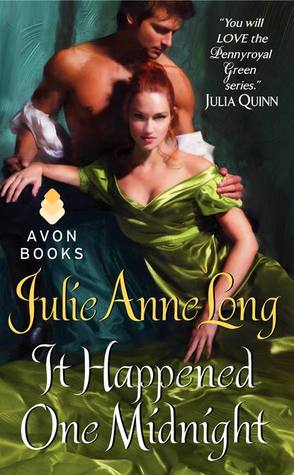
Review: It Happened One Midnight by Julie Anne Long


Caucasian man in right profile with dark hair wearing a white shirt unbuttoned and hanging on his elbows, stands behind a red haired woman in a green historical dress staring outward and leaning slightly left. His arms hold her left arm and right shoulder lightly.It Happened One Midnight would be far more enjoyable as a single title than as an entry in the Pennyroyal Green series. Eight books in I don't care at all about the missing Lyon or the weary Olivia. Every mention of either character detracts from the story. That's a shame because Lyon has an actual purpose this time out.

Jonathan Redmond is Lyon's less paternally satisfying sibling. After multiple disappointments Father Redmond is cracking down on Jonathan in an attempt to mold a child he can approve of. The shadow of Lyon's absence keeps him from seeing Jonathan clearly. Cue inevitable father and son clash. Enter Thomasina, (hereafter Tommy) our heroine.

Tommy is a woman with a mysterious background. (This review is long enough without exploring the holes in it.) She may or may not be a courtesan. She's searching for the security of marriage while keeping her eyes open for other revenue sources. Jonathan brings her into his start up as an investor. Of course Jonathan and Tommy find there is more to each other than they realized. (Duh.) There's a subplot about child labor but the main focus is on Tommy and Jonathan's banter.

Overall It Happened One Midnight is a satisfying romance of the light history variety. Characters are varied enough to provide interest and appear to have lives outside of the time spent in Tommy and Jonathan's orbit. While there are no real surprises neither are there serious offenses. Yet It Happened One Midnight became a rant read for me in it's closing pages. It's not about the numerous errors I understand the finished book contained.

HEREAFTER BE SPOILERS, YO!

If you believe that one of the purposes of genre fiction is to uphold or undermine cultural norms what are we to make of the choices here? Tommy is the bastard daughter of a Duke and the courtesan he allegedly loved. The Duke rejected Tommy at birth yet her mother raised her to revere him, going so far as to claim if she were ever in need The Dukester would step up and assist. (I'm not sure who is needier than an infant, but Tommy's mom isn't the first woman in history unable to accept he's really not going to pay child support.) Tommy goes on to have a horrific childhood complete with near death events. Still she believes, because the child inside her has nothing else.

While Long gives Jonathan the opportunity to confront and insult the Duke, she gives no such moment to Tommy. Tommy's father left her to die. When confronted by Jonathan he confirms his belief that working class children are expendable. Tommy's father is a completely reprehensible person. I felt no sympathy for Tommy's father. He knowingly works children to their death. He knowingly abandoned his own child not once but twice. Why should I (or Tommy) care for him?

Long treats Father Redmond differently. Tommy and Jonathan are both given opportunities to condemn his actions. Despite Redmond being a present and loving father in the past, his current pain is tearing apart his relationships. It is bizarre that he is given more condemnation than Tommy's absent father. Both Tommy and Jonathan threaten Redmond with his greatest fear - losing another child. At this point I expected Long to give Tommy's father an unlikely change of heart through his friendship with Redmond. It would have been unlikely and predictable but Long laid the groundwork for it.

Instead the book closes with Tommy and the Duke estranged. In the book's final pages Long has Tommy return a family keepsake to her father with an encouraging note. It is this encouraging note that moved It Happened One Midnight from the A minus to the Low Middle B grade on my reader report card. In having Tommy urge her father to "be brave" Long wants the reader to believe emotional cowardice is the root of his parental rejection. In doing so she places Tommy's life in a separate category from the other children the Duke would condemn. I don't think Long is making a class superiority comment so much as one of family solidarity. This incredibly toxic message is showing up in too many historical books this year. Our heroines are returning to abusive families and begging for emotional connections. This is not a happy ending, this is a recipe for disaster.

27 June, 2013

Review: Lord of Wicked Intentions by Lorraine Heath

This was going to be the book where Heath and I break up, but she surprised me. Which is not to say I recommend the title.

Heath is working with a problematic trope in that the hero (Rafe) buys the heroine (Evelyn) at an auction. (Spoiler alert - he's not secretly a reformer.) Evelyn is believable as a highly sheltered daughter of privilege who is unable to understand that her world changed overnight. It takes her quite a while to get with the program.  Rafe is just plain crazy yet he's far more credible than he was in the earlier Lost Lords books. This is a kid who has been traumatized by circumstances very similar to Evelyn's. Both of them lost their father in one breath and found their entire world altered in the next. Where Evelyn's brother auctions her off without her knowledge, Rafe's brothers sell him without his consent. (This somewhat mitigates that Rafe's actions. In his view he's offering Evelyn more of a shot than he got, making him the good guy. In the reader's view he's telling himself pretty lies about his actions. But again, dude is crazy.) I liked the way Heath presented Rafe and Evelyn. It would be unrealistic for a woman in Evelyn's situation to have more options than the distasteful ones Rafe explains to her. Certainly Rafe could have escorted her to any number of charity homes but then we'd have a different book. So Rafe shows Evelyn her only currency is her body and offers to pay an insanely high price for it. Evelyn realizes he's right and makes her own bed to lie in. she gets her Pretty Woman and they work toward HEA.

Overall, Lord of Wicked Intentions is the best of my least favorite Heath series. However, like the rest of The Lost Lords Lord of Wicked Intentions repeatedly pulls the WTF card. There are errors of time and place that threw me out of the story repeatedly. Early on Rafe examine a wide selection of ornate molded chocolates. That's great, but molded chocolate is late Victorian and this book is not. He could've bought rolled truffles, I suppose, but Heath explains them in a way that strongly indicates molds. Rafe takes Evelyn slumming so she can react with horror at the wretched lives of the underclass.  Nobody wants to be the underclass, not even them. Wretched things do happen when you add lack of options with lack of resources. It's still pretty obnoxious to walk Evelyn through it like a cautionary zoo exhibit. Rafe claims to process a million pounds a night at his gaming house. (I don't feel like doing math, so here's an excellent article on Crockford to explain how ludicrous this number is. Just know the guy would be turning over more than 4 billion a month at that rate.) The heroine runs away for obscure heroine reasons and takes shelter with the hero's estranged family. Because of course their desire to se him happy means they've befriended this unknown quantity and placed her needs above his. (That's the kind of family they are.) It's full of things that require a veritable bungee cord of disbelief. I can't leap off a bridge that has the hero divested of all his belongings and scrubbed naked at ten then has him in adulthood stroking a coin he's held onto since the day of his father's death. (Where did he hide it during the strip and scrub?) Toward the end our hero proves his love by administering a beat down to someone who wronged the heroine at the beginning of the book. He assumed a woman being auctioned off for sex was a whore, we must pummel him now. Because love. And he wasn't the winning bid. And reasons. I don't even know.

I closed the book feeling tired of Heath writing in this era. She's had some great stories to tell but Lost Lords feels like she's more than ready to move on. So am I. Hopefully her next outing finds her back in form because I don't think we've got more than one date left in us. There was enough here to make me come back, but not enough for me to fall in love.

24 May, 2013

DNF Review: Sins of a Virgin by Anna Randol

Maybe I've burnt out.

Each reviewer has their own personal ARC policy. Mine is that I will review your book if I accept it, but the review might not be to your liking. I will make every effort to finish your book and reserve DNF reviews for purchased items. I try to get all ARC's reviewed within a week of the publication date. I have failed Sins of a Virgin as completely as it failed me. I don't think this one is necessarily Randol's fault. I've been trying to read SOAV for close to a year. I keep stalling out very early in the book. I'm not even really reviewing SOAV. I'm using it to talk about reader reaction.

Madeline is a Secretly Chaste Courtesan who has decided to sell herself to the highest bidder. She hires Gabriel to ensure that the bidder she selects will be able to pay her fee. Gabriel is a Bow Street Runner looking for his sister's killer, some of whom are bidding on Madeline. On paper, this should be a good read for me. I'm okay with the Secretly Chaste Courtesan set up because Madeline is up front about her status (hello, book title!) and her reasons for the auction make sense. Except they don't. This coupled with Gabriel's super moral disapproval derailed me fast and kept me from getting far into the novel.

Madeline has spent ten years working as a government spy because reasons. Despite her service to the government, she is left unable to establish herself properly and therefore makes the choice to auction herself off. Here my reader reaction stops the story from moving forward. How are all these heroines pretending to work in the sex trade without ever suffering a sexual assault? In an age where rape was so common and so hard to prosecute, how are they navigating these men while keeping body and soul intact? How has Madeline worked as a fake courtesan without being tested? This myth that these girls can be trained in seduction, live among men and pass as purchasable goods without being assaulted seems so much in line with the Hermetically Sealed Heroine that I can't turn my mind off. What are we reading when we read about these women? Often (as in another recent DNF read but not this one) the hero is busy obsessing over what a durty durty hurr the heroine is while his employees are inexplicably reacting to her as if she is their better. When the hero realizes she is not a durty hurr and falls to his feet in tearful apology we are supposed to feel... something. Something besides impatience.

On the surface the message of the SCC or HSH is one of redemption. You have misjudged me, you have wronged me, I was not the durty hurr you assumed, but the lost daughter of aristocrats, meant for better things than I have had. As an apology, you may elevate me to my proper status. I shall play Lady Bountiful for your people, who saw what you could not. (If it's true that we read to escape into our privileges, then perhaps my recent problems with these romances has been a misalignment of needs.) I cut my teeth on the romances of the 70's, where a woman wandering alone was a woman moments from a gang rape. While I don't miss the days where love meant a disco floor and an act of violence, I do miss the message that the woman was still loved. At the end of whatever happened to her, she was still worthy. She had value. The hero wanted to be with her for her. She was, as is the core message of romance, enough. So often these days I feel that while the heroine has gotten smarter, stronger, more capable, her actual worth has diminished. He wants her even if she is a durty hurr, but it's ok, because secretly she's not. Even if she's been married before the odds are very good he was gay or impotent or drunk. Even if half the men in town claim to have banged her like a townie against a dumpster, it's all a lie. She is too good for that.

If she's good, what are the rest of us? If the message of the 70's and 80's was Stand By Your Man and As Long As He Loves Me, what is the message of the 90's and 00's? Is Madeline a virgin because she's more deserving than the other girls? Because she's smarter, as though being clever can provide safety from predators? What made her immune from being used in every way a tool is used in a time when she would have been so very disposable? I give Madeline credit for honesty - she has decided to exchange her body for money. She will do whatever she is required to do to meet the goal she's set for herself. I'd like to stick around long enough for Gabriel to tell her to tun off the red light, but I haven't been able to. My brain won't stop asking questions the book can't possibly answer.

23 May, 2013

DNF Review: When You Give a Duke a Diamond by Shana Galen

I've been doing a lot of DNF reading lately. Sometimes I set a book aside and try again. Sometimes I soldier on, carried aloft by the wave of hate reading. It's pretty rare that I hit a book two, three, four times and just say forget it. (2013 has not been a good year for me.) Lord & Lady Spy was the first Galen I abandoned. When You Give a Duke a Diamond is the second.

Meet Juliette. She's famous for being famous. She plays men off each other, collecting their offerings of wealth. She has a scandalous protector who is actually, um, something that gets revealed in the part of the book I didn't read. In the first half he's off the page. Apparently she and two other women are pretending to be his lover. He sets them up with the cash and the flash and they're going to find aristocratic husbands. Because that is the natural outcome of life at the high end of the sex trade. (If the Hermetically Sealed Heroine had a cousin, she'd be the Secretly Chaste Courtesan.) Juliette is divorced yet oddly eager to reenter the matrimonial state. Given that Juliette's ex husband is a scary abusive creep I would've expected her to have some reluctance. Perhaps, with her gift for social climbing, she might have considered actually becoming a courtesan. In that life she would have an escape hatch. But this is a tale where abuse issues are excuses for bonding. Or bondage. We'll get to that.

Juliette meets William in a series of nonsensical events. They aren't just tedious to follow, they don't pass the logic test. William leaves his fiancee on the balcony. When he returns she is missing. Juliette claims the woman has been murdered. There is a bullet in the wall and no sign of dead fiancee. Since dead fiancee has been having extramarital sex (unlike Juliette) no one but her parents worry much about this. William wavers between believing Juliette and repudiating her. They engage in some public scenes where neither of them are terribly lucid. Juliette runs to William (whom she barely knows) for protection from a known threat rather than the men she already has on the string. Once forced into his life, she challenges him at every step with such stunningly tone deaf antisocial behavior that my sympathy began shifting to her ex husband. Juliette wears entitlement like a perfume. Bravado or not, it's shocking when William begins craving her company. Of course, William is a Duke. And Juliette is known as The Duchess, one of the Three Diamonds who are the alleged lovers of the Earl of Sin.

I just typed that. With my fingers. I could insert a lecture on the mine cut diamonds of the pre-1900 era and the frequency of foil backing as a method to improve their appearance, but I will just bow to the De Beers machine and move on.

William has OCD from his abusive father's questionable parenting methods. Rather than act like almost every formerly abused child I've ever known (and I've known plenty) William acts like the Abused Child of Fiction. He cannot be free. He lives his life, despite unimaginable access to power and resources, in the narrow constraints his father dictated. He upholds the order bequeathed to him without question. Having been unloved, he does not form attachments. He is a stern and rigid man. He and Juliette bond over tales of - what is the word for dog murder? Is there such a word? Canineicide? Anyway, they had a puppy and then they didn't and it was their fault for being such bad, bad boys and girls. (Take a moment here to wonder why William didn't buy a litter of puppies to piss on his father's grave daily.) Dead dogs mean I love you. Or something. Soon Juliette is introducing Surprise Bondage to their lives and trying my nerves in new and inventive ways. Someone attempts to rape her. Is it the guy who killed William's forgotten fiancee? Is it Juliette's ex husband? (She not only dismisses that possibility she fails to share  the thought.) I suddenly realized I didn't care. I was more interested in the dead fiancee than either of the people pretending to look for her.

30 January, 2013

Spoileriffic Review: One Good Earl Deserves A Lover by Sarah MacLean

*Since we're diving deeper into the book I thought the step back would be a more fitting graphic than the cover. 

A few days ago I suggested you preorder Once Good Earl Deserves A Lover, read it at midnight and meet me back here to discuss where I thought it fell apart. I can only show you the path, I can't make you walk it. If you're reading this without having finished One Good Earl  that's on you, kitten.

With everything I loved about OGEDaL this is not a cliche free book. MacLean deals with the logistics of a girl who wears glasses so well that I forgave that girl being an intellectual. (The details of Pippa trying to tie a mask to her face won me over.) While I'd love to read about vision impaired heroines without their defective eyes conferring intellectual power, I get that this stereotype is hardly negative. But still. Smartacles. The magic of myopia.

With all the Pippa Middleton / Prince Harry shipping in the zeitgeist it took me a moment to get past our leads being Pippa and a tall charming redhead. It certainly didn't hurt that Cross was also an intellectual. (Say what you will about Harry but he's never been known for scholarly prowess.) I appreciated how Pippa dominated the book. Cross was well represented but it's Pippa that drives the story and dictates the action. She never becomes a passive passenger in her own story. The human relationships were (with some exceptions) well defined and realistic. I believed the divide between Cross and his family, as well as the interactions between Cross and his partners. I appreciated MacLean leaving Cross and his sister estranged. It was truthful and appropriate. What was neither was the distance of Bourne. I found his exclusion completely implausible. It's one thing for Cross to conspire with Pippa, it is another thing for his partners to do so. Events escalate to the point that the partners spend 19 million in company funds (300,000 plus pounds converted to modern pounds) without consulting or informing him. (The 19 million spent made little sense. This was a feel good resolution that didn't hold logically. It also put the owners - and thus Bourne -  into business with men they didn't wish to entertain.) Aside from the financial aspect, Bourne is invisible in his own family life. He is a prop used to support the HEA from a prior book instead of a realistic character.  This is Bourne, he likes to bang Penny now - as though there is no other purpose to his existence. Send your prior characters on a tour of Europe if you're going to write them out of their own lives.

Cross and Pippa have a nemesis in rival club owner Knight. Of course Knight has a daughter. Since Pippa has two men on her string you know we're going to end with one of them marrying the girl. It's unlikely, unrealistic and unbelievable. It weakens the overall story when characters not destined to be sequel bait pair off like animals on an ark. There is no need for Knight (or his daughter) to bag an aristocrat. Late in the book events also weaken the portrayal of our extra earl. It's understandable that Pippa would build a plan requiring the full cooperation of a recently rejected lover. It's less understandable that he would comply. Marrying him off to Knight's daughter undermines the only simple explanation for his eager compliance. We needed more characterization of his friendship with Pippa to understand what appears to be an inexplicable willingness to comply with her desires. "Hi, I'm not going to marry you. It's really sweet of you to offer to marry me even if I'm pregnant or just desperate, and I totally adore how you're keeping the offer on the table, but would you come help me win the man I want instead?" What makes him agree? Nothing but the needs of the plot.

One aspect of the book I I really enjoyed was Pippa's frank acceptance of human sexuality and lack of disdain for sex workers. Pippa struggles to understand who would choose such a life (and if they would). I felt MacLean was having it both ways when Pippa tells a prostitute that there is no shame in the word, then tells the hero she cannot condone the life. On the one hand, a heroine refreshingly free of slut shaming. On the other, nod to conservative reader expectation. When the prostitute flips on Pippa she has a wonderful defense of her actions that again, is adjusted to reader expectation by her regret at having wronged our Pipster. I'm conflicted in my feelings about this aspect of the book.

I'm not at all conflicted about the final pages. Cross has his last minute revelation. He runs down the street to make the church on time where he finds Pippa in the foyer instead of walking down the aisle. A public proposal follows, and a babylouge ties it off in a bow. This part of the story couldn't be more cliched if it starred Hugh Grant. Pippa has called off her wedding. Why is she at the church? If not Pippa then at least her family is aware she has jilted an earl and will be subject to extreme public scrutiny. Pippa is sporting a bruised face and a blackened eye. Someone around her (oh, I don't know, Bourne?) might have feelings about her appearance. Someone might suggest (her mother?) that society is going to assume the earl beat her and thus she canceled the wedding or that her father beat her for canceling the wedding. Either way, bare faced Pippa hanging out at the church is going to create unwarranted and unsavory rumors for someone. I didn't believe that she'd appear or that she'd hang out in the lobby. Far more likely that Pippa would be at home or at the wedding breakfast (where her appearance could possibly be explained). Pippa is in the church only to facilitate the cinematic staging of her proposal. In a book so deeply concerned with logic and intellect it doesn't hold together. Plus, babylouge. So, so sick of babylouges.

I still loved One Good Earl Deserves A Lover. Books, like people, don't need perfection to be worthy of affection. We can embrace them and see their flaws simultaneously. MacLean owns me for her next release and probably two or three after that. If there's an author / reader version of reality show immunity, she's got it.

18 January, 2013

Review: One Good Earl Deserves A Lover by Sarah MacLean

Emotionally, One Good Earl Deserves a Lover is absolutely fantastic. Epic. Sheer greatness. Best Book Of The Year material. Critically, One Good Earl Deserves a Lover has substantial flaws. Much like Jennifer Ashley's book The Madness of Lord Ian MacKenzie reader investment overcomes the structural problems. I was so engaged in the story of Pippa and Cross that I forgave the book everything. In Pippa we have an educated woman free of the cultural bias authors generally ascribe to educated heroines. Pippa does not rebel against conventional femininity nor does she require anyone's defense. She is accepted by those around her. Pippa is not disdainful of people who think differently than she. This is an intellectually curious woman with difficulty understanding and processing emotional cues.

Pippa uses information as a shield against embarrassment, a way to mimic the conventional behavior that seems so alien to her. By studying the strange world most people inhabit, Pippa can move confidently within it. This brings her to Cross, a business partner of her brother in law. Pippa is marrying a perfectly nice man, a man she wants because he wants her. Pippa is aware her interests do not mirror those of conventional society. She is grateful to have found a man who honors her unique qualities. In the interest of conducting herself properly as a wife, Pippa seeks to understand human sexuality. This is a common beginning for historical romance - the naive heroine in need of a sexually experienced tutor. MacLean tweaks the plot by pairing her ingenue with a celibate. Cross is also a prodigy. Where Pippa is emotionally unconnected, Cross is attuned to the way emotions dictate human behavior. He understands and categorizes it the way another might their personal library. What is a mystery to Pippa (human sexuality and attraction) is an open book to Cross. He shares her interest in science as well as her inability to stop thinking critically about the world surrounding him. Where Pippa labels herself as odd, Cross labels himself as continually inadequate. The difference between them is larger than age or experience. It is built by their extended family. One is embraced, the other was rejected. Pippa has never before had a need to decode human interaction. Cross has always been forced to look outside his home for warm appreciation.

Because the emotional strengths of One Good Earl Deserves A Lover outweigh the structural weaknesses I'm going to run a second review after the book's release. It will discuss the dissatisfactions I had with the framing of Cross and Pippa's courtship. I'm splitting the review because I strongly recommend One Good Earl Deserves a Lover and believe it should be read without spoilers. Pre-order this one, read it at midnight and come back on the 30th to see what I have to complain about. All you need to know before you crack the cover is that MacLean has written a celibate hero, a strong female lead and an emotionally satisfying resolution. Enjoy it, for tomorrow (or in two weeks) we quibble.


23 December, 2012

Review: Deck The Halls With Love by Lorraine Heath

I think Lorraine Heath and I just broke up.

There's nothing seriously wrong in Deck The Halls With Love. The hero was once interested in the heroine but stopped chatting her up because he felt obligated to make an offer of marriage to someone else. He's free, she's not, can these crazy kids get back together? Of course they can. Deck The Halls With Love is a classic novella in the sense that you know exactly what's going to happen. Storms lead to shelter which lead to sexy times which leads to... You've read this before, except you haven't.

It's a shame, because the bones of Deck The Halls With Love are good. If the heroine was engaged to an interesting man instead of a transparent (and rarely seen) fortune hunter then we could have had a book. As it is, the hero was really into her but honor demanded he marry another (who called off the wedding) and now he wants her to call off a wedding she's not really that into. Even then, we could have had a book if anyone truly cared about honor. They don't. Mild spoiler here - the heroine is due to be married in just a few weeks. The hero makes a public proposal. Everyone shrugs and toasts them. Sure, the heroine just told the former groom she wasn't going to meet him at the altar after all, but who knows that? Fortune hunter dude hasn't had time to process the information, much less make a public announcement or discuss it with her family. You'd think someone in the crowd might point out that she's already engaged. Or ask what happened to the other guy. Or something.

A mildly pleasant and fully predictable novella with a few eye rolling moments isn't enough to break me up with a favorite author. What may have killed it for me and Heath comes later, with an excerpt from the final Lost Lords of Pembrook. It opens with the heroine's brother selling her off to a room full of men under the uncaring eye of the hero. This isn't presented as something he struggles with, something odd for him or something morally repellant. It's just what you do sometimes. You're broke so you sell off a sibling. Of course our hero decides she's so touchingly innocent (unless she's a great actress, of course. Can't have him think well of her) that he will inexplicably demand that she be his. In fact, she should be delivered to his house the next day via UPS. Wow. How can I not want to know more about this couple? He's ok with treating women like livestock, she might be too dim to know she's being sold. Will they make it work? I think you're going to have to find out without me.

21 December, 2012

Review: The Lady Most Willing by Julia Quinn, Eloisa James and Connie Brockway

In this unconnected follow up to 2010's The Lady Most LikelyQuinn, James and Brockway continue the conceit that this is more than a collection of novellas. Where it worked well in the former, it's less successful in The Lady Most Willing. Unlike the prior collection, the stories fail to flow into one tale. I struggled to finish the book. Changes in character that might be forgiven in a grouping of shorts stood out strongly when presented as part of a whole. Adding to my boredom was no real sense of suspense. Here are the couples. Watch them pair off. Four men, four women, an engagement every few chapters.

In the first tale we meet the obligatory duke and his future duchess, the mistakenly kidnapped Catriona Burns. This was the most captivating of the couples, despite being as instantly forgettable as the rest. Catriona becomes our narrator, despite not being the actual narrator of the book. It's a shock when she abruptly departs at the next chapter heading. Now our heroine is Fiona of the ruined reputation and passive aggressive acceptance. This isn't quite the Fiona we think we've gotten to know, nor is her suddenly malicious sister Marilla the same desperate girl we've been reading about. (Where did this strong dislike between the sisters come from?) Instead of two very different girls tolerating each other it's open dislike with a veil of civility. Marilla switches from overly eager young colt to vengeful nemesis. I liked the new version of Fiona but I didn't understand her. The new Marilla I'll get to later. (Catriona is now reduced to ducal snuggle sessions.)

Fiona spends most of her tale in sexual longing. Or not. Honestly, my initial interest in her quickly turned to page skimming boredom. (Everyone thinks I'm a whore. Let's have sex.) There was some weird subtext going on I didn't quite grab hold of or care enough to unearth. Fiona, thought to be sexually open is actually the victim of unwanted male desire. As a result she's repressed her natural desires. Faced with a spoiled young sibling, she carefully guards her inner passions so they cannot be detected. (Sensing a theme?) Of course this leads to sex in the stables. Because that's what this character would do when faced with something she wants. (I liked Fiona better when she was throwing the hero over and planning an independent life.)

Our not so final heroine Cecily has an abundance of everything. Blessed with face, fortune and indulgent parents she has been waiting for The One. Of course she finds him in less than a second. Meeting her hero's eyes as she leaves a carriage, Cecily is certain he's the man she's meant to wed. There is so much going on with Cecily that I don't know where to start. I don't believe at love in a glance, I think it requires at least a conversaton. A women with Cecily's options and experience deciding to seduce a man with a love them and leave them reputation was a hard hurdle to jump. Add in her later qualms about whose place it is to make the first move and Cecily just annoyed me. Toward the end of her story she started to reclaim my attention but it was too late, the book was done. And this brings me to the fourth heroine, Marilla.

I had serious problems with the presentation of Marilla. Is she a woman making the most of an opportunity? Is she a hateful bitch determined to ruin her sister? Is she an underage seductress playing games far above her experience? Is she a sensualist used to indulging herself? Marilla has only one consistent aspect to her character. The other women dislike her. The other men (save her hero, presented as no prize at all) hold her in mild contempt. Every woman in the book is given a sympathetic viewing but Marilla. She's fairly young, she's ambitious, she wants to have fun and she wants to marry someone who will indulge her. During Fiona's story she's malicious, but for the rest of the book she's misguided and impetuous. Because she is obvious in her desires and open in her goals, the other characters strongly dislike her. This rather made me dislike them. It's not that Marilla was so likeable. None of her faces were sympathetic. In a book where each character's personality quirks were explored and explained, only Marilla was freely disdained. Her happy ending is a father figure of a husband. I had issues.

The Lady Most Willing was far from the worst book I read this year. If the shorts were sold independently I'd say grab Catriona's chapters and forget the rest. Since they come as a bundle, you'll have to decide for yourself.

*In reviewing my former thoughts about The Lady Most Likely I discover that a homophobia ran through it not unlike the homophobia on display in Eloisa James recent short Seduced By A Pirate. I need to quit Eloisa James. We're not good for each other.

07 December, 2012

Review: The Importance of Being Wicked

*I've been off being all medical again, because everyone needs a hobby and reviewing books doesn't have the same flair as recreational use of anesthesia. 

Oh Miranda Neville. We should be a perfect match and yet I find myself turning you away. I admire you so. While I was reading The Importance of Being Wicked I found myself thinking how well done it was, what a refreshing idea this or that aspect of the story was. It was so polite. I didn't want to leap into the pages and shake a bitch or weep into a cotton hankie while urging them to value themselves more. It was all the admiration in the world and none of the emotional passion. This means it's not you, it's me? Or something?

Doesn't help. Let's move on. Your cover is eye catching. I hate it. It's got this shade of dyed red hair seen clutching early bird special menus coupled with a red and rust palette straight out of fall. Her tomato red dress, the crimson chaise, it's a big yawn. The title is fine. I totally want a gig naming Avon romances, except I don't drink. Avon titles are the things you come up with after a long night of partying, the punchy humor that begs for high fives. But they work. They move books and they're memorable.

The Importance of Being Wicked has nothing to do with Oscar Wilde slash (sigh) and everything to do with a Duke. (Can we just move on to pretend kings? All these dukes. I expect Julia Quinn's next book to be You Only Duke Twice featuring a widowed duchess choosing from six lovely dukes. Maybe she's been widowed twice but runs away with an earl. Crazy stuff. Or wait, it could be The Duke Of The Month Club! Our heroine has one year to choose from an assortment of dukes reaching their majorities! A free YA suggestion. It's a gift. Holidays. You know.) Thomas The Duke comes from a long line of men who marry rich women. His dad screwed that up, so Thomas wants to get back on track. Caroline is the completely broke widow housing his teenage bag of cash. Enter hijinks.

Actually there are hardly any hijinks. Neville does a great job with Caroline. Impetuous and bad with finances, she's the girl who never wants to leave the party. As long as she's hosting, people love her. With the food and wine on offer the artistic community she adores will fill the silent corners of her home. Caro wants to have fun and forget when the bill collectors come round. She's always one step ahead and two bits short. Mostly this is her ex husband's fault. Disappointing, but it's a time honored truth that a widow in want of finances is rarely to blame. Thomas The Duke is super interested in family honor, almost as much as he is in refilling the family coffers. When the bright and beautiful butterfly of Caroline crosses his path he wants to forget everything and follow her.

It's a classic set up. Neville gets deeper into the motivations and causes of the characters than most authors bother with. Caroline is alternately frustrating and delightful. Thomas is a little less clearly drawn but he's a character that can't communicate emotionally so there's that. Problems are generally addressed and worked out leaving the conflict one of putting two lives together, not finding authorial reasons to keep them apart. What kept me from connecting to The Importance of Being Wicked was the sheer amount of sequel bait it held. Here is a character, here is a ton of background, here is a different character. Rinse and repeat. So many side threads are left unresolved. I got tired of waiting for a player to factor in a meaningful way or have their own storyline summed up. The canvas felt too infinite, the players too multiple. This one is a friend but also a nemesis, an enemy but also maybe a relative, a thief but also maybe.... my patience wore out. Tell the story you are telling me. Don't lay the case for a different one. I stop caring about what we have when I'm constantly told what I'm getting. The product placement may be skillful, but it's not necessary to the tale.

Overall, my admiration for The Importance of Being Wicked overpowered my weary rejection of it's chorus line. If you like Tessa Dare or Julie Anne Long I think Miranda Neville will fit the bill nicely.

05 November, 2012

Review: Seduced By A Pirate by Eloisa James

* Note, this may have been the short included in the print version of The Ugly Duchess. I'm so annoyed by the prospect of buyers getting even less value in an ebook that I can't be bothered to ascertain exactly which title they tossed in the MMP. Either way, it's now for sale as a short.

Eloisa and I are breaking up. I probably have one or two books left in me, but the writing on the wall seems pretty clear now. Everything I disliked about The Ugly Duchess is magnified in Seduced By A Pirate. (More than a sister story, Seduced By A Pirate could almost be a synopsis.) Where Sir Griffin Barry was a thug for most of The Ugly Duchess, here he was always a pirate with a heart of gold. Pity the poor press ganged boy who sees no way out but to rebel against his moral father by embracing immorality.

Let's pause for a second. Griffin is a 17 year old member of the landed gentry (Or is it nobility? Griffin seems to have gotten a title upgrade.) when he is taken by a press gang. Right. Assuming Griffin keeps silent about his identity, he then becomes a pirate because his dad spent too much time at work. Griffin doesn't want to be a servant of the people, he wants to rape, rob and pillage. (If you only read the short, you'll think Griffin was freeing slave ships and changing lives his whole career. Not so much.) We will give James her Hollywood Pirate and move on.

Griffin returns home with a full pardon and a wife he married through parental arrangement. His wife has spent the last 14 years denying her sexuality, so she's a virgin. (Hermetically Sealed Heroine alert!) When Griffin returns she sensibly explains to him that she's economically sound and interested in dissolving their marriage. She's failed to do so over the last decade and a half under the assumption that he'd get himself killed and there'd be no need to bother. Griffin says he'd rather get laid and five sentences later she's up for that too. Seriously. "I want a divorce. / I want you. / Ok, then." Apparently one look at Griffin's super muscled pirate build is all she needs to go from frigid to frothing. Phoebe (whose name he doesn't even know) instantly switches to concerns that she's not enough for her recently returned spouse. Will he desire her? Is she still pretty? Can they do it on the floor right by the front door as soon as he gets home?

By the end of the day they're pledging their love for each other. Approximately 10 hours from "Who are you?" to devoted beloved. (It takes Insta-love to new levels.) Along the way Griffin finds out he actually likes his dad and his dad arranges for him to become a judge, or a magistrate or some sort of thing. Because when your son has been a pirate for 14 years with nary a letter home of course your first thought is handing him a gavel. Wait, did I forget to mention his sisters? Yes, Griffin also has sisters that he has ignored. He tells himself that sending his pirate money home was buying their freedom from the sort of arranged marriage he suffered. I'm sure, given a few more pages, they'd have been just as forgiving as Phoebe and Griffin's dad. It's that kind of tale.

Closing out this short novella are not one but two epilogues, each with a baby nicely tucked inside. So you get a baby. And YOU get a baby. And Griffin gets his virgin wife. Let the HEA'ers abound.

29 October, 2012

Review: A Notorious Countess Confesses by Julie Anne Long

Isn't the cover for A Notorious Countess Confesses perfectly seasonal? While I love the warm tones, I don't know that it fits the characters. This is one of those Vicar meets Courtesan books. (He's Jesus, she's Magdalene, can two crazy kids from such different backgrounds make it work?) I mean, look at her face and posture. She's thinking "As if" while he's working on his best Fabio moves. I think he's whispering something like "You promised we could!" At least they have heads. With a crop treatment the gripping hand would turn menacing. Taking the story out of it, it's well done.

But back to our Magdalene. This is the seventh novel in the Pennyroyal Green series and my first Julie Anne Long. I enjoyed about 85% of it, putting her on par with Eloisa James. In fact, I enjoyed Long's style so much I was halfway through the book before I realized she'd named her lead couple Adam and Eve. (I got over it and kept reading.) Long does a great job with Adam's uncertainty. Instead of a fire and brimstone vicar he's a man of doubt doing the best he can to muddle through. While the world of Long's Pennyroyal Green is absolutely wallpaper historical, her depiction of a conflicted man of faith rang very true. Likewise, the inhabitants of her fictional town are appropriately hypocritical. I had a little more trouble with Eve. I'm getting rather tired of famous courtesans who've barely had sex at all. In Eve's case, she's had two protectors and a spouse. A woman does not become a legendary courtesan without a nightly rate. But we will give Eve her backstory. There are plenty of readers who will balk at any number.

Eve has decided to live a respectable life, now that she's widowed. (With a fairly small living from her dead husband's estate and a number of financial responsibilities it seems unsustainable. I gave her that too.) While she could return to her former life, she wants a new one. While Eve is ready for a fresh beginning the village is already familiar with her past. Who else for Eve to turn to but the town's moral center? Adam isn't just a local boy made holy. He's the town heartthrob. Despite being of a lower financial status, Adam is the subject of many a local girl's hopes. His well attended sermons are dissected and discussed among the single girls. I found the relationships between Adam and Eve, between Eve and the matrons, between Adam and the girls plausible. The relationship between Eve and the girls made me roll my eyes. With nothing in common beyond their age, Eve is soon giving advice on men to them. This advice is rather modern. Be yourself. Make him treat you like a queen. Confidence is beauty. Eve has seen the darker sides of men. I think she'd lead with other aspects of the male / female power dynamic but if she's still a romantic who am I to argue?

85% of A Notorious Countess Confesses was a pleasure. Early in the book Eve tells Adam she has serious control issues. She makes the choices in her life, not the men. Eve's number one statement to Adam is about self determination and self direction. This is a key aspect of her personal security. Of course the HEA blows that all to hell. Adam not only disregards this, he treats her like a child while he does it. 90% of those reading A Notorious Countess Confesses will find the ending jaw droppingly romantic. Adam covers all the bases. He makes a public stand that couldn't leave anyone in doubt of his emotional stake. Eve is thrilled. I'm thinking she had a head injury somewhere along the way because the Eve from the front of the book would see right through this. I don't want to spoil the ending. Let's use a completely different example to illustrate the point. Suppose your lover invites your mother to live with you. And maybe your mother in law. Without asking you. And let's suppose both of them are out of work and emotionally needy. I'm guessing you might have feelings about that. Feelings you might express loudly, amid the slamming of a lot of doors. Because if you wanted your mother and mother in law as housemates, you could certainly arrange that yourself. As Eve is neither stupid nor completely illiterate, Adam's end of the book assumption that he knows best in all things made me crazy. Fortunately for him, he'd banged the brains right out of Eve so she found it charming. I give these crazy kids six months.