18 March, 2012

Review: She Tempts The Duke by Lorraine Heath

If you are ever in Indiana I suggest you check out a place called Arni's. On the rare occasions I find myself in Lafayette I HAVE to go and get a pizza. I don't know why. Nothing about it seems like a good idea. I generally eat way too much and regret it for a week or two after. On paper, there is so much wrong with their pizza I can hardly tell where to start. On my plate, it's delicious and devoured.

There is so very much wrong with She Tempts The Duke. I read it cover to cover. (I wish I had an Arni's to go with it. In a different location there's this cute little train that delivers drinks to the tables and... oh right. Books.) She Tempts The Duke takes a basic Beauty & the Beast plot then turns the melodrama up past eleventy. Add to that a completely wonky sense of place and a fairly stale trilogy framework. On paper, this thing is a disaster. We start with three young orphans locked in a tower awaiting their murderous uncle. (As they do) Escape presents itself and the lads scatter to the far corners of plotsville to determine their future narratives.

Our Duke, whose name I've already forgotten, joins the military and fights in a few bazillion wars, leading to his scarred and sinister appearance. He carries a bag of dirt around in his pocket so he can huff it and dream of the land he lost, the land he will reclaim, the property that not even foreclosure by murder could wrest from his hands. (Super melodrama. I am telling you.) On the way he dropped one brother off at a workhouse so he could rise through the ranks of the underworld to become a gaming hell mob lord. (Yawn.) I don't know why our young Duke thought a workhouse was a great idea. I can't imagine my go to girl Paris Hilton thinking "Hey, we totally need to drop Baron off in juvvie, that's going to work out fine." Next he sells his twin brother to a ship. Because ship captains will totally buy your brother off you, especially when the two of you are completely interchangeable. (Now we have our Pirate.) He leaves behind his childhood sweetheart. (I had to go look her name up. Mary and Sebastian, those are our young lovers.) Mary tells her dad that she thinks Sebastian's uncle might be totally evil. Her dad's response is to lock her in a convent and become an alcoholic. As you do.

Pop quiz! What's our time period?

I cannot believe how many of you got it right. YES, shortly after the marriage of Queen Victoria. God, you people are good. I had no idea. When they started talking about Vic's dress I was totally blindsided. Sebastian comes to reclaim his heritage, which happens off the canvas. He and his brothers meet back up after umpteen years apart to have their revenge. Their uncle hasn't declared them dead because he thought it might look bad to accept they aren't just missing until all of them are of legal age. Apparently with all those properties, servants and employees the suddenly missing sons of a suddenly dead Duke didn't raise any red flags before that. Days before he is to declare his spoils well won, those pesky kids show up to keep him from getting away with it. Somehow Sebastian has taken steps to "secure his inheritance" without tipping off his Uncle. I'm not sure how he did that. It was apparently really quick and easy, taking just a couple of days and no legal folk involved at all. So reclaiming his London home is just a matter of a surprise appearance, a melodramatic speech, and a call for the vile one to vacate at once. Of course Sebastian flies into a murderous rage in the process so the gentle hand of Mary can stay him.

Mary just got sprung from the nunnery herownself and is marrying up with a pretty decent guy. Lord Whoever doesn't want much, but he would appreciate it if she'd stop letting herself into Sebastian's house and charging his bedroom. Chaperones still seem pretty important too. Right, so fast forward to (huge spoiler!) Mary and Sebastian getting married. Mary is all we should totally have sex. Sebastian is all wow, sex would be great but it must be on my land because that will make it way hotter for me. Also, I'm really into total darkness. I've got body issues like woah. Mary is like, ok dude, whatever gets you going, but it's just a house. Then they fight. Then Sebastian has the sorts of emotional breakdowns you will after running away from home for like, ever and getting a shot and burned and stabbed in the process. Eventually there is a near death experience and a villain unmasked and all the rest. Then it's baby time!

*PS - Avon cracked on the Agency price with this title, so you can check it out for $5 USD instead of $8. I think that's a better price point.


*PPS - Further reflection on this title makes the choice to send the youngest brother to a workhouse even less understandable. White poverty was criminalized in a way that black poverty is today. The white poor were often sterilized, they were considered mentally deficient and innately immoral. Especially in the early Victorian age, when this sort of social judgement was picking up the steam that would eventually lead to measuring skulls and eugenic theory. I know, it's a romance but C'mon son.

17 March, 2012

Review: Gone To Amerikay by Derek McCulloch, Colleen Doran, Jose Villarrubia

I would call this one a tale often told, but told entertainingly.

While Gone To Amerikay doesn't release until early April it seems appropriate to talk about an Irish tale on St. Patrick's Day. As an imprint Vertigo means brightly colored and often slick commercially appealing work to me. Gone To Amerikay fits nicely into that target. Divided into three parts it takes Irish immigrants from 1870, 1960 and an Irish billionaire from today to tell a story anyone who's ever cued up a playlist of ballads could recognize. The book is strongest in all areas when it's dealing with the 1870's story of Ciara O'Dwyer. Focusing on the Gangs of New York era Five Points, the issue of anti-Irish bias is largely avoided. I really wanted more of this section, as Ciara lands in America ahead of a husband who may or may not arrive. Working a variety of jobs to keep her young daughter fed and safe, Ciara travels through different levels of New York society.

Gone To Amerikay's tales are told in unison, with the art serving to distinguish them on the page. This aspect of the book was so well done. Even without the visual cues of clothing it smoothly transitioned between the time periods. Colleen Doran has done some lovely things with the backgrounds, making the time register naturally. (I'd consider Gone to Amerikay for some of the panels alone.) In the 1960's we meet a folk musician named Johnny McCormack. His story is not quite as engaging as Ciara's, but it's a story we don't encounter in many graphic novels. The details work, the characters (Is that a John Barrowman inspiration I see there?) ring true. If the stories of 1870 and 1960 were tied together by a different thread, I think I'd like both much better. While the twist that knots them is also in keeping with classic ballads, it feels forced. I don't want to give away the story. Having enjoyed it, I hope you would as well. The connection between Ciara and Johnny is too easy for me. Making it requires the inclusion of the third, and least successful, time period. If those pages had been dedicated to more of Ciara and Johnny I'd have preferred it.

The advance copy reports that Lewis Healy, our modern day Irishman, will have a connection between himself and them revealed. That's a bit of a stretch. Lewis is a fan of McCormack's whose wife takes him through a Who Do You Think You Are style reveal of their times and places. You know those comics they used to hand out in the 70's telling you not to light forest fires? Or maybe the ones where a superhero stumps for RIF? The time spent with Lewis feels like that. It's not bad, and as a narrative thread it ties everything together while giving the author a way to move forward. The difficulty lies in it feeling like a commercial for the joys of genealogy. Lewis isn't important to the plot except as a conveyance for the readers. He's a Harlequin Presents piece of perfection with a loving wife who uses their well funded accounts to research a pet project for him. Unlike Johnny and Ciara,  there's nothing at stake for Lewis either emotionally or physically. I think Lewis would work better with a deeper investment, allowing the reader to invest in him.

Overall, I enjoyed Gone To Amerikay. Frequently I admired it. This is the sort of graphic novel that can easily slip through the market unnoticed. Commercial work tends to cause less of a splash than something perceived as indie or edgy. While not completely successful, I'd check it out. When it's working, it's as lovely as lovely gets.

16 March, 2012

Things You Should Listen To: Adelaide by Meg Myers


I don't do music reviews because if I started I would never get anything else done. Music and me, we have a deep personal relationship. Sometimes we hurt each other. It's hard to talk about. (Ok, not at all but that sounded deep and dramatic which is absolutely required for musical discussion.) Right. Just listen to Adelaide by Meg Myers (which you will love) and then go download her EP. Thank me when she's famous and you get to say "Oh, Myers? Right. I started with her when she was fronting that band..." which will totally be a lie, like people who say they bought Tori Amos as a metal head, but it will impress the gullible. Play Adelaide again. You know you want to.

14 March, 2012

Review: Third Grave Dead Ahead by Darynda Jones

I didn't like it.

I'm so incredibly disappointed by this that I can't think how to begin. I've been cheerleading the Charley Davidson series as the best thing to happen to light and ridiculous paranormal since Sookie Stackhouse. Third Grave Dead Ahead has me wondering if I will ever read another volume. Remember that moment in the Harper Connelly series where you realized Harris really was going all in on the pseudo incest? It's sort of like that. The abuse dynamics in Third Grave are turned way, way up. Intolerably hot. It's not even the sort of abuse dynamic where you can say "But he doesn't hit her!" because he does. He absolutely does. Then there's the painful info dumping. (If you want to hear 23 times that Charley bound Reyes into his corporeal form, then be my guest. Walk right past this review and get to reading.)

Everything you'd need to know for a book four can be extracted from book three and summarized into two sentences. The overall plot gets two sentences of advancement. Possibly one if I chose my words carefully. From the opening chapter to the last third of the book the story drags it's heels. Opening with a clown named Ronald (classic Charley but not an attention grabber) the reader is bogged down in multiple and lengthy asides recapping the prior two books. This is not an author who has grasped the delicate art of giving just enough to keep the new reader engaged without destroying the very soul of the established fan. Not even a little bit. So, strike one for Holy Info Dump, strike two for plodding pace (for the first 2/3) and strike three for abuse dynamics. Adding insult to injury is the final plot reveal.

Charley gets off on Reyes being the super bad boy son of Satan guy. Attempts are made at establishing triangles but it's always been clear that Charley is as hung up on Reyes as Bella is on Edward. He is the one boy in all the world for her. While Reyes was in a coma all the dire warnings from people that knew him better fell on deaf ears. Meanwhile, Charley had crazy incorporeal sex or was saved from imminent harm by her dark lover. (Can we take a second here for a PSA? I don't care how great the guy is in the sack, if people are telling you that you don't know him, that he isn't the guy you think he is, that he is bad news and the ultimate destroyer you better wake up to face some reality. Every damn time the news story starts with "She thought she understood his soul" and ends with caskets.) Ok, so Charley, banging Reyes. Reyes so misunderstood. Reyes so damaged. In this book Reyes is awake and angry at Charley. If she tries to sleep for even a second, she is instantly having "angry sex" or as I like to call it, rape. Her enjoyment is not her consent. If she was consenting, she'd be sleeping. Mainlining coffee for 14 days is not consent. Reyes claims she is raping him, as he cannot stop his actions. According to Reyes, Charley is totally asking for it, controlling his actions, and forcing him to come to her when she slumbers. He is angry at her for her actions in waking life, for her lack of knowledge of her supernatural side and her having nonconsensual sex with him. All of this is deeply problematic. Then he starts hurting her. Which she punishes him for by kissing someone else. FFS, really? He kidnaps her, threatens to kill her family (oh, but he doesn't MEAN it), knocks her out, blackens her eye, duct tapes her mouth, ties her, handcuffs her,  sets her up to be stalked and tortured by a crazed killer and tells her she brought it on herself. She's too attractive. She's too independent. She forces him to hurt her. The author tries to offset this by showing Reyes being horribly abused in childhood (after coming to earth seeking out Charley) and being badly injured when Charley naps (forcing him asleep as well). So when he is injured, it is her fault. When she is injured, it is her fault. Things are Charley's fault. All the time. How hot is that?

Right. Not at all.

Charley's response is to get angry and ... not much else. She still cries over him, she still obsesses over him, cusses him out and kisses a biker. She's so independent and self actualized! Charley has gone from interesting character to absolute victim. As always, Jones telegraphs her plot moves. Given that the Davidson books are WTF popcorn reads, I can't really fault her for that. I can fault her that one of those moves had me silently begging her to stop. I absolutely never use the phrase "jump the shark". I hate it. I hated the Happy Days episode it's based on, I hate the way it's used like salt on the salad of internet conversations. I loathe it. You know what I loathe more? The spoiler I'm about to reveal. Charley picks up a guardian. The angels of Heaven have sent her a Caretaker for protection against non-living beings. Yes, Charley gets a dead dog. A Rottweiler to be precise. Consider that shark well and truly jumped.

13 March, 2012

Review: Bossypants by Tina Fey

Warning: this is not an actual review.

In the event of an actual review, I would bitch about the content with supporting details. I might praise or gush over another aspect, again with supporting details. With a bestseller of this magnitude I'd probably not bother mentioning it at all unless I loved it more than it's mother.

Instead I offer you these facts. I picked Bossypants up in hardcover. It's in softcover now. I still haven't finished it. (We're not talking War & Peace here.) Unlike James Joyce, Fey uses punctuation with reasonable skill. The edition I have is in my native language. There is no reason for Bossypants to languish unfinished but it's content. I just don't care to read another page. I have given it several college tries (whatever that is, I think it involves beer kegs and vomit) yet failed. Parts of Fey's book strike me as classist. Parts of Fey's book struck me as racist. Precious little of it struck me as interesting or amusing. I've always enjoyed Tina Fey. I expected to enjoy Bossypants enough to preorder it. This is a book that one can judge by the cover. I thought the cover was odd, not as amusing as it intended and off putting. For me (and possibly me alone) the contents were the same. I'm giving up and sending it to the bin. If you were considering Bossypants I suggest your local library. Chances are good they've had a few copies donated.

10 March, 2012

Review: In The Shadow of No Towers by Art Spiegelman

So, like I said, I went on a graphic novel kick. Having heard bad things about In The Shadow of no Towers I decided to try it out for myself.

Oh, Art.

Spiegelman is a brilliant artist but I begin to suspect that the strength of Maus was pairing him with what was ultimately someone else's narrative. When dealing with his own life Spiegelman tends to be claustrophobically interior. He doesn't require broader strokes of perspective for what he already knows. In The Shadow of No Towers could have been a brilliant book if he had been able to step back from the material. As a cathartic work the emotion represented is a fair representation of how a section of the population felt. As a graphic novel it fails. If the name wasn't on the cover, the work wouldn't be in the bookstore as stand alone content.

Using perhaps half a dozen pages Spiegelman focuses on very little. It's not that he is wrong in his emotion. That is how he felt. That is what he thought. But why do we care? Why is his inability to settle his mind of emotional importance to the reader? Without a narrative other than "9/11 made me feel crazy and I am angry at my government's response" there is no emotional connection. Further distancing the reader is the combination of styles. Drawing stylistically on pre 1920 news cartoons with a strong Crumb influence, Spiegelman confuses the casual reader. (I have a pretty deep knowledge of the history, so I understood what he was doing with it.) Most readers are going to scratch their heads and say WTF? I wish he had taken these iconic characters and assigned them roles if he felt it important to include them at all. Perhaps turning to these familiar images helped him gain the emotional distance he needed to work the strips. It's hard to say because the content is so slight. Refreshingly, this is a 9/11 concerned work that doesn't feel a need to demonize half the world. Regrettably, Spiegelman is in the inside job camp of conspiracy theory. (He eases off the throttle toward the end.) While Bush & Cheney certainly hijacked the attack for their own ends, focusing on hatred of them dilutes the power of what happened in New York. I did not leave the scant pages of In The Shadow of No Towers with a deeper understanding of anything. It makes me sad that I can't recommend it.

07 March, 2012

Review: Persepolis 2 The Story of a Return by Marjane Satrapi

 Having talked about Persepolis: The Story of a Childhood I suppose I should address the sequel. Most people are going to read these two books in one volume. I almost wish they were not packaged together. While the story Marjane tells in this second section of her life is no less compelling it is less universal. 

In the first, Satrapi is a young child at the mercy of the forces around her. In the second she is a young adult making the sorts of bad choices many young adults make. Because she is in some control it is easier for the reader to judge her. In judging her the tale loses some of it's universal power. Where young Satrapi is grounded in her family, teenage Satrapi is lost. Her focus moves from the external to the internal. Having become an expatriate she is without family or culture to sustain her during some very formative years. She falls into self destructive habits that ultimately force her back to Iran. As much as Satrapi has changed (her parents don't recognize her) so too has her country. Now we are in an Iran Westerners feel comfortable with. Her struggles feel less immediate, there is a distance that one doesn't feel in The Story of a Childhood. I think the author is a remarkable woman and a remarkable talent. I am certain that some of the events she depicts so honestly in The Story of a Return haunt her to this day. It is to her immense credit that she neither excuses nor defends herself from reader censure. Satrapi reports her life and then stands beside it. 

In The Story of a Return Satrapi covers the drug years, the misguided love years, the years of finding herself in small rebellions that wouldn't have been open to a woman of a different class. She acknowledges her privileges and her limitations. Ultimately, like many displaced by war, the author realizes that she cannot live in her home country again. It is something often forgotten when we discuss immigrants. They are caught between worlds, having children that will always be slightly alien to them, trying to assimilate into a culture they didn't truly choose. When Germany unified all East Germans woke up in another country. The streets were the same, the neighbors were the same, but their home was forever gone. No matter how much they longed for freedom, that is a massive adjustment one can only imperfectly make. I hope there is, or will be, a third volume of Persepolis (The Story of Exile?) covering these years for Satrapi. She has had great success in her adopted country but I wonder what the cost was. 

04 March, 2012

Review: Persepolis, The Story of A Childhood by Marjane Satrapi

Last night I was discussing Habibi and it's affection for rape. Passages of Habibi put me in mind of contrasting passages from Persepolis. There is a scene with Satrapi's mother early in the revolution. she is accosted by a group of young men who threaten her with rape. Late in the book a young refugee is raped and executed. Both of these events happen offscreen. The effect of the events on Satrapi's family is the focus, not the events themselves. There is no loving close up of violence against women. Any close up is on the revulsion and fear that violence created. Two panels of violence's aftermath is more realistic than anything in Habibi. Women live in the constant shadow of sexual violence in a way men, although often victims themselves, do not. While Habibi used this violence frequently, in Persepolis it is barely mentioned but far more devastating.

Persepolis is one of the gold standards in graphic memoir for a reason. It might seem unfair to treat it as a fictionalized book but the power of it's real life events further illuminate the failure of imagination present in sexualized fiction. Satrapi comes completely alive in her book. We know who she is, we know the people around her, we care about their fates. A young child when the Shah is overthrown, Satrapi travels through her country's journey from a modern state to a repressed region. (Given that we will likely be at war with Iran before the end of the year, Persepolis becomes even more important.)

As a young girl, Satrapi has a personal relationship with Allah. She is educated in French schools and lives a life of comfortable affluence with her own servant (slave) and material comfort. As her country falls into disquiet and revolution, so does she. Marx slowly replaces God in her dreams, her goal of being The Prophet is replaced by dreams of revolution. Her parents march in the streets until the Shah is deposed and victory seems at hand. Satrapi struggles to make sense of the conflicting revolutions. War with Iraq arrives as long lost uncles and parents stream out of the prisons. The religious right scoops it's own political prisoners up for torture or execution and the veil is imposed. Western schools are closed and segregated. The cultural revolution isn't going the way her family intended. Classmates disappear through emigration or death. Even in her protected bubble of wealth and connections Satrapi is forced to confront the millions killed for the protection of political powers. Her own small rebellions, her refusal to relinquish everything about her former life lead her to a crossroads. Satrapi can either embrace radicalism or she can embrace exile.

When Neda Soltan was killed in 2009 many Westerners thought surely that would bring down the regime. Our Persian friends had a clearer view. They knew, as young Satrapi would have, that she was just one of the many. Yet another girl killed in the name of power, in the name of a narrow view of faith that must be upheld above all reason. In the early days of the revolution Satrapi's uncle thought that religious radicalism could not last. He believed that the men of faith would return to their temples and leave the daily running of the land to a new idealistic democracy. (Obviously, he misjudged that one. A cautionary tale for women in the current American political climate.) With so many books like Habibi, Aaron & Ahmed and Holy Terror on the market it is a gift to read Persepolis again. When we demonize  the people of Iraq or Iran instead of the institutions holding them captive, we demonize young Satrapi. Read Persepolis; The Story of a Childhood and think about who the enemies really are.

03 March, 2012

Review: Habibi by Craig Thompson

Habibi has been getting some great reviews. It's not surprising. Thompson is a beautiful artist with a real gift for page layout and imagery. To page through Habibi is to expect great things. In a way, Thompson's work is like Darger's. On the surface it is a mix of new and familiar pictures assembled into a grand narrative. At the heart it is a disturbing fetishization of the victimization of girls. There's also a slice of White Liberal and a dollop of Latent Homophobia running through it like a river  (Look, I come not to bury Habibi but to review it so let's get that underway.)

Thompson offers his tale of a world being slowly destroyed by profiteering and elitism, a tale of racial tensions and minority exploitation, a tale of pseudo-incest, pedophiles, abuse of power, human trafficking ... I lost track of it all actually. Over the bubbling stew of his big ideas is his smaller one, a comparison of Islam and Christianity. (I think Rumi's texts should be a controlled substance, like medical marijuana or Mad Dog.) Habibi starts with our young heroine Dodola being sold at age nine to her husband. Improbably (although certainly not impossibly) her husband has no family and so we open with child rape. (Kind of a sign the author has opinions on Arab culture.) It's okay because he teaches her to read and she comes to understand her rapist is like a child himself, captive to his desires. (I know. Pass the Excedrin.)

Dodola's husband is murdered and she is enslaved. There she claims a small black child she names Zam. Although she is still a child herself, her husband has made her literate and her abuse has made her feral so soon Dodola escapes the slavers and flees with Zam. At this point, and for much of the novel, Dodola and Zam appear to live in a long distant past. By the end of the novel they are freely moving in contemporary days asking us to accept that past events happened there as well. It doesn't work. Why is there an open 18th century slave market, complete with branding? Why don't they just shoot Dodola when she runs? Why is Zam's mother convinced they will be sold apart? (Human trafficking is still with us but the details do shift with the times.) Dodola and Zam escape to the desert where they find a marooned 1950's style yacht in the sand. They live there undisturbed for years. Dodola trades sex for food from the occasional camel caravan while Zam grows and gathers water. As the water dries up, he is forced to forage farther afield. As the only human he knows, Zam becomes drawn to Dodola sexually. (I started to call them Chris & Cathy in my head at this point.) But wait! After years of being raped in the desert (I mean bartering sex) Dodola is stolen away and taken to the Sultan's harem (really). She is obsessed with recovering her son Zam, to the extent that she doesn't bond with her actual son until he is the age Zam may have been when she met him. (Zam's age at their meeting could seriously use some continuity editing.) Her son reminds her of her most recent rapist and is therefore tainted. She wanted him to be black, like Zam, and when he is not she is disgusted. (This is getting way too long. I'm leaving half of it out and we haven't even got to Zam falling in with the transgendered and cutting his penis off in disgust over his lust for Dodola. Let's just cut to the chase.) Dodola becomes an opium addict. Zam rescues her from the harem, considers killing himself when he realizes he couldn't impregnate her anymore,  gets and quits a job as a middle manager at the water plant and they have a happily ever after nuclear family resolution when they adopt another slave. Whew.

Along the way we find there is no such thing as a decent Arab man. From Dodola's father explicitly selling her for sex to her multiple rapists to the seemingly friendly but actually unhinged fisherman working the diseased river, every Arab is corrupt. They don't keep their word, they rape and murder. Our black characters are just as one dimensional. There is the Mammy in the harem and the Magical Enuch, the Slave Mother and Zam. Women don't fare much better. Dodola is the most fully realized of them but she reads more as male fantasy than actual female. She is a motherly figure of intense dedication to her child / lover while a shrewd seller of self as well. Even as an opium addict or starving in a jail cell I couldn't connect with her. The transgendered are predatory, most obsessed with sex in some fashion. When Dodola and Zam attempt to return to Eden they find the ship overrun with refuse, a trash pile covered in trash pickers and their children. The rivers run with sewage, fish bones and filth. Only the water of the city is pure - carefully hoarded for wealth over health and filled with the toys of the modern world. Where Dodola and Zam have seemed to exist (even in the Sultan's home) in an English liberal fantasy circa 1780, now they dwell in 2010. This has to be a deliberate choice on Thompson's part but it falls flat. Our fairy tale is already drowning in detail and moral. Adding the sudden appearance of modern life makes it fall apart. So much of Habibi wants to be an aha moment. The author begs you to connect the lines of corruption, to see the way we have wandered from both faiths, the way the sins of the past and the sins of now are the same sins. Instead I connected finishing the book with wanting a long hot shower with a lot of soap. (Men love to draw women being raped. It's so meaningful!)

Habibi is lovely. It's trying to tell an ugly story and it succeeds but the tale it tells is uglier than the one it intended. People are going to embrace this, people are going to endow it with superlatives. I think most of them will be white and culturally Christian. Habibi hits all the White Liberal buttons hard on it's way down. Good intentions and all that.

02 March, 2012

Bonus Entry: Ringer on The CW

The most popular and enduring form of television is the soap opera. I love them without shame.

Because of her stint as Kendall on All My Children I will follow Sarah Michelle Gellar Prinze anywhere. When CW picked up Ringer, they wisely advertised to their strengths. "Hey, we hired Sarah." Good enough. I'm in. Everything about Ringer was made for me to love it.

You may have heard the production values are incredibly bad. This is absolutely true. Their green screen work is hilariously low budget and I think they might have only three permanent sets. Maybe two. I don't care. I'm tired of investing in well funded shows that drag you along then get canceled mid season. (Flash Forward) I don't care for sitcoms. When I watch police procedurals I tend to call out who did it with their first screen appearance. (This week's Castle? Sleeping Beauty. Sorry if I spoiled it.) I love soaps because they offer continual payment with minimal investment. They don't need me to get their freak on. Soaps say "Look, there's no way you could have seen this coming, because it's all batshit crazy!" Playing hard to get like that makes me need them even more.

This is what my TiVo looks like.

1) General Hospital
2) Ringer
3) Whatever Steven Moffat is doing.
4) Programs for the kids.
5) Top Chef 
6) Project Runway

I hope that wasn't too personal. 86% of my TiVo is Things My Kids Want To Watch with the top two spots marked Delete And I Will Kill You. If Ringer was on every day I would watch it every day. If it conflicted with school pick up times or a paying job something would have to give and it wouldn't be Ringer. I love every glorious second of this absolutely trashtastic show. The basic premise is simple. Sarah plays twin sisters. The bad sister, Bridget, is actually the good sister but has assumed the life of the good sister, Siobhan, who is actually the bad sister that Bridget thinks is dead. (I know, right??) Everything else is up for grabs. Ringer is the sort of whiplash television where retconning isn't a sin but a raison d'ĂŞtre. The only character with continuity is Bridget, and that is because the show is unfolding before her eyes. Her assumptions are our assumptions (although we're a bit ahead of her since we get to watch Siobhan as well). Bridget may also be the only character in possession of a soul. 


Ringer is not interested in your respect, your awards or your critical acclaim. Ringer wants you to say WTFOMGNOWAY at least once a week, possibly even texting your friends to see if they just saw that too. You should have a big bowl of popcorn and be prepared for it to spray across the room if you aren't ready for the hairpin plot turns. Initially I was less in love with Ringer. Any soap needs time to sink you into their world and Ringer took a few episodes to establish that yes, they are going to kill off main characters and yes, the focus of the show will be changing on a dime. Once you accept you're on a carnival ride it's all good times. I was also concerned with how very white the world of Ringer is. The sole black character (Bridget's sponsor, best friend and former lover Malcolm) seemed to be on the show only as a target for violence. As Ringer progressed it became clear that Malcolm is about a thousand times smarter than Bridget. He and Solomon (a newly introduced black character, bringing our total to two) are the only people Bridget can trust. Both are currently written as solid men trying to help out the crazy rich white chick someone (or several someones) is trying to kill. Everyone else in Bridget's life is just evil. 


(It could be that Prinze is working out her Hamptons Issues.)

29 February, 2012

Review: Aaron & Ahmed by Jay Cantor and James Romberger

I've been on a graphic novel kick lately, and sometimes graphic novels mean having to say you're sorry.

I am very sorry I read Aaron & Ahmed. I really should have known better. The thing is, when a graphic novel promises to be a difficult read, emotional, challenging, all of that - I expect it might offer something new. A love story between two men in a time of war? A meeting of two cultures? A transcendence of humanity over inhumanity? Look, it doesn't have to all be Maus. At a certain point I'll take A Very Special Sugar & Spike.

9/11 graphic novels are all sophistic pieces of crap, and I should know that by now.

Aaron & Ahmed opens by showing how our poor schmo Aaron never really had a chance. With a Jewish name (turns out he's a nonreligious halfsie) and a dead dad, he loses his fiancee in the second plane. (Complete with real time phone call and touching the window of her plane as she goes.) Right. So now that the attempt at emotional manipulation has been made, we turn to Gitmo where a Dr. Mengele type is turning prisoners into dogs and frothing about how we are all programmable meat puppets awaiting the right coding of information to cast off our humanity. You know, the kind of shit that sounds deep when you're 11 (getting high at juvvie) or 17 (getting high at your mom's place in the Hamptons) or 43 (drunk on Tea) and male. Soon our young Aaron is feeding Ahmed (our chosen prisoner) estrogen to calm him while trying to make him fall in love via the patient / therapist relationship. Yea, I know. This book seriously wants to be deep. It thinks it has some profound insights about the nature of love and the nature of religion (hint, it hates the latter) and the ways of men who might like men when mixed with Stockholm Syndrome.

Soon Ahmed is magically transporting Aaron off to the depths of training camps in Pakistan where Aaron's first serious exposure to religion (and hard drugs) convert him into a walking time bomb of paranoid fervor. Returned to NYC, Aaron awaits his deployment while Ahmed has some bizarre change of heart. Wait, back up a second - just as emotionally manipulative as the early sequences for Aaron are the mid sequences for Ahmed. The West is bad but the East is worse and there will be war without end, praise Allah. Any complexity of the view from the other side is obscured by the need to have Aaron falling prey to the fanatical brethren. It's like a tiny bit of reason dropped into a giant shaker of bigotry and anger turned into a propaganda martini and served cold. (Insert Ron Paul joke here.)

Ok, so back in NY Aaron has God Fever and his meat puppet is out infecting other meat puppets while Ahmed is offering him romantic love and wanting to run away with him for a life of western decadence. Ahmed's change of heart is never explained. His reasons for taking Aaron to Pakistan are left in the dark, and his switch from trusted driver of OBL to homosexual craver of all things McDonald's rings untrue. Ahmed fails to evoke emotion or drive the plot in a logical manner. He stands in for Aaron to impose his own perceptions on before becoming a device to drive the plot in the circle the author wants it to go.

Religion exists to control us and is harnessed for evil by many forces. Money and power drive wars. Governments don't care about the human cost. Absolute power corrupts absolutely. There is no nuance in fervor. The masses can be manipulated. (It just goes on and on.) If you're drug free and over the age of consent do yourself a favor and give Aaron & Ahmed a pass. There may be an interesting and multifaceted look at the underlying causes of 9/11 out there but I doubt it's got an English translation. I should brush up on my German. Or maybe Swedish. Possibly Japanese. I don't know. Oh, also, gay people are noble and stuff. Love drives Ahmed to his doom!!! (Sorry, was that a spoiler?)

24 February, 2012

Review: A Rogue By Any Other Name by Sarah MacLean

Bodices are ripped in the making of this novel.

I am not even kidding. It's like an internet video as our hero channels The Incredible Hulk and rips not one but two articles of clothing off the heroine. The first time she is shocked. (As are we. Didn't bodice ripping go out with the 80's? She is bundled up in winter wear. Has the author ever tried to rip a few layers of wool apart, even with well sewn buttons being the focus? And a nightgown - get one, put it on, ask someone to grab the front edges and give it a tear. Then wait a really, really, really long time. Eventually they might get it, but unless you perforated it in advance it's not the quick one two move popular imagination paints it. Ok, I might have just damaged a cheap shirt from Target giving it the college try, but that was on the seam. Does our heroine have front seams on all her attire?) The second time she sort of digs it. Penelope, she's not big on the self preservation.

It's fitting that the focus of this cover is the heroine. She is the redemption of the book (until she isn't) and the primary reason I'd recommend it as a read. While there is a bit of late in book ass covering (Early on Penelope seems unconcerned at the thought of her father dying while she is unwed despite having a Boy Next Door example of what happens when your parents die on you. Late in the book she's yelling about how her father could have died while she was unwed and how could anyone think she hadn't considered that? Y'know, that sort of thing.) overall Penelope is the awesome kind of heroine I'd like to see more. She's not that into trading her self worth for male approval, she has interests and goals, she doesn't lie to herself, she faces reality and she makes the best of whatever life hands her. We could totally do lunch. Toward the end it all goes a bit ass over teakettle as everyone falls in love with her and she shows an astonishing propensity for beginner's luck when it comes to gambling, but hey. While it's good it's great. If you're going to read A Rogue By Any Other Name, read it for the heroine.

The hero is an immature ass. But he has some really cool artwork. Actually, I'm not sure why he has the really cool artwork. He's a gambling addict who is a partner in a gaming club that boasts a multi level two way stained glass window of Lucifer. The club itself I'd totally check out if it had live music instead of gambling. It's all about the glossy woods and the saturated colors with the bold graphics of damnation pulsing through the party. I think he has the really cool artwork to make you interested in the club and to stop you from thinking about why he owns part of it. The guy who really owns it is said (late in the book) to have plucked Bourne off the streets to run his games and tell him the ways of the aristos, yet early in the book Bourne just seems to be good at bitching about his life. Bourne makes a point of being ignorant about the aristo world, while the dude who plucked him off the street knows all about it. It's inconsistent. What do you expect when your hero is a a gambling addict who lost everything in a game of 21 yet spends his life obsessed with revenge while taking everything from other gambling addicts? They are losing their estates because they are weak, foolish addicts and he lost his estate because his guardian was a big meanie that cheated him. (The cheating allegation comes quite late in the book and is part of the effort to villainize the villain so you'll get over Bourne being a whiny bitch.)

Right, so Bourne loses it all gambling, makes it all back gambling, and focuses his life on penalizing the dude he lost it to. (Oh Hello, Self Awareness. Table for none?) His childhood sweetheart Penelope (star of an earlier book as well) is languishing at home when her father makes her the new holder of Bourne's land (which he got while gambling despite our villain having previously refused all offers for it) and suggests she get married already. Penelope goes for a melancholic walk in the woods in the middle of the night while it snows (as you do) and Bourne appears to rip her dress in half. Rather than just, you know, ask Penelope to marry him he's devised this ginormous plan of entrapment and artifice so he can get on with the revenging already. Their dynamic is a weird hybrid of abusive and tedious. I totally believe they will stay together forever and be drama queens into eternity but I think Bourne is right when he says Penelope deserves so much more. I also believe her when she says he's all she wants. Life has stripped the self worth off her enough for her to think he's a good catch.

Everything about this book would have been improved by the villain not being a villain. If the big denouncement scene had ended with the villain saying "Well Bourne, you were stupid as the day is long and therefore bound to lose it to someone. As your guardian who better to ensure your assets remained intact until you got some damn sense? And so what if I adopted a kid? I should leave my brother's son to a life of grinding poverty and shame? What kind of man does that make me? Glad you grew a pair, here's your stuff back." But no, he's an evil scheming woman smacking bad guy who wronged our poor self pitying Bourne. Let's all hold Bourne's hand while he cries. Again. Bourne could have been a compelling hero. His hitting bottom as an addict, his walking away from his life and his love, his reinvention from the ashes using the very thing that destroyed him - all the bones of epic greatness are here. For me, greatness goes unrealized.

Yet I didn't hate the book. I loved the lush descriptions. I loved the sense of place (if not time). I loved the family dynamics and the internal conflicts of Penelope as she struggled to rebuild her sense of self over and again. I stayed in the story even as I wished for a sudden change of hero. The constant rehashes of events already known to me were brushed aside. I forgave the blatant sequel bait as little hooks were dangled for future tales, tidbits barely relevant to the events at hand. I accepted yet another world where everyone goes by one name like Madonna. No one has a near death experience, although Penelope does have stupidly unlikely beginner's luck at any game of chance she sets her mind to. Overall there was plenty to like about A Rogue By Any Other Name. I just needed more than a late book revelation of What Is Really Important to buy Bourne as a guy worth wanting.

23 February, 2012

Why My Next E-Reader Will Be A Kindle

Safe As Houses, Ma!
E-Readers And Why I Bought Them.

1) Sony PRS-505 after the Smart Bitches, Trashy Books Test Drive.

2) Sony PRS-505 as a gift for a family member.

3) Amazon Kindle 2 as a gift for a family member who uses Audible.

4) Sony PRS-300 as a gift for a family member.

5) Sony PRS-300 as a gift for a family member.

6) Sony PRS-350 for myself.

7) Amazon Kindle with Keyboard given to me.

8) Sony PRS-350 as a gift for a family member.

You can see I have been a Sony loyalist. Amazon and I have a bit of a history. (It's sort of like the whole Matlin / Carville thing but with less procreation.) Events transpired this week to flip me over to the Amazon loyalist side which fit nicely into my prior comments about service dominating an industry where price is no longer a primary consideration. First, Sony created the opportunity. You may recall that the stylus on the PRS-350 broke after 3 months of use. Sony does not consider it a warranty item and wanted over $65 to send me a new stylus. I've been making do without one.

Since I got the K3 as a gift I've used multiple readers. There are things I like about the K3 and things I dislike. I am very attracted to Sony from a design angle and (stylus aside) they have been quite durable for me. Recently I heard an odd sound when taking my Kindle out of it's case. Apparently I bent or dropped it and the screen was broken internally. While the bottom corner of the screen refreshes normally, the rest of it appears to have delaminated (for lack of a better term) leaving a permanent mixed media of graphics and lines. This section of the screen does not refresh. I called Amazon. Amazon apologized and is sending me a new Kindle by 2 day delivery.

I asked Amazon if they understood that I almost certainly broke the Kindle myself.  My customer service agent not only understood, he asked if 2 day service was quick enough as I was still under warranty and the screen was completely covered. A few seconds later I had a return address label for the broken unit. A few hours later I had a tracking number for the new unit. Cost to me? Nothing. Nada. Zero dollars and zero cents. While I am still attracted to Sony from a design sense, it would be the height of foolishness for me to purchase another product from them. Obviously, with price removed from the consideration and features being roughly equal, buying a Kindle is a no-brainer.

It really is all about the service.

16 February, 2012

Review: The Lemonade War by Jacqueline Davies

We have a guest blogger today. She is a seven year old who was assigned The Lemonade War in class. I think our young reviewer shows some promise.


Each character gets to tell his or her side for each chapter. The characters ran into the trouble of a Lemonade War which is a bet. Evan and Jessie discovered each others feelings and learned they didn't achually know each others feelings.

Evan was really mad at Jessie, but then he was like hey, maybe Jessie is sad not mad, instead of being all like hey, I'm gonna so beat her so badly she's gonna cry so hard. They made up because Evan gave her his money after her money got stolen.

They demonstrated teamwork by working on their Lemonade War with friends not alone. They overcame the issue of the Lemonade War that they started against each other. The war ended after Evan gave Jessie his money because he stole her money and Scott stole it from him so he didn't have it anymore.

My favorite part of the story was when the war ended, but my least favorite part was when the war began and they got all violent. I would change Megans last name because it's too hard to pronounce while your reading. I would give this book 4 out of 5 stars because not all of it was in my taste of books.

15 February, 2012

It's The Service - A Tokidoki Story

Favola Bello, Ramblers Bowling, Famiglia Stellina
After a Twitter conversation with Dianne Farr I was thinking about branding. The Big Six have relied heavily on consumer loyalty to the concept of the publishing industry to carry them through a time of unprecedented change. Along the way they have discarded numerous opportunities to maximize their future. Pricing is an art. People don't care about your production cost, they care about an ephemeral thing called value. If the consumer perceives the value to surpass the cost, they will purchase. Your item cost being fifty cents or fifty dollars is irrelevant to what the market will pay. When the consumer does not perceive the value to justify the cost, they become very vocal about your (previously irrelevant) cost. As a seller, defending your price is the absolute wrong place to be.

The primary component of value is personal to each consumer. Where the business has an opportunity to create an increased perception of worth is in service or quality. Recently I had a service opportunity with tokidoki that I think illustrates where consumer perception affects the bottom line. The bags in the Fall 2011 collection had some serious quality control issues (double printed fabrics, lack of seam closures). After 3 exchanges I kept 2 bags that were still imperfect because of my perception of service from the company. When the Winter 2011 collection was released I ordered two new bags and planned for a third. (Yes, I have a handbag issue. I've heard you talk about shoes.) The bags which arrived were not the same bags pictured on the website. While the company eventually corrected their mixed up product descriptions, they did not reach out to customers who had placed orders during the errors. I believe that they wanted to make it right, and I believe that they care about consumer satisfaction, but the result was my returning both bags. I ended up making a single purchase from a seller I could speak with on the phone. When I buy directly from tokidoki they make a much larger profit than when I buy from a third party seller. A few careless mistakes after a legitimate concern created a long lasting erosion of consumer trust, and ultimately a smaller market share.

Publishing is no different. Avon was a very trusted imprint at one time, and they are working hard to regain consumer trust. Experimenting with pre-sale pricing of ebooks while looking to create a new avenues of ARC distribution, Avon appears eager to regain ground ceded in the early days of ebook adoption. On the other hand, Harlequin was quick to understand the challenges of the new marketplace. They offered a direct storefront to consumers with a DRM free publishing arm. As a result my perception of value has changed. Prior to Agency pricing I felt that Avon was a quality imprint with a few clunkers and Harlequin was a clunker imprint with a few quality books. The service of direct purchase and competitive pricing completely flipped my perception of the two imprints. Where I would previously have greeted a poorly edited (or written) Avon title as a surprising exception, I now viewed it as typical. Charting my reviews over the last few years of both imprints my hits and misses haven't shifted. It is only my perception of those hits and misses that changed, which is a purely emotional consideration. (Obviously this plays out to other imprints as well, I use them as an example.)

One of the concepts I had pitched to Ms Farr as a missed opportunity was a world where a customer could walk into a store, purchase a Valentine's Day card and have it loaded with an ebook to give their intended recipient. Another was reclaiming used book sales by offering consumers the chance to "resell" their digital files to others with a portion of the discounted price returning to the publisher. The adoption of DRM was (to my mind) the single biggest factor in allowing Amazon to dominate the ebook market. When a consumer is pushed into a closed system, the one who runs the system best wins. If publishers had offered loading stations, scannable ebook gift cards, personal imprint store fronts, discounted subscriptions, any number of dynamic pricing possibilities, they could have capitalized on the now squandered consumer loyalty. Piracy is an unwinnable war. A certain number of people enjoy stealing, that is a fact of life. Most consumers want to pay a fair price for goods and want the maker of the goods to benefit. Packaging the desire to be honest with direct revenue paths would have allowed publishing to reposition themselves in the new marketplace. Setting up an adversarial relationship with the consumer left the way clear for Amazon to dominate. In the end, everyone loses.

Watching the Big Six interact with consumers and libraries I wonder who will rise to challenge Amazon after the Big Six fall. Maybe it will be Starbucks. Pick up your Grande Half Soy Mocha and reload your girlfriend's book card.

13 February, 2012

Review: Her Ladyship's Companion by Joanna Bourne

 Oh, Joanna Bourne. 
While some girls have it bad for sparkly vampire triangles, I am all about the traditional regency with a cliff and a few dead governesses. Give me a mysterious guardian and his young imperiled ward over melting folds and throbbing pleasure poles any day of the week. I am all about the nicest room she's ever had and the strange dysfunction of the new household. With all of this being true, how did I ever miss Her Ladyship's Companion? (I can answer that, actually. In 1983 I was buying most of my books used. As well, I was an imprint snob. Signet and Dell Candlelight were my drugs of choice.) While I am sorry that I read Her Ladyship's Companion already knowing the primary players, I can't regret coming to it so late in it's life. Too many beloved authors never published again. Imagine, however, a world in which Bourne had continued publishing gothics, a world where I could find a backlist dozens of volumes deep. I can never be new to Carla Kelly or new to Edith Layton, but I could have been new to Joanna Bourne, if Joanna Bourne hadn't gone and had a life. 

What's done is done! The popularity of Downton Abbey makes this the perfect time to republish older Regencies. The spoiled daughter of the house, the frustrated member of the house party, the acerbic and all seeing matriarch. and of course, always, the young ingenue trying to discover true love before someone kills her. In this case Giles has recruited the unfortunately named Melissa to act as a companion to the lady in question. He'd have done better to replace the recently deceased governess of the house, but putting Melissa in a slightly different role gives her a broader view of the action. Is someone trying to kill the young master? Is he a lonely and overly imaginative child? C'mon! They have a cliff AND an island! What do you think?
Her Ladyship's Companion also features the first appearance of Bourne's personal Rothgar, the beloved Adrian Hawkhurst, I expected Bourne would have reinvented these characters for her newer works but Adrian certainly works both as Hawker and as the charming houseguest we see through Melissa's eyes. A reader approaching Her Ladyship's Companion looking for a modern tale may be slightly disappointed, but the fault lies in their desires. In 1983 Bourne delivered a pitch perfect tweak of the gothic regency and it holds up very well today. I longed for a shelf full of books just like it as soon as I closed the cover. Is that always the effect of Joanna Bourne? In some ways, she hasn't changed her style at all.

09 February, 2012

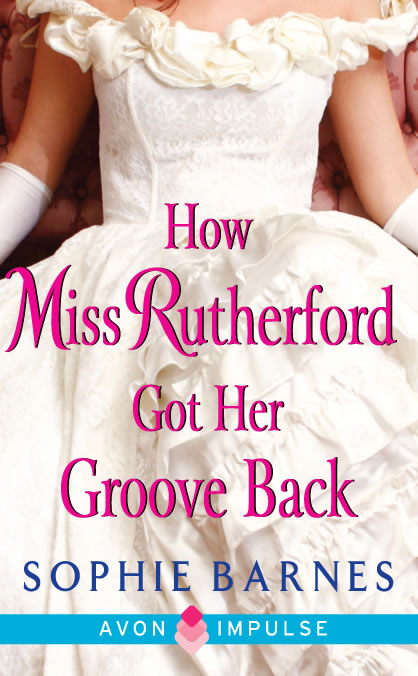
Review: How Miss Rutherford Got Her Groove Back by Sophia Barnes

This cover suggests Boxing Helena to me. Miss Rutherford is presented as a headless torso in an open position. It feels somewhat soulless, which brings me to the title. A genre that is aggressively Caucasian mimicking a very popular contemporary African American title is problematic. Add in that How Stella Got Her Groove Back was a thinly disguised tip to the author's own (now failed) marriage and certain problems in Barnes' book are thrown into even sharper relief. Emily is a complete Mary Sue, and a manic one at that.

When we first meet Emily she could put Snow White to shame. Living in a cottage with her sisters after being disinherited by her evil step-relative, she whistles while she works. Scrubbing floors and living for the one day a year she is invited to the ball, Emily dreams of marrying her neighbor, her childhood sweetheart, her savior. When this fails to pass, she becomes suicidal. (She is fond of saying things like she should have been "left to die".)  It is not that Emily breaks as much as she dents. Her suicidal depression leaves as quickly as it arrives. Emily walks through a series of cliches that range from the allowable to the completely infuriating while those around her hold her hand and weep over her noble purity of feeling. Those who bruise the tender fruit of Emily's soul are heartless creatures, while Emily herself is excused of all responsibility.

Given that the side characters are so thinly drawn it hardly matters that their emotions are barely noted. At one point Emily is put in possession of an elderly chaperone who immediately goes to her room and fails to appear until close to the end of the book. (Much like the eldest Martin child in the American serial All My Children, who walked upstairs in the 1970's and was never seen again.) Gone and forgotten, when she is mentioned again I had to flip back to recall who they were discussing. Further removing the reader from an ability to sympathize is the author's inability to choose a path and stay on it. In one scene Emily urges her former fiance and his intended to enjoy every second of their betrothal ball as she could not stand to diminish it in any way. With her very next breath she berates them as undeserving of her. Whiplash moments like these abound. Later in the book Emily rushes off to see the previously rejected BFF as "I have no quarrel with her, you know." Emily is prone to this kind of passive aggressive bullshit when she isn't making her own life infinitely harder through impulsive and ill considered actions. The author drops in and out of these implausible shifts with equally awkward conversations.  Not naturally, or in a way that makes internal sense, but to point out the author realizes this is kind of a left field event. As a reader, I was as bewildered as Emily's former fiance. In addition to the emotional curveballs the author keeps the plot curveballs coming too. (What's that, Lassie? Emily must marry in a month or her sisters lose all? Why didn't anyone mention this 2/3 of the book ago?)

So. Emily kisses childhood friend, Emily jokes about marrying childhood friend, entire town and both families expect it to occur, Emily (when faced with a need to marry) does not tell him. She lives on the neglected corners of his life scrubbing her own floors and waits.  Emily charms the birds from the trees with her gaiety. Childhood friend runs off to London and falls in love with BFF who returns to town but doesn't tell Emily who she is engaged to marry so that it can be a shocking revelation at the ball. This makes no sense. I can buy both of them as completely clueless about Emily's air castles, but to not tell your BFF you're marrying a mutual friend? Not to challenge your son on his fiance's changed circumstances? Not to tell your parents ahead of the ball you will announce the engagement at that you're marrying? Like the rest of the book, these events have to happen for other events to happen. At one point I wrote "Miss Barnes has gone a cliche too far."

The real one eyed reading occurs at the end of the book. Our hero has been harboring the deep dark secret that he is a surrogate child. His father was so enraptured by the surrogate that he installed her in all their homes, preferring her to his wife and living openly with her after his wife's suicide. Since his death said evil doer has been blackmailing our hero for fairly absurd sums of money on the basis of a signed letter confessing all! Why our hero's father would write such a letter set aside, why the hero wouldn't just let her give her plot a shot, all of this you have to take on faith. (After all, this is the guy who thinks Emily isn't like the rest of us but means that in a good way.)  Kate (the former BFF) runs to Emily (because she hasn't had enough gas-lighting) and tells Emily that the hero's biological mother is actually his mistress. Rather than run suicidally off into the night like the last time, Emily runs suicidally off to a formerly barely mentioned and shortly never to be mentioned again diabolical relative. She'd rather marry him (here we discover the must marry in a month timetable) than face Hero McIncestCheaterpants again!! (Histrionic, much?) Emily arrives, determined to marry Edward. I was sort of hoping he'd ask Emily if she'd ever consider a soothing drink and a nice cooling cloth, but he's as over the top as the rest of them.

First he gloats about his feelings of inadequacy and then he proclaims he's going to rape her. Emily can't go back to her sisters, her life or our hero. Remember, her former BFF who is engaged to her pretend fiance told her that a woman old enough to be his mother is sleeping with the hero! Rape is her only option!!! Emily starts to take her clothes off like the good little martyr she is. (I think the only way I followed this bit is my southern heritage. Convoluted explanations are our birthright.) Luckily Emily is saved by the hero and Edward is whisked off the canvas with a "Sorry, my bad" after the hero stakes his prior claim. While we were waiting for Emily to finish taking her clothes off Kate was being berated (yet again) by Emily's equally reality challenged sister. How could Kate make such an allegation? Doesn't she know Emily self harms?? (I hope Kate learns her lesson here and puts as much distance between this toxic family and herself as possible.) Emily is whisked off to marry the hero in secret, since he stopped off at the Get A Special Permit Store and took care of business. At his home, he confesses all (after first dillydallying about confessing anything) and they decide to trick the blackmailer into revealing the location of the letter.

Crazy things happen (big shock) that I am really not interested in reliving. In the course of them the blackmailer reveals a secret addition to the dead Earl's will that leaves her buckets of things. She will trade Emily the letter in return for access to the home (that she already had access to earlier in the book, and earlier in her life) so she may retrieve it. But what's this! As the hero braces himself to learn how his father further betrayed him he discovers the codicil is a giant "Pwnd!" intended for the blackmailer. It reveals that the letter in question has a fake signature! It can't be used! He knows his wife didn't commit suicide but was killed by his mistress and he kept sleeping with her because... I can't even. Why would you write either document? Man up, dead Earl. Quit abandoning your wife, your son and your duty to the estate. Don't leave her with an inheritance and a blackmail letter and a lot of bad sex memories! On the other hand, if he hadn't then our blackmailer couldn't do what we were all longing to do at this point. She whips out a hidden gun and shoots Emily.

Sadly, Emily survives.

*Since I wrote this (and scheduled it) my kindler, gentler, less annoyed short form review was the subject of one of many sock puppets out in force for those who dare to dislike this book. My personal puppet was as unable to pick a lane and stay in it as Emily herself. (Bless.) Someone should hold a class on Effective Puppetry For The Debut Author with a section on Making It Look At Least Plausibly Organic.  That someone won't be me. I can't be bothered. I left How Miss Rutherford Got Her Groove Back intending to try the author's next book. Despite some style issues there were indications that (freed from her melodramatic bent) Barnes could deliver an entertaining tale. Watching the drama playing out over multiple sites I would rather make my break with Miss Barnes as clean as my break with Emily.  

04 February, 2012

Review: The Summer Of You by Kate Noble


I've been in a bit of a book slump lately so I thought I'd take the suggestions of others and try Kate Noble. I bought The Summer of You when it first came out as a trade paperback and it has been languishing on my TBR pile ever since. I can completely appreciate The Summer of You even as I discard it. (Perhaps I should call this Grant Syndrome in honor of A Lady Awakened?)

The Summer of You does have strong characters and a fresher setting. While a Duke is present, we're not playing Duke, Duke, Groom as the only Duke present is the heroine's ailing father. The characterization was good, the relationship between our heroine and her drunken immature brother was one of the more realistic sibling pairings I've read and yet... There was something far too modern about this read. I'm all for updating the standard hero and heroine to a more realistic level. Times change, people don't. Yet people are still a product of their times. Did I buy these people in these times reacting in these ways? I'm not sure I did. The townspeople were stronger than the leads, never a good sign for me. There was another pet problem of mine, one I don't have a snappy name for. Participant Peril? Heroine Harm? I don't know. We've got a war hero with a bad leg saving a drowning child with a concussion so I thought we'd gotten our brush with death out of the way, but it was not to be.

The subplot of our disgruntled heroine stranded in the suburbs with her forgetful father and drunken brother meets mysterious and reclusive neighbor story is that the town has decided he's a highwayman. Apparently a series of non violent crimes have coincided with his arrival and he is just unfriendly enough to convince all he must be the villain. This (oh, it is probably way too late for a spoiler tag isn't it? It's not a new release, you'll just have to forgive me.) of course leads to a few near arrests, an actual arrest and a grand proclaiming that the heroine was twisting the sheets with the hero on a night in question. Really, who does that? Who alibis someone in the middle of a house party? I suppose she does. Because she has to in order to flee into the night where she might as well end up feverish in a chicken coop for all the pointless disaster that befalls her.

While escaping from the scandal of her own making, and at the command of the brother she has (up to now) largely ignored, she is set upon by the true highwayman. Luckily, many people figured out that dude's identity about five seconds before so help is one the way. Our highwayman has decided to move from profit to violence which makes almost no sense. He apparently knows she has cleared the hero, but he assumes she will be readily believed. By attacking her he cements the alibi and further complicates his own situation. Raping the heroine is much more awesome to him than living a comfortable life under the nose of those from whom his gain is ill-gotten so off he goes to pillage. She gets knocked silly, she gets rescued, he reveals he planned to frame our hero all along, but is thwarted by a surprise stowaway in the carriage.

What is the surprise stowaway even doing there? Earlier in the chapter we are asked to believe that a comfortably situated member of the minor gentry has decided to get away from it all by leaving her parents a note and slipping away with the disgraced ducal daughter. What? I mean, full stop, what? Why does she think said disgraced daughter either will or can fund her escapade? How would she return to live in the village after running off with the recently revealed tramp? It doesn't make any sense. Does she expect she can hitch a ride to her sister's home? Does she expect she can make a new life with what she's wearing and the goodwill of a neighbor she barely knows? Is there a thought in her head besides "Someone is going to have to reveal the villain in a few pages when he gets all villainy?" In a contemporary, yes. In a WW2 novel, yes. Heck, possibly even in a late Victorian. Maybe. But how is this girl planning to survive if everyone turns her out? She has not previously exhibited a lack of all brainpower. I couldn't go there. I can see why so many have suggested Kate Noble so strongly to me, but I don't think I'm in for another go. I'd like to read another book by her but not another historical. 

02 February, 2012

Review: Jazz Age Josephine by Jonah Winter & Marjorie Priceman

Jazz Age Josephine wasn't slated for review on this blog, but after reading it I really hope it finds a wider audience. Too few books on black icons exist that haven't been hopelessly sanitized for white audiences. While my fellow reviewers at Amazon would have preferred to leave race out of the story, I am so glad the authors left it in.

Josephine's reasons for leaving St Louis are tagged to the larger issue of the St Louis fire instead of the specific abuse she endured as a child laborer. I don't really know how to answer readers complaining that white people have been presented as bad people or that the merits of  minstrel shows aren't included. (I might need to watch Bamboozled fifty or sixty more times to process that one.) I'd say it's interesting to me that children can process all sorts of villains and peril if it is presented by Disney yet cannot handle the truth about our nation but it's really not. It's incredibly boring and often infuriating. (It's also destroying our two party system, but that's a whole different kettle.)

Anyway, if you're raising a kid in the reality based community (or working with an adult literacy program) Jazz Age Josephine is a delightfully illustrated book with a syncopated text that lends itself well to reading aloud. (Wait, I'm still getting over my fellow reviewers. Young Josephine being so poor that rats nibble at her feet is fine, but white citizens burning out a black section of town is just too disturbing for the little tykes? Um. Ok.) While Josephine Baker's life is far more complex than one children's book can hold, her rags to riches story is framed in a message of self belief and personal reliance. Josephine faces adversity and overcomes it to attain a fame that is as empty as it is satisfying, showing that even a Princess can't have it all. I'm going to give Josephine the last word (or image) here. She created an amazing and often inspirational life that this book presents in an appropriate context for children. As refreshing in it's refusal to ignore race as it is in it's refusal to pretend wealth heals all wounds, Jazz Age Josephine deserves your attention.

01 February, 2012

Review: Ali in Wonderland by Ali Wentworth

I did not enjoy Ali Wentworth's book. It is entirely possible her material plays better if you have some frame of reference for her as a comedian. When I read Kathy Griffin, I heard her voice in the story. When I read Mindy Kaling I lacked that voice but the book stood up on it's own. For Ali In Wonderland I had no voice to hold up what was ultimately very weak material.

There could have been a great book from the bones of her story, but Wentworth didn't write it. I felt alienated from the author. Unlike Sedaris, where the joke is generally on him and the evisceration of others is done with some kindness, Wentworth's came across as a child of privilege resenting others judging her for that privilege. It was difficult to find a way to commiserate with her. When I would start to get some interest in her life she would throw something out that derailed it again. Getting through the book was such a chore I posted to Twitter every few pages as an encouragement to finish. Perhaps instead of a proper review I will follow the path taken by the book and offer you my loosely connected and highly personalized thoughts, direct from Twitter and chat.

I am not enjoying this upcoming release. Everyone in the memoir but the heroine sucks and it is saturated in unexamined privilege.


Author Washington insider, assures us all the family money gone, then launches into elite life. Own your status.


Opens with castle rented to propose to her, segues into DC life. Currently in prep school where she can do things like fly home at will.


Her life could be a funny and fascinating memoir but her writing style is SO off putting. Hasn't a kind word for anyone, really.


I could see the material being amusing in certain verbal delivery styles. Not coming across in print at all.


Book has a lot of marketing money behind it, expected to be huge. I'm going to get pummeled for hating it. Whatevs. Kiss my Ammy rank g'bye.


Oh hello, Girl Interrupted.


The author of this book just called out 153 lbs as an impossible tipping of the scales, her own mother doesn't recognize her.


Talking about an ex with a clunker, she relates how her mom is worried about safety so sells him her car at token price of 1k.


She and mom lie to him about why, because crazy pride! But hey, worth it for safe boyfriend car!


Not for boyfriend safety, mind you, but for hers. We should always lie to the poorer classes.


Author started to win me over, promptly killed it with dismissive remark about girls with less advantages than she. Calls them Escorts.


Her class issues are flying through the whole thing, triggering all of mine. She pisses away choices then judges people without them.


She calls herself middle class while jaunting about the world and dining with world leaders.


She walks off on an internship at Christie's because they had a dress code and expected her to fetch tea. London housing, even.


Author wants it both ways. Does not want to be judged for her silver spoon, yet wants to judge them for their lack of utensils.


This next tidbit... Almost gang raped by Mexican crack heads, go to the Four Seasons for 2 wks of pampering. Tries to tie in that old car would have been safer.


Situational humor requires a heart. Author saves her warmth for herself.


I am not sure why this book is funny. 3 big blurbs on it, but I haven't even smiled.


Omg. 9/11 has hit and the author takes to her bed at a luxury hotel when she has a perfectly good hotel room farther away.


No really,  9/11 just used as an anecdote to demonstrate how skewed her family is.


Halfway through. Second time author has said yes to an unwanted proposal. It's easier.


On page 215 I laughed. Yes, it was because she compared baptism to preparing a baby for roasting, but it was a welcome drop in this desert.


By page 234 I am back to frown faced reading.


The book is done! The review will wait. I might start a new personal blog since last night I killed Jesus. (Didn't mean to.)


And thus we conclude our first real time review of a book. I appreciated the opportunity to read Ali In Wonderland, it was an advance copy and I always regret disliking a gift. Ali Wentworth is probably perfectly lovely in real life, charming and amusing on a chat show. I have no doubt she is a better person than she came across to me in this book. If I had to guess, I would predict Ali In Wonderland will hit big and satisfy a core market. The crossover appeal is limited. On to the next.