18 July, 2012

Review: Rape Girl by Alina Klein

Rape Girl is a young adult novel actually intended for tweens and teens.  With so many adults reading YA these days it can be challenging to find books thematically appropriate for actual 10 to 14 year olds. I was given an advance copy of Rape Girl to review but it took it's time getting to the top of my TBR pile. I find it difficult to read about rape, especially date rape or the abuse of a child. I shouldn't have worried. Rape Girl is not really about rape. While the description of what occurs during a rape kit is somewhat detailed, it is not graphic. The rape itself occurs largely off the page. Rape Girl is concerned with what happens after you speak up. I would love to see Rape Girl adopted as a discussion book for groups of both genders. Valerie's experience is not limited to girls who report their attacker. When Adam (Valerie's rapist) explains himself he speaks words that have been spoken to many girls in many places. Overall, Rape Girl gets the details right and deserves to find a wide audience.

As a young tween and teen I went to many of the parents-out-of-town parties that Valerie throws at the beginning of the book. I was never invited to the all ages block party she experiences later, although I throw them myself. The drunken party gone wrong is rooted in truth but still a cliche. Rape Girl neatly sidesteps this pitfall. In a sense, the party is the roller coaster ride and the rape occurs when the reader thinks Valerie has safely navigated the turns. Details are revealed in a bit of a haze. This makes sense for Valerie's state of mind. She is a pitch perfect teen, confrontational, reclusive, resentful. Because is the victim of a non-violent rape, she has trouble articulating her own feelings about what has happened to her. While she did not consent, does she have a prosecutable case? Is a failure to physically fight a type of consent? If Adam considers it consensual sex does she have the right to call it rape? These are things young date rape victims struggle with for years.

While Rape Girl gets the big details right, there are some smaller details that don't come together. For a young reader unfamiliar with Utah or Mormons, the setting will be lost. An adult reader will understand the importance of Adam becoming a missionary, but a tween or teen might not know what a religious mission is. Valerie's father is dead. His death seems irrelevant to their lives. Valerie doesn't reflect on him being gone in the context of what has happened to her.  In a very strong scene Valerie's mother gives her a car, but afterward Valerie is primarily driven by her mother. Valerie's time was slightly off for me too. I am not sure, for example, that waterbeds are still prevalent. In my part of the country they were once commonplace but currently unheard of. She checks Facebook from her shared family computer instead of her iPod or smart phone. These are minor  (and possibly regional) things but they gave Rape Girl a hybrid 90/10's feel. The small disconnects kept Rape Girl from being a truly exceptional book and placed it firmly in the good category.

For a young adult reader, none of these details may matter. I hope Rape Girl is adopted as a summer read for many girls. Beyond the rape itself Valerie's commitment to standing up for herself is a valuable example. The social price she pays (and the unexpected allies she finds) reach beyond her specific events. There is a universal appeal to Rape Girl that will allow young readers to easily identify with Valerie's struggle.

16 July, 2012

Review: Booker's Place: A Mississippi Story by Raymond De Felitta and Yvette Johnson

Booker Wright was a man.

I don't know if he was a perfect man. I doubt he was. From my own life I know that overcoming obstacles and perfection rarely walk hand in hand. Booker Wright was a man who kept his eye on the prize. Work hard. Save up. Build something better. Then NBC came to town. What do you do if you've been silent your whole life and someone asks you to speak? A man speaks. So Booker Wright did. To modern ears what he said may not seem very strong. His short speech is available on the internet and was recently featured in various stories about this film. The important part of Booker Wright's story is that he waited. He waited until his speech would be documented, until his speech could endure. Booker's words were a pebble in his own life, a pebble in the lives of those who heard him on the night his words aired. The ripples slowly faded.

Just as Booker's life collided with filmmaker Frank De Felitta's, so Booker's granddaughter collides with Frank's son Raymond. The resulting film, Booker's Place: A Mississippi Story gives voice to the hundreds of Bookers that America held in the recent past. There were Booker Wrights standing up across the south and refusing to Yassir another day. We are taught about Malcolm X and Martin Luther King not because these men were alone in their work, but because they were the most recorded, the most organized, the most eloquent. The black men of America are not made up of the nightly news. The black men of America are Booker Wright. If you ask them to speak, they will.

Booker knew there was a price to his words and he paid it. While he survived the initial attack, he was later murdered. The film, like the family, have their own suspicious about the event. I don't know if I agree. It is tempting to believe in something grand conspiring to put Booker back in his place. It's even reasonable. But sometimes the greatest story can end for senseless reasons. Someone gets drunk. Someone gets even. There may be a broader narrative at work but there doesn't have to be. Booker Wright is enough. We don't need more. The film, however, does. Using the scant source material of Booker Wright available to them the filmmakers rely on a repetition of key scenes or phrases to drive various points home. It's both effective and off-putting. While it doesn't damage the viewing experience it does make the film seem lighter in content than it is. De Felitta interviews many principals of the time and of his father's earlier NBC documentary.

For all that has changed, not much has. Faced with black pain, the white response is still a bewildered "Ain't I been good to you?" One white man stands to talk about that old canard, the black mother. Faced with a black perspective he becomes very emotional. He says he wouldn't have given up that relationship for anything, that he was equally important to the black woman, that he treated her well and she loved him. This is America in a nutshell. Faced with the reality of black life, white America won't give up it's privileges for anything. We are still, in so very many ways, the plantation owner of the 1966 film. And Booker Wright's words are as brave and important now as they were then.

Yvette Johnson, the granddaughter in the film, has collected her blog posts about Booker and Booker's Place into an ebook. I scanned her blog after writing this review and I may cover the book at a later time. As well, there is an excellent review of Booker's Place from the Chicago Sun-Times blog. I don't usually do links, but these are worth a glance.

12 July, 2012

Notes From The Road.....

I am in transit, with an Internet connection too unreliable for image uploading or post formatting. This happens more than you'd expect. Making notes for a review it occurred to me that my review notes rarely line up with the actual review. I don't write in drafts. Since this isn't a paying gig it is a one and done transaction. Sure, I hope the review is useful or entertaining or not a complete waste of our collective time, but I save the sweat and tears. I need that for profitable endeavors. Back to my point. In situations like this I often make a few notes in case I've forgotten what I wanted to say about the just finished book by the time I get around to the review. Enjoy this look at how little those notes translate into a finished product. In this case the notes were for Milan's The Governess Affair,I believe.
TGA Who he is vs who he is in response,  parent hopes,  his hopes.  Her mother? Her astute assessment of soap market. Identifying with a mother procuring education for a son. Consent,  shades of. Unhappy ending. Crazy people think they're sane. Robert is the villain. Dealing with Richard via Robert? Jobs that just are not worth it. Past cannot be preserved, broken glass jar. Letting things go, Hugo vs Serena's sister.
Back when my brain worked all of that would have been five words, tops. I have pages of notes I no longer understand. Back in the day I could recreate five pages of thoughts from less than five words. I miss that!

08 July, 2012

Review: The Last Victim by Karen Robards

Let's get the petty complaint out of the way quickly. In the opening pages of The Last Victim our heroine, Charlie Stone, is regretting drinking the booze laden "Goofy Grape Kool-Aid". Ok, two points. Maybe three. Goofy Grape was a Funny Face flavor that ended production in 1983. The events are taking place in 1997. Our heroine was born in 1980. It is possible she was so fond of Goofy Grape at the age of three that she adopted it as her generic name for grape flavored drink mixes, but it bugged me. Like I said, petty. Fast forward 15 years and I've got some issues with The Last Victim that are far from petty. I'm writing this in early June, so my entry into the book was cold, not an advance review in sight. If you go into the book knowing the basic plot you may enjoy it far more than I did. Robards has good pacing, she has distinct characters, their actions are consistent and logical to who they are. Unfortunately there is one element of The Last Victim I couldn't get past for all the Goofy Grape in the world.

Charlie Stone  is about the dumbest heroine I've ever read. (I know Robards likes the name, she's used it before, but if you're going to write a series about a woman who sees dead people the names Charley and Harper are taken.) Charlie Stone is self destructive in a completely new and original way for me. She is sexually attracted to serial killers. Ok, that might not be fair to Charlie. She is sexually attracted to a dead serial killer. Our supposed love triangle is between Mr. Great On Paper who leaves her unaffected and Mr. Rocking Body Dead Guy who killed seven women before he was placed on Death Row. Charlie muses to herself that the attraction is sick (YES) and unwise (YES) and maybe even a bad idea (DO YOU THINK?) yet finds herself unable to resist his rock hard abs. Because if a man is hot, even if you know he is evil, sex is what you can't stop thinking about (NO). This aspect of the book is so problematic that the rest of it doesn't even matter. If you can get past the hero being a serial killer, if inmate fantasy is your thing, The Last Victim is going to rock your world. If you think a woman who survived a serial killer, studies serial killers and is trying to save a young girl from a serial killer overlooking a serial killer's crimes for his hot body is reasonable, have I got a book for you. We've seen this dynamic before. Let's do a quick compare and contrast between Robard's Charlie and Darynda Jones' Charley. For Robards, we will use CS, for Jones we will use CD. Ready?

Sees dead people. CS / CD
Is the Grim Reaper. CD
Has super hot physical encounters when asleep. CS / CD
Is normal human who should know better. CS
Boyfriend has been in jail. CS / CD
Boyfriend killed or tried to kill parent. CS / CD
Boyfriend pursued by apparent demons from hell CD / CS
Boyfriend appears to protect her when needed, even against own will. CD / CS
Boyfriend admits to having done great evil. CD / CS
Boyfriend claims innocence of murder. CS

So yea, the paranormal girl and the super bad boy from hell is a thing, apparently. It's better than Charlaine Harris and her incest-lite sibling couple... ok it's not. I am more comfortable with the high ick factor in the Grave Sight series than I am with Charlie Stone and her boy toy. I completely get that Robards is going to pull a switcheroo in the second book and reveal that Garland is not a serial killer. (He hints at it enough.) But you have to go with what is on the page. On the page Garland is a man being drawn into Hell who threatens, who intimidates, who admits to having done very bad things and who has been convicted by DNA and other evidence. Charlie actually wonders, while getting frisky, if sexual gratification is what flips his psycho switch. The reader may suspect Garland will turn out to just be an average criminal, but Charlie believes him to be otherwise and there lies a very dangerous thing indeed. A serial killer is not a child who went wrong one day. They are not a misunderstood person in need of compassion. A serial killer is a predator who sees other humans as prey. A love affair between Charlie and Garland is like a chicken loving Colonel Sanders. How can a reader buy into that?

Garland is shown to have an explosive temper and a bad past. But he watches ESPN! And he is physically attractive! He can't be so evil as that, can he? Look! He engages in grooming behavior with Charlie! He protects her and berates her! He compliments her! He's a good guy gone wrong! He can be saved, right? No! It doesn't matter if Garland turns out to be innocent in a later book. We are in this book. And in The Last Victim he is the last person I'd consider a hero. That Charlie, with the information she has at hand, falls for him makes her impossible to root for. She can never overcome my personal judgement of Dumber Than A Rock by a later revelation of innocence. It's like the old Regencies where the girl dresses up as a guy so the hero can run around saying NoHomoTho while checking out her ass. I'm not interested in any trend that requires me to go NoPsychoTho.

All of that said, this book is going to have devoted fans. I think it will spark a lot of conversation in romance about where the boundaries of mainstream couples are and what leeway we will and won't give an author in telling her story. I know what side I'm on.

06 July, 2012

Review: Raised By Wolves by Christie Mellor


 Harper likes this book so much they titled it twice. With this being the time of year that well meaning adults buy comedic life skills books for their departing progeny (or the progeny of others) I checked out this new to me book. Please don't buy it for anyone you like. This is the self help guide to adulthood you buy for someone you dislike, possibly even for someone you loathe.

However you title it, Mellor's Wolves  is written in that sort of ha-ha lightly abusive passive aggressive tone that people use to tell you you're fat. She takes the position that you are probably an overindulged child that others find tedious. With the will to change that reading her book has demonstrated, she can teach you to half ass your way to a responsible adulthood. Along the way she has proven tips, theoretical tips, and tips she heard other people talk about. It's like all the clippings your drunk grandmother ever sent anyone in the 1970's when she was tweaking her way through a Reader's Digest backlog.

I find these books interesting because I did leave my far from indulgent childhood home lacking most basic life skills. Cleaning, cooking, job holding, socializing, all of those were skills rapidly learned to function in the larger world. Post, Martin, Bombeck, I read them all. I found that there are two kinds of books. The first is useful, it clearly teaches you some basic knowledge. The second makes a buck for it's author and lets the giver feel superior. Under either title Raised By Wolves is far more the latter than the former. Fittingly, it's pricing is all over the map. Want the US trade paperback with the retro glam's feel? $5.60. Want it on Kindle? $10.99. Hardcover on clearance with the 1960's edutainment cocktail hour graphics? $7.98. Because Publisher Price Fixing* is all about helping you, the consumer, have choices. Buy and ship their dead stock or pay for the right to avoid storing pulp.

*I will now refer to Agency Pricing by the more accurate Publisher Price Fixing term. I never should have bowed to peer pressure and adopted the A word. what can I say, I'm weak like that.

01 July, 2012

Review: Barnes & Noble vs Anyone Else

No. Really.
This is a US-centric tale told in reverse order. It begins yesterday. 

I very rarely do business with Barnes & Noble.  I don't like the way they conduct themselves. As of today, I won't bother with them until the going out of business sale. The kids saw a book and craft combo for $16 during a kill some time browsing session. I told them before I opened it I wanted to check the online reviews. Turns out the chain exclusive set is available for $7 online. With free store pickup. From the same location.

Yes, I'm returning it. It's the final straw in my Barnes & Noble coffin. I differ from many readers in my choice of retailer. Here are my standards. Don't screw me over and I will shower you with money. That's it, that is the full list. You don't need rock bottom prices (although I love a bargain as much as the next girl.) You don't need the fanciest or most stylish location. You need to have the item I want to buy (or get it in a timely fashion) and not screw me. Barnes & Noble has repeatedly failed the test. 

The blogworld asks me to shower my money upon different vendors. In the beginning, I was as anti-Amazon as the next girl. I thought their discounted prices were a result of their inflated shipping costs and I ordered from other sources. Then Amazon stopped screwing me on shipping. I was a strong supporter of Waldenbooks until they closed, then Borders until they did the same. During these years the blogworld begged me to shop at my local indie retailer. I didn't have one. Haven't had one for a good 25 years. So thanks, blogworld, but I can't sign on. Then they wanted me to mail order from my local indie retailer, chosen apparently at random. I tried a few. I had an 80% order correct completion rate. I went digital. I supported digital indie retailers. Then Agency publishing driven by Apple and Barnes & Noble screwed me. And them. I stopped showering those publishers with money. I went Harlequin and Amazon. (Most of my big six reviews are library or ARC driven. I considered dropping all reviews for those publishers, but with book buying dollars more important honest reviews seemed more important to me.) Avon revised their pricing  and I said ok, Avon can get showered with my money again. 

The big trend in blogworld now is begging me to support Barnes & Noble. I don't see why. They screw me every chance they get. They screw me in the store by charging me double what they charge me if I don't impulse buy. (That is some messed up retail logic right there.) They screw me with the worst digital customer service of anyone I've dealt with ever. They screwed me with price fixing in the digital world which was preceded by price fixing in the paper world. None of the tactics they are currently in hot water for, that I am currently being asked to support them through, are new. Barnes & Noble has never been a retail white knight, ever. I'm done showering them with money and I'm done with being asked to. Stick a fork in them and let's all move on. You know what I would support? Here's a small business idea. Open a kiosk with a computer terminal and one copy of a few hundred books. Let me browse them. I'll pick the ones I want and you'll send a download link to my email. Don't screw me and I'll shower you with money. Just make sure the books aren't Agency, because until the DOJ is done with them I am as well. 

28 June, 2012

Things You Should Listen To: Flashing Lights by Kids These Days


What do I tell you about Kids These Days that I haven't already said? They are, without question, the best young group working today. It's everything you like about rap, everything you like about soul and a few things you didn't even know you missed coming together in perfect little bites. Turning Kanye's Flashing Lights into a social commentary Kids These Days give us the best thing since Jay-Z dusted off  Ice-T's 99 Problems. It's like Marvin Gaye's What's Goin' On jumped into the future to see how little has changed. Austin Vesely perfectly matches the retro-modern feel with his 60's inspired visuals. The final shot of the thin young  drummer, his arms raised before being cut off into the dark, is a perfect end note. 

"Lock you up cause they don't want to see you in no cap and gown." - Kids These Days

You don't have to watch this video thinking about Rekia Boyd or that Chicago has had more than 250 murders in six months. But think about that. At least one Chicago resident dies every day, most of them black. Yesterday it was 7 year old Heaven Sutton at a candy store. Look at this page and tell me you don't want to holler. Every day in Chicago people are dying, people are crying, and people are lying about why. Chicago is not unique. Chicago is their America, I have mine. You have yours. 

"Brother, brother, brother there's far too many of you dying." - Marvin Gaye


27 June, 2012

Review: Scandal Wears Satin by Loretta Chase

 Loretta Chase is a victim of high expectations. Scandal Wears Satin is a perfectly serviceable book with a few flaws. Unfortunately when you write like Loretta Chase does you end up being graded on a curve. This is my least favorite Chase book but it still beats most of the wallpaper historical authors working. I want to establish that I know this book would kill as a debut novel. As the second installment of The Dressmakers series it collapses under it's own weight.


Scandal Wears Satin wants to be too many things to too many characters. This keeps it from truly serving any. It also has a tic. I hate that. It can be J.D. Robb running an anal, it can be Jayne Castle and her coff-tea, it can be Loretta Chase and the surname Noriot. I don't care about the context, a tic drives me out of the story and up a wall. In Scandal Wears Satin the word Noirot is an all purpose wallpaper covering a multitude of plot needs.  Why does Sophy do that / think that / feel that? Because she is a Noirot. Often repeatedly. The problem is that while Chase understands enough of what being a Noirot means for the explanation to satisfy, the reader does not. It was her Noriot pride and her Noriot lack of morality and her Noriot style coupled with her Noriot wit that made Sophy a chore to hang out with. Sophy has what could be a fascinating backstory kept hidden from view by the gauzy hand wave of her surname. Sophy also has three sisters. What richer soil is there than the sibling relationship between women? It's never used. Occasionally her older sister (from the prior book) will comfort her or she will worry about the possible reaction of the third sister. (The third sister is nearly invisible.) We have Sophy, from a family of grifters who died of cholera in Paris. She sneaks around London in disguise, works as a columnist and is co-owner of a dress shop. Her sister has recently married a Duke. So of course we spend all our time with Longmore.

Longmore's family is even more fascinating than Sophy's fabled Noriot line. First of all, he's titled and rich. His sister is impulsive and somewhat spoiled. His mother dislikes Sophy. Ok, that's it, we're done. Of course the problems of the extended Longmore clan are the most interesting place to go with this story. It is obvious. Even a Noirot could see it. Or someone who isn't a Noirot. I get confused. Anyway, we also have a street kid with a host of nicknames and a few deft skills that is also just window dressing. His story doesn't go anywhere either. 90% of Scandal Wears Satin involves getting Longmore's incredibly boring sister out of the incredibly predictable problem she's gotten herself into. While there are some interesting side note (Love, love, love Hampton Court as a retirement home) most of the book is just waiting for a different book to happen. Why does Sophy even like Longmore? She thinks he's an idiot. Why does he feed her delusion that he's slow? He shows every sign of intelligence. Why does the rival shop from the prior book enter the picture at all? It doesn't affect the plot in any significant way. Everything about Scandal Wears Satin leads to why? Perhaps it all becomes clear in a third book, perhaps not. Either way I wanted more from the excellent start to this series than I received from Scandal Wears Satin. Maybe it's the Noirot in me.

26 June, 2012

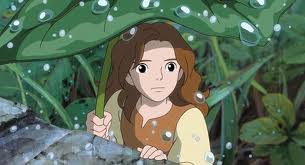
Beyond Brave: The Secret World of Arrietty

Brave is being treated as some new, unexpected, long awaited event. It's a film. Intended for children. Marketed and distributed by Disney Pixar. With a female lead. With a mother daughter relationship. If you take away the word Pixar and add the word Ghibli, this happened in February too. The difference is hardly anyone went. If there is such a pent up desire for alternatives to the Disney Princess machine, what kept parents away from The Secret World of Arrietty? This film opened to almost precisely ten percent of Brave's opening. (U.S. numbers).

If you saw Brave I urge you to consider The Secret World of Arrietty. Do you want voice over stars? How about Amy Poehler, Will Arnett, and Carol Burnett? Good reviews? How about a 94% at Rotten Tomatoes? Strong female lead? Check. Troubled but resolved mother / daughter relationship? Check. Fight over traditional values versus a new way of living in the world? Check. Princess? Sorry. No Princess here. Asexuality? No, Arrietty has an age appropriate curiosity. Prince? Nope. Not even close. Her love affair is doomed from the start, such as it is. Strong message of social responsibility? Check. Feminist viewpoint? Check. Total American box office? 19 million. Brave made that on it's opening day.

Face it people. You like the Princess. You want the Princess. It's the Princess you turn out for.

Back to Arrietty. (A local elementary school was so taken with this film they canceled lessons for the day and organized a field trip to the cinema.) Our entry into Arrietty's world is the narrator, Sho. Sent to live with his grandmother prior to heart surgery, Sho spots Arrietty in the grass. Arrietty lives in a two parent family where her father treats her as a fully capable person. Her mother is housebound and fearful, causing friction with Arrietty who strains at the rules her mother imposes.  Arrietty's father is training her to provide for their family, with her mother's support. She is expected to do all he does. She faces the same potentially fatal dangers he does, she gathers the same provisions he does. Arrietty is praised for her strength but chastised for her lack of caution. She's a tween, it's what they do. They rebel.

Pod (her father) and Homily (her mother) have warned Arrietty all her life against mixing with humans. It's not xenophobia, it's hard earned experience. Arrietty is a brave and self reliant character. She makes herself a weapon and uses it in her own defense. She prides herself on her ingenuity and physical abilities. Merida climbs a rock face? Arrietty climbs a similar distance in a treacherous storm. When the new human (Sho) arouses her curiosity she investigates. This leads to repeated fights with her mother. Despite Sho's best intentions Pod and Homily are right. He endangers them. Homily is taken from the family and only Arrietty can save her. In doing so she realizes that her mother's rules are based on hard experience and pragmatism, not caprice. By disregarding her mother, Arrietty has cost her family their comfortable home. She says goodbye to Sho as her family is forced to leave everything behind. In doing so Arrietty urges him to fight for his own life, to follow his own path as she will. She embraces the necessity of her parent's rules but does not adopt their bigotry.

Look Arrietty, I'm not white!
But your dad trusts me!
Weird!
Arrietty is not without flaw. There are some slow pacing moments (like Brave) and a subtle racism in the depiction of Spiller, a Borrower from another area. Because he is a forager he is shown in stereotypical 'savage' attire. But Spiller is also their salvation. Where her parents thought they were the last of their race, Spiller proves differently. He offers to be their guide to a new home and shows a strong attraction to Arrietty. She treats his interest casually, her mind is full of Sho and her family. Alongside the messages of self reliance and family respect is a strong rejection of materialism. Arrietty is told time and again to take only what she needs. While they beautify their home it is through their own craftsmanship and recycling. Goods they have not made are a trap they must never accept. It is better, in her family's mind, to live independent lives through their own labor than risk being enslaved in luxury. They pride themselves on repurposing items to meet their needs.

So here was a strong female lead with a complex mother / daughter relationship. It had the Disney brand, big name voice actors, and a full advertising campaign. America stayed home. Don't tell me these characters don't exist. Disney has tried to bring you a number of female leads from Ghibli. Mononoke was even a Princess. Maybe next time we will talk about Sen from Spirited Away or Kiki from Kiki's Delivery Service. I know you think "Well, if they can bring them over as imports why can't they produce these stories in America?" Why should they? You don't go to see them.

25 June, 2012

Things Unseen: The Bear And The Bow and Brave

So once upon a time Brenda Chapman had a movie planned for Pixar. It might have been good. It might have been awful. I've been trying to find the original concept for Brave because I can't shake the feeling that this wasn't the intended Girl Power message. (And really, I will move on soon. It's the contrarian in me. As more and more reviews arrive jumping over the incredibly low bar of Not Completely Sexualized to herald Merida as a triumph, I find myself saying Yes, But...)

The largest piece of information I can find is the following text. If you wrote it, let me know. Most people have sourced it to a 2010 Entertainment Weekly article, before Reese Witherspoon dropped the project. So assume authorship as EW until I find differently or confirm the issue.

Brave is set in the mystical Scottish Highlands, where Merida is the princess of a kingdom ruled by King Fergus (Billy Connolly) and Queen Elinor (Emma Thompson). An unruly daughter and an accomplished archer, Merida one day defies a sacred custom of the land and inadvertently brings turmoil to the kingdom. In an attempt to set things right, Merida seeks out an eccentric old Wise Woman (Julie Walters) and is granted an ill-fated wish. Also figuring into Merida’s quest — and serving as comic relief — are the kingdom’s three lords: the enormous Lord MacGuffin (Kevin McKidd), the surly Lord Macintosh (Craig Ferguson), and the disagreeable Lord Dingwall (Robbie Coltrane). - Entertainment Weekly


That sounds like a completely different movie. But it also sounds like the same movie. Since the three lords stayed to become her father's drinking buddies, I think there is a story untold. Until Brenda Chapman gives her post career interview or Brave comes out on the Deluxe Bonus From The Attic Edition DVD with the requisite rueful voiceovers, it remains unanswered. I still want to know why Merida has to apologize for everything but her father gets a pass. Sure, he was under the influence of bear but I still think (since she was tied down and all) that he could've taken a second to set aside his manly anger and listen to his kid. Just me on that one?


Along with the Scot-Face theming, I'm leaving the fantastic (natural black) hair alone. I've already spent more time on Brave than I intended or care to. If I say more it will be on the subject of our low expectations (all Merida had to do for Amazing Status was not be interested in marriage or overtly sexual) and our cultural blindness. Why didn't we salute Arrietty for it's strong family message? Why wasn't that capable and curious girl held up as a girl we'd like to see more of? Despite a wide release through Disney Arrietty (like the female lead of Spirited Away) was largely ignored by the same people overly excited about the extremely conventional Merida. If Merida had been a boy, the reaction to Brave would be quite different and far less enthusiastic. When we embrace Brave we set the bar for female narratives low indeed.

Just say no to sexuality and we will love you. Weird.

24 June, 2012

Maiden Mother or Crone, Brave Is A Small World After All

Yesterday I was unable to move beyond Brave's normalization of domestic violence to really discuss where it fails as a Pixar film. Much ink has been spilled on the replacement of original director Brenda Chapman with Mark Andrews over creative differences. I really didn't care. Directors get replaced all the time. Mark Andrews co wrote two of my favorite Pixar shorts, One Man Band and Jack Jack Attack. I had high hopes for him. In the aftermath of seeing Brave I think he might be a huge part of where the film went wrong. I've read a few dozen interviews with him this morning and two points come up again and again. He added animals and streamlined the characters, cutting away those that were not the main family.

There you have it. Girls like horses, right? Merida gets a horse. The most important part of this story is Merida learning to respect her place and Elinor loosening up a bit, so focus on them. Unlike every other Pixar film (except, perhaps Up) and every Disney Princess ever, Merida has no confidantes. She has no comrades. Elinor has no support system. These two women are alone except for the men they must please. When the clans come to visit there is great talk of the close bonds between the families. Elinor is given the hushed impersonal respect common to Traditional Values while the men are excused from being reasonable. Her taming hand causes them to bow and scrape. When she's a powerful bear they tie her naked body down and prepare to kill her. I don't buy the "But she's a BEAR!" aspect of this. She is a bear when Merida's brothers recognize and obey her authority. In a film supposedly about women there are only three - maid, mother and crone. (Ok, there is a sexualized and fairly dim servant, but otherwise.)

Name another Pixar film where the main character has no friends. I'll wait.

Still working on that? In order for Merida or Elinor to have the same friendship offered other Pixar characters, they would have to be seen as something outside of their gender. As long as Merida is trapped in her Token Female Lead role, she is stuck in the trinity. I assume at one point Merida did have a friend. Andrews says he cut the extraneous characters, which means other plot lines were abandoned. Since Merida's father still has a large and varied social group it seems likely that women were once in the cast. Think about the scene just before the ending. Merida reminds the men what makes them great. It is their friendship, it is the service they have done one another. In a film about a mother and daughter, the most significant speech the enlightened heroine gives is... about the glory of men.

23 June, 2012

Review: Brave by Pixar

Hey look, Pixar used a girl. Check out that weapon! Merida is going to use her abilities in a traditionally male arena to win recognition of her equality, right? Yeah. Not so much. In fact, Merida is going to realize that her true power lies in submission. It's going to be so awesome. Unless you have an abuse background and then it might be traumatic. Let's get to it!

I saw Brave in a group of six people. Three adults, three kids. Of the adults, two have an abuse background. Of the kids - well that's for them to decide, isn't it? Anyway, the children and one adult proclaimed Brave "Heartfelt, life affirming family fun." No really, someone said that. The other two adults hated it for different reasons. The first adult felt Brave was antifeminist, normalized domestic violence, telegraphed it's intentions, lacked charm and changed characters to suit the needs of the plot. The other adult was vaguely traumatized and wished walking out halfway through had been an option. But the rendering was cool.

For me, Brave failed on every level. (Since this will make me the least popular reviewer on the internet, I'm going to explain why in detail. You might want to see the film first then come back, because I will be talking about all major plot points.) We meet Merida in the traditional pre-titles happy family opening sequence. Then a bear ruins it all. Instead of semi-orphaning Merida as one might expect, the bear just traumatizes her father. He has bear issues. It's like, his thing. Merida's father wants her to be able to take care of herself, despite being a Princess. (The faux Scots things is all over Brave but I will leave that for someone else.) Merida's mother, who wears her hair tightly bound and extra long to show her feminine strength, wants Merida to play the dulcimer and meet the domestic pinnacles of princessdom she herself holds. In what is meant to be a send up of princess culture, Merida's mom rattles off all those traditional values while Merida rolls her eyes. Too bad the film undermines that. To begin with, Merida's father dwarfs The Incredible Hulk. Merida's mother is a slight and beautiful wisp. So the only thing Merida gets from her father is her hair. A hulking muscle bound Princess? Please. Merida's mother even complains that Merida overeats, because a Princess has an eating disorder. It's ok. Merida really only eats the occasional apple. Her plate of cookies is just for show. And her brothers. They can eat what they want because, you know, boys.

Mostly Merida's mom is just impatient with her willful teenage daughter. Things don't boil over until Merida's mother announces that the clans have been invited to compete for Merida's hand in marriage. Merida understandably balks at this announcement. Her mother tells her not to be silly, it's just marriage. Even she was nervous when she was handed off. Let's take a second here. Merida's appetite is unacceptable. Her physical prowess is unacceptable. Pimping her out to the neighbors is just fine. (Traditional family values for the win.) Merida attempts to use the traditional rules of the firstborn being able to compete for the hand of the princess to circumvent the bartering of her sexuality for social order. This infuriates her mother. Repeatedly Merida is told she doesn't know what she's done. Unless someone is allowed to marry her (read, have nonconsensual sex with her for life) the kingdoms will go to war. This message is repeatedly driven home to Merida in a number of ways. Without the Queen's calming and stoic voice controlling them the men fall into violent chaos. Without the right to marry Merida, conflict breaks out. The only thing holding these base animal men back is the dulcet and accepting tones of a confined woman. Okay then.

Moving on from the landmine of sex trafficking and young girls, we encounter Merida's plan to save herself. She runs off to cry. That's about it. She yells at her mother, and storms out. She doesn't set out to lead her own life. She doesn't open an archery school. She doesn't take a meaningful step toward independence because that is what a boy would do. Girls flounce. The magic of the forest leads her to a Miyazaki style crone in the woods who sells her a way to poison her beloved mother. To be fair to Merida, the bear obsessed witch never says the word poison. Neither does Merida. She wants to change her mother (not herself) and thus change her fate. She doesn't want independence or a solution - she wants to control her controlling mother and thus alter in some unspecified and therefore clearly unimportant way, her future. The witch is like hey, I did this once before and it really didn't work out so well but if you're paying, I'm playing. Merida tricks her mother into eating the poisoned cake.  Her mother promptly turns into a bear. Wow! A bear! (Hey wasn't there another bear at the start of this movie?) Merida is like, I didn't ask for a bear. I just asked a complete stranger to feed mind altering chemicals to my mom so she'd stop being such a drag. WTF, bear?

The point of the bear is twofold. The first is for Merida to show her mother that the life skills she gained from her father were not useless. The second is to normalize domestic violence. Merida quickly realizes that since her mother is a bear, if her father sees her she will be murdered. This is all Merida's fault. If she had just let herself be pimped out, none of this would have happened. Later, Merida's mother attacks her and lays open her arm. Merida assures her regretful mother that it is Merida's fault. If Merida hadn't acted so hastily and foolishly, her mother wouldn't have hurt her. (That's right kids, it's always your fault.) Merida's father sees the torn clothes of Merida's mother and decides the bear has eaten her. The only way to avenge her death is to kill the bear. The bear that is actually his wife. If you change to the point that your husband doesn't recognize you (although all four of your children do) he will kill you (because he loves you so much) and it will be your daughter's fault. Men are scary irrational creatures women barely hold in check and upsetting that balance has terminal consequences. Merida has to keep her mother alive, control her massive father, keep the kingdom from going to war, and apologize about fifty times. If she had only been a little bit skinnier and a little bit sluttier none of this would be happening.

Of course it is through her brains and her brawn that Merida wins the day and saves the kingdom, right? Well, not so much. Mostly it is through accepting her fate. Merida apologizes a bunch more and demurely walks into a crowd of warring men to use her placid feminine voice to calm them and agree to marry at once so no one has to die. Her mother, still a bear, has seen that Merida holds more value than her stone face and untouched vagina, so she intervenes by giving Merida permission to refuse the marriage. Well, sort of. Merida postpones the marriage by suggesting that free will be given in the choosing of sex partners. No one is really into this until the young men agree that maybe they don't want to sleep with Merida either. The fathers agree that Merida will be courted by the sons and choose one later, maybe after falling in love, thus deferring the still planned upon matrimonial ending. Or course her mother is still a bear and her father still wants to kill her. Merida has to rush upstairs and do some sewing (really) run after her enraged father, fight him off to defend her mother, then cry an awful lot and beg her mother's forgiveness. You see, Merida's mom has always been there for her. All she asked of Merida was one little thing (her entire life) and Merida was so ungrateful that she refused, poisoned her, and brought the kingdom to ruin. If only Merida had just done what was expected of her everyone would be safe and her father wouldn't murder her mother or brothers.

Well, I feel empowered, how about you?

Merida breaks the curse, the other bear is revealed (and defeated) the kingdom is happy, etc. Merida's mother learns to let her hair down a bit (literally) Merida learns her proper place, and with his women returned to their roles the king settles down and doesn't kill anyone. Along the way some small children dig around in a buxom maid's breasts and millions of young girls learn valuable lessons. You can be whoever you want, as long as you have permission. Control over your own body is granted by others. Strength is nice to have, but it's not what really counts in the end. Love means always having to say you're sorry. They wouldn't hurt you if you weren't so difficult. It really is your fault. Crying can totally solve things.

I have long defended Disney's Princesses. I will make a case for the ability to be empowered by any of their willowy young beauty queens. I have to make an exception for Merida. That chick is toxic and so is her whole movie. Thankfully the youngest girl in our group said "Ok, I don't see why Merida had to say she was sorry though." There's hope for the next generation.


21 June, 2012

Review: The Price of Inequality by Joseph Stiglitz

To be completely honest, I can't really call this a review. Perhaps I should have labeled it a strong recommendation. What would I say? As a protagonist the legislative bodies of America frequently act in odds with the nation's self interest. I find it unlikely that such actions would occur. Insanely rich people are completely fine with breaking the economic core of the nation, rendering them unsympathetic.  Voters are locked in an abusive relationship through a lack of choices and a powerful desire to self harm.

Actually, that review would probably rock. Alas, it remains unwritten.

With The Price of Inequality Stiglitz lays out some pretty tedious economic theory in an accessible and popular way. You might think you understand why our economy is bleeding jobs while your bank account gets thinner but you really don't. Unless you do, I don't want to prejudge you. However I am not a Nobel Prize winning economist and therefore found Stiglitz made several outstandingly infuriating points. What we do about it, that's a different story. Step one, admit you have a problem.

We are so screwed.

I'd like to pretend that I've been spending my time reading books like this one. Or genre fiction, or comic books. To be truthful I've spent the slump evaluating various iPad games. VelociRapture vs Monsters Ate My Condo? I'm your girl.  Things are looking up though, since I switched from the K3 back to the Land of Sony Readers my reading has gone up dramatically.

13 June, 2012

Review: Three Weddings And A Murder

Books just aren't holding my interest at the moment. Three Weddings And A Murder is a decent slump breaker.

I believe I have crossed over into the Obsolete Reader section of the market. My grandmother used to complain that there were no good Gothics anymore. Now with Gothics a distant memory, Regencies having evolved into Wallpaper Historicals, and the rise of Paranormals I begin to see her point. Long live the Victorians! I'm sure my kids will lament their demise as the Windsorian books begin to hit shelves. (Is Windsorian even a word? Well, we've a decade or so to figure that out.) Three Weddings And A Murder made me reflect on my place in the genre food chain because Tessa Dare is a very good author who bores me silly.

On paper, I should love Tessa Dare. In practice I find myself emotionally removed from her work. I'm not quite ready to cue my reader to the oldies station (Best of yesterday and today!) but my bones are creaking. In The Scandalous, Dissolute, No-Good Mr. Wright Dare tells a time lapse tale of a young girl and a not so old man. I enjoyed it more than other works I've read by Dare but I felt the characterization was somewhat uneven. The heroine's speech patterns didn't work for me. She was given to more exposition than I found strictly plausible. The hero was charming, but his HEA required evolution didn't feel organic. (Why would he do that? Is he insane?) Tessa Dare is firmly in the list of authors I admire yet avoid. If you like Tessa Dare, I'd buy the anthology just for her novella - it's the closest she's come to winning me over.  

Of course the draw for me was Courtney Milan's The Lady Always Wins. As an open fanatic of Milan I was not disappointed. While it lacks the emotional punch of The Governess Affair I found it the strongest of the four. (It played to my personal fetishes. Tulipmania has always fascinated me.) This is a tale of lovers lost, but their loss has a solid cause. I believed their separation as much as their reunion. You can't live on love, and Ginny knew that far better than Simon. (The formerly meddling parents are some of Milan's best characters. I adored their brief appearance.) I think what kept The Lady Always Wins from hitting great (it's very good) is the resolution. Ginny, who is risk averse, is required to bet almost everything in a way I am not sure she would. I believed her motivations, but her actions I have mixed feelings about. The fact that I spent so much time worrying about Would Ginny Have Done That reflects my investment in the characters.

Leigh LaValle was one of two authors new to me. The Misbehaving Marquess didn't work. This is a short where a little bit of communication between the primary characters would go a long way. They felt very modern in a historical setting, treating their relationship as something easily set aside. The reasons for estrangement were thin and the reunion therefore lacked power. Both of them needed a pair of Big Kid pants. Carey Baldwin was also a new author to me. I'm reasonably certain (but too lazy to do any actual research and verify) that she's a debut author.  Solomon's Wisdom is a modern suspense that wouldn't be out of place next a Susan Elizabeth Phillips book. I don't think it does Baldwin any favors to follow three similarly themed tales with such a change of pace. Once I adjusted to the swap there was a lot to appreciate. While not offering a real challenge to solve, her mystery had several fresh touches that kept me interested. (I may check out her full length novel.) Overall this benefit compilation is worth checking out.

27 May, 2012

Review: Deadlocked by Charlaine Harris

Harris is not a gifted writer. Her skill lies in her plotting and her ability to keep you interested in the next twist her road will take. Unfortunately Sookie spends large portions of Deadlocked driving in circles.This isn't to say you should skip Deadlocked, but there are some larger-than-Harris flaws in this one. Can we open with the big one?

Harris has always had a somewhat complicated racial world view - in fact this blogger has already summed that up nicely. Harris goes for broke in Deadlock. Alongside her usual quiet bigotry she highlights the character of Palomino - a vampire with "caramel" skin and "cornsilk" hair. Later in the book she has a character toss out the phrase jungle-bunny in an attempt to emotionally affect KeShawn Johnson. He (of course) is above such things. In a world where a black woman of superhuman strength and experience would permit herself to be named after a pony, I suppose we can allow for KeShawn's tolerance.

Deadlocked sums up some of the troubling aspects of the series. While Sookie doesn't dump vampires for their abusive ways, she does begin to examine her choices. Unfortunately Deadlocked is a character dump. The time spent with vampires isn't the engaging run through their soap opera ways that we're used to. Vampires come and go through Deadlocked without really capturing your attention. High stakes vampire drama seems like an afterthought to the real focus. Fairies. Ok, not really, but the addition of her fairy heritage is where (in my opinion) Sookie's story went to pieces. Deadlocked is full up to here with fairy. (I think we're fairly clear of them for the final book as Deadlocked seems to set the stage for their removal.) But vampires and fairies and werewolves, oh my. Everyone and everything makes an appearance in Deadlocked. If a character isn't included, they're contemplated. Relationships we don't care at all about are lingered over and remarked on. People take her to brunch. Sookie cooks half a dozen times for half a dozen occasions. She describes everything about her days in mind-numbing detail. She wonders what a flash drive is and understands a Reader's Digest reference. By the end of Deadlocked Sookie has closed the door on most of her past. She's walked away from most of the distractions the first eleven books brought her to refocus on the things that mattered to her in the first one. I think it may be a misdirection. My money for book 13 finds Sookie dead and sleeping with the angels, all of whom will undoubtedly be hard bodied sex machines who can't resist her small town ways.

25 May, 2012

Review: Rainshadow Road by Lisa Kleypas

Just... no.

As much as I loved Christmas Eve At Friday Harbor I disliked Rainshadow Road.  If this were a debut book I'd probably like it more. I'd say the author shows promise. I'd say it was flawed but likeable. As a new work by Lisa Kleypas, I have to go with Oh Hell No. While maintaining the early Loveswept vibe of her first Friday Harbor novel Kleypas has decide to take a giant leap into the paranormal pond for no apparent reason at all. It doesn't serve the story. Look, to explain why we are going to have to spoil most of Rainshadow Road. If you're planning on reading it stop here and come back when you're done. I'll wait. It's a blog, there's no time limit.

Spoiling on - our heroine has a dysfunctional relationship with her sibling after a health scare causes her parents to stop using their brains and enable her younger sister for the rest of eternity. Young Lucy discovers that when in the grip of strong emotion (Carrie) she can transform glass into something living and beautiful. No scorpions or boa constrictors for our delicate heroine - the wrongs of her life are reshaped into birds and butterflies. So, of course, she goes into glasswork for a living. After all, there's nothing like dropping thousands of dollars into materials and watching it fly out the door during a mood swing. Except that doesn't happen. Lucy's glass-ventures are relegated to minor events and disposable items. She loses a drinking glass here and there, orgasms require new window panes as they flutter into the sky. (Talk about wondering if it's worth the work. No thunderstorm sex for her.) Lucy has a few magic realism dreams and she makes a window that changes with her moods. That's pretty much it. Her glass abilities do nothing to advance the plot beyond the dream giving her a reason to be further entwined with our local winemaker, Sam.

We know Sam from the last book. Now he talks to plants and heals withered ones with a brush of his fingers. He doesn't make a vine forest, have plants shoot needles into foes or do anything interesting. The only reason he has a magical ability is so he can bond with Lucy and believe her crazy story about the magic window dream. He has a withered transplanted vine in the garden that won't bloom until - well, let's leave some mystery. (You already know, right?) OK! So if you remove all of the magic from the book you're left with an underdeveloped plot that could have been omgsogood if it wasn't for the time wasted. One of Sam's brothers is heading for the altar. The other is recently divorced and diving into a bottle. Because of his dysfunctional past Sam is all about not actually sleeping with women (so tired of that one) and only having casual sex. He chases Lucy like a dog chases cars and has the same reaction to catching her.

Lucy has a live in boyfriend that quickly reveals himself to be sleeping with her sister, Alice. Without getting into whose name is on the lease territory, Kevin (the cad) informs her that Alice is moving in so she has to get out. Lucy goes for a long bike ride and a good cry, where she briefly meets Sam. She will continue to briefly meet Sam until she ends up living with him in the worst case of plot convolution I've seen in a good long while. Lucy moves into a boarding house. She is good friends with the owners and their biker gang buddies. (She created a special window for the Biker Church.) Lucy gets in car accident and breaks her leg. (Here I need to disclose recent personal experience with an injury very like Lucy's, except I detached my foot from my ankle because I am gangster like that.) Of course she will go to Sam's house to recover, this man she has met twice. She can't return to her actual home because the owners are too busy to help. She can't fly her parents in because that would be... logical? Despite having been hit by a car neither her insurance nor the inevitable lawsuit appear to extend to in home care. She can't take the biker gang's offer of assistance because Sam hates the very thought of it. Repeatedly. For no reason. Vintage Schwinn bikers = good. Motorized bikers = bad. Even though the bikers have protected her in a bar, fixed her car and otherwise been good to her, Sam commands her to not even consider their help and takes her home. Again, for no apparent reason but that the plot demands proximity. There is a lot of this. Kevin asks Sam to date Lucy for no reason other than the opportunity for Sam to demonstrate his honesty and Lucy to later brag on it. Things happen for reasons that have nothing to do with probable real world human reactions and everything to do with the demands of the inorganic plot.

Further annoying me is the way the broken leg is handled. Having just spent a fair amount of time doing things like crying on the floor in frustration over my inability to swing my leg into my walk in shower stall, I found Lucy's mobility (and libido) completely ridiculous. Sam carries her about like she's a handbag without any strain on him or pain for her. That's not how it goes. Lucy has no daily physical therapy. She has a fairly normal life except for being couch bound and carried up or down stairs (!) by Sam the wonder man. Her showers are conducted by sitting on a plastic stool (no stopping at the medical supply store) after Sam wraps her leg in plastic. There's no leaking, no itching, no swelling or other daily concerns of a serious injury. The jostling of everyday life means an adjustment in her ice packs instead of a throbbing discomfort that damages her ability to think. When they eventually have sex it doesn't even slow her roll. Heck, Sam even gets her a new bike a few short months (weeks?) later. (Good luck flexing for the peddle without some PT, Lucy.) My ability to suspend belief took a complete hike.

Lucy is the kind of heroine you want to climb off the cross already, and Sam is the sort who never met a hair shirt he couldn't don. They will probably be very happy together but I couldn't root for them. There was no developed conflict, no true stakes. They fell in love because they were both single. They spent time together so we could have a book. This is a love story with zero calories and all the pages of the books you love!

24 May, 2012

Review: Yes Chef by Marcus Samuelsson

From the exceptional cover design to the last page, I loved almost everything about Yes, Chef. I loved it's honesty, I loved it's style, I loved the unique life it describes. Holding me back from outright glee were some minor construction problems and Samuelsson himself. He is such a complicated man. I have so much compassion for him yet his honesty also leads me to impatience. There is a myth that one can have everything in life. The thing about everything is that you can't have it all at once. In Samuelsson's case he has had the work ethic, the family support, the drive, the charisma, the intelligence - but he is an absolutely (spoiler alert!) horrible father. Yet his honesty makes him the most charming failure of parenting I've read about in a long time. At the same time he ignores his own child, Samuelsson mentors others. He has a strong desire to bring African Americans into the world of fine dining. He believes in diversifying the upcoming kitchen crews and showcasing Harlem as the convergence of color and culture it has always been. He is a a fascinating person to read about.

With all the honesty Samuelsson eloquently brings to his life story, he has a blind spot. This is a man who feels safest in the kitchen, who has a flight response to emotional damage. Samuelsson has emotions I don't think he's even labeled yet. For all he has overcome, there is much lying in wait for him. What to make of such a conflicted individual? While sponsoring scholarships for relatives in his native Ethiopia and working with the youth of Harlem, Samuelsson also abandons his only child. How will she read this book, as an adult? What will she make of his revelations? Inside is a portrait of a young man who was plucked from impossible odds to land in a safe and loving home. Fortunate enough to find a calling when his first dream died, he applied a single minded focus to achieving it. But this man who is so clear in the dynamics of a kitchen family is adrift in his own. His love for his child is clear, his conflict obvious. But both are presented in terms of himself, and only himself. He didn't want to be "that guy" who fathered an out of wedlock child, so he kept her a professional secret. His career had to come first, but if it had derailed (he claims) then he would have been present in her life. He paid his child support diligently (after his parents insisted) but never called, never wrote. He discussed her life with her mother, but not with her. There were no gifts. Until she was 14, her father was not accessible in any way. When she confronts him, he says he just didn't know how to find the words, how to make the time, what to do. So he didn't.  He is proud she has seen him as a success, proud he was able to introduce her to Kanye West, ready to take responsibility now and face her anger because he prides himself on being able to take the heat. The heat is over. His daughter is a young woman. At the end of the book he lists all of the things he has to be thankful for. It's a list both personal and professional. It's not brief. It doesn't contain his child.*

In the first 2/3 of the book Samuelsson's story is linear and focused. He knows who he was and why he made the moves he did. He talks with love and insight about his family and himself. In the last 1/3 of the book Samuelsson founders. His unresolved emotional conflicts are exposed. The book jumps about in time and becomes less concise. While powerful, it is obvious that these are parts of his life that are in progress, still being weighed and cataloged. Unable to ask if his own parents abandoned him, unable to face what abandoning his daughter really meant, Samuelsson leaves a document of explanation for her if she is able to see it. When his birth mother was dying she used the last of her strength to seek medical attention for her children. His father was in parts unknown. A man can be great without being famous. A man can be great without being perfect. Marcus Samuelsson is a great man who has (and will) impact many lives in positive and meaningful ways. Yes, Chef is completely worth reading. I say go ahead and pre-order it.

*I read this book in ARC form. I hope she's added before publication.

23 May, 2012

Things You Could Watch: The L.A. Complex

Ok, two television reviews, two CW shows. I know what you're thinking, but I am not a pro-ana tween. In fact, it has been so long since my PTA days that I never saw a single episode of Felicity or Dawson's Creek. My tweendom involved Phoebe Cates. I blame her for my occasional dips into the CW now. Ok, not really. But I do blame specific actresses, because there are women I will follow anywhere. (Oh hai Jewel Staite.)

After five DNF reads in a row I fired up the TiVo and drowned my sorrows in The L.A. Complex. On the surface The L.A. Complex is a completely disposable show doing a paint by numbers DeGrassi style underbelly of entertainment bit. Really, it's pitching to the choir with me. I appreciate a nicely done soap as much as I suspect that the entertainment world is filled with soul killing narcissists who would have mirrors embedded in their shoes if only the light didn't disturb setup. Under the surface The L.A. Complex is pretty much what it was at first glance. It's plot twists are telegraphed, it's characters neatly fill an Edgy Casting 101 class. What made me go a fourth episode (and has me all in till the finale) is an honesty in the script coupled with some exceptional performances. Jewel Staite is ripping the role of Raquel apart. It's up there with Kudrow's deeply uncomfortable (but far too mannered) Valerie Cherish. While an element of discomfort remains, Staite goes in a completely different direction. Her Raquel is all internal rage and frustration. She knows how talented she is, knows how the clock ticks in Hollywood, but by going against her own instincts her career is deader than Johnny Chase's in the early seasons of Entourage. Raquel will claw her way back to the top if she can just find a place to grab. (Note to Raquel - if they offer you Dollhouse, don't take it. That show is a rapetastic mess.)

The rest of the cast is a mishmash, again Degrassi style. You've got the Hot Young Star, Connor. His mommy didn't love him enough and he self harms just to feel something. See, you don't care about him either. We can just move on. Abby, Illegal Immigrant (cough, young Raquel) is a confused mess. Will she strip? Will she act? Will she sing? Will she sleep with the entire cast in the first season? I don't care and neither will you. She's fine, but she's basic. Abby spends a lot of time with Nick, the unfunny comic. Nick's story arc is learning to get out of his own way, plunder the lives of those around him, and cast off the compassion for his fellow humans that will eternally block him in Hollywood. They cast a James Franco type that is so James Franco it required a script nod. Joe Dinicol is a better actor than Franco but the role is going nowhere fast. Actually, the rest of the cast is such a jumble that we should just skip ahead to the other standouts.

Benjamin Charles Watson does a great job with the oh so out there Gay Black Man. He's working with an underdeveloped role while playing off the cliched P. Diddy style world surrounding him nicely. Some of his choices are absolutely absurd (A remote B&B? Really, Tariq?) but Watson is giving a great vulnerability. He's suggesting almost a young James Baldwin as he takes the world around him in and tries to process a place for himself inside it. His counterpart, Ice-T/50-Cent OG with a record rapper Kaldrick is a perfect foil. Andra Fuller develops real charisma out of an unstable character. You've every reason to dislike Kaldrick (and the heavy handed statement he is a human stand in for) but Watson and Fuller are probably going to break my heart.

Also winning me over is an absolutely perfect performance from Aaron Abrams as washed up child star Ricky Lloyd. Give him and his agent their own show and I am there. The L.A. Complex is the sort of show where vomit means still having to ride the city bus. You aren't broke in a giant Manhattan apartment paid for by your Oxford educated boyfriend - you're fishing through other people's trash for recyclables. I can forgive it the broadcast plot twists and straight from central casting characters for the sheer quality of half it's stars. (The other half can go to just about any other CW show on the schedule without my shedding a tear.) It's the sort of show where you know the stripper is going to be a porn star long before she's a backup dancer, but her desperate plea for support gets you anyway. Add Chelan Simmons to the list of actors to watch in The L.A. Complex. This is a footnote show - the thing you never watch and years later can't believe all this amazing talent was in. I'm just going to view it now. I'm hipster like that.

Edited to add - after writing this I decided to see how Staite views the role and googled up some interviews. Click for the best.


21 May, 2012

Review: A Night Like This by Julia Quinn

Smythe-Smiths,  I adore you.

Quinn writes firmly in Regencyland. She's not interested in layering on the historical accuracy. Where she excels is light comedic romance with well conceived side characters. You don't read a Quinn book solely for the hero and heroine, you read it for the ensemble cast. Few authors can pull this off without sliding into slapstick. There's something reminiscent of Alcott in Quinn's best books. If anyone ever markets Little Women With Land Sharks they need to tap Quinn for the job.

In this second book of the Smythe-Smith series we pick up independent of the first but in the midst of it's conclusion. Daniel has returned from a three year duel induced exile to find his best friend involved with his sister. Daniel left a slightly spoiled but basically good man and he returns as someone much older. He is not haunted by his experiences, but he is informed. Which will be needed since he has set his sights on his cousin's governess. Anne has made some unwise choices in her youth which led to her own exile from the rich and entitled. Of the two, I liked Anne better. Daniel has a strong sense of family and a realistic self importance (without being overbearing) but he doesn't quite spark for me. I never fully engaged with Daniel, although I liked him.

Anne has the clearer eyes. She cannot afford to lose her job (and thus her safety) because Daniel won't stop flirting with her. She makes every effort to avoid him, but Daniel is still the oldest son of a privileged family. What he wants to do, he does. Anne's inability to shut him down encourages his pursuit, even as he realizes it's not in her best interests. Anne knows that a few choices made differently would make Daniel's interest in her fairly acceptable. Those choices belonged to a younger woman, a woman she can't admit to being. Quinn places the bulk of A Night Like This firmly in her area of strength. When the focus is on family (Daniel, Anne's, the Duelist's) the book glides. The children Anne oversees squabble appropriately. The adults meddle in appropriate ways. Late in the book is where A Night Like This hits a few wrong notes.

Anne and Daniel both have stalkers. For the most part, this is handled exceptionally well. Until it isn't. I don't think the final chapters are poorly written, there is just a bit too much for my taste. Anne's stalker has a viable reason for his actions. I believed him just as I believed the actions of her parents. Unfortunately Quinn doesn't believe him. As a result she gives the stalker a secondary motivation that I couldn't buy. It was a step too far. Without that additional motivation, I would call this one a complete home run. A Night Like This is still a great read. If Quinn decides to move forward a generation, I hope Anne is the matriarch chosen.

*PS - While I love the colors chosen for this Cinderella cover, I have to question the model's balance. Either her legs are exceptionally long or she's about to take a facer in the mud. Unstable ground, spike heels, long skirts and that leg extension? Tragic. 

06 May, 2012

Review: The Proposal by Mary Balogh

Recently I read an awesome quote, and I think it's one I am going to live by. Kurt Busiek is one of my favorite graphic artists. If you haven't checked out his Astro City, you absolutely should. If you hate graphic novels, comic books, or works with illustrations or any kind, you can still enjoy his sage wisdom.

Busiek Rule 1: Don't buy books you hate in hopes they'll get better. Buy books you like. If the bad books get better you'll hear about it. - Kurt Busiek


And thus, I break up with Mary Balogh. 


The Proposal is not a bad book. It is a book of missed opportunity. Balogh builds a wealth of back history for the characters and then does nothing with it. All of their conflict is internal and unrelated to either that history or each other. Major sources of pain or conflict in their life are swept aside. I knew I was in trouble on when the annoying friend of the heroine is first seen by the Duke and he thinks to himself (as everyone in this book always thinks - to themselves and at great length) that this 34 year old woman has really let herself go.


"She also carried too much weight upon her frame, and most of it had settled quite unbecomingly beneath her chin and about her bosom and hips. Her brown hair had lost any youthful luster it might once have had" - The Proposal by Mary Balogh, Page 43


Really? That's what middle aged dukes spent their time thinking about? Mind you, this character is being set up as selfish, needy, tiresome and social climbing. But my god, she's FAT? Well. The heroine obviously deserves better companions. I'm not sure why. At this point in the book she'd little to recommend her. Toward the end I knew I was done for the series. Our hero (spoiler alert) has gone to war after a falling out with his father, a falling out reconciled only on his father's deathbed. Their once close relationship was ruined by his young stepmother after she attempted to seduce him. He ran off to war. His father eventually died. His stepmother continued to manipulate all around her. When this predator haltingly apologizes for her actions he dismisses it with a blithe "It was my choice". There are tons of these moments. A huge build up to a possible scandal is averted by a bizarre (and frankly unlikely) save from another character. Issues of class are largely brushed aside even as they are used for the main wedge between our alleged lovers. I say alleged because Gwen and Hugo are so tepid in their emotions that I was left uncertain if their first sexual encounter was even enjoyed. I'm not one for the sex scenes (a reason for my long standing Balogh love) yet I generally leave knowing if the principals would do it again. I frankly thought we were headed for one of those It Gets Better speeches from the hero. Instead, after a few chapters, I ascertained that Gwen was perfectly happy with how things had gone.


Hugo was equally confusing. He has fallen for Gwen because she is the heroine. Hugo dislikes the aristocracy in principal, he openly states his main reason for wanting to marry is being able to get sex at home, and he - wait, let's back up. I don't care enough about Hugo to keep discussing him. I am so tired of romance discussing whores and brothels and paid sex like the people paying were forced to do so. The sex trade was alive in the past as it is alive today. Real women, real children, real people are used to feed it. Objecting to the sex trade on a matter of principle makes me respect the hero. Participating in the sex trade because he is a product of his time makes me accept the hero. Sneering a bit at the women who work it while worrying about how paying for sex makes him look is a quick route to hero hatred for me. Hugo is a plain spoken man who honors daily labor. He should honor women forced to make a living off men like him. At the least, he should recognize them as people.  He doesn't. He thinks of them as slightly shameful and rather inconvenient. He is a hypocrite of high order. 


I don't know. There is plenty to enjoy in The Proposal. I was held back from doing so by excessive ruminations and a feeling of excessive cliche. Balogh is launching a new series of largely disabled heros with The Proposal. Given the way she handles the heroine's racehorse fragile ankle I am not sure I care to see what she does with her blind or crippled veterans. Hugo carries Gwen around like a package. Being carried is not such an easy feeling, nor is it so easily achieved. I wonder if the disabilities of the others are going to be so lightly worn? Further, there is a casual insult to her treatment of Gwen. At one point she is carried downstairs so she doesn't miss the company - no tray in her room for Gwen! After a brief conversation, she is given a tray in the drawing room and the party removes to eat. Gwen is refused the comfort and privacy of her room but not fully included in their evening. To what end? Moments like this make me wary of Balogh's next work. 

02 May, 2012

Review: Comic-Con Episode IV A Fan's Hope by Morgan Spurlock

Never having attended SDCC nor having watched a Morgan Spurlock film, I might be bringing a different perspective to this. My viewing party consisted of a child, a SDCC 2007 attendee who has comic connections and myself. I left the film having no desire to ever attend SDCC. The 8 year old said "Did you buy this? Because as a rental, OK, but if I bought this I would be mad." Anger isn't the emotion I'd have but it's definitely not a film I will watch again. Spurlock has decent pacing, his technical work is good, the art direction is appropriate. On the scale of competency, the film scores. In content it is a little more problematic. There is nothing in Comic-Con Episode IV: A Fan's Hope to challenge any preconceived notions one might have about the comic world.

Statements by the chosen elder statesmen aren't challenged. When McFarlane said the only thing he looks at in a portfolio is the quality of the art my viewing mate laughed. Apparently they once skipped a portfolio review because McFarlane would only meet with people willing to relocate to Phoenix. No feedback without commitment to potentially accept an offer. (Artists don't routinely relocate, either.) Now McFarlane is a busy guy. How he runs his business is his concern, but the documentary frames his statements as ones of accessibility. Like other aspects of the film, there is a lot more to the reality of SDCC.

Spurlock focuses heavily on Chuck from Mile High Comics as a way to illustrate that the con has moved far from it's roots. Chuck's been in a hard business a long time. That doesn't make him the most interesting person to base a large section of the film on. In fact, most of the participants seem chosen for being fairly dull and fitting a geek mold. There is the collector who stores his mid range figures in a gun safe, the lovers with a suffocating dynamic, a young artist who wants to be discovered instead of making something happen, it's a mishmash of expected figures. If I were not already immersed in the geek world, I certainly wouldn't join it on the basis of the film.

With such rich subject matter Spurlock could have addressed issues of accessibility inside the con itself. The most interesting character is a young black soldier. He is the most prepared, the most professional, and the most talented. He is given too little attention. Issues relating to race are completely ignored. Issues relating to women are barely mentioned. A short aside about cosplay women "forgetting their pants" is the only time gender is raised. The staff working the event go uninterviewed. I feel like Spurlock wasted an opportunity. The material underlying Comic-Con Episode IV: A Fan's Hope is so rich. There is so much for a documentary to say about this culture, this collision of commerce and cult. Spurlock didn't say any of it. If you believe Comic-Con to be a collision of misfits and moneymakers, then Spurlock has you covered. Right down to Joss Whedon, master marketer, decrying the raiding of his fellow geek's pockets.


Comic-Con Episode IV: A Fan's Hope won't offend you. It won't enlighten you. It won't do much but make you glad you're not those dudes. And hey, Frank Miller looks pretty sober in it.