30 August, 2013

Review: The Arrangement by Mary Balogh


Some books permanently change the reader / author relationship. Having loved Mary Balogh since her earliest days I half-heartedly defended her previous disability themed books but still cringed when she announced The Survivor's Club series. There are authors that do disability well, and then there's Mary Balogh. Her disabled characters are more Matt-in-Downton-Abbey than Harold RussellThe Arrangement is the second TSC book. In some ways it's more successful than The Proposal. (I mean, I finished it without rage reading.) Here Balogh is concerned with a blind hero and a destitute heroine.
Vincent Hunt is a golden god of a man. He's also blind. He has recently acquired an unexpected title and musical ability. That's pretty much all you need to know about Vincent. Despite tons of backstory describing him as a take charge problem solving man of action, Vincent undergoes a radical personality change once blinded. His dependency extends past the physical into the emotional. His family coddles him so he runs away to pout about it. Enter Sophia, the poor relation with a comedically unkind family. Sophia is kept at home in her small village by a domineering aunt and social climbing cousin. I couldn't stand Sophia. She's one of those women who climbs on the cross and frantically smacks anyone trying to help her off it. She is a martyr of the highest order. She's also the only one in Vincent's life (he feels) to see past his blindness and into his soul. He doesn't care if his peers tell him she's not pretty (and it would be far more interesting if she wasn't). He's drawn to her voice and her innate goodness. Vincent's right hand man and alleged close childhood friend distrusts her so that seals the deal and they hitch up.
At this point I'm not certain what offended me more in The Arrangement. There is so much to choose from. It was readable and it had some lovely touches so it's going to do well with people that can set aside the problems of one note characterizations, family dysfunction, class reinforcement and random violence. Balogh asks us to believe that Saint Sophia the Self Effacing is the only person in Vincent's life that would think to put up a guide rope for his walks. Farmers have used guide ropes for blinding weather conditions since we first made animals sleep outside the house. Either everyone in Vincent's life is insanely dim or... ok everyone in Vincent's life is insanely dim. I can't come up with a second choice. Sophia presents a multitude of ideas to expand Vincent's limitations, ideas that were in place for a few hundred years prior to her arrival and yet unexamined by anyone else. But let's step beyond Sophia's innovations and Vincent's all encompassing blindness.
Remember Sophia's living situation? The family that refused to let her leave the home and then cast her out to starve? Them? Vincent encourages Sophia to resume ties with not only that crew, but also the extended relatives that couldn't be bothered to meet her. Vincent has such a large loving family that he wants Sophia to have a nest of self interested vipers to balance things out. So she does. She takes her toxic extended clan, people who left her to starve, and she embraces them. Saint Sophia the Self Effacing accepts their misdeeds and presents a clean slate to everyone. Well, almost everyone. She can't quite forgive the one who called her ugly, so Vincent arranges to beat the ever loving crap out of the guy. Nothing says "I love you" like domestic violence. (Um, spoiler alert. Sorry.)
The first half of The Arrangement is stronger than the second. Sophia doesn't really get her sainthood rolling until after she meets Vincent's friends. Characterization is stronger before Sophia is demoted from new friend to care coordinator. The relationship between Vincent and his childhood friend / devoted companion disappears once he reenters the forced world of The Survivor's Club. Whatever personality Vincent held apart from his disability is dominated by their insistence on telling us who he is despite Balogh showing us someone different. A truly bewildering dynamic between Vincent and another member of the nobility is tossed in for no apparent gain beyond pathos. It's like a same sex relationship that isn't. You'll know it when you get there.
Vincent and Sophia began as strong characters finding their way through temporary challenges. They ended as a typically Inspiring Couple made of pity and pathos. Without Sophia's guiding hand everyone else in Vincent's life (including Vincent himself) would have failed to make commonsense changes to adapt his home to his life. Without Vincent's massive cash infusion Sophia would have been forced to sex work or starvation. Luckily, they end up together and a merry band of misfits toasts their eternal union. Even the childhood friend comes around. Oh, and his mother cries. Happy tears, naturally. I just took an aspirin and moved on to the next book.
*This review was first posted at Love In The Margins

26 August, 2013

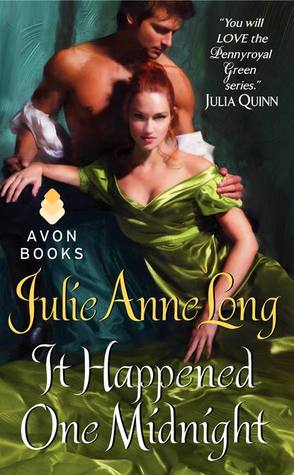
Review: It Happened One Midnight by Julie Anne Long


Caucasian man in right profile with dark hair wearing a white shirt unbuttoned and hanging on his elbows, stands behind a red haired woman in a green historical dress staring outward and leaning slightly left. His arms hold her left arm and right shoulder lightly.It Happened One Midnight would be far more enjoyable as a single title than as an entry in the Pennyroyal Green series. Eight books in I don't care at all about the missing Lyon or the weary Olivia. Every mention of either character detracts from the story. That's a shame because Lyon has an actual purpose this time out.

Jonathan Redmond is Lyon's less paternally satisfying sibling. After multiple disappointments Father Redmond is cracking down on Jonathan in an attempt to mold a child he can approve of. The shadow of Lyon's absence keeps him from seeing Jonathan clearly. Cue inevitable father and son clash. Enter Thomasina, (hereafter Tommy) our heroine.

Tommy is a woman with a mysterious background. (This review is long enough without exploring the holes in it.) She may or may not be a courtesan. She's searching for the security of marriage while keeping her eyes open for other revenue sources. Jonathan brings her into his start up as an investor. Of course Jonathan and Tommy find there is more to each other than they realized. (Duh.) There's a subplot about child labor but the main focus is on Tommy and Jonathan's banter.

Overall It Happened One Midnight is a satisfying romance of the light history variety. Characters are varied enough to provide interest and appear to have lives outside of the time spent in Tommy and Jonathan's orbit. While there are no real surprises neither are there serious offenses. Yet It Happened One Midnight became a rant read for me in it's closing pages. It's not about the numerous errors I understand the finished book contained.

HEREAFTER BE SPOILERS, YO!

If you believe that one of the purposes of genre fiction is to uphold or undermine cultural norms what are we to make of the choices here? Tommy is the bastard daughter of a Duke and the courtesan he allegedly loved. The Duke rejected Tommy at birth yet her mother raised her to revere him, going so far as to claim if she were ever in need The Dukester would step up and assist. (I'm not sure who is needier than an infant, but Tommy's mom isn't the first woman in history unable to accept he's really not going to pay child support.) Tommy goes on to have a horrific childhood complete with near death events. Still she believes, because the child inside her has nothing else.

While Long gives Jonathan the opportunity to confront and insult the Duke, she gives no such moment to Tommy. Tommy's father left her to die. When confronted by Jonathan he confirms his belief that working class children are expendable. Tommy's father is a completely reprehensible person. I felt no sympathy for Tommy's father. He knowingly works children to their death. He knowingly abandoned his own child not once but twice. Why should I (or Tommy) care for him?

Long treats Father Redmond differently. Tommy and Jonathan are both given opportunities to condemn his actions. Despite Redmond being a present and loving father in the past, his current pain is tearing apart his relationships. It is bizarre that he is given more condemnation than Tommy's absent father. Both Tommy and Jonathan threaten Redmond with his greatest fear - losing another child. At this point I expected Long to give Tommy's father an unlikely change of heart through his friendship with Redmond. It would have been unlikely and predictable but Long laid the groundwork for it.

Instead the book closes with Tommy and the Duke estranged. In the book's final pages Long has Tommy return a family keepsake to her father with an encouraging note. It is this encouraging note that moved It Happened One Midnight from the A minus to the Low Middle B grade on my reader report card. In having Tommy urge her father to "be brave" Long wants the reader to believe emotional cowardice is the root of his parental rejection. In doing so she places Tommy's life in a separate category from the other children the Duke would condemn. I don't think Long is making a class superiority comment so much as one of family solidarity. This incredibly toxic message is showing up in too many historical books this year. Our heroines are returning to abusive families and begging for emotional connections. This is not a happy ending, this is a recipe for disaster.

16 August, 2013

Review: The Heiress Effect by Courtney Milan


My abiding love for Courtney Milan books is well documented. You should know that I have neither objectivity nor credibility on this subject. (Which means you should totally read every Courtney Milan review I ever write because the breakup is going to an epic bit of room clearing.) ANYWAY. The Heiress Effect. The book she didn't really want to write. Ok, that's probably not true. I'm fairly sure CM wanted to write The Heiress Effect as much as she's wanted to write any of her books in the Brothers Sinister series since she's self publishing and therefore not beholden to contracts, Everything about The Heiress Effect indicates an author wanting to push the edges of the genre out just a bit farther and squeeze more interesting people in the box. Our core couple, Oliver and Jane, are a fairly typical lead. Oliver is of noble blood but moderate birth. He's the stuck between two worlds kind of guy busy figuring out what price is too high to pay for his ambitions. I liked him fine. Jane is desperate to protect her family but constrained by limited legal rights. They should just kiss and get married already so we can move on to the secondary romance.

 Ok. FINE, That's not fair. Oliver and Jane do not suck even a little bit. Jane is a woman of outlandish attire and complete social failure. Oliver is a man of painful exactitude. In each other they recognize kindred spirits, people constrained by the demands of their lives to wear social masks. I loved them, they rock. Jane gets extra points for refusing to take a man willing to accept her when an outsider would claim that's the best she can get. Oliver and Jane, super awesome. But wow, the secondary romance. I need to not spoil it but I need to tell you everything about it in extreme detail. There is a minority character who clearly sees the limits racism put on his career and daily life. There is a disabled character who refuses to accept the limitations others confer on her because of her medical constraints. These crazy kids meet and save themselves. Push a couch under me because I'm swooning.

But wait! You also get the voting rights movement, same sex attracted characters who are neither saints nor sinners, class turmoil and complicated family dynamics. Now how much would you read this? (If Oliver's sister doesn't bat for the home team and hook up with Obvious Childhood Friend I will be so sad. I'm pretty sure Obvious Childhood Friend is actually going to hook up with Jane's Friend instead, though. Wait! What if Jane's Friend and Oliver's Sister are... yes kids, I'm shipping the secondaries.) I'd love to give The Heiress Effect an unqualified endorsement but I can't. The side story of Anjan and Emily is so strong that it occasionally overpowers Oliver and Jane. I don't want to leave Emily to find out what Jane is doing, although when I do Jane is perfectly interesting in her own right. My other caveat is a scene where Emily stands up for proper pronunciation that makes sense from a class and ethnicity perspective but was an eye roller from a reader perspective. I also feel completely unqualified to judge Anjan's family dynamics or Emily's understanding of them. Is she correct? Is this stereotypical? I have no idea. Let me know after you read it.

* This review was originally posted at Love In The Margins.

11 August, 2013

Review: Cat Vs. Human by Yasmine Surovec

There are plenty of cat lovers in my life. I am not one of them. (Some of my friends have to be avoided during sweater season.) Cat Vs Human is a popular site I was unaware of until I saw this book in Kinokuniya. From the cover I wasn't sure if it was for cat lovers or cat phobics. The answer is yes.

As a proud member (but not active participant) of Team Dog most cat humor eludes me. Less than 1 in 10 forwarded cats move me to anything other than an irritated click of the delete key. Imagine me sending you random captioned photos of old sneakers. Sneakers on my laptop. Sneakers unlaced and strewn on the floor. Sneakers sitting on a windowsill. Sneakers everywhere a sneaker shouldn't be, doing what they do best - which is not much for me. For the cat immune, that is internet life. One long pile up of people admiring various used shoes for reasons you can't emotionally comprehend.

Cat vs Human does an excellent job of appealing to both camps. Surovec is obviously Team Cat till she dies, but she has a fair understanding of the non afflicted. Her cartoons focus on the adorable cat themes without ignoring perplexed non cat loving partners. This is a quick breezy read slightly more filling than All My Friends Are Dead. As gift books go this is better than most. It's pretty age appropriate for teens or bosses. Giving it will either signal that you accept their insanity or that you can embrace something they love. Either way, it's a pretty solid win. (I've got to launch my Sneakers vs Cats tumblr, I think that's going viral fast.)

07 August, 2013

Double Review: The Sweetest Dark and The Deepest Night by Shana Abe

*If you haven't read Abé's earlier Drakon books there will be mild spoilers in this review. Read on with that in mind.

Shana Abé moved her Drakon series to young adult and it's taken me time to catch up. While book two is stronger than book one (and neither is free of all the issues I had with her romance series) overall I prefer this take on her girls who turn to smoke and dragons. We left the Drakon rebuilding their ruined world in an attempt to curb extinction. In The Sweetest Dark that appears to have been a futile endeavor. Jumping forward to WW1, Abé focuses on a young orphan whisked away from London and into an exclusive boarding school. Here our Littlest Princess meets the requisite young lord and the silent groundskeeper.

Eleanore (Lora), Armand (Mandy) and Jesse begin an uneasy relationship (cue dramatic drum roll) destined to change all their lives! The Sweetest Dark is a languid read. It hits all the notes of the orphan amongst the privileged as it slowly acclimates readers to the world of the Drakon and the place these three hold within it. (The companion novel, The Deepest Night is a much more action driven read.) Abé has made multiple adjustments to the Drakon universe to fit the YA market. Both books hint at sexuality more than they explore it. Jesse is almost ridiculously understanding of Lora's age and Mandy's actions. If Jesse was black he'd be the book's Magical Negro as his primary purpose appears to be filling out the triangle and imparting wisdom. It's a shame that Abé leaves him underdeveloped as it's been a long time since a character perceived as mute has been a romantic lead. She has also toned down her Fated Mate fetish. While still drawn to characters who self describe as Alpha and whose actions are excused as beyond their rational reason, the relationships between Jesse, Mandy and Lora do not skirt the edge of abuse as found in Abé's romantic genre series.

Lora is largely passive for The Sweetest Dark. In The Deepest Night she is actively controlling her life. Where the flaw of the former is a lack of action the flaw of the latter might be an excess of it. Events happen at a rapid pace, with barely a breath between them. England is at war and Lora is ready to fight it. This is not a conflict with nuance. Lora is Team England. It's her or them and she consistently chooses them. The brief interactions she has with German soldiers give her no reason to examine if her actions are the right ones. She is the weapon. They are the target. I found the scenes behind enemy lines the weak point of the book. There is a point where Lora's lack of regard for her own life is meant to feel significant but (given her near suicidal state for much of our time together) seems only expedient. As well,  this section of the book includes a quick introduction of a Gay Predator from Mandy's past. I'm incredibly tired of the only representation of a same sex attracted person being negative. The point this blink-and-you'll-miss-him stereotype makes could easily be presented through other means. It's a regrettable flaw in an overall excellent read.

While I tend not to respond to YA as a category, Abé has done an excellent job in taking the best parts of her romance series and molding them into a YA read with a powerful female lead. The characters read age appropriate overall. Late in The Deepest Night they seem matured beyond their years, but not their experiences. The reader is surprised to realize Lora has a year of schooling left to complete. Although the events of the war and her past make us ready to launch her fully into adulthood, the demands of the series require that she remain a schoolgirl. Depending on your tolerance for alcohol as a casual beverage this series could be read anywhere from fourth grade up. I'm looking forward to the next book.

02 August, 2013

Things That Happen

In the last ten days I have been distracted by life.

Two different couples announced their engagement. Two people died prematurely, (one quite young). Between the flights and the dresses and the tears and the toasts I've pushed everything aside.

Something I'm excited about has come from this brief hiatus. A number of blogger / reviewers I enjoy talking to have decided to join together for a joint reader space. I'm going to run reviews there before I run them here. This shouldn't (once we get rolling) make much of a difference but I hope you will look in on the new site as well.

As soon as it's live, I'll link it. My first posts there (and later here) will be new books by Long, Balogh and Milan as well as an examination of asexual reading. I'm hoping that this challenges me to examine my reading choices in the same way that I examine authorial choice. That's my hope - that I can still write completely ill thought and unprepared reviews while piggybacking onto a group of more considered thinkers. It's worked this far in life.

In the meantime, I'll be looking at Shana Abe's young adult series next week as well as some graphic novels I've been kicking around the book bag. I'm also thinking about privilege and paranormal - which might be a bigger bite than I care to take at the moment but we will see...


22 July, 2013

Review: Life Is Short Laundry Is Eternal by Scott Benner

Parenting memoirs swing between kid worshipping eye crossers and bitterly frustrated justifications of career abandonment. It's pretty rare to find one that doesn't wear it's welcome out long before the final chapter. I wanted Life Is Short Laundry Is Eternal to be that memoir, but it wasn't. Instead Benner offers a weird hybrid of both ends of the genre, leaving the reader struggling to catch up. I still think you should consider reading it.

In the last third of the book Benner's infant daughter is diagnosed with Type 1 diabetes, which is sort of like being diagnosed with Stage 4 cancer. Without diligent management Type 1 diabetes will kill you fast. With diligent management Type 1 diabetes will kill you slowly, quietly eroding your body despite all your efforts. The terror of a parent facing the disease is well captured and Benner is matter of fact in his explanation of what is required to keep his daughter alive. He might have been better served to narrow the memoirs focus to this topic, abandoning the first two thirds of the book as extraneous.

When we first meet Benner he's right out of a Hollywood movie. Who gave me this kid? how do I keep it alive? Hey, I changed a diaper, am I awesome or am I awesome? Why is my wife mad? Should I be nicer to her? Wow, I'm a jerk! My wife works hard and misses everything. The sunlight on a tear in my child's eyelashes is a metaphor for the ephemeral beauty of the impermanent world. Stay at home moms keep the world running, am I right or am I right, ladies? It's a scattershot blog to book style read. His kids are awesome, fatherhood satisfies his soul, he's a frail imperfect man doing his best and occasionally stricken with panic. Great blog content but not a page turner in book form. When Benner is down on himself the reader feels like he's looking for validation. When Benner praises himself the reader wants him to slow his roll. It's probably a realistic look at his life but Enjoyment of Life Is Short Laundry Is Eternal will depend on the reader's tolerance for our narrator explaining it all.

18 July, 2013

Review: Serving Victoria by Kate Hubbard

The opening chapters of Serving Victoria are a total slog. Hubbard seems unable to choose between too much background and too little. The reader skips between eras with abandon, as Hubbard references different points in Victoria's life without warning. By the time Serving Victoria rolls into the middle chapters the reader has adapted and is engrossed. Courtiers in Victoria's world had to deal with a mercurial and self centered monarch who saw herself as steadily benevolent. Court life was tedious at best, with those called into service treating it as a holy obligation meant to strengthen their spirit. Duty overrides the narrative as Victoria's servants find themselves in roles their station in life hasn't prepared them for. Her middle class members have an advantage here, as service to the queen conferred benefits to them they might not have otherwise achieved.

Seen through the prism of limited writings from a selection of her staff, Victoria emerges as a complex woman lacking self awareness. She seems fortunate in her support system and almost willfully obtuse in her daily life. Hubbard is forced to leave some questions for a true biographer of the queen while she illuminates what being by Victoria's side entailed. While the reader emerges with a clear picture of the almost suburban isolation of Victoria's world, one occasionally wishes for further insight. Why, after Albert's death, did Victoria so enjoy the drunken disrespect of the Brown brothers? Was it a personal fetish? A rejection of the rigid morality she demanded from others? Alternating between complimentary and condemning, this look at Victoria through the eyes of those serving her is ultimately a look at the business of monarchy. Victoria, for all her freedoms, is as imprisoned as her court.

I found Serving Victoria a rewarding read at the close. The disconnect between her true self and her public image informs the delicate dance still required of the British Monarchy today. Her rejection of her successor (the Prince couldn't win with his parents) and favoring of her daughter is played out in her shuffle of favored ministers. Victoria's court is one where those in waiting do just that for hour upon stultifying hour, dolls in a game of house with far reaching consequences.  I ended with a deeper appreciation for both Alberts and a respect for Victoria's attempts to bridge her idealized world with her actual one. No one in Serving Victoria seems truly happy save (perhaps) the Browns. Respect is a far easier emotion to grant than love or satisfaction.

17 July, 2013

Review: Valentine's Day by David Bowie


As much as I enjoyed The Next Day it wasn't until I heard Where Are We Now playing in a shop in Essen that I understood how little of the album I'd considered. On my iPod, Where Are We Now was a pleasant tune with a nice tinge of nostalgia. In Germany, it was suddenly heartbreaking. "Fingers are crossed, just in case" plays differently when the the person in front of you might be East German. I walked out to a bench, thinking about that moment. What was it like, to be the East Germans when the wall fell? Walking freely into West Germany, was it surreal? Frightening? Welcome? A relief? A burden? An East German is currently the face of Germany, but the wealth divide between Ossi and Wessi remains.

The video for Valentine's Day provides a similar experience. On the iPod it's a sweetly swooping song, maybe you don't listen to the lyric's too closely. The content might elude you. The video is confrontational, contemptuous. The singer has no love for Valentine. This is the Goblin King in all his cruel glory. Part of me finds it all too easy. Valentine's Day. Massacre. School Shootings. Part of me finds it a refutation of Pearl Jam's Jeremy. This is not a song looking for sympathy. The narrator isn't wondering what went wrong when he focuses on Valentine's icy heart. Unlike the bullied and suicidal Jeremy, Valentine fantasizes about murder. He loves contemplating the power of it all.

As a visual artist Bowie is hit or miss for me. His theatrical tendencies can take him to conceptual places that border on the obvious or overwrought. It's always interesting to see what he comes up with. I never interpret a song quite the same way after seeing one but I don't consider them definitive statements on the track. Bowie makes the album he wants, whether it's the Adler Diaries or a video game soundtrack. The joy of being a Bowie fan is watching them unfurl through your life, changing as you change, revealing new aspects of even the most familiar tracks. With the video for Valentine's Day Bowie urges the listener to understand. Valentine isn't okay.

16 July, 2013

Review: That Scandalous Summer by Meredith Duran

*Someone at Pocket really likes the Angelina Jolie look.

I started this review and then I totally forgot what the book was about. True story.

Duran is not getting enough credit for working outside the Regency period. Sure, Victorian England is the new Regency, but still. She's also diversifying her heroines, replacing the typical virginal heiress with a borderline alcoholic. Our meet cute here finds the heroine passed out drunk in the street and our hero winding his way home from another hard day at the office. Call it the party girl meets the medic. There was something Courtney Milan in the set up, but aspects of the story I expected to find more fully developed slipped away into a conventional resolution.

Liza is down a lover, down a fortune and racing the clock to find herself a new man. With a strong sense of responsibility to her dependents, Liza is the standard Regency hero in a skirt. She's sewn her oats and she's ready to re-don the ball and chain. Duran flirts with the way Liza numbs herself through drink yet she never fully commits to the concept. Liza drinks enough to wake up in strange shrubbery unattended. It's a bit unexpected to find she actually can stop whenever she wants. Happiness easily sobers her up. Overall she's a refreshing change from an uncomplicated heroine but her sadness seemed more assumed than truly heart-wrenching.

Michael has family problems. He's been care-taking his mentally unbalanced brother since the death of said brother's wife and he just can't take it anymore. His brother is destroying himself with grief and suspicion. Here, too, Duran pulls the punch. While the Duke gets a few wonderful lines about the completeness of his power, his resolution makes almost no sense. Liza has the key to breaking through his madness and she comes by it accidentally. She uses that key to blackmail him in a last minute plot twist that doesn't bear deep thought. It works because the story needs it to work and a veil is drawn over any issues. The relationship between Michael and his brother was fairly strong until the easy resolution. The Duke's decline was too total, his radical demands of Michael too intense for the resolution to satisfy. Michael himself becomes an afterthought for me. While he has a number of interesting qualities I wasn't compelled by him.

Overall That Scandalous Summer was a decent but to required read. I enjoyed it as quickly as I forgot it. With a few changes Duran would've had something epic here. I hope next time she dips into mental illness she commits more fully. For me the Duke's cure was akin to Balogh's Silent Melody and equally unsatisfying.

09 July, 2013

Review: Fifth Grave Past The Light by Darynda Jones

I'm as surprised as y'all that I read book five of this series. Truly. I'm even more surprised I was given an ARC.

Fifth Grave repairs a lot of what was going wrong with the Charley Davidson series before magnifying new flaws. I find Jones so frustrating as an author. There is a great series here, with a strong point of view and a compelling frame, but it doesn't quite hit the page. She constantly uses one pound of story for a five pound bag. The Charley Davidson series is part Charlaine Harris, part Jenny Lawson, part Janet Evonavich. This should be an adorable cracktastic thrill ride, not a misaligned wooden coaster.

When we meet Charley this time her PTSD has died down and so have the abuse dynamics of her relationship with Reyes. He still tries to kill those close to her but Charley finds it endearing instead of traumatic. He's working on his communication skills while still keeping Charley in the dark as often as possible. (No, that wasn't a play on words.) His position of manipulation is absolute. He knows the answers to all of Charley's questions but refuses to tell them. He insists she make choices without being fully informed of the outcomes. Jones moves Reyes out of the Bad Boy mold and into the Benevolent Billionaire a little more in this chapter. Reyes is still the guy all the girls want, who only wants Charley. He is a trophy mate with a taste for terror.

Also disturbing me is an uptick in ghost children. Charley is attracting dead children who don't want to leave. Her assistant, Angel, has shadowed his mother for longer than he was alive. Her (special needs?) assistant Rocket lives in an abandoned building with his traumatized sister Blue and the somewhat disturbed sister of a living cop. In book four a formerly possessed living deaf boy was added and in this volume we meet a murdered elementary school girl. I find a child ghost far less charming than Charley does. There is a horror in early death. There is a horror in children trying to comfort parents who cannot see or respond to them. It it no mystery that most of Charley's young ghosts are disturbed, they are trapped in a cycle of perpetual neglect. It is an interesting choice, this army of dead children, but it's not necessarily a good one.

The weight of the mythology this series wants to hold is pushing the Ghosts Du Jour to the side. With deliberate ADD pacing, action pinballs from terrorized female ghosts to a new therapist, to her sister's side story, to Reyes sister's side story, to Garrett, and so on. At this point Jones needs to drop the mythology or the crime of the day and get serious about one of them. (She also might want to ease up some on the whimsical humor. It's reading like a lack of ideas instead of a style choice.)  I've got that 50 volume series feeling happening and there isn't enough at stake to hang in that long. Add in Surprise Bondage plus Pointless Heroine Assault and you've got why I wasn't going to buy Fifth Grave. I'd probably read Sixth Grave if it was free, but I can't promise I'd finish it.

05 July, 2013

Review: Monsters University

If you have a kid you've probably already seen this but I want to talk about it anyway. I find the American relationship with children's cinema fascinating because we are so completely uncritical of it. Kid's films are either "bad" or "good enough" or "adult worthy" and not much discussion about the rest of their content occurs. If we do discuss a film aimed at children, we do so (generally) from a point of parenting rather than as a reflection of society. I would argue that children's cinema has more to say than we choose to consider.

To truly review Monsters University I would need three or four viewings. Like other successful Pixar projects it's a blending of standard cinema fare with a candy coating. A little Mission Impossible, a little Rudy, a touch of Generic Frat Film and the time honored odd coupling blend into what falls somewhere between "good enough" and "adult worthy" on the kid scale. At it's heart MU is a sports story. Instead of the kid with a dream making the big leagues he comes to understand that team work is the key to success and a great player is nothing without a great coach. As with other Pixar works there are some lines aimed firmly at Mom and Dad which mostly work well.

Monsters University is selling the American myth of meritocracy. Sully enters MU as a legacy student with a strong family history of success. Used to falling upward, Sully is quickly weeded out and finds his future in danger. He and the little kid with the big dream find themselves on the same footing. Although they succeed at redeeming themselves, they initially do so as a result of Sully's flexible ethics (no surprise to viewers of Monsters Inc.) then as a result of Mike's strong work ethic. Expelled from college,  their dream of being in the big leagues is achieved by starting in the mail room and working upwards. This is a key part of the Pixar success story. Their films often reinforce the myths we tell ourselves as a people while giving them a tweak. Mike won't be a star quarterback but teams need coaches too. Sometimes breaking and entering is the only way to inspire your friends. No matter what you do, you will never look like the Abercrombie models. Standard stuff. Kid's films love to tell you that the least popular are the most worthy. Monsters University dials that up to 11. It's a little too far.

Mike and Sully are forced to join the fraternity no one wants. They compete against the status obsessed old guard, who give Randall the acceptance he craves. It's a strange subtext in Monsters University.  He is not Mike and Sully, therefore his desire to achieve a higher social status is unworthy, it is tainted by the preordained future known to the viewer. Although it is Mike and Sully who impede Randall's successes, it is Randall we are asked to blame. To a viewer who has not seen the prior film, it's an inexplicable shunning that reflects poorly on the lead duo. The other groups are equally cliched. There are the grey toned punks, the beautiful and beautifully matched sorority sisters with terrifying interiors, and the averagely popular. Although some make what appear to be genuine overtures to the misfits, the film makes sure we know it is only to set them up for ever greater humiliations. Outcasts are genuine and supportive, the socially successful are cold to the core. So, at it's heart and despite Randall, Monsters University wants to be an anti-bullying film. Unless you are a bed wetter.

While I did not, a fair number of the world's children suffer from enuresis. All the Pull-Ups and Good-Nites in the world can't cover the societal shame we've inexplicably assigned to the condition. Parents vary wildly, from accepting to enraged. Where some children are taken for medical evaluation, others end up dead. Every year there's an abuse headline with bedwetting as the trigger point. Help boards for parents are full of discipline stories, as though a child's physical development can be changed with the proper chastisement. (My kid is not of average height, so I took away his toys. Why hasn't he started to grow?) Every parent either has a child who struggled with dry nights or has a friend who did. Like any bullying point, the stigma outlasts the ignorance. We know a great deal more about this medical condition than we did in the past. All of that leads up to this - there is a point in the movie where a scare simulator is prepared. The device uses "bedwetter" as the lowest difficulty setting and "heavy sleeper" as the highest. This is like saying you can set the oven at 300 degrees or at 300 degrees. That aside, how many kids in the theater felt that shot in the gut? Here they are, watching an anti-bullying film about hard work leading to success and they get sideswiped by a bedwetting gag. A little shame to sprinkle on their popcorn. Pixar knows better than this and they disappoint me by taking a cheap shot at these kids.

Beyond that, Monsters University is perfectly acceptable. It's a boy-centric crowd pleaser with plenty of comedic moments. (There is no Boo here, all the female characters are either adult authority figures or so far to the side as to be irrelevant.) Your kids will love it. It's unlikely you'll hate it even as the dvd hits the drive for the 15,000th time. It is a perfectly fine film with a lot to say about how we see ourselves and how little we examine our assumptions about who the hero of a story may be.

01 July, 2013

Review: At Your Pleasure by Meredith Duran

I can't explain this cover. It's wrong for the era and vaguely disturbing. She looks like a vacant doll. Of course, Nora kind of is a vacant doll at times but still....

Wait, what? This isn't a Regency? At Your Pleasure is set at the end of Queen Anne's reign? This is a Jacobean / Georgian that never goes to Scotland? Shut! Up! I'd say how did I miss this when it came out but I already know the answer. Despite being one of my favorite authors Duran fell on the Agency Pricing sword. Anything priced higher than MMPB I neither purchased nor requested for review. Recently there's been some more realistic pricing for Duran's books so I grabbed the ones I'd missed.

Wowsa.

Where do we start? Nora is a widow holding her brother's estate after her father's conviction for treason. With George the 1st coming to assume the throne, her family has chosen to remain Jacobites. Adrian, her former lover, is a Catholic lord fighting to maintain his own properties in a time of religious intolerance and upheaval. George sends him to capture Nora's brother, a task he's very willing to undertake. And with that set up, Duran is quickly off to the races. This is old school romance in the sense that the stakes are far higher than someone being embarrassed. The lives of Adrian and Nora, as well as those of their people, are very much in play. Nora's loyalty to her brother could end up costing all of them everything.

Nora is a woman of both limited and limitless power. Her actual standing is small but her ability to influence the elements at play is huge. Her conflict is choosing between her family or her future. Have they gambled on the right side of the royal cause? Does it matter? Does she owe more to herself or to her brother and father? Whose version of history is true - Adrian's or Nora's? Or neither? There was so much in Nora's conflict I responded to as the age old problem of family interest versus personal interest played out. Even more engaging was Adrian, stuck as he was playing all things to all people while trying to protect those determined to self destruct. It's too rare that I really love a romance, but I loved At Your Pleasure and was sorry to see it end. This is the kind of book I want when I say I want something different in the genre that's also exactly the same.

27 June, 2013

Review: Lord of Wicked Intentions by Lorraine Heath

This was going to be the book where Heath and I break up, but she surprised me. Which is not to say I recommend the title.

Heath is working with a problematic trope in that the hero (Rafe) buys the heroine (Evelyn) at an auction. (Spoiler alert - he's not secretly a reformer.) Evelyn is believable as a highly sheltered daughter of privilege who is unable to understand that her world changed overnight. It takes her quite a while to get with the program.  Rafe is just plain crazy yet he's far more credible than he was in the earlier Lost Lords books. This is a kid who has been traumatized by circumstances very similar to Evelyn's. Both of them lost their father in one breath and found their entire world altered in the next. Where Evelyn's brother auctions her off without her knowledge, Rafe's brothers sell him without his consent. (This somewhat mitigates that Rafe's actions. In his view he's offering Evelyn more of a shot than he got, making him the good guy. In the reader's view he's telling himself pretty lies about his actions. But again, dude is crazy.) I liked the way Heath presented Rafe and Evelyn. It would be unrealistic for a woman in Evelyn's situation to have more options than the distasteful ones Rafe explains to her. Certainly Rafe could have escorted her to any number of charity homes but then we'd have a different book. So Rafe shows Evelyn her only currency is her body and offers to pay an insanely high price for it. Evelyn realizes he's right and makes her own bed to lie in. she gets her Pretty Woman and they work toward HEA.

Overall, Lord of Wicked Intentions is the best of my least favorite Heath series. However, like the rest of The Lost Lords Lord of Wicked Intentions repeatedly pulls the WTF card. There are errors of time and place that threw me out of the story repeatedly. Early on Rafe examine a wide selection of ornate molded chocolates. That's great, but molded chocolate is late Victorian and this book is not. He could've bought rolled truffles, I suppose, but Heath explains them in a way that strongly indicates molds. Rafe takes Evelyn slumming so she can react with horror at the wretched lives of the underclass.  Nobody wants to be the underclass, not even them. Wretched things do happen when you add lack of options with lack of resources. It's still pretty obnoxious to walk Evelyn through it like a cautionary zoo exhibit. Rafe claims to process a million pounds a night at his gaming house. (I don't feel like doing math, so here's an excellent article on Crockford to explain how ludicrous this number is. Just know the guy would be turning over more than 4 billion a month at that rate.) The heroine runs away for obscure heroine reasons and takes shelter with the hero's estranged family. Because of course their desire to se him happy means they've befriended this unknown quantity and placed her needs above his. (That's the kind of family they are.) It's full of things that require a veritable bungee cord of disbelief. I can't leap off a bridge that has the hero divested of all his belongings and scrubbed naked at ten then has him in adulthood stroking a coin he's held onto since the day of his father's death. (Where did he hide it during the strip and scrub?) Toward the end our hero proves his love by administering a beat down to someone who wronged the heroine at the beginning of the book. He assumed a woman being auctioned off for sex was a whore, we must pummel him now. Because love. And he wasn't the winning bid. And reasons. I don't even know.

I closed the book feeling tired of Heath writing in this era. She's had some great stories to tell but Lost Lords feels like she's more than ready to move on. So am I. Hopefully her next outing finds her back in form because I don't think we've got more than one date left in us. There was enough here to make me come back, but not enough for me to fall in love.

26 June, 2013

Review: She Left Me The Gun by Emma Brockes

I want you to read this book. It's going to win a basket of awards. It's the memoir of the year, for certain. I don't care who writes a memoir this year, Brockes has the top spot sewn up. There are some second half issues and the author occasionally loses her way but it doesn't matter. Because this book is everything. She Left Me The Gun is about the complexity of the mother / daughter relationship. It's about clashes of culture and class. It's about the inability to have cross generational understanding until one of the parties has gone. The questions come too late, the understanding of what we didn't know part of the hole left in the leaving.

Brockes and her mother speak different languages. They come from different countries, homes, classes and times. The thing that holds them together is the parent child bond, something Brockes mother has had to create from whole cloth. I found She Left Me The Gun compelling because Brockes is very clear eyed about her own reactions. She sees where she resisted when her mother would allude to her life. She sees the involuntary judgements she makes on her distant family as she meets them. Brockes is aware that she has not lived the experiences they have, that she is unknowingly shaped by them but apart from them.  There is a passage midway through the book between Brockes and a friend that I think (by it's inclusion) sums her self awareness up.


"Fascists under our bonnet," I say to Pooly. 
"Yeah," she says. "Be grateful you're not the black one."
By the time the third biker pulls over we are so numb to the situation that when he takes his helmet off and turns out to be a woman, with long blonde hair and a weather beaten face, the relief hardly registers. - Emma Brockes

Brockes gets many of the small details right. She understands that she cannot, on a fundamental level, understand. The rules of her world don't apply to those of her mother or her mother's siblings. In the same way that she was a British daughter of a South African woman so too is she the protected child of an unprotected parent. Some gulfs of experience cannot be filled, they can only be bridged. Ultimately, Brockes is writing a letter of love and respect to her mother and in so doing she offers a unique insight to what it is like to be successfully raised by an abuse survivor. Too many memoirs focus solely on  unbroken cycles while the world itself offers far more possibility. 

25 June, 2013

Review: Oz The Great And Powerful

*Having recently taken a number of transatlantic flights, I'm pretty caught up on the selection of B tier movies that are offered to insomniac fliers. They ranged from the surprisingly good to the incredibly awful. And then, of course, there was the Kill It With Fire selection. Which one do you think we're going to talk about? Ha! Trick question! That said, Jack The Giant Killer was surprisingly good and you should see it instead of this complete disaster of a flick. 

I couldn't finish Oz the Great and Powerful. I made it as far as the creation of the Wicked Witch of the West and no farther. I've heard the Wicked Witch of the East is killed off toward the end, which makes perfect sense because Oz is all about killing women. The magic of Frank L. Baum's legacy lies in it's social commentary. He created a world for children with almost entirely female leads and he trusted boys to stay with it. He did not say "Well, this book is for girls and therefore the boys may be excused from the room." Baum wrote about a myriad of women in complex ways (especially given his contemporaries). He wrote about flawed women, shallow women, greedy women, saintly women, naive women, frightened women, brave women, women who were once men. These women have adventures. They rescue others, men included. They expose corrupt leaderships and galvanize others to carry on in their names. They are conventionally beautiful (Ozma) and unconventionally attractive (The Patchwork Girl).

Here is what Baum never wrote. He never wrote about a shallow flawed abusive man with a "good heart" (Lord save us from that life lie) who was the only hope of otherwise capable women. He never wrote about girls turning against their sisters or standing by and waiting for the arrival of a worthless dick holder to create meaning inside them. He wrote the opposite of that. I was cursing through OTGAP long before the Hollywood moment of West turning green with envy for Glinda. The core message of OTGAP was that women are frequently bitches and any sad excuse for a man is better than one of them. Everyone in the film exists to tell Oz (a charlatan and a fraud, as in the book but with the new addition of womanizing) what a good boy he is. He can do it! He can find the tiniest scrap of soul and use it to lead a kingdom to victory over two sisters that just want power and gold. Since Oz also wants power and gold, he likes this message. The hot babe attached to it doesn't hurt either. This is a man who lies to get with women, who plays them like toys and disposes of them just as casually. But when one of those women finds herself engulfed in fury over his lack of sincerity, she is to blame. Her inner evil is revealed. The problem isn't in him, it's in her expecting anything else.

I couldn't watch another frame from the point West drops into Munchkinland to wave some threats around. I don't want to see anyone in this movie in any other movie. I don't want to watch a film anyone associated with this writes, directs or sweeps floors for. Because the problem with Oz, the thing that needed (apparently) to be fixed, is that it's not about a worthless boy and the jealous bitches he has to deal with. Look, Frank L. Baum was a deeply flawed man. He was a racist with colonialist views and genocidal leanings. But he was able to see women as complex individuals capable of great adventures. What does it say that 100 years later one of our major film companies couldn't? Nothing I can discuss without profanity. Do better, Disney. Do much, much better.

11 June, 2013

Holding Patterns

Memorial Day Memories by meoskop
Memorial Day Memories, a photo by meoskop on Flickr.

I'm a few weeks behind on reviews for reasons pictured. (No, that's not my car. That car hit my car.) I'm fine, but the ridiculous aftermath is taking up my time. I should have a few reviews up in the end of June and be back on track after that.

04 June, 2013

Sudden Bondage Doesn't Mean I Love You

Lately I'm seeing a lot of Sudden Bondage. Nothing makes me lose my investment in a story faster than the use of childhood abuse as a substitute for real conflict resolution. If you're not familiar with the concept, Sudden Bondage is the scene where the heroine (or hero, but more often the heroine) ties the partner up with little or no warning (and certainly not fully informed consent) as a demonstration that they are trustworthy. The tied partner usually has a history of abuse, often with PTSD symptoms attached. The dominant partner wants to tie being bound with pleasure instead of having it be bound with pain.

Leaving aside the issues of personal sexual preference and the importance of consent between non-damaged partners, let me explain why Sudden Bondage is so problematic to me in mainstream romance. I get that bondage is trendy right now, but I don't read romance for the sexy-times-rawr, I read romance for the character conflicts. If you take someone who has trust issues, who has an abuse history with control needs and you bind them without consent you don't get the gentling-the-wild-horse fetish that ends up on the author page. You are far more likely to get violence, panic, racing heartbeats, more distrust and an end to your relationship. This person is not going to be thinking "Wow, so hot after all" they are going to be thinking "Oh my god, please stop, don't touch me, I have to get away." You are also unlikely to get the kind of casual we-will-see-what-happens agreement that some characters in romance offer. Your character is wondering why their lover isn't respecting their boundaries. You character is wondering why their lover thinks they have to be cured rather than appreciated. Sudden Bondage tells me you don't understand abuse issues. You don't understand anything about this character point you've decided to use and I will hate your story proactively from that moment forward.

Like any group of people, abused children are not all the same. Some like double dark chocolate, some like vanilla, some like spumoni, some eschew ice cream entirely. Being one myself and having known a considerable number as well, I will say the adult abuse survivor of romanceland generally resembles an actual adult abuse survivor about as closely as a manatee does a mermaid. (Yes, I meant to make the fictional version the manatee. Manatees float dumbly along in the ocean occasionally eating their own waste while mermaids have complex and varied lives. There was a documentary and everything.) In my experience, adult survivors of abuse have many challenges. We don't think like the other kids. We don't have the same needs as the other kids. Our emotional triggers are not theirs. We are also endlessly resourceful. We seek and appreciate fun. We value the human ties and freedoms that we've attained. Respect and consent are not abstract concepts to us. We do not believe in doing things for someone's own good. Put me in a room of people and I go to the ones laughing the most, smiling the most and making the best jokes. Someone beat the crap out of them and then it stopped. It's time to live. It's time to appreciate life.

In fiction the adult survivor is shuttered down into themselves. They cannot form attachments. They do not trust their own instincts. They are trapped in the mental prison their parents built for them, broken until the fictional lover gently leads them into the light. I dunno, man. Maybe this is true of some I haven't meant. Maybe it's true of adults who were in abusive relationships. After years of exposure to some of the most fucked up family situations to walk the planet, I can tell you it doesn't line up with what I've been or seen from kids who grew up and got the hell out. My old man dies and leaves me a vast estate? I'm not gonna cry in my pillow about upholding his mantle. I'm gonna throw a party that makes Puff Daddy look like a cheapskate. My lover thinks they know what I need more than I do? I'm getting a new lover yesterday.

It's obvious to me when a writer approaches abuse from a place of pity instead of a place of experience. Some writers do a great job with abuse from their research and intuition. Nora Roberts is pretty much perfect in her handling of male and female abuse survivors. Courtney Milan does a nice job as well. (No WAY Mark lives in that house, I am still saying.) It's totally possible. But like Brenda Joyce's historical black friends your abuse adult is a stereotype with little rooting in plausible reality. You might want to get that looked at.

29 May, 2013

What's Wrong With This Series?

There is a liberating moment in the Southern Vampire Mysteries where Sookie Stackhouse realizes she doesn't have to live this way. She's been abducted and (yet again) maimed. She stumbles out of a cornfield into a blinding array of headlights. Humans have come to rescue her. The humans she disdained in Dead Until Dark, the humans whose thoughts have driven her to seek out paranormal beings, these humans are also the ones who run after an abducted girl. Over the course of Dead Ever After Sookie examines what she needs from life and who meets those needs. To the anguish of fan girls everywhere, the answer is not an abusive undead lover. Sookie chooses the imperfections of human life and a (mostly) human mate in her search for reliability and security. For me, unlike most, this redeemed what had been a deeply problematic ride.

Eve Duncan is another heroine with lovers vying for a place by her side as she endured multiple assaults and horrors. Even a stone cold series finisher like myself couldn't make it to Bonnie, the allegedly final chapter in the actually ongoing Eve Duncan Chronicles. Humanity wasn't enough for Johansen. She raises her I See My Dead Daughter ante with other paranormal aspects late in the game. What started life as a compelling series rooted in reality became mired in international government conspiracies, super humans and paranormal abilities. The Eve Duncan Chronicles was a total bait and switch. A dominant theme of this, like so many popular romantic suspense series, was mutilated women and children.

In the Charley Davidson series I'm experiencing a blend of both these worlds. Like Sookie, Charley is put through a horrific ordeal with each book. Tortured, beaten, sexually assaulted, Charley never makes it to the final pages intact. People she trusted betrays her. Her lover abuses her and withholds information. Unlike Harris, Jones appears committed to her core couple. No matter what information Reyes has withheld from Charley or what peril he places her in, the omgsohot sex will let Charley forgive him. There is a scene in every book where Reyes saves her from something, giving the swooning reader a chance to excuse whatever Reyes has done or will do to Charley outside of that action. The reader is told how protective and good Reyes is, an abusive past is trotted out to excuse dysfunctional treatment.

Robards, formerly one of my favorite authors, launched her Charlotte Stone series last year. The heroine is haunted by a dead serial killer who she finds sexually compelling despite the living and non criminal man in front of her. I panned the book but readers strongly defended it. There were hints laid that the serial killer might have been innocent. He. Might. Have. Been. Innocent. Maybe. Meanwhile, he was absolutely convicted. He absolutely played creepy mind games with Dr. Stone during their pre-death encounters. After surviving the required near death terror porn experience, Charlotte rejects the living supportive man in front of her for the less than honest dead guy who probably killed girls for kicks in her head. This is past Bad Boy Romance and deep into Toxic Self Destruction.

Remember Batgirl? Daughter of a cop, crime fighter, lover of Robin? In The Killing Joke DC made the controversial choice to break her spine. The Joker raped her and left her for dead. Afterward, she was faced with the long road to recovery. Her mental and physical changes were played out over years of story as she rebuilt herself into Oracle, a chair bound superhero who relied on her mind to perform the tasks her body used to. Barbara underwent a traumatic experience with real effects. She emerged a different but still highly capable woman. She did not start dating the Joker. In 2011 DC made the even more controversial choice to magically heal her and restore Barbara to the cowl as Batgirl. The Oracle, a more powerful character to many, was erased. I had complicated feelings about that (and other choices). DC and I broke up after many, many (many!) years together.

Where are our series with men who suffer unimaginable abuse and are still instantly hot for it? Where are our heroines who lie, abuse, mistreat and rage at our hero but are forgiven via their sad childhood? Why do we want to read about women being broken and men who make their burden heavier? I've lost count of the ways women or children are imperiled in romantic suspense. Girls in cages, books told from the killer's POV, girls buried alive, paranormal heroines having their skin peeled off, rapes and torture abound. Are these empowering because the heroine triumphs over an exaggerated version of real world horrors? Does the failure of the heroine to succumb to life ending injuries reinforce the lie that horror can never happen to us? Does her refusal to demand honesty and support from her problematic partner reinforce the message that wanting this in our own lives is unreasonable? We can be beaten. We can be tortured. We can undergo anything, see anything, and we can soothe Man Pain while we do it. Backwards. In heels. It's an incomplete thought, but it's on my mind lately. Extreme Romance (as DA's Robin terms it) may be on the rise but it's roots have been in romance for years.

On the healthier side of the coin we have both Eve Dallas and the Bishop's Special Crimes series. While women are still injured or tortured on the regular, the heroines are promised healthy and unconditional support from their partners. Women injured in the line of work stay injured. There is very little paranormal instant healing. The men generally support their choices and respect their agency. Most importantly, the relationships are mutually supportive. Past abuse is used as motivation or explanation, but never as an excuse or a free pass. These series are romantic suspense without the self hatred, and they are what I look for when I pick up a series. I wish they weren't so damn hard to find. I wish I knew why we (collectively) want the abuse dynamic reinforced in our fiction. If we didn't, it wouldn't sell.


24 May, 2013

DNF Review: Sins of a Virgin by Anna Randol

Maybe I've burnt out.

Each reviewer has their own personal ARC policy. Mine is that I will review your book if I accept it, but the review might not be to your liking. I will make every effort to finish your book and reserve DNF reviews for purchased items. I try to get all ARC's reviewed within a week of the publication date. I have failed Sins of a Virgin as completely as it failed me. I don't think this one is necessarily Randol's fault. I've been trying to read SOAV for close to a year. I keep stalling out very early in the book. I'm not even really reviewing SOAV. I'm using it to talk about reader reaction.

Madeline is a Secretly Chaste Courtesan who has decided to sell herself to the highest bidder. She hires Gabriel to ensure that the bidder she selects will be able to pay her fee. Gabriel is a Bow Street Runner looking for his sister's killer, some of whom are bidding on Madeline. On paper, this should be a good read for me. I'm okay with the Secretly Chaste Courtesan set up because Madeline is up front about her status (hello, book title!) and her reasons for the auction make sense. Except they don't. This coupled with Gabriel's super moral disapproval derailed me fast and kept me from getting far into the novel.

Madeline has spent ten years working as a government spy because reasons. Despite her service to the government, she is left unable to establish herself properly and therefore makes the choice to auction herself off. Here my reader reaction stops the story from moving forward. How are all these heroines pretending to work in the sex trade without ever suffering a sexual assault? In an age where rape was so common and so hard to prosecute, how are they navigating these men while keeping body and soul intact? How has Madeline worked as a fake courtesan without being tested? This myth that these girls can be trained in seduction, live among men and pass as purchasable goods without being assaulted seems so much in line with the Hermetically Sealed Heroine that I can't turn my mind off. What are we reading when we read about these women? Often (as in another recent DNF read but not this one) the hero is busy obsessing over what a durty durty hurr the heroine is while his employees are inexplicably reacting to her as if she is their better. When the hero realizes she is not a durty hurr and falls to his feet in tearful apology we are supposed to feel... something. Something besides impatience.

On the surface the message of the SCC or HSH is one of redemption. You have misjudged me, you have wronged me, I was not the durty hurr you assumed, but the lost daughter of aristocrats, meant for better things than I have had. As an apology, you may elevate me to my proper status. I shall play Lady Bountiful for your people, who saw what you could not. (If it's true that we read to escape into our privileges, then perhaps my recent problems with these romances has been a misalignment of needs.) I cut my teeth on the romances of the 70's, where a woman wandering alone was a woman moments from a gang rape. While I don't miss the days where love meant a disco floor and an act of violence, I do miss the message that the woman was still loved. At the end of whatever happened to her, she was still worthy. She had value. The hero wanted to be with her for her. She was, as is the core message of romance, enough. So often these days I feel that while the heroine has gotten smarter, stronger, more capable, her actual worth has diminished. He wants her even if she is a durty hurr, but it's ok, because secretly she's not. Even if she's been married before the odds are very good he was gay or impotent or drunk. Even if half the men in town claim to have banged her like a townie against a dumpster, it's all a lie. She is too good for that.

If she's good, what are the rest of us? If the message of the 70's and 80's was Stand By Your Man and As Long As He Loves Me, what is the message of the 90's and 00's? Is Madeline a virgin because she's more deserving than the other girls? Because she's smarter, as though being clever can provide safety from predators? What made her immune from being used in every way a tool is used in a time when she would have been so very disposable? I give Madeline credit for honesty - she has decided to exchange her body for money. She will do whatever she is required to do to meet the goal she's set for herself. I'd like to stick around long enough for Gabriel to tell her to tun off the red light, but I haven't been able to. My brain won't stop asking questions the book can't possibly answer.